BOE(000725)

Search documents
京东方取得显示模组及其组装方法专利
Sou Hu Cai Jing· 2026-01-02 05:58
声明:市场有风险,投资需谨慎。本文为AI基于第三方数据生成,仅供参考,不构成个人投资建议。 来源:市场资讯 天眼查资料显示,京东方科技集团股份有限公司,成立于1993年,位于北京市,是一家以从事计算机、 通信和其他电子设备制造业为主的企业。企业注册资本3741388.0464万人民币。通过天眼查大数据分 析,京东方科技集团股份有限公司共对外投资了74家企业,参与招投标项目297次,财产线索方面有商 标信息776条,专利信息5000条,此外企业还拥有行政许可47个。 成都京东方光电科技有限公司,成立于2007年,位于成都市,是一家以从事仪器仪表制造业为主的企 业。企业注册资本2500000万人民币。通过天眼查大数据分析,成都京东方光电科技有限公司参与招投 标项目915次,专利信息5000条,此外企业还拥有行政许可520个。 国家知识产权局信息显示,京东方科技集团股份有限公司取得一项名为"显示模组及其组装方法、显示 装置"的专利,授权公告号CN116110293B,申请日期为2023年2月。 ...

京东方取得显示面板和显示装置专利
Sou Hu Cai Jing· 2026-01-02 04:12
国家知识产权局信息显示,京东方科技集团股份有限公司取得一项名为"显示面板和显示装置"的专利, 授权公告号CN114188351B,申请日期为2021年10月。 天眼查资料显示,京东方科技集团股份有限公司,成立于1993年,位于北京市,是一家以从事计算机、 通信和其他电子设备制造业为主的企业。企业注册资本3741388.0464万人民币。通过天眼查大数据分 析,京东方科技集团股份有限公司共对外投资了74家企业,参与招投标项目297次,财产线索方面有商 标信息776条,专利信息5000条,此外企业还拥有行政许可47个。 成都京东方光电科技有限公司,成立于2007年,位于成都市,是一家以从事仪器仪表制造业为主的企 业。企业注册资本2500000万人民币。通过天眼查大数据分析,成都京东方光电科技有限公司参与招投 标项目915次,专利信息5000条,此外企业还拥有行政许可520个。 声明:市场有风险,投资需谨慎。本文为AI基于第三方数据生成,仅供参考,不构成个人投资建议。 来源:市场资讯 ...
京东方取得显示面板及其制备方法专利
Sou Hu Cai Jing· 2026-01-02 02:23
成都京东方光电科技有限公司,成立于2007年,位于成都市,是一家以从事仪器仪表制造业为主的企 业。企业注册资本2500000万人民币。通过天眼查大数据分析,成都京东方光电科技有限公司参与招投 标项目915次,专利信息5000条,此外企业还拥有行政许可520个。 声明:市场有风险,投资需谨慎。本文为AI基于第三方数据生成,仅供参考,不构成个人投资建议。 来源:市场资讯 国家知识产权局信息显示,京东方科技集团股份有限公司取得一项名为"显示面板及其制备方法、显示 装置"的专利,授权公告号CN117356195B,申请日期为2022年4月。 天眼查资料显示,京东方科技集团股份有限公司,成立于1993年,位于北京市,是一家以从事计算机、 通信和其他电子设备制造业为主的企业。企业注册资本3741388.0464万人民币。通过天眼查大数据分 析,京东方科技集团股份有限公司共对外投资了74家企业,参与招投标项目297次,财产线索方面有商 标信息776条,专利信息5000条,此外企业还拥有行政许可47个。 ...
京东方取得摄录检测方法专利
Sou Hu Cai Jing· 2026-01-02 01:44
Group 1 - BOE Technology Group Co., Ltd. has obtained a patent titled "Method, Device, Equipment, and Computer-Readable Storage Medium for Recording and Detection," with authorization announcement number CN116137071B, applied for on February 2023 [1] - BOE Technology Group, established in 1993 and located in Beijing, primarily engages in the manufacturing of computers, communications, and other electronic devices, with a registered capital of 37,413.880464 million RMB [1] - The company has invested in 74 enterprises, participated in 297 bidding projects, and holds 776 trademark records and 5,000 patent records, along with 47 administrative licenses [1] Group 2 - Chengdu BOE Smart Technology Co., Ltd., established in 2020 and located in Chengdu, focuses on technology promotion and application services, with a registered capital of 300 million RMB [1] - Chengdu BOE has invested in 1 enterprise, participated in 39 bidding projects, holds 48 patent records, and possesses 98 administrative licenses [1]
京东方取得闪烁体面板及其制作方法专利
Sou Hu Cai Jing· 2026-01-02 00:56
Group 1 - BOE Technology Group Co., Ltd. has obtained a patent for "Flicker Panel and Its Manufacturing Method, Radiation Image Detection Device," with authorization announcement number CN114114373B, applied on November 2021 [1] - BOE Technology Group, established in 1993 and located in Beijing, primarily engages in the manufacturing of computers, communications, and other electronic devices, with a registered capital of 37,413.88 million RMB [1] - The company has invested in 74 enterprises, participated in 297 bidding projects, holds 776 trademark records, and possesses 5,000 patent records, along with 47 administrative licenses [1] Group 2 - Beijing BOE Sensor Technology Co., Ltd., established in 2017 and located in Beijing, focuses on other manufacturing industries, with a registered capital of 5,779.48 million RMB [1] - The subsidiary has invested in 4 enterprises, participated in 79 bidding projects, holds 623 patent records, and has 1 administrative license [1]
京东方取得显示模组和显示装置专利提升散热性能
Sou Hu Cai Jing· 2026-01-02 00:46
国家知识产权局信息显示,京东方科技集团股份有限公司取得一项名为"一种显示模组和显示装置"的专 利,授权公告号CN114078946B,申请日期为2021年11月。 天眼查资料显示,京东方科技集团股份有限公司,成立于1993年,位于北京市,是一家以从事计算机、 通信和其他电子设备制造业为主的企业。企业注册资本3741388.0464万人民币。通过天眼查大数据分 析,京东方科技集团股份有限公司共对外投资了74家企业,参与招投标项目297次,财产线索方面有商 标信息776条,专利信息5000条,此外企业还拥有行政许可47个。 来源:市场资讯 成都京东方光电科技有限公司,成立于2007年,位于成都市,是一家以从事仪器仪表制造业为主的企 业。企业注册资本2500000万人民币。通过天眼查大数据分析,成都京东方光电科技有限公司参与招投 标项目915次,专利信息5000条,此外企业还拥有行政许可520个。 声明:市场有风险,投资需谨慎。本文为AI基于第三方数据生成,仅供参考,不构成个人投资建议。 ...
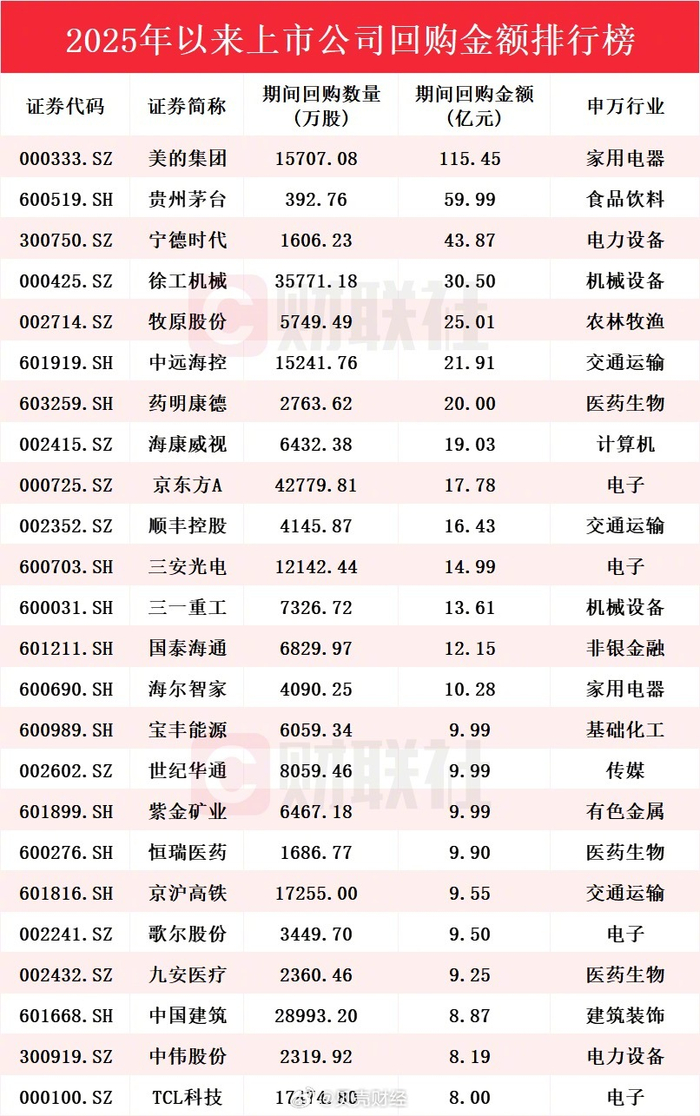
年内1494家A股公司回购1392亿元,美的集团115亿元居首
Bei Ke Cai Jing· 2025-12-31 14:23
Group 1 - As of the report date, 1494 A-share companies have implemented share buybacks in 2025, with a total amount exceeding 1392.84 billion yuan [1] - Among these, 14 companies have repurchased more than 1 billion yuan, with Midea Group leading at 115.45 billion yuan [1] - Other notable companies include Kweichow Moutai with 59.99 billion yuan and CATL with 43.87 billion yuan in buybacks [1] Group 2 - The top companies by buyback amount include: - Midea Group: 15,707.08 thousand shares, 115.45 billion yuan [1] - Kweichow Moutai: 392.76 thousand shares, 59.99 billion yuan [1] - CATL: 1,606.23 thousand shares, 43.87 billion yuan [1] - XCMG Machinery: 35,771.18 thousand shares, 30.50 billion yuan [1] - Muyuan Foods: 5,749.49 thousand shares, 25.01 billion yuan [1]







国内验证:产链壁垒,海外降维,三代黑电MiniLED从领先迈向全面突破
East Money Securities· 2025-12-31 13:33
Investment Rating - The report maintains an "Outperform" rating for the home appliance industry, specifically focusing on the Mini LED segment [2]. Core Insights - The Mini LED technology is positioned as a core driver of transformation in the black electrical appliance sector, with significant advancements in display technology and market penetration expected [16][17]. - The report highlights a shift in consumer preferences towards larger screen sizes and superior picture quality, which Mini LED technology addresses effectively [21][34]. - The competitive landscape is evolving, with domestic brands leveraging cost advantages and government subsidies to enhance market share both locally and internationally [6][49]. Summary by Sections 1. Mini LED as the Core Driver of Black Electrical Transformation - Mini LED technology represents the third generation of display technology, competing with OLED and other emerging technologies [18]. - The performance of Mini LED displays, particularly in brightness and longevity, positions it favorably against OLED, which excels in flexibility and contrast [21][22]. - The global sales of Mini LED TVs are projected to surpass those of OLED TVs for the first time in 2024, with a significant increase in market penetration expected [22][24]. 2. Building High Barriers in the Mini LED Supply Chain - The report discusses the optimization of the Mini LED backlight industry and the advantages of high-generation panel layouts, which strengthen the competitive position of domestic manufacturers [2.1][2.2]. - The cost of 65-inch Mini LED backlight modules is expected to decrease significantly from $150 in 2023 to a range of $80-100 by 2025, enhancing profitability for domestic suppliers [2.3]. - The report emphasizes the importance of the supply chain's evolution, with key players like 聚飞光电 and 京东方 showing strong revenue growth and margin improvements [2.4][54]. 3. Domestic Brands Expanding Internationally with Mini LED - Chinese brands are strategically entering high-value markets in the U.S. and Europe, capitalizing on the mismatch in supply and demand for high-end televisions [3.1][3.2]. - The report notes that the average size of televisions in China is expected to exceed the global average by 11.3 inches by 2025, indicating a strong trend towards larger displays [5]. - The competitive dynamics are shifting, with Chinese brands like TCL and Hisense aggressively expanding their presence in emerging markets while traditional Korean brands adopt a more conservative approach [5][6]. 4. Market Dynamics and Consumer Preferences - The report identifies a significant shift in consumer purchasing criteria, with an increasing focus on picture quality and size rather than just price [41]. - The penetration of Mini LED technology is driven by a cycle of price reduction and increased demand, which is expected to continue as production costs decrease [46][49]. - The sales data from 京东 indicates a substantial increase in the market share of Mini LED TVs, reflecting the successful implementation of competitive pricing strategies by brands like 小米 [46][49].




大国基座2025:新材料三重战线的突破与2026年体系化决战
材料汇· 2025-12-31 11:27
Core Viewpoint - The article discusses the strategic transformation of China's new materials industry by 2025, emphasizing a "three-dimensional war" approach that includes "fortress materials" for national security, "sovereign materials" for technological independence, and "fusion materials" for future industry definition [3]. Group 1: Fortress Materials - The development of safety dimension materials is closely tied to national core interests, focusing on absolute reliability and performance under extreme conditions rather than cost-effectiveness [5]. - A significant breakthrough in 2025 is the mass production of the fourth-generation single crystal high-temperature alloy turbine blades, which can withstand temperatures above 1200°C and have a lifespan increased by nearly 50% compared to previous generations [8][10]. - Continuous silicon carbide fibers have transitioned from laboratory preparation to stable engineering mass production, with a production capacity of hundreds of tons, marking a strategic leap in the aerospace sector [14][15]. Group 2: Sovereign Materials - Sovereign materials focus on achieving "self-control" and enhancing industrial competitiveness, particularly in strategic sectors like semiconductors and high-end manufacturing [40]. - In the semiconductor sector, the production of 12-inch silicon wafers has reached a milestone with over 500,000 monthly shipments, and significant advancements in low-oxygen high-resistivity silicon wafer technology have been made [44]. - The domestic supply ratio of 300mm semiconductor silicon wafers is expected to increase from 15% to 40% by the end of 2025, significantly reducing reliance on imports [45]. Group 3: Fusion Materials - The fusion materials dimension represents a shift towards creating new demands and defining new products, characterized by the integration of materials science with cutting-edge fields like artificial intelligence and synthetic biology [72]. - AI-driven platforms for materials research have emerged, enabling rapid property prediction and screening, significantly reducing development cycles for critical materials [74]. - The integration of intelligent materials in robotics is evolving, allowing materials to interact with their environment and make autonomous decisions, marking a shift from passive components to intelligent structures [77].






京东方、TCL华星将为三星手机供应OLED屏?
WitsView睿智显示· 2025-12-31 09:25
Core Viewpoint - Samsung Electronics is considering a dual-supplier model for the upcoming Galaxy A57, involving both Samsung Display and TCL Huaxing for OLED screens, to enhance competitiveness and manage costs [1][3][4] Group 1: Supplier Strategy - Samsung is likely to rely more on Samsung Display for OLED supply, given the high demand for the Galaxy A series, which is a hot-selling model [1] - The dual-supplier approach aims to mitigate potential supply shortages and ensure a steady supply of OLED screens for both Galaxy A57 and Galaxy S FE models [1][4] - TCL Huaxing is expected to provide OLED screens at a lower price, which could help Samsung control costs while adopting flexible OLED technology [4][6] Group 2: Product Development - Starting with the Galaxy A57, Samsung plans to replace rigid OLED panels with flexible OLED panels, which offer greater design flexibility but come with higher manufacturing costs [3][4] - The adoption of flexible OLED technology is seen as a way for Samsung to enhance its competitiveness in the mid-range smartphone market, especially as Chinese manufacturers are already using flexible OLED in lower-priced models [3][6] Group 3: Market Dynamics - The increasing competition in the global smartphone market and rising component costs are prompting Samsung to reassess its OLED supply strategy [6][7] - Chinese manufacturers like BOE and TCL Huaxing have improved their technology and production capacity, posing a significant challenge to Samsung Display's market dominance [7] - The shift towards Chinese suppliers for OLED panels may provide Samsung with cost advantages, but it also indicates a potential erosion of its competitive edge in the panel industry [7]