BSGCO(000959)
Search documents
2025年中国加固材料行业发展历程、产业链、市场规模、竞争格局及未来趋势研判:建筑加固改造的需求增加,加固材料市场规模近千亿元[图]
Chan Ye Xin Xi Wang· 2025-07-29 01:24
Core Viewpoint - The reinforcement materials industry in China is experiencing significant growth driven by urbanization, aging infrastructure, and increasing safety standards, with the market expected to reach approximately 914.2 billion yuan in 2024, reflecting a year-on-year growth of 7.7% [1][13]. Industry Overview - Reinforcement materials are essential in civil engineering, used to strengthen existing structures to meet new safety and usage requirements. Common types include structural adhesives, crack injection materials, cement-based grouting materials, polymer mortars, and fiber-reinforced composites [3][4]. Industry Development History - The reinforcement materials industry has evolved through three stages: early development, growth, and modern development, with significant advancements in carbon fiber cloth technology and chemical grouting materials [5]. Industry Chain - The reinforcement materials industry chain consists of upstream raw materials and production equipment, midstream manufacturing, and downstream application fields, including building reinforcement, bridge engineering, and water conservancy projects [7]. Key Application Areas - The bridge engineering sector is a major application area for reinforcement materials, addressing issues like structural aging and damage. The total length of roads and bridges in China is projected to grow from 5.756 million kilometers in 2019 to 6.466 million kilometers by 2024, with a compound annual growth rate of 2.35% [11]. Market Dynamics - The carbon fiber cloth market is expected to reach approximately 7.713 billion yuan in 2024, driven by its high strength, lightweight, and ease of application in various structural reinforcement projects [14]. Competitive Landscape - The global reinforcement materials industry features a diverse competitive landscape, with international brands like Sika, Hilti, and Toray competing alongside domestic companies such as Hanma and Guterbang, which leverage technological innovation to gain market share [17][20]. Future Trends - The industry is moving towards smart technology integration, with IoT and big data enhancing monitoring and predictive maintenance capabilities. Additionally, there is a shift towards green materials, with a focus on low-carbon and recyclable options, and a trend towards comprehensive service models that integrate design, construction, and maintenance [25][27][28].
反内卷下,钢铁股的弹性几何?
Changjiang Securities· 2025-07-27 15:20
Investment Rating - The investment rating for the steel industry is Neutral, maintained [8] Core Insights - The current round of supply-side optimization in the steel industry emphasizes the "supporting the strong and eliminating the weak" approach, indicating that underperforming capacities should be limited while leading companies are expected to strengthen [2][6] - The market sentiment has significantly improved with the deepening of the "anti-involution" policy, leading to a positive signal of "volume and price linkage" in the steel market [4] - The report highlights that the execution of the "anti-involution" policy may be smoother compared to previous years due to the absence of large-scale stimulus measures, suggesting a gradual improvement in the industry's long-term trends despite short-term fluctuations [2][6] Summary by Sections Supply and Demand Dynamics - The apparent consumption of the five major steel products decreased by 1.03% year-on-year and 0.36% month-on-month, while the average daily transaction volume of construction steel increased by 2.10 thousand tons per day compared to the previous week [4] - The average daily pig iron output of sample steel companies decreased to 2.4223 million tons, a decline of 0.21 thousand tons per day [4] - Total steel inventory decreased by 0.14% month-on-month and 24.22% year-on-year, with long product inventory down by 27.40% year-on-year and plate inventory down by 17.74% year-on-year [4] Price and Profitability - Shanghai rebar prices rose to 3,450 RMB/ton, an increase of 180 RMB/ton, while hot-rolled prices reached 3,520 RMB/ton, up 160 RMB/ton [5] - The estimated profit for rebar is 238 RMB/ton, with a lagging cost profit of 495 RMB/ton [5] - The report suggests that with the support of the "anti-involution" policy and strong determination to curb deflation risks, steel prices may show an upward trend that is easier to rise than to fall [4] Elasticity and Valuation - The report calculates the elasticity of steel stocks based on the assumption that the average net profit per ton of listed steel companies could rise to 200/300/400 RMB/ton, compared to 56 RMB/ton in Q1 2025 [6] - Companies such as Hualing Steel, Nanjing Steel, Baosteel, and CITIC Special Steel are identified as having significant elasticity [6] - The report emphasizes that if the valuation of steel stocks returns to historical averages, it could indicate strong investment opportunities, particularly for companies with low price-to-book (PB) ratios [6][32] Investment Opportunities - The report identifies four main investment lines: 1. Companies benefiting from the release of new capacities in iron ore and coke, such as Nanjing Steel and Hualing Steel [32] 2. Steel stocks with low PB ratios that may experience significant performance and valuation recovery, such as New Steel and Fangda Special Steel [32] 3. Mergers and acquisitions under the state-owned enterprise reform theme, which could enhance asset quality and subsequent valuation recovery [33] 4. High-quality processing leaders and resource leaders, particularly in specialized fields, are also highlighted as worthy of attention [33]
钢铁行业周报(20250714-20250718):钢铁行业稳增长工作方案即将出台-20250720
Huachuang Securities· 2025-07-20 14:17
Investment Rating - The report maintains a "Recommendation" for the steel industry, indicating a positive outlook for investment opportunities [6]. Core Viewpoints - The steel industry is experiencing a warming sentiment combined with cost support, leading to a strong performance in steel prices. The report notes that the prices for five major steel products have shown weekly increases, with rebar prices reaching 3,316 CNY/ton, reflecting a 0.83% increase week-on-week [1][2]. - The Ministry of Industry and Information Technology is set to introduce a work plan aimed at stabilizing growth in key industries, including steel, which is expected to optimize supply structure and eliminate outdated production capacity [3]. - The report suggests that the steel industry is likely to see a long-term recovery in both valuation and performance, driven by improved profitability and a reduction in production capacity in certain regions [4][5]. Summary by Sections 1. Weekly Market Review - As of July 18, 2025, the prices for five major steel products are as follows: rebar at 3,316 CNY/ton, wire rod at 3,629 CNY/ton, hot-rolled coil at 3,345 CNY/ton, cold-rolled coil at 3,775 CNY/ton, and medium plate at 3,425 CNY/ton, with weekly changes of +0.83%, +0.76%, +1.47%, +1.16%, and +0.91% respectively [1][15]. - The total production of the five major products reached 8.6819 million tons, a decrease of 45,300 tons week-on-week [1]. - The average daily molten iron output from 247 steel enterprises was 2.4244 million tons, an increase of 26,300 tons week-on-week, with a blast furnace capacity utilization rate of 90.89%, up by 0.99 percentage points [1][18]. 2. Key Industry Data Tracking (a) Production Data - The report highlights that the production data indicates a slight increase in iron output and a recovery in electric arc furnace operation rates, suggesting a stabilization in the industry despite seasonal demand weakness [2][18]. (b) Consumption Volume of Five Major Steel Products - The total consumption of the five major products was 8.7011 million tons, reflecting a decrease of 29,600 tons week-on-week, with specific changes in consumption for rebar, wire rod, hot-rolled, cold-rolled, and medium plate [1][39]. (c) Inventory Situation - The total steel inventory stood at 13.3766 million tons, a decrease of 19,200 tons week-on-week, with social inventory increasing by 81,000 tons to 9.2211 million tons, while steel mill inventory decreased by 100,200 tons to 4.1555 million tons [1][51]. (d) Profitability Situation - The average molten iron cost for 114 steel mills was reported at 2,256 CNY/ton, remaining stable week-on-week. The gross profit per ton for high furnace rebar, hot-rolled coil, and cold-rolled coil was +171 CNY/ton, +146 CNY/ton, and +32 CNY/ton respectively, with slight variations noted [1][4]. 3. Stock Market Performance - The steel index closed at 2,294.69 points, with a weekly increase of 0.36%, while the overall A-share index rose by 1.40% [4][6]. - The report indicates that the overall valuation of the steel sector remains low, with specific companies showing potential for recovery in both valuation and profitability [10].
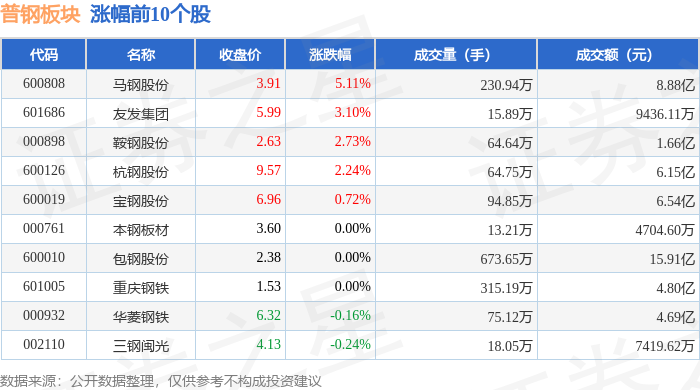
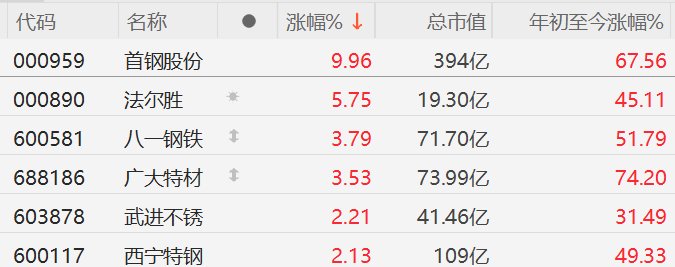
A股钢铁板块盘中移动,柳钢股份涨停封板,盛德鑫泰涨近6%,首钢股份、华菱钢铁、方大特钢、新钢股份等跟涨。
news flash· 2025-07-17 02:18
Group 1 - The A-share steel sector experienced significant movement, with Liugang Co., Ltd. hitting the daily limit up, indicating strong investor interest [1] - Shengde Xintai saw an increase of nearly 6%, reflecting positive market sentiment towards steel stocks [1] - Other companies such as Shougang Co., Hualing Steel, Fangda Special Steel, and New Steel Co. also experienced gains, suggesting a broader rally in the steel industry [1]
【财经分析】钢铁行业上半年利润“逆袭” 自律控产仍是下半年大棋局
Xin Hua Cai Jing· 2025-07-17 01:34
Core Viewpoint - The steel industry has seen a profit rebound in the first half of the year, driven by cost reductions, export boosts, and proactive cost-cutting measures by companies, with self-discipline in production being a key factor for profit improvement [1][4][6]. Group 1: Company Performance - Several listed steel companies have issued positive performance forecasts for the first half of the year, with notable increases in net profits: - Shougang Co. expects a net profit of 642 million to 672 million yuan, a year-on-year increase of 62.62%-70.22% [2] - Minmetals Development anticipates a net profit of 107 million yuan, up 111% [2] - Liugang Co. projects a net profit of 340 million to 400 million yuan, a staggering increase of 530%-641% [2] - Fangda Special Steel expects a net profit of 380 million to 430 million yuan, an increase of 133.33%-164.03% [2] - Other companies like Xinyu Steel, Shandong Steel, and others forecast a turnaround in profitability for the first half of 2025 [2]. Group 2: Industry Trends - The steel industry is experiencing a reduction in production and structural adjustments, with weak steel prices prevailing [2][4]. - The overall profit for the black metal smelting and rolling industry from January to May reached 31.69 billion yuan, better than the 29.19 billion yuan for the entire year of 2024 [4]. - The self-discipline in production among steel companies is seen as a core factor for profit improvement, despite ongoing supply-demand structural contradictions [4][5]. Group 3: Future Outlook - The outlook for steel prices in the second half of the year is uncertain, with expectations of limited upward movement due to weak domestic demand and potential challenges in maintaining high export levels [6][7]. - Analysts suggest that self-discipline in production will remain a critical variable influencing price trends, with a focus on quality and efficiency rather than merely high production volumes [7][8]. - The industry is urged to enhance integration, improve industry concentration, and phase out inefficient production capacities to achieve high-quality development [8].
再论供给侧改革:制度优势实现供给约束破局通缩困局,掘金钢铁、有色行业投资机会
Soochow Securities· 2025-07-16 12:12
Investment Rating - The report maintains an "Overweight" rating for the steel and non-ferrous metal industries [1] Core Viewpoints - The supply-side reform in China is expected to break the deflationary cycle and create investment opportunities in the steel and non-ferrous metal sectors [1][6] - The report emphasizes the importance of "supply constraints" to manage the supply-demand balance and mitigate economic downturn risks [6][12] - The steel industry is facing severe overcapacity, with state-owned enterprises holding a significant market share, which facilitates the implementation of administrative measures to control production [6][28] Summary by Sections 1. Supply-Side Reform and Economic Management - The socialist market economy in China allows for effective macroeconomic control, contrasting with the cyclical issues faced in capitalist economies [12][13] - Historical experiences show that demand stimulus alone is insufficient to resolve deep-seated deflationary pressures [14][15] - The supply-side reform initiated in 2016 has proven successful in stabilizing prices and improving corporate profitability [21][22] 2. Steel Industry Analysis - The steel industry has been in a state of oversupply from 2007 to 2024, with crude steel production increasing from 490 million tons to 1.01 billion tons, while apparent consumption has not kept pace [28][29] - The production capacity utilization rates for rebar and wire rod are expected to decline from around 70% to 50% due to weak real estate demand [33][34] - The concentration of production among state-owned enterprises is high, with central state-owned enterprises accounting for approximately 63% of total production in 2024 [38][39] 3. Investment Recommendations - The report suggests focusing on three categories of investment targets: profit recovery, stable profit with valuation repair, and stable high-dividend stocks [51] - Specific companies recommended for profit recovery include Liugang Co., Taigang Stainless Steel, and Shandong Iron and Steel, with projected annualized PE ratios improving significantly under favorable conditions [51]
钢企中期盈利普遍回升!行业迎来新转机?
Sou Hu Cai Jing· 2025-07-15 12:58
Group 1 - The steel industry has shown significant improvement in profitability in the first half of the year due to falling raw material costs and cost-cutting measures [2][4][5] - Despite the overall recovery in performance, the steel sector experienced a collective pullback in stock prices on July 15, with notable declines in companies such as China Iron Titanium and Chongqing Steel [2][4] - A total of 24 A-share steel companies have released mid-year performance forecasts for 2025, with 19 reporting substantial profit improvements, including several companies achieving double or triple-digit profit growth [4][5] Group 2 - The steel industry faces challenges from a sluggish real estate market, limited infrastructure investment, and increased export pressure, leading to a significant decline in steel prices and ongoing profitability pressure [4][6] - Companies are addressing demand contraction by eliminating outdated production capacity, optimizing product structures, and enhancing product value, which has contributed to profit recovery [5][6] - The current supply-demand dynamics in the steel industry are improving, with major steel companies announcing production cuts under the "anti-involution" policy, which is expected to strengthen supply contraction [6]
研判2025!中国冶金工业节能减排政策汇总、产业链图谱、经营效益、主要参与者及发展趋势分析:“双碳”目标指引下,行业蓬勃发展[图]
Chan Ye Xin Xi Wang· 2025-07-15 01:47
Overview - The metallurgical industry in China is focusing on energy conservation and emission reduction, aiming to minimize energy consumption and pollutant emissions while ensuring product quality and output [1][9][21] - In 2024, total investment in energy conservation and emission reduction by metallurgical enterprises is projected to decrease to 42 billion yuan, with energy-saving benefits dropping to 13 billion yuan [11] Market Policies - The Chinese government has implemented a series of policies to promote energy conservation and carbon reduction in the metallurgical industry, including action plans and guidelines aimed at reducing energy consumption and carbon emissions [4][6] - Specific targets for comprehensive energy consumption and carbon emission intensity in the steel industry have been established to guide the development of energy conservation and emission reduction efforts [4][6] Industry Chain - The energy conservation and emission reduction industry in metallurgy includes manufacturers of energy-saving equipment, technology providers, and software service providers [7] - The upstream supply chain consists of raw material suppliers, component manufacturers, and research institutions, while the downstream market primarily targets the steel and non-ferrous metal industries [7] Current Development - In 2023, the metallurgical industry consumed 680 million tons of standard coal and emitted 1.98 billion tons of CO2, with significant reductions expected in 2024 due to policy support [9][11] - The environmental cost per ton of steel is approximately 138 yuan, with carbon trading revenues estimated at 3.5 billion yuan [11] Competitive Landscape - Major players in the industry include large metallurgical groups like Baowu Steel and Hebei Iron and Steel, which are leading the development of energy-saving technologies [13][16] - Specialized energy-saving technology companies, such as China Metallurgical Group, focus on specific areas like waste heat recovery and flue gas purification [13][18] Future Trends - The dual carbon goals and related policies will continue to drive the metallurgical industry towards stricter energy consumption and emission standards [21] - The adoption of electric furnace short-process steelmaking technology is expected to increase, gradually shifting the industry away from traditional long-process methods [21]
A股钢企中报预告分化,“反内卷”驱动资金博弈
Di Yi Cai Jing· 2025-07-14 11:05
Core Viewpoint - The steel industry is experiencing pressure from weak demand and high costs, leading to a focus on policy-driven capacity optimization to alleviate profitability issues [1][5]. Group 1: Market Performance - The Shenyin Wanguo Steel Index has rebounded by 11.86% since June 23, while the Wind All A Index increased by 6.53% during the same period [1]. - In July, the Shenyin Wanguo Steel Index rose by 9.31%, marking the largest monthly increase since October 2024, with 21 stocks in the steel sector rising over 10% [4]. Group 2: Company Earnings Forecasts - Eight steel companies have released their mid-year earnings forecasts, with Shougang Co. expecting a net profit of 642 to 672 million yuan, a year-on-year increase of 62.62% to 70.22% [3]. - Shandong Steel anticipates a net profit of 12.71 million yuan for the first half of the year, a year-on-year increase of 98.1 million yuan [2]. - Fushun Special Steel and Hangang Co. are expected to report losses, with Fushun projecting a loss of 260 to 300 million yuan, a year-on-year decrease of 214.06% to 231.6% [3]. Group 3: Industry Challenges - The steel industry has been in a downward cycle for four years, with approximately 30% of steel companies still reporting losses as of the latest financial reports [5]. - The demand for steel, particularly from the real estate sector, has significantly declined, with demand dropping from 377 million tons in March 2020 to 215 million tons in 2024, a decrease of 42.9% [5]. - The focus on cost reduction has become prevalent among steel companies, with raw material prices significantly impacting profitability [5]. Group 4: Policy and Structural Changes - Recent central government meetings have emphasized the need to eliminate outdated production capacity, strengthening expectations for supply contraction in the steel industry [4][6]. - The current round of "anti-involution" policies aims to optimize supply and demand dynamics, with a focus on differentiated control of production based on efficiency and environmental standards [6].
反内卷下的钢铁板块投资机会
2025-07-14 00:36
Summary of Steel Industry Conference Call Industry Overview - The steel industry is undergoing supply-side reforms driven by anti-involution policies, aiming to improve competition and reduce excess capacity, which presents long-term investment opportunities [1][4][29] - The profitability of steel companies is significantly influenced by supply-demand dynamics, with a strong production incentive when rebar profits exceed 100 yuan, but this can lead to price declines [1][7] Key Points Supply and Demand Dynamics - The real estate market downturn has negatively impacted demand for construction steel, with new housing starts and construction area both declining [1][12] - Infrastructure investment has increased but is insufficient to offset the decline in residential construction, leading to an expected 5%-6% decrease in construction steel demand by 2025 [1][13] - Global iron ore supply is expected to increase, with new low-cost projects disrupting oligopolistic structures and optimizing cost structures [1][18] - The steel industry is currently experiencing a low inventory cycle, which reflects pessimistic market expectations and could lead to a supply-demand tightening if restocking occurs [1][17] Policy and Regulatory Environment - The government has emphasized anti-involution policies, with measures aimed at controlling production and promoting industry consolidation [4][5] - The central government has set a production reduction target of 50 million tons for 2025, although local implementation has been slow [8][10] Company Performance and Outlook - Leading companies like CITIC Special Steel and Baosteel are expected to benefit from product upgrades and high-value income, with their PB valuations currently low [2][30] - Hualing Steel and Shougang have strong profit elasticity, with Hualing expected to recover profits to 1.4-1.5 billion yuan [2][31] - Fangda Special Steel is maintaining profitability due to its efficient business model, even in a downturn [2][33] Market Sentiment and Investment Opportunities - The steel sector is at the bottom of the profit cycle, with low valuations and low public fund allocations, indicating high potential returns [2][26] - The market anticipates that strict capacity reductions could lead to a rebound in steel prices and profitability in the second half of the year [2][26][34] Future Trends - The demand for construction steel is expected to decline by 6% in 2025, but a gradual recovery is anticipated from 2026 to 2028 [21] - The global steel production landscape is shifting, with non-China regions expected to see slight growth while developed countries face declines [22] - The steel industry is expected to see significant changes in the next three years, with a clear direction towards supply-side reforms [29] Additional Insights - The anti-involution policy is expected to significantly impact profit distribution within the steel industry, potentially improving domestic steel companies' profit margins [28] - Historical data suggests that strict enforcement of production cuts can have profound effects on market dynamics, emphasizing the importance of supply-demand relationships [27] This summary encapsulates the key insights from the conference call regarding the steel industry, highlighting the current challenges, regulatory environment, company performances, and future trends.