
LCXX(000977)

Search documents
浪潮信息(000977) - 北京市君致律师事务所关于浪潮信息2024年度股东大会的法律意见书
2025-04-29 12:24
北 京 市 东 城 区 北 三 环 东 路 36 号环球 贸易中心 B 座 11 层 电话(Tel): 52213236/7 邮编(P.C): 100013 北京市君致律师事务所 关于浪潮电子信息产业股份有限公司 2024 年度股东大会的法律意见书 致:浪潮电子信息产业股份有限公司 一、关于本次股东大会召集、召开的程序 对本法律意见书的出具,本所特作如下声明: 1、本所及经办律师依据《证券法》、《律师事务所从事证券法律业务管理办 法》和《律师事务所证券法律业务执业规则》等规定及本法律意见书出具日以前 已经发生或者存在的事实,严格履行了法定职责,遵循了勤勉尽责和诚实信用原 则,进行了充分的核查验证,保证本法律意见所认定的事实真实、准确、完整, 所发表的结论性意见合法、准确,不存在虚假记载、误导性陈述或者重大遗漏, 并承担相应法律责任。 2、本所律师仅就本次会议的召集与召开程序、召集人和出席现场会议人员 资格、会议表决程序及表决结果的合法性发表意见,不对本次会议所审议的议案 内容及该等议案所表述的事实或数据的真实性、准确性和完整性发表意见;本所 律师无法对网络投票过程进行见证,参与本次会议网络投票的股东资格、网络 ...

浪潮信息(000977) - 关于浪潮集团有限公司增持公司股份取得专项贷款承诺函的进展公告
2025-04-29 12:19
本公司将持续关注本次增持计划的实施情况,并依据相关规定及时履行信息 披露义务,敬请投资者注意投资风险。 浪潮电子信息产业股份有限公司 关于浪潮集团有限公司增持公司股份取得专项贷款 承诺函的进展公告 浪潮集团有限公司保证向本公司提供的信息内容真实、准确、完整,没有虚假记载、 误导性陈述或重大遗漏。 本公司及董事会全体成员保证公告内容与信息披露义务人提供的信息一致。 基于对公司长期投资价值的认可,为增强投资者信心,浪潮集团有限公司(以 下简称"浪潮集团")拟使用自有或自筹资金通过深圳证券交易所交易系统以集 中竞价或大宗交易方式增持公司股票,增持金额不少于人民币1亿元(含)且不 超过2亿元(含),增持实施期限自增持计划公告之日起6个月内。具体内容详见 公司于2025年4月11日在巨潮资讯网上披露的《关于浪潮集团有限公司增持公司 股份计划的公告》(公告编号:2025-021)。 近日,公司收到浪潮集团通知,浪潮集团取得了中国建设银行股份有限公司 济南铁道支行(以下简称"建设银行")的贷款承诺函,建设银行承诺对浪潮集 团增持本公司股份事项提供贷款支持,贷款金额不超过1.8亿元,贷款期限3年, 专项用于增持本公司股票。因 ...
浪潮信息:浪潮集团拟1亿元-2亿元增持公司股份
news flash· 2025-04-29 11:58
浪潮信息(000977)公告,浪潮集团拟1亿元-2亿元增持公司股份,增持资金为自有资金及专项贷款。 ...
浪潮信息:2025年一季度净利润4.63亿元,同比增长52.78%
news flash· 2025-04-29 11:55
浪潮信息(000977)公告,2025年第一季度营收为468.58亿元,同比增长165.31%;净利润为4.63亿 元,同比增长52.78%。 ...
浪潮信息(000977) - 2025 Q1 - 季度财报
2025-04-29 11:55
Financial Performance - The company's operating revenue for Q1 2025 reached ¥46.86 billion, a significant increase of 165.31% compared to ¥17.61 billion in the same period last year[5] - Net profit attributable to shareholders was ¥462.66 million, representing a growth of 52.78% from ¥306.46 million year-on-year[5] - Basic and diluted earnings per share were both ¥0.3143, reflecting a 52.80% increase from ¥0.2082 in the same quarter last year[5] - Total operating revenue for the current period reached ¥46,858,373,514.91, a significant increase from ¥17,661,624,883.15 in the previous period, representing a growth of approximately 165.5%[18] - Net profit for the current period was ¥461,423,565.54, up from ¥292,520,826.81 in the previous period, indicating a growth of approximately 57.7%[19] - Earnings per share (EPS) for the current period was ¥0.3143, compared to ¥0.2057 in the previous period, marking an increase of about 52.7%[19] Cash Flow and Liquidity - The net cash flow from operating activities improved to ¥5.80 billion, a remarkable increase of 265.48% compared to a negative cash flow of ¥3.48 billion in the previous year[5] - Operating cash inflow for the current period reached ¥57.92 billion, a significant increase from ¥19.56 billion in the previous period, representing a growth of approximately 195%[21] - Cash inflow from financing activities totaled ¥8.65 billion, up from ¥3.10 billion, indicating a growth of about 179%[22] - Net cash flow from financing activities was ¥4.96 billion, a turnaround from a negative cash flow of ¥1.39 billion in the previous period[22] - The company reported a net increase in cash and cash equivalents of ¥10.27 billion, compared to a decrease of ¥4.94 billion in the previous period[22] - The ending balance of cash and cash equivalents stood at ¥17.64 billion, significantly higher than ¥7.18 billion at the end of the previous period[22] - The company received ¥1.50 billion in tax refunds, a substantial increase from ¥154.47 million in the previous period[21] Assets and Liabilities - Total assets at the end of the reporting period amounted to ¥91.48 billion, up 28.44% from ¥71.19 billion at the end of the previous year[5] - Total liabilities increased to CNY 64.82 billion from CNY 44.59 billion, indicating a rise of about 45.3%[15] - Total assets reached CNY 91.48 billion, up from CNY 71.23 billion, which is an increase of about 28.5%[15] - Total liabilities increased to ¥70,872,058,298.01 from ¥50,922,635,763.58, representing a rise of approximately 39.2%[16] Operational Efficiency - The company reported a 45.51% increase in accounts receivable, attributed to the expansion of business scale and outstanding receivables[9] - Short-term borrowings surged by 279.55%, driven by increased funding needs due to business expansion[9] - The company experienced a 63.50% rise in asset impairment losses, primarily due to increased inventory levels and fluctuations in raw material prices[9] - The company reported a significant increase in inventory, which rose to CNY 45.88 billion from CNY 40.68 billion, a growth of approximately 12.9%[14] - Payments to employees decreased slightly to ¥708.96 million from ¥762.78 million, reflecting cost management efforts[21] - The company did not report any new investments or acquisitions during this period, focusing instead on strengthening cash flow and operational efficiency[21] Equity and Investments - The weighted average return on equity was 2.30%, an increase from 1.69% in the previous year[5] - The company’s total equity remains stable, with no significant changes reported in the equity structure[13] - Total equity attributable to shareholders of the parent company rose to ¥20,276,819,559.02 from ¥19,970,877,883.46, an increase of about 1.5%[16] - Long-term equity investments slightly decreased to CNY 424.60 million from CNY 426.57 million, a decline of about 0.5%[15] - The company’s total non-current assets amounted to CNY 4.38 billion, down from CNY 4.47 billion, reflecting a decrease of approximately 2.0%[15] Research and Development - Research and development expenses for the current period were ¥658,119,208.00, slightly up from ¥642,462,339.75 in the previous period, reflecting a growth of approximately 2.4%[18] Financial Expenses - The company reported a financial expense of -¥194,394,116.30, a significant improvement compared to ¥1,433,566.01 in the previous period, indicating a reduction in financial costs[18] - Other comprehensive income after tax for the current period was -¥7,422,209.10, down from ¥32,484,188.80 in the previous period, showing a decline of approximately 122.9%[19]
转债周记(4月第5周):自主可控相关板块转债标的梳理-20250429
Huaan Securities· 2025-04-29 11:55
Report Industry Investment Rating The provided content does not mention the report industry investment rating. Core Viewpoints of the Report - The escalation of the tariff event has accelerated the process of self - controllability in key areas. China is using "independent innovation" to drive "import substitution" and upgrading the high - end manufacturing supply chain [2]. - The semiconductor, computer, AI, and military industries are expected to benefit from the trend of self - controllability. The semiconductor industry is in an upward cycle, the computer industry is gradually recovering, the AI industry has more development opportunities, and the military industry shows strong resilience [7]. - Some convertible bonds, such as Xingfa Convertible Bond, Weil Convertible Bond, Daotong Convertible Bond, and Kelan Convertible Bond, are worthy of key attention [9]. Summary According to the Directory 1. Breakthrough and Establishment: Accelerated Implementation of Self - Controllability in Key Areas 1.1 Tariff Event Review - In early April 2025, the Sino - US tariff event escalated. The US continuously increased tariffs on Chinese goods, and China took counter - measures. The event objectively accelerated the process of domestic substitution [15]. 1.2 Semiconductor Industry - The self - autonomy process of the Chinese semiconductor industry has accelerated. China is considering strengthening cooperation with other regions to diversify the supply chain, but the key lies in independent innovation. The "integrated circuit origin rule" promotes the transfer of the industrial chain to the domestic market [19][20]. - In terms of semiconductor materials, China is trying to break through the import dependence on key materials such as CMP polishing materials, high - end photoresists, and electronic special gases. Some domestic companies have achieved certain results [21]. - For semiconductor chips, the tariff event has a short - term impact on imports, but it also accelerates domestic substitution. In the long run, it promotes the construction of a "de - Americanized" supply chain [24][25]. 1.3 Information Technology Application Innovation (ITAI) - The tariff event has a short - term impact on the ITAI industry but catalyzes long - term domestic substitution. The ITAI industry is upgrading from "usable" to "good - to - use" [26]. - Huawei's HarmonyOS has achieved breakthroughs in technology and ecological construction. It faces challenges in application and developer ecosystems but has the potential to form a tripartite situation with Android and iOS [28][30]. - The tariff event accelerates the R & D and iteration of domestic industrial software, promoting its market penetration and competitiveness [32][35]. 1.4 Satellite Internet - The satellite Internet industry in China has transformed from policy - driven to technology and market - driven, with a complete industrial chain. It has achieved technological breakthroughs but also faces challenges such as security protection and standardization [36][39]. 1.5 Domestic Computing Power - The domestic computing power industry is in a critical turning point from following to leading in technology. It has achieved multi - dimensional breakthroughs in basic software and hardware, and the market is in a virtuous cycle of investment and application [42][43]. 1.6 National Defense and Military Industry - The national defense and military industry has a high degree of self - controllability in the supply chain, showing strong resilience in the tariff event. The military electronics and aerospace industries have achieved system - level development [45][46]. 2. The US Imposes Tariffs on China, and the Self - Controllable Sector May Become the Dominant Force 2.1 Semiconductor Industry - The global semiconductor industry is recovering, entering an upward cycle. AI development and automotive intelligence drive the industry. Some leading companies have achieved significant performance growth. Key convertible bonds to focus on are Weil Convertible Bond and Xingfa Convertible Bond [47]. 2.2 Military Industry - In 2024, the performance of military industry listed companies showed a more significant structural differentiation. Leading enterprises maintained growth, while small and medium - sized manufacturers faced challenges [50]. 2.3 Computer Industry - In 2024, the computer industry gradually recovered. Leading enterprises achieved performance growth through innovation and market expansion. Daotong Convertible Bond is worthy of attention [56]. 2.4 AI Industry - In 2024, the AI industry had more development opportunities. Leading enterprises achieved performance growth through innovation. The industry is expected to benefit from the expansion of application scenarios and policy support. Kelan Convertible Bond is worthy of attention [58]. 3. There Are Many Relevant Convertible Bonds, and Some Can Be Focused on 3.1 Xingfa Convertible Bond - Xingfa Group has transformed from a traditional chemical enterprise to a high - end chemical new material supplier. Its business is distributed at home and abroad, and its net profit has increased significantly [61]. 3.2 Weil Convertible Bond - Weil Semiconductor is a leading global semiconductor design enterprise. Its performance has grown significantly, and it is in a leading position in the industry [63][65]. 3.3 Daotong Convertible Bond - Daotong Technology is a leading global enterprise in automotive intelligent diagnosis. Its net profit has increased steadily, and its overseas business revenue accounts for a high proportion [67]. 3.4 Kelan Convertible Bond - Kelan Software is an important participant in the financial technology field. Its performance has grown steadily, and it continues to expand its business areas [70].




研判2025!中国税务大数据行业产业链图谱、发展历程、发展现状、竞争格局、重点企业以及发展趋势分析:税务大数据市场前景广阔[图]
Chan Ye Xin Xi Wang· 2025-04-24 01:18
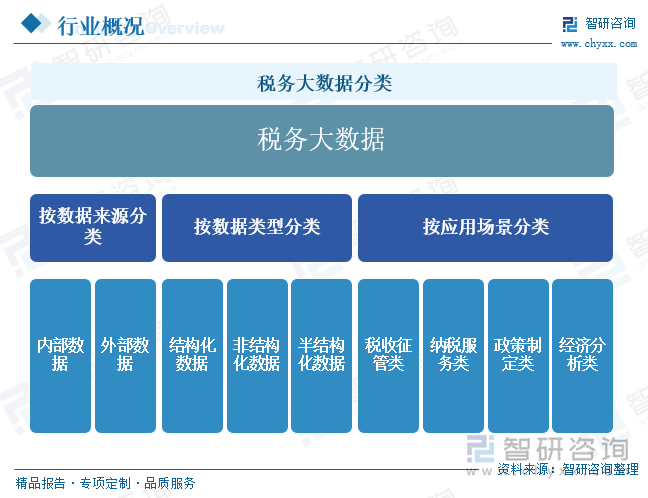
Core Insights - The tax big data market in China is experiencing significant growth, with the market size projected to increase from 30.869 billion yuan in 2019 to 103.213 billion yuan by 2024, indicating a strong demand driven by ongoing tax administration reforms [1][9]. Tax Big Data Industry Definition and Classification - Tax big data refers to the vast and diverse data sets generated, collected, stored, and managed during tax management, collection, and inspection processes, encompassing structured, unstructured, and semi-structured data [1]. Tax Big Data Industry Value Chain Analysis - The industry value chain includes data collection from various sources, data storage and processing, and application services, with a focus on optimizing tax management and enhancing taxpayer services [3]. Development History of China's Tax Big Data Industry - The industry has evolved from initial informatization in the 1980s to intelligent applications post-2013, with significant advancements in data integration and risk management [5]. Current State of China's Tax Big Data Industry - The market is growing steadily, with a notable increase in demand for tax big data software and services due to the implementation of data-driven tax management strategies [9]. Downstream Application Areas of Tax Big Data - The industry exhibits a diversified application landscape, with tax collection accounting for 45% of the market, risk prevention at 25%, taxpayer services at 18%, and economic analysis at 10% [11]. Key Enterprises in China's Tax Big Data Industry - Major players include Digital China, which focuses on tax digitalization solutions; Aerospace Information, a leader in electronic invoicing; Inspur, which provides infrastructure and data governance; and Yonyou Network, specializing in enterprise tax management [13][14][16]. Future Development Trends of China's Tax Big Data Industry - The industry is expected to enhance data governance and compliance, expand data sharing and integration across departments, and leverage technologies like AI and blockchain to innovate business scenarios and improve efficiency [18][19][20].





【兴证计算机】2025Q1持仓分析:低配1.63%,环比上季末提升0.24个百分点
兴业计算机团队· 2025-04-23 15:12
点击上方"公众号"可订阅哦! 兴业证券计算机小组 蒋佳霖/孙乾/ 杨本鸿/ 陈鑫/张旭光/杨海盟/桂杨 数据来源:Wind,兴业证券经济与金融研究院整理 图 2、计算机行业的标准配置比例 4. 98 4. 58% 5% 3. 86% . 57% 4 4. 11% 3. 57% 4. 18% 4. 04% 3. 36% 56% 3. 54% 23% 4% 3. 3.52% 3, 2. 919 2. 86! 3.09 2. 68% 2- 71 67% 3% 2. 19% 2. 29% 2. 60% 2. 50% 2. 08% 1_38% 1. 65% 2% 1.4 1. 44% 1. 36% 1. 29% 1% 14% 13. 36% 11. 52% 12% 11. 30% 10% 8. 97% 8. 84% 7. 88% 7.72% 8% 7. 50% 6. 3 6. 75% 6. 119 6. 51% 696 4. 67% 5. 00% 4. 80% 4. 35% 4. 8RW 01% 4 496 4. 29% 4. 44% 3.64% A 149 3.78% 3.19% 3. 24% 2. 72% 2. 6 ...




报告:2024年中国网络安全硬件市场规模达到210.159亿元人民币,深信服位列第一
news flash· 2025-04-21 10:20
Core Insights - The report indicates that the Chinese cybersecurity hardware market is projected to reach a size of 21.0159 billion RMB in 2024 [1] - The top three companies in the market are Deepin Technology, Qihoo 360, and H3C, with market shares of 11.1%, 10.8%, and 10.3% respectively [1] Company Analysis - Deepin Technology holds the largest market share at 11.1%, indicating a strong position in the cybersecurity hardware sector [1] - Qihoo 360 follows closely with a market share of 10.8%, reflecting its competitive presence in the industry [1] - H3C ranks third with a market share of 10.3%, showcasing its relevance in the cybersecurity hardware market [1] Industry Overview - The overall growth of the cybersecurity hardware market in China is significant, with a total market size of 21.0159 billion RMB expected in 2024 [1] - The competitive landscape is characterized by a few key players dominating the market, highlighting the importance of market share in assessing company performance [1]

高盛:中国人工智能服务器:中国云资本支出将支持未来增长;首次覆盖华勤和灵逸,评级为买入;浪潮评级为中性
Goldman Sachs· 2025-04-21 03:00
Investment Ratings - The report initiates coverage on Huaqin and Lingyi with a Buy rating, and Inspur is rated Neutral [1][54]. Core Insights - The China AI servers supply chain is expected to be driven by increasing demand from the domestic market, with China Cloud capital expenditures projected to grow at 26% year-over-year in 2025 and maintain a similar high level in 2026 [1][27]. - Huaqin's net income is anticipated to grow at a CAGR of 22% from 2025 to 2027, while Inspur and Lingyi are expected to see net income growth of 17% and 31% CAGR, respectively, during the same period [2][54]. - The report highlights the competitive landscape, noting that Huaqin's strengths include extensive experience in smartphone ODM, strong R&D capabilities, and a highly automated production process [27][51]. Summary by Sections Huaqin - Huaqin is positioned as an ODM company with a diverse product range, including smartphones, PCs, and AI servers. The company is expected to benefit from increased Capex spending on AI servers and market share gains in legacy businesses [23][51]. - The 12-month price target for Huaqin is set at Rmb79.8, reflecting a target P/E multiple of 20x based on 2025E EPS estimates [26][52]. - Revenue is projected to grow significantly, with contributions from servers and wearables expected to rise to 29% and 7% by 2028, respectively [23][40]. Inspur - Inspur is recognized as a leading supplier of AI servers, with a focus on serving Chinese clients. The company is expected to experience net income growth at a CAGR of 17% from 2025 to 2027 [54]. - The 12-month price target for Inspur is set at Rmb53, with a current trading P/E of 21x for 2025 [54]. - Inspur's strong R&D capabilities and experience in the server market are highlighted as key advantages in capitalizing on the growing demand for AI servers [54]. Lingyi - Lingyi is expected to benefit from the rising demand for AI devices and changes in smartphone form factors, with a projected net income growth of 31% CAGR from 2025 to 2027 [2][54]. - The report initiates coverage on Lingyi with a Buy rating and a price target of Rmb9.4, indicating a 30% upside [1][54]. Market Dynamics - The report discusses the competitive dynamics within the AI server supply chain, emphasizing the importance of local foundation models and the potential for market share gains as local peers exit the market [27][51]. - The valuation of Huaqin, Inspur, and Lingyi is compared to the Taiwan AI servers supply chain, with Huaqin and Lingyi trading at higher multiples due to their growth prospects [3][19].

