
CR Sanjiu(000999)

Search documents
华润三九(000999) - 2025 Q2 - 季度财报
2025-08-15 10:45
Financial Performance - The company's operating revenue for the first half of 2025 was CNY 14.81 billion, representing a 4.99% increase compared to CNY 14.11 billion in the same period last year[19]. - The net profit attributable to shareholders decreased by 24.31% to CNY 1.82 billion from CNY 2.40 billion year-on-year[19]. - The net profit after deducting non-recurring gains and losses fell by 26.46% to CNY 1.70 billion compared to CNY 2.31 billion in the previous year[19]. - The net cash flow from operating activities increased by 21.03% to CNY 2.86 billion from CNY 2.36 billion in the same period last year[19]. - The total assets of the company at the end of the reporting period reached CNY 57.26 billion, a 42.86% increase from CNY 40.08 billion at the end of the previous year[19]. - The net assets attributable to shareholders increased by 7.22% to CNY 21.34 billion from CNY 19.90 billion year-on-year[19]. - The basic earnings per share decreased by 24.31% to CNY 1.09 from CNY 1.44 in the same period last year[19]. - The diluted earnings per share also decreased by 24.31% to CNY 1.09 from CNY 1.44 year-on-year[19]. - The weighted average return on equity was 8.80%, down from 12.32% in the previous year, a decrease of 3.52 percentage points[19]. Industry Trends - The pharmaceutical industry is currently facing a temporary adjustment period, with the retail pharmacy market size declining by 2.3% year-on-year to CNY 247.4 billion in the first five months of 2025[27]. - The hospital market size has also seen a year-on-year decrease of 1.7% in Q1 2025, indicating a plateau phase[27]. - Government policies are increasingly supporting high-quality development in the pharmaceutical sector, with measures introduced to enhance the quality and competitiveness of traditional Chinese medicine[28]. - The aging population in China is projected to reach 22.0% of the total population by 2024, creating significant demand for chronic disease management and traditional Chinese medicine[29]. Research and Development - The company has established a comprehensive R&D system and has received 9 national science and technology progress awards, emphasizing its commitment to innovation[35]. - The company invested 662 million CNY in R&D during the first half of 2025, with a total of 205 projects under development[43]. - The company achieved a joint R&D collaboration on the HiCM-188 project, which is the world's first regenerative treatment for heart failure based on induced pluripotent stem cells, currently advancing to Phase II clinical trials[46]. - The company has made progress in its R&D pipeline, with multiple products such as PXT3003 and Anshen Droplets receiving production approval and completing clinical trials for various indications[47]. - The company is focusing on leveraging its strengths in R&D to develop a diversified product matrix, particularly in the prescription drug sector[35]. Product Development and Market Strategy - The company aims to become a leader in the public health industry by focusing on high-quality pharmaceutical health product innovation and smart manufacturing[32]. - The company’s CHC health consumer products cover various categories, including cold, gastrointestinal, and pediatric products, and it continues to expand its product offerings[32]. - The company is actively expanding its product line in the respiratory category, launching new products such as 999 Yiqi Qingfei Granules and 999 Binglian Qingyan Spray[55]. - The company is focusing on a multi-brand strategy, enhancing its brand portfolio in the CHC and traditional Chinese medicine sectors[36]. - The company collaborates with major online platforms like JD Health and Alibaba Health to enhance its sales channels and reach[34]. Financial Management and Governance - The company is enhancing its compliance management system and legal risk prevention mechanisms to ensure robust governance and operational integrity[61]. - The company has established a comprehensive investment management system to address risks associated with mergers and acquisitions[95]. - The company has committed to continuous innovation and product development, with a focus on clinical research and new product launches[93]. - The company emphasizes quality improvement initiatives to strengthen its competitive position in the pharmaceutical industry[99]. Social Responsibility and Sustainability - 华润三九在2025年上半年积极履行社会责任,推进公司治理、环保、慈善公益等工作,助力可持续发展[123]. - 公司将中医药传承创新与乡村振兴相结合,重点建设中药材种子种苗基地,推动中药农业升级[123]. - 华润三九强化环保管理,动态识别并管控生态环境风险,推进产品全生命周期绿色低碳化[123]. - 公司积极开展产业帮扶、义诊、药品捐赠等公益活动,提升医药可及性,保障基层医疗公平[123]. - 公司致力于打造医药制造行业绿色低碳发展新标杆,响应国家乡村振兴和产业帮扶政策[123]. Shareholder and Equity Management - The company plans to distribute a cash dividend of CNY 4.5 per 10 shares (including tax) to all shareholders[5]. - The proposed cash dividend for the first half of 2025 is 4.5 yuan per 10 shares (including tax), totaling approximately 751.31 million yuan, which accounts for 41.39% of the net profit attributable to shareholders for the same period[104][105]. - The company has a stock incentive plan in place, which was approved by the board and independent directors[106][107]. - The company has completed the necessary procedures for the release of restricted shares as per the 2021 stock incentive plan[182]. - The company’s basic and diluted earnings per share will be diluted due to the increase in total shares[184]. Compliance and Legal Matters - The company has maintained strict compliance with legal regulations over the past three years, with no significant violations reported[134]. - The company has confirmed that it has not been subject to any regulatory measures from the China Securities Regulatory Commission[134]. - The company has committed to providing accurate, complete, and truthful information during the transaction process, ensuring no false records or misleading statements exist[130]. - The company will take legal responsibility for any losses incurred by investors due to false records or misleading statements related to the transaction[132].

华润三九(000999) - 2025年第十次董事会会议决议公告
2025-08-15 10:45
股票代码:000999 股票简称:华润三九 编号:2025—057 华润三九医药股份有限公司 2025 年第十次董事会会议决议公告 本公司及董事会全体成员保证信息披露的内容真实、准确、完整,没有虚假记载、 误导性陈述或重大遗漏。 华润三九医药股份有限公司(以下简称"公司"或"华润三九")董事会 2025 年 第十次会议于 2025 年 8 月 14 日在华润三九医药工业园综合办公中心 107 会议室召开。 会议通知以书面方式于 2025 年 8 月 4 日发出。会议由公司董事长邱华伟先生主持,本 次会议应到董事 11 人,实到董事 11 人,公司监事会成员和部分高级管理人员列席会议。 本次会议的召开及程序符合《公司法》和《公司章程》的规定,会议合法有效。会议以 投票方式审议通过了以下议案,并形成决议: 一、 关于公司 2025 年半年度报告及报告摘要的议案 本议案提交董事会前已经公司董事会审计委员会审议通过。 公司 2025 年半年度报告全文请见巨潮资讯网相关公告(网址:www.cninfo.com.cn), 报告摘要请见《华润三九医药股份有限公司 2025 年半年度报告摘要》(2025-059)。 同意聘任 ...
华润三九(000999) - 关于公司2025年半年度利润分配预案的公告
2025-08-15 10:45
股票代码:000999 股票简称:华润三九 编号:2025—060 华润三九医药股份有限公司 关于公司 2025 年半年度利润分配预案的公告 本公司及董事会全体成员保证信息披露的内容真实、准确、完整,没有虚假记载、 误导性陈述或重大遗漏。 (二)公司 2025 年半年度经营情况 根据公司 2025 年半年度财务报表(未经审计),2025 年上半年,公司实现归属于上 市公司股东的净利润 1,815,258,362.79 元,未分配利润 17,446,597,574.54 元;母公 司实现净利润 787,783,851.83 元,根据《公司法》和《公司章程》的规定,提取法定 盈余公积金 78,778,385.18 元,截至 2025 年 6 月 30 日母公司未分配利润 8,377,056,553.62 元。 (三)方案调整原则 在实施权益分派的股权登记日前,如享有利润分配权的股份总额发生变动,则以实 1 一、审议程序 公司于 2025 年 8 月 14 日召开董事会 2025 年第十次会议,以 11 票同意、0 票反 对、0 票弃权的表决结果,审议通过了《关于公司 2025 年半年度利润分配预案的议案》。 该议 ...
感冒药大王“感冒”了!华润三九营收净利首现双降,押宝并购却成“拖油瓶”
Hua Xia Shi Bao· 2025-08-14 09:40
Core Viewpoint - The company, China Resources Sanjiu, is facing significant challenges as its traditional revenue streams are stagnating, new business ventures are not performing well, and it is struggling to keep pace with competitors in a tightening regulatory environment [2][3]. Business Performance - In 2024, the company reported total sales of 276 billion yuan, but the growth rate is declining, indicating potential risks [3]. - The company's flagship products, which account for 45% of sales (approximately 125 billion yuan), have seen a decrease in growth from nearly 20% in 2023 to 14% in 2024, suggesting they are nearing market saturation [4]. - New products launched in 2024, such as vitamin D drops and probiotics, contributed less than 3% to revenue, indicating poor market reception [5]. Prescription and Over-the-Counter Drugs - The prescription drug segment, which was previously a strong revenue generator, has been negatively impacted by national price cuts, resulting in a gross margin decline of 4.6 percentage points in 2024 [5][10]. - The company’s retail business generated 33.7 billion yuan in 2024, but with a low gross margin of only 13.4%, highlighting inefficiencies in physical store operations [6]. Financial Metrics - In Q1 2025, the company reported revenue of 68.54 billion yuan, a year-on-year decline of 6.04%, and a net profit of 12.7 billion yuan, down 6.87% [8][10]. - Compared to competitors, the company is lagging, with its gross margin at 53.28%, significantly lower than peers like Dong-E E-Jiao at 73.62% [9][10]. Acquisition and Integration Challenges - The acquisition of Kunming Pharmaceutical Group has not yielded expected benefits, with its revenue growth at only 7.3% and a gross margin drop of 7.4 percentage points [6][11]. - The company faces high management integration costs post-acquisition, and the goodwill from acquisitions poses a risk of impairment, amounting to 51.24 billion yuan, which is 25.7% of the company's net assets [11]. Research and Development - The company has increased its R&D investment from 5.94 billion yuan in 2022 to 8.02 billion yuan in 2024, maintaining a 16.8% annual growth rate [12]. - However, the capitalized R&D ratio has dropped from 22.35% to 15.87%, indicating potential issues with project maturity and profitability [13]. - The R&D team has expanded significantly, but labor costs now account for 37.7% of R&D expenses, raising concerns about the efficiency of these investments [14].

借助并购重组等资本市场工具 深市国企持续提高核心竞争力
Xin Hua Wang· 2025-08-12 05:47
Group 1: Government Initiatives and Corporate Strategies - The government work report emphasizes the need to improve the modern enterprise system with Chinese characteristics and to create more world-class enterprises [1] - State-owned enterprises (SOEs) are encouraged to leverage capital markets, particularly through mergers and acquisitions (M&A), to enhance core functions and competitiveness [1] Group 2: Mergers and Acquisitions - M&A is identified as a crucial tool for supporting the high-quality development of listed companies, with SOEs in the Shenzhen market actively pursuing professional integration through M&A [2] - Tianshan Cement is exploring the acquisition of quality minority stakes and expanding overseas M&A opportunities to enhance growth potential [2] - China Resources Sanjiu has completed the acquisition of Kunming Pharmaceutical Group to optimize its traditional Chinese medicine supply chain and aims to become a leader in the elderly health and chronic disease management sectors [2] Group 3: Traditional Industry Upgrades - Traditional industries are encouraged to adopt new technologies for transformation, promoting high-end, intelligent, and green development [3] - Gansu Energy and Chemical has integrated core businesses through asset restructuring and acquisitions, effectively consolidating quality coal resources in Gansu Province [3] - Yantian Port initiated a major asset restructuring to acquire quality port assets, aiming to expand business scale and market share [3] Group 4: Value Management and Shareholder Returns - The State-owned Assets Supervision and Administration Commission (SASAC) has introduced value management as a performance assessment criterion for SOE leaders [4] - Dividend distribution, share buybacks, and stock purchases are highlighted as primary tools for value management, with many SOEs having significant dividend potential [5] - Gansu Energy and Chemical has distributed over 2.02 billion yuan in dividends since its listing, while Yantian Port increased its cash dividends by 50% in 2022 [5][6]


资金不断关注,《中国房颤管理指南》首推创新中药,中药ETF(159647)冲击3连涨
Xin Lang Cai Jing· 2025-08-12 02:32
Group 1 - The Chinese medicine ETF (159647) has seen a continuous inflow of funds, totaling 30.03 million yuan over the past five days, with a net inflow of 22.14 million yuan since August [1] - The China Traditional Chinese Medicine Index (930641) has increased by 0.77%, with notable gains from companies such as Kang En Bei (600572) up 5.41% and Zhong Sheng Pharmaceutical (002317) up 4.80% [1] - The release of the "Chinese Atrial Fibrillation Management Guidelines (2025)" recommends the use of Tongluo drugs, specifically the Shen Song Yang Xin capsule, for maintaining sinus rhythm in paroxysmal atrial fibrillation [1] Group 2 - Jiang Hai Securities highlights that the labeling of expiration dates on traditional Chinese medicine pieces enhances product transparency, boosting consumer confidence and potentially expanding the market [2] - The top ten weighted stocks in the China Traditional Chinese Medicine Index account for 54.58% of the index, with major companies including Yunnan Baiyao (000538) and Tong Ren Tang (600085) [2] - The Chinese medicine ETF closely tracks the China Traditional Chinese Medicine Index, which reflects the overall performance of listed companies involved in the production and sale of traditional Chinese medicine [2]


华润三九股价微涨0.09% 入选上市公司现金分红榜单
Jin Rong Jie· 2025-08-08 17:30
Core Viewpoint - China Resources Sanjiu's stock price is currently at 31.66 yuan, reflecting a slight increase of 0.03 yuan from the previous trading day, indicating a stable market performance [1] Company Overview - The company specializes in the research, production, and sales of pharmaceutical products, including prescription drugs, OTC drugs, and health products [1] - As a significant player in the pharmaceutical industry, China Resources Sanjiu has been included in the latest cash dividend ranking list for listed companies in China, which evaluates companies based on dividend amount and ratio, emphasizing continuity and stability of dividends [1] Market Performance - The stock reached a high of 31.82 yuan and a low of 31.51 yuan during the trading session, with a trading volume of 90,049 lots and a total transaction value of 285 million yuan [1]
7月以来股价翻倍,这家药企与华润三九合作布局减重药大单品丨机构调研
2 1 Shi Ji Jing Ji Bao Dao· 2025-08-07 09:22
Core Viewpoint - The innovative pharmaceutical company, Borui Pharmaceutical, has seen its stock price double since July, following a collaboration with China Resources Sanjiu on the development and commercialization of its GLP-1 product, BGM0504, which could yield up to 282 million yuan in milestone payments [2][3][4]. Investment Highlights - Borui Pharmaceutical has reached a collaboration agreement with China Resources Sanjiu for the GLP-1 project, with potential milestone payments of up to 282 million yuan [4]. - The company has signed a strategic cooperation agreement with Hanyu Pharmaceutical to plan for commercial production capacity [8]. - Borui is advancing its pipeline in the Amylin space, with ongoing IND application submissions for BGM1812 in both China and the U.S. [9][10]. Company Overview - Borui Pharmaceutical (688166.SH) is engaged in the research and production of high-tech pharmaceutical intermediates, active pharmaceutical ingredients, and formulations, focusing on antiviral, antifungal, immunosuppressive, respiratory, and anti-tumor products [2][4]. Market Performance - Since July, Borui's stock price has increased by 100.15%, reaching 107.5 yuan per share, with a total market capitalization of 45.4 billion yuan as of August 7 [3]. Clinical Data and Product Potential - BGM0504 injection, a dual GLP-1 and GIP receptor agonist, has shown promising results in Phase II clinical trials, with significant weight loss observed in various dosage groups [4][5]. - The clinical trial data indicates that at the 24-week mark, the percentage of participants achieving weight loss of ≥5% was 87%, 93%, and 100% for the 5mg, 10mg, and 15mg groups, respectively [4]. Strategic Collaborations - The collaboration with China Resources Sanjiu is primarily for sales promotion rather than the transfer of R&D pipeline rights, allowing Borui to leverage Sanjiu's strong OTC channels to enhance sales [6]. - Hanyu Pharmaceutical will provide stable and compliant raw material supply for Borui's metabolic pipeline, supporting the global industrialization of Borui's innovative drugs [8]. Future Outlook - Borui's BGM0504 is expected to be approved for market entry in China by 2027, given the ongoing clinical trials and the large market potential for diabetes and weight loss medications [8]. - The company is also advancing its Amylin product, BGM1812, which has shown potential in preclinical studies and is expected to complement GLP-1 therapies [10].

华润三九(000999.SZ):海外业务在公司总体业务中占比较小
Ge Long Hui· 2025-08-06 08:51
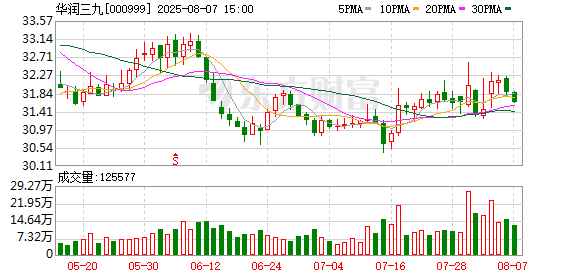
格隆汇8月6日丨华润三九(000999.SZ)于投资者互动平台表示,公司海外业务在公司总体业务中占比较 小,公司将跟随国家战略,积极探索公司产品向海外推广。 ...
华润三九股价微涨0.12% 与博瑞医药达成创新药合作协议
Jin Rong Jie· 2025-08-05 17:03
华润三九属于医药制造行业,主要从事医药产品的研发、生产和销售。公司核心业务涵盖CHC健康消 费品和处方药领域,拥有覆盖全国的销售网络,与超过60万家药店保持合作。 8月1日,华润三九与博瑞医药就创新药BGM0504注射液达成合作协议。根据协议,华润三九将获得该 药物在中国大陆地区的研发、注册、生产及商业化权利。BGM0504是一种GLP-1和GIP受体双重激动 剂,目前正在进行III期临床试验,在降糖和减重效果上展现出优于同类产品的潜力。 8月5日主力资金净流出1877.29万元,占流通市值的0.04%。近五日主力资金累计净流入1.22亿元,占流 通市值的0.23%。 风险提示:医药研发存在不确定性,合作项目进展可能不及预期。 华润三九最新股价报32.16元,较前一交易日上涨0.12%。盘中最高触及32.28元,最低下探至31.82元, 成交金额达4.54亿元。 ...