
Bank Of Lanzhou(001227)

Search documents
10月13日基金调研瞄准这些公司
Zheng Quan Shi Bao Wang· 2025-10-14 03:48
Group 1 - On October 13, a total of 9 companies were investigated by institutions, with 6 companies being surveyed by funds, indicating a strong interest in these firms [1] - LiuGong was the most popular among the surveyed companies, with 15 funds participating in its investigation, while QingNiao Fire and KeLu Electronics attracted 4 and 2 funds respectively [1] - Among the surveyed companies, 4 were from the Shenzhen Main Board and 2 from the ChiNext Board, highlighting the diversity in market segments [1] Group 2 - The total market capitalization of the surveyed A-share companies included 2 firms with a market value of less than 10 billion yuan, specifically Anli Co. and Baoli International [2] - In terms of market performance over the past 5 days, 3 stocks among the surveyed companies saw an increase, with KeLu Electronics leading at a rise of 7.49%, followed by LiuGong at 1.97% and Baoli International at 0.46% [2] - Conversely, 2 stocks experienced declines, with QingNiao Fire and Anli Co. showing decreases of 1.88% and 1.30% respectively [2]





天水古城焕新颜
Jin Rong Shi Bao· 2025-10-14 02:07
Core Viewpoint - The People's Bank of China, Tianshui Branch, is enhancing financial support for the cultural and tourism industry, particularly through local banks like Lanzhou Bank, to promote regional economic development [1] Group 1: Financial Support - Lanzhou Bank's Tianshui Branch has provided a total of 500 million yuan in loans for the construction of the Tianshui Ancient City project [1] - This financial support aims to transform Tianshui Ancient City into a prominent symbol of the local cultural and tourism economy [1]
调研速递|兰州银行接受鹏华基金等1家机构调研 透露多项关键要点
Xin Lang Cai Jing· 2025-10-13 12:19
Core Insights - Lanzhou Bank aims to achieve a total asset of 509.742 billion yuan by June 2025, reflecting a growth of 4.82% from the beginning of the year, with a core Tier 1 capital adequacy ratio of 8.50% [1] Group 1: Asset Growth and Financial Performance - The bank's asset growth will consider market demand, capital constraints, and yield optimization [1] - As of June 2025, the net interest margin is projected to be 1.37%, slightly below the average of A-share listed banks, with short-term pressure but potential stabilization in the medium to long term [1] - The bank's deposit interest rate is 2.22%, down 25 basis points from the beginning of the year, indicating a continued decline in funding costs [1] Group 2: Regional Economic Development - Gansu Province's GDP reached 646.9 billion yuan in the first half of 2025, growing by 6.3%, with key industries including manufacturing, agriculture, new energy, and digital economy [1] - Lanzhou's GDP was 203.36 billion yuan, with a growth rate of 5.6%, focusing on sectors like semiconductors, new energy, biomedicine, and infrastructure [1] Group 3: Loan Demand and Quality - Public loan demand in Gansu Province is growing, with a total loan balance of 3,002.7 billion yuan, an increase of 51.5 billion yuan since the beginning of the year [1] - The non-performing loan ratio for corporate loans decreased from 1.85% to 1.74%, while retail loan non-performing rates increased from 1.77% to 2.01% [1] Group 4: Strategic Initiatives - The bank plans to expand its commission income by developing wealth management and other services to offset declines in self-managed investment income [1] - The bank holds a market share of 12.02% in deposits and 10.17% in loans within Gansu Province, ranking first and second respectively [1] Group 5: Capital and Dividend Strategy - The bank intends to supplement its capital through various means, including issuing subordinated debt, and has maintained a stable dividend payout ratio since 2019, with a cumulative dividend of 2.398 billion yuan and a dividend yield of approximately 4% [1]
兰州银行:截至2025年9月30日收盘,股东总户数为101535户
Zheng Quan Ri Bao· 2025-10-13 12:13
Group 1 - The company, Lanzhou Bank, reported that as of September 30, 2025, the total number of shareholders is 101,535 [2]

兰州银行(001227) - 2025年10月13日投资者关系活动记录表
2025-10-13 11:40
Group 1: Company Growth and Financial Performance - As of June 2025, the total assets of the bank reached 5,097.42 million CNY, reflecting a growth of 4.82% since the beginning of the year [2] - The core Tier 1 capital adequacy ratio stands at 8.50%, indicating a stable capital position [2] - The bank aims to maintain reasonable growth in asset scale while optimizing its structure, considering market demand, capital constraints, and yield [2] Group 2: Economic and Industry Overview - In the first half of 2025, Gansu Province's GDP was 6,469 million CNY, with a year-on-year growth of 6.3% [2] - Lanzhou's GDP reached 2,033.6 million CNY, growing by 5.6% year-on-year, with key industries including semiconductors, new energy, and biomedicine [2] - The province's financial institutions saw a net increase of 30,027 million CNY in loans, indicating a stable demand for corporate loans [3] Group 3: Loan Demand and Market Trends - Corporate loan demand has shown overall growth, while retail loan demand remains lower and more sensitive to interest rates [3] - The bank's mortgage loans have increased, with 76% of the loans directed towards external markets, particularly in regions like Longnan and Tianshui [3] - The real estate market outside Lanzhou is performing better than within the city, with stable sales in county-level areas [3] Group 4: Risk Management and Asset Quality - The bank has implemented a "control existing, limit new" strategy to manage asset quality, resulting in a decrease in the non-performing loan (NPL) ratio from 1.85% to 1.74% [9] - The retail loan NPL ratio increased from 1.77% to 2.01%, indicating challenges in that segment [9] - The bank has established a professional collection team to enhance the recovery of non-performing loans [7] Group 5: Financial Metrics and Future Outlook - As of June 2025, the bank's net interest margin was 1.37%, slightly below the average for urban commercial banks [6] - The deposit interest rate has decreased to 2.22%, down by 25 basis points since the beginning of the year [6] - The bank's financial investments totaled 1,650 million CNY, accounting for 32.37% of total assets, expected to remain stable [12] Group 6: Competitive Position and Market Share - The bank holds a market share of 12.02% in deposits, ranking first in Gansu Province, while its loan market share is 10.17%, placing it second [11] - The bank is actively exploring various capital-raising methods to enhance its capital structure [12] Group 7: Dividend and Capital Plans - The bank has issued perpetual bonds worth 50 million CNY in 2025 and plans to continue optimizing its capital structure [12] - The bank has maintained a cash dividend payout ratio exceeding 30% since its listing, with a total cash dividend of 23.98 million CNY [12]
城商行板块10月10日涨1.16%,齐鲁银行领涨,主力资金净流出4.17亿元
Zheng Xing Xing Ye Ri Bao· 2025-10-10 08:46
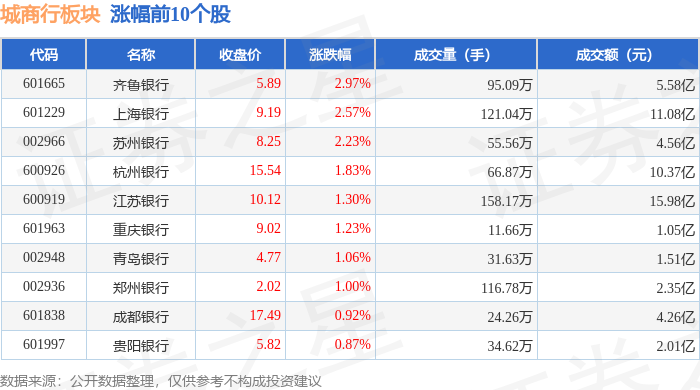
Core Insights - The city commercial bank sector experienced a rise of 1.16% on October 10, with Qilu Bank leading the gains [1] - The Shanghai Composite Index closed at 3897.03, down 0.94%, while the Shenzhen Component Index closed at 13355.42, down 2.7% [1] Stock Performance - Qilu Bank (601665) closed at 5.89, up 2.97% with a trading volume of 950,900 shares and a transaction value of 558 million yuan [1] - Shanghai Bank (601229) closed at 9.19, up 2.57% with a trading volume of 1,210,400 shares and a transaction value of 1.108 billion yuan [1] - Suzhou Bank (002966) closed at 8.25, up 2.23% with a trading volume of 555,600 shares and a transaction value of 456 million yuan [1] - Hangzhou Bank (600926) closed at 15.54, up 1.83% with a trading volume of 668,700 shares and a transaction value of 1.037 billion yuan [1] - Jiangsu Bank (616009) closed at 10.12, up 1.30% with a trading volume of 1,581,700 shares and a transaction value of 1.598 billion yuan [1] Capital Flow - The city commercial bank sector saw a net outflow of 417 million yuan from institutional investors, while retail investors contributed a net inflow of 176 million yuan [2] - Shanghai Bank had a net inflow of 101 million yuan from institutional investors, but a net outflow of 51.32 million yuan from speculative funds [3] - Jiangsu Bank experienced a net inflow of 59.37 million yuan from institutional investors, with a net outflow of 68.54 million yuan from speculative funds [3]






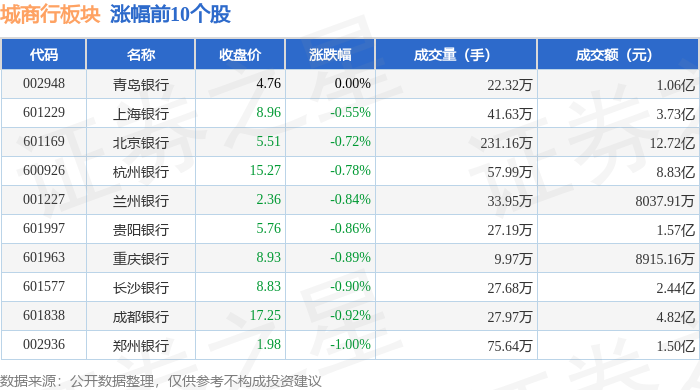
城商行板块9月30日跌1%,苏州银行领跌,主力资金净流出4.62亿元
Zheng Xing Xing Ye Ri Bao· 2025-09-30 08:51
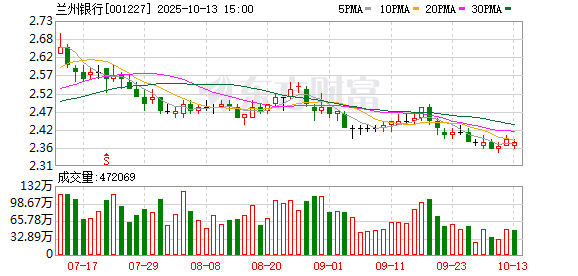
Core Insights - The city commercial bank sector experienced a decline of 1.0% on September 30, with Suzhou Bank leading the drop [1] - The Shanghai Composite Index closed at 3882.78, up 0.52%, while the Shenzhen Component Index closed at 13526.51, up 0.35% [1] Stock Performance Summary - Qingdao Bank: Closed at 4.76, unchanged; trading volume of 223,200 shares, turnover of 106 million [1] - Shanghai Bank: Closed at 8.96, down 0.55%; trading volume of 416,300 shares, turnover of 373 million [1] - Beijing Bank: Closed at 5.51, down 0.72%; trading volume of 2,311,600 shares, turnover of 1.272 billion [1] - Hangzhou Bank: Closed at 15.27, down 0.78%; trading volume of 157,990 shares, turnover of 883 million [1] - Lanzhou Bank: Closed at 2.36, down 0.84%; trading volume of 339,500 shares, turnover of 80.379 million [1] - Guiyang Bank: Closed at 5.76, down 0.86%; trading volume of 271,900 shares, turnover of 157 million [1] - Chongqing Bank: Closed at 8.93, down 0.89%; trading volume of 99,700 shares, turnover of 89.151 million [1] - Changsha Bank: Closed at 8.83, down 0.90%; trading volume of 276,800 shares, turnover of 244 million [1] - Chengdu Bank: Closed at 17.25, down 0.92%; trading volume of 279,700 shares, turnover of 482 million [1] - Zhengzhou Bank: Closed at 1.98, down 1.00%; trading volume of 756,400 shares, turnover of 150 million [1] Capital Flow Analysis - The city commercial bank sector saw a net outflow of 462 million from main funds, while speculative funds had a net inflow of 331 million, and retail investors had a net inflow of 131 million [2] - Suzhou Bank: Main fund net inflow of 55.9396 million, speculative fund net outflow of 11.5337 million, retail net outflow of 44.4059 million [3] - Changsha Bank: Main fund net inflow of 33.8793 million, speculative fund net outflow of 13.6525 million, retail net outflow of 20.2268 million [3] - Qilu Bank: Main fund net inflow of 8.6825 million, speculative fund net outflow of 2.7980 million, retail net outflow of 5.8846 million [3] - Hangzhou Bank: Main fund net inflow of 7.6881 million, speculative fund net inflow of 44.2474 million, retail net outflow of 51.9354 million [3] - Guiyang Bank: Main fund net inflow of 4.8665 million, speculative fund net outflow of 1.6412 million, retail net outflow of 3.2254 million [3]
上市银行“十四五回望”之资负结构与息差变迁
CMS· 2025-09-28 15:09
Investment Rating - The report maintains a recommendation for the banking industry [3] Core Insights - The report provides a comprehensive analysis of the asset-liability structure and interest margin changes of 42 A-share listed banks during the "14th Five-Year Plan" period, highlighting a shift towards corporate loans on the asset side and a stronger retail focus on the liability side [12][14] - The asset-liability structure indicates a significant increase in the proportion of corporate loans, rising from 57.02% to 63.22% from the end of 2020 to mid-2025, while the proportion of demand deposits decreased from 41.94% to 30% [12][14] - The report notes a decline in both asset yield and interest margin, with the yield on interest-earning assets dropping from 4.43% to 3.32% and the net interest margin decreasing from 2.23% to 1.53% during the same period [14][15] Summary by Sections Overall Asset-Liability Structure and Interest Margin Changes - The asset-liability structure shows an increase in loan-to-earning asset ratio from 54.19% to 56.49%, with corporate loans making up a larger share of total loans [14][15] - The average yield on interest-earning assets decreased significantly, with the loan yield falling from 5.34% to 3.82% [15] - The net interest margin for listed banks remains higher than that of commercial banks, despite a decline [14][15] Changes in Each Banking Sector's Asset-Liability Structure and Interest Margin - City commercial banks experienced a more significant increase in the proportion of corporate loans, with their interest margin narrowing less compared to other banks [18] - The report highlights that the proportion of deposits in interest-bearing liabilities for state-owned banks decreased, while it increased for rural commercial banks [18] - The decline in interest-bearing liabilities' cost rate was most pronounced in city commercial banks, leading to a smaller reduction in their interest margin [18]





固收深度报告20250927:从42家上市银行半年报解读银行债券投资“攻守道”




Soochow Securities· 2025-09-27 14:32
1. Report Industry Investment Rating No information about the report industry investment rating is provided in the given content. 2. Core Viewpoints of the Report - External environment factors such as interest rate fluctuations, bond supply - demand, and policy orientation jointly impact bond investment returns. In H1 2025, the bond investment of 42 listed banks showed certain characteristics in scale, structure, and profit and loss, but there are still challenges in maintaining stable returns in the future [1]. - The overall bond investment scale of 42 listed banks expanded steadily in H1 2025. There were differences in the investment structure among different types of banks, with state - owned banks and city commercial banks having stable growth in the bond allocation portfolio, while joint - stock banks and rural commercial banks increased their efforts in the bond trading portfolio. The bond investment portfolio generally presented a pattern of "stable foundation and flexible gain" [1]. - The coupon income of 42 listed banks was generally stable in H1 2025 but showed a slight year - on - year decline. The fair value change loss was significant, and the investment income increased. However, the bond investment of the banking industry still faces pressure to maintain stable returns [1]. 3. Summary According to the Table of Contents 3.1 42 Listed Banks' Bond Investment Volume - **Overall Bond Investment Scale: Steady Expansion**: In H1 2025, the total scale of the three types of bond - type financial assets of 42 listed banks showed a steady expansion trend. The growth of debt investment - type financial assets measured at amortized cost was relatively slow, while the growth of trading financial assets measured at fair value and included in current profits and losses was relatively large, indicating that banks increased the proportion of trading positions [9]. - **Differentiated Bond Investment Distribution Structures among Different Bank Types**: In H1 2025, state - owned banks and city commercial banks showed stable growth in the bond allocation portfolio, which may be related to their participation in the primary - market issuance of important national and regional bond varieties. Joint - stock banks and rural commercial banks slightly weakened their bond allocation power but significantly increased their efforts in the bond trading portfolio, showing a differentiated feature of "stable allocation by large banks and prominent trading flexibility by small and medium - sized banks" [13]. - **Bond Investment Allocation Tilted towards Government - Related Bonds**: In H1 2025, commercial banks increased their allocation of government - related bonds, with an average month - on - month increase of about 10% for state - owned banks, joint - stock banks, and city commercial banks, and a slightly smaller increase for rural commercial banks. The allocation of financial bonds and other bonds was differentiated. All banks held a relatively large scale of government - related bonds, followed by financial bonds and credit - related bonds [18]. - **Correlation between Financial Asset Types and Bond Variety Structures**: The banking industry maintained a stable growth of interest - rate bonds in the bond allocation portfolio and increased the allocation of credit bonds, while the allocation of financial bonds was relatively weak. In the bond trading portfolio, interest - rate bonds and financial bonds were the core varieties, with a more significant increase than credit bonds, showing a "stable foundation and flexible gain" pattern [22]. 3.2 42 Listed Banks' Bond Investment Profit and Loss - **Coupon Income: Generally Stable and Still the Main Source of Income**: In H1 2025, the total coupon income of 42 listed banks decreased slightly year - on - year. Although the scale of held - to - maturity bonds increased, the decline in the coupon rate of newly issued bonds led to a decrease in coupon income. In the future, coupon income is still expected to be the main source of bond investment income for commercial banks [26]. - **Fair Value Change Loss: Losses in the Trading Level**: In H1 2025, the total fair value change loss of 42 listed banks decreased significantly year - on - year, indicating that it was difficult to obtain capital gains through short - term trading in the volatile bond market, and there were floating losses in bond trading [28]. - **Investment Income: Growth in All Bank Types**: In H1 2025, the actual investment income of 42 listed banks in the bond field increased significantly year - on - year. Although the book value appreciation of bond - type trading financial assets and other debt investment - type financial assets was not as good as that of the previous year, banks could still increase their investment income by selling floating - profit old bonds and waiting for the maturity of high - coupon bonds [31]. 3.3 Attribution and Summary - **External Environment Driving Factors: Interest Rate Fluctuations, Bond Supply - Demand, and Policy Orientation Jointly Impact Bond Investment Returns**: In H1 2025, the "more adjustments and fewer opportunities" bond market environment led to a general decline in the prices of existing bonds, resulting in a significant year - on - year decline in the fair value change loss of listed banks' bond investment. The supply of national bonds, local government bonds, and policy - based financial bonds increased, but the coupon rate of newly issued bonds decreased, leading to a decline in coupon income. Regulatory policies indirectly affected bond investment performance [35]. - **Banking Industry's Bond Investment Pressure and Future Outlook** - Overall Income Shows a Positive Trend but There Are Still Hidden Concerns: In H1 2025, the actual bond investment income of 42 listed banks increased slightly year - on - year, but the coupon income faced downward pressure in the interest - rate downward cycle, and it was more difficult to obtain spread income through band trading. Since H2 2025, the "stock - strong and bond - weak" pattern has emerged, and the loss caused by fair value change will be more obvious [3]. - Different Bank Types Show Differentiated Performance, and State - owned Banks' Pressure Is Relatively Controllable: State - owned banks can maintain a certain profit - making ability in the low - interest - rate volatile bond market due to their advantages in bond allocation and trading portfolios. Joint - stock banks, city commercial banks, and rural commercial banks are more vulnerable, and they may increase their capital allocation in the equity market, commodity market, and related structured fixed - income products in the future [3].
兰州银行股份有限公司首次公开发行前已发行股份上市流通提示性公告
Shang Hai Zheng Quan Bao· 2025-09-26 19:28
登录新浪财经APP 搜索【信披】查看更多考评等级 证券代码:001227 证券简称:兰州银行 公告编号:2025-043 兰州银行股份有限公司 首次公开发行前已发行股份上市流通提示性公告 首次公开发行前,本行总股本5,126,127,451股,发行后本行总股本5,695,697,168股,包括有限售条件流 通股5,126,127,451股,无限售条件流通股569,569,717股。目前尚未解除限售的股份数量为1,482,931,751 股。 本次上市流通的限售股为本行首次公开发行前已发行但未办理股权托管确权手续的部分股份,由白楠萍 等19户股东所持有,现已完成确权,并已在中国证券登记结算有限责任公司深圳分公司进行登记。该部 分限售股共计983,817股,占本行总股本的0.0173%,锁定期为自本行股票在深圳证券交易所上市交易之 日起12个月,该部分限售股已于2023年1月17日锁定期届满,将于2025年9月30日上市流通。 (二)本行上市后股份总额变动情况 本行及董事会全体成员保证公告内容的真实、准确和完整,没有虚假记载、误导性陈述或者重大遗漏。 特别提示: 1.本次限售股上市流通数量为983,817股,占本 ...