Bank of Ningbo(002142)

Search documents
调研速递|宁波银行接受富国基金等3家机构调研,聚焦贷款增速与资产质量等要点
Xin Lang Cai Jing· 2025-09-24 08:08
Group 1 - The core viewpoint of the news is that Ningbo Bank is actively engaging with institutional investors to discuss its strategies and outlook, particularly in loan growth and capital management [1] Group 2 - Ningbo Bank has been focusing on supporting private small and micro enterprises and the manufacturing sector, leading to steady growth in loan scale [1] - The bank plans to expand its financial services coverage and maintain reasonable credit growth to support the real economy, aided by policies aimed at boosting domestic demand and consumption [1] - Following the release of new regulations by the National Financial Supervision Administration in November 2024, Ningbo Bank is researching and monitoring the implementation of advanced capital measurement methods [1] - The bank aims to maintain asset quality at a relatively good level despite challenges posed by economic cycles and changing circumstances, utilizing a comprehensive credit risk management approach [1]

宁波银行(002142) - 2025年9月24日投资者关系活动记录表
2025-09-24 07:30
Group 1: Loan Growth and Support for the Economy - The company has focused on key sectors such as private small and micro enterprises, manufacturing, import-export businesses, and consumer services to enhance financial services and support the real economy, resulting in steady loan growth [2] - Future loan growth is expected to be maintained due to ongoing policy benefits aimed at expanding domestic demand and promoting consumption [2] Group 2: Capital Measurement and Regulatory Compliance - The company is actively researching the implementation of advanced capital measurement methods as per the new regulations issued by the National Financial Supervision Administration [2] - The bank is closely monitoring regulatory developments and the progress of peers in applying for advanced measurement methods [2] Group 3: Asset Quality Outlook - The bank anticipates challenges in asset quality management due to economic fluctuations and changes in domestic and international situations [2] - The company will focus on key areas and adhere to risk management principles, employing a comprehensive credit risk management process supported by financial technology [2] - Asset quality is expected to remain at a relatively good level within the industry [2] Group 4: Investor Communication and Compliance - During the investor relations activity, the company ensured thorough communication with investors while adhering to disclosure regulations, with no significant undisclosed information leaks reported [2]
宁波银行分析师会议-20250923
Dong Jian Yan Bao· 2025-09-23 14:47
Report Summary 1. Reported Industry Investment Rating No information provided. 2. Core Viewpoints of the Report - The company adheres to a differentiated business strategy, adapts to the changing business environment, and accumulates comparative advantages to drive high - quality development [23]. - The company focuses on the relationship between dividends and internal capital growth, and internal capital will create greater value for the company's development [24]. - The company will actively respond to the changing business environment, focus on key areas, and maintain its asset quality at a relatively good level in the industry [24][25]. 3. Summary by Relevant Catalogs 3.1. Research Basic Situation - Research object: Ningbo Bank [16] - Industry: Banking [16] - Reception time: September 23, 2025 [16] - Listed company reception personnel: The company's investor relations team [16] 3.2. Detailed Research Institutions | Detailed Research Institutions | Reception Object Type | Institution - Related Personnel | | --- | --- | --- | | Marshall Wace LLP | Others | Isabella Huang | | Aberdeen Asset Management PLC | Asset management company | Alec Jin | | Public Sector Pension Investment Board | Investment company | Grace Li | | Millennium Capital Management (Hong Kong) Limited | Asset management company | Sharon Li | | Millennium Capital Management Ltd. | Others | Jerry Lou | | Morgan Stanley Investment Management Inc | Asset management company | Jerry Peng | | Robeco Institutional Asset Management B.V. | Fund management company | Angela Qin | | North Rock Capital Management, LLC | Others | Hu Shen | [17] 3.3. Research Institution Proportion No information provided. 3.4. Main Content Data - **Advantages in industry competition**: The company adheres to a differentiated business strategy, deepens the main business line, strengthens professional operation, accelerates technological transformation, and guards the risk bottom - line [23]. - **Refinancing and internal growth**: The company coordinates the relationship between dividends and internal capital growth. Given the current regulatory requirements for refinancing, internal capital will create greater value for the company [24]. - **Outlook on future asset quality**: The company will actively respond to the changing business environment, focus on key areas, and use the "Four - modernization and Five - assistance" service system and improve the full - process credit risk management. The asset quality is expected to remain at a relatively good level in the industry [24][25]
银行行业9月23日资金流向日报
Zheng Quan Shi Bao Wang· 2025-09-23 10:11
Core Viewpoint - The banking sector showed a positive performance with a 1.52% increase, while the overall market experienced a slight decline of 0.18% on September 23, 2023 [1] Market Performance - The Shanghai Composite Index fell by 0.18% on September 23, 2023 - Among the sectors, five industries saw gains, with banking and coal being the top performers, increasing by 1.52% and 1.11% respectively - The sectors that faced the largest declines were social services and retail trade, with decreases of 3.11% and 2.90% respectively [1] Capital Flow - The net outflow of capital from the two markets reached 996.85 billion yuan, with only three sectors experiencing net inflows - The banking sector had a net inflow of 14.00 billion yuan, while the construction and decoration sector saw a net inflow of 1.69 billion yuan, and the coal sector had a minor net inflow of 399.41 million yuan - A total of 28 sectors experienced net outflows, with the electronics sector leading with a net outflow of 200.43 billion yuan, followed by the computer sector with 166.60 billion yuan [1] Banking Sector Details - The banking sector had 42 stocks, with 40 stocks rising and only one stock declining - The top three banks by net inflow were Industrial and Commercial Bank of China (4.62 billion yuan), Bank of China (2.50 billion yuan), and China Merchants Bank (2.36 billion yuan) [2] - The stocks with the largest net outflows included Ningbo Bank (1.81 billion yuan), Chengdu Bank (1.03 billion yuan), and Shanghai Pudong Development Bank (967.62 million yuan) [2][3] Individual Stock Performance - The top performing bank stocks included: - Industrial and Commercial Bank of China: +3.06% with a net inflow of 462.06 million yuan - Bank of China: +1.73% with a net inflow of 249.79 million yuan - China Merchants Bank: +1.54% with a net inflow of 236.27 million yuan - Other notable performers included Agricultural Bank of China (+2.47%) and China Construction Bank (+3.03%) [2][3]




宁波银行(002142) - 2025年9月23日投资者关系活动记录表
2025-09-23 08:14
Group 1: Competitive Advantage and Business Strategy - The company adopts a differentiated business strategy to adapt to changes in the operating environment, focusing on sustainable development and high-quality growth [2] - Key strategies include deepening operational focus, strengthening core advantages, accelerating technological transformation, and maintaining risk management to ensure stable operations [2] Group 2: Capital Growth and Financing - The company emphasizes the long-term relationship between dividends and internal capital growth, ensuring a solid capital foundation for sustainable business development [2] - Internal capital is expected to create greater value for the company's development, with a commitment to enhancing performance and maintaining steady internal capital growth for shareholder returns [2] Group 3: Asset Quality Outlook - The company acknowledges new challenges in asset quality management due to economic fluctuations and changes in domestic and international situations [2] - It plans to focus on key areas, adhere to risk management principles, and implement prudent credit policies while enhancing risk monitoring through financial technology [2] - The asset quality is projected to remain at a relatively good level within the industry [2]
13只股中线走稳 站上半年线
Zheng Quan Shi Bao Wang· 2025-09-23 03:46
Core Viewpoint - The Shanghai Composite Index is currently above the six-month moving average, with a slight decline of 1.04% and a total trading volume of 1.262 trillion yuan [1] Group 1: Market Performance - As of 10:29 AM today, the Shanghai Composite Index stands at 3788.76 points, indicating a trading volume of 12,621.13 million yuan [1] - There are 13 A-shares that have surpassed the six-month moving average today, with notable stocks including Air China Ocean, Guisheng Co., and Samsung Medical, showing divergence rates of 4.09%, 2.35%, and 1.79% respectively [1] Group 2: Individual Stock Analysis - The top three stocks with the highest divergence rates are: - Air China Ocean (Code: 833171) with a price increase of 4.78%, a turnover rate of 10.78%, a six-month moving average of 10.52 yuan, and a latest price of 10.95 yuan, resulting in a divergence rate of 4.09% [1] - Guisheng Co. (Code: 600992) with a price increase of 4.08%, a turnover rate of 5.15%, a six-month moving average of 14.45 yuan, and a latest price of 14.79 yuan, resulting in a divergence rate of 2.35% [1] - Samsung Medical (Code: 601567) with a price increase of 4.73%, a turnover rate of 2.47%, a six-month moving average of 23.27 yuan, and a latest price of 23.69 yuan, resulting in a divergence rate of 1.79% [1]





多家银行赎回“二永债” 银行业资本补充仍迫切
Zheng Quan Ri Bao· 2025-09-23 00:52
Core Viewpoint - Recent announcements from multiple banks regarding the redemption of subordinated capital bonds and perpetual bonds indicate a strategic response to changing interest rates, regulatory requirements, and capital management needs. The "perpetual bonds" will continue to be an important tool for capital replenishment in the banking sector [1][2]. Group 1: Reasons for Redemption - Several banks, including China Construction Bank and Qilu Bank, have recently redeemed their "perpetual bonds" due to three main reasons: lowering capital costs, enhancing market reputation, and specific bond terms that allow for redemption after five years [2][3]. - The decline in interest rates allows banks to redeem high-cost old bonds and issue new ones at lower rates, effectively reducing interest expenses and alleviating net interest margin pressure [3]. Group 2: Capital Management and Regulatory Compliance - The implementation of new capital management regulations has led to stricter counter-cyclical capital supervision, particularly for globally systemically important banks, necessitating the replacement of old bonds to optimize capital structure and improve capital tool adaptability [3][6]. - Redemption of old bonds may temporarily decrease a bank's capital scale, but if new bonds are issued simultaneously, it can enhance capital replenishment efficiency [3][4]. Group 3: Market Dynamics and Future Trends - The demand for capital replenishment in the banking sector remains urgent due to significant credit needs during economic transformation and the necessity for capital buffers in dealing with non-performing assets [5]. - The issuance of "perpetual bonds" is expected to show a divergence trend, with large banks and quality joint-stock banks likely to continue leveraging the interest rate decline to accelerate the redemption and issuance of new bonds, while smaller banks may face increased challenges in issuing new bonds [6].

上市银行中期分红计划稳步推进
Zheng Quan Ri Bao· 2025-09-22 16:31
Core Viewpoint - The mid-term dividend distribution among A-share listed banks is progressing, with several banks announcing their plans for 2025, indicating a positive trend in the banking sector's profitability and governance [1][4]. Group 1: Dividend Announcements - Recently, Hu Nong Commercial Bank and Changsha Bank announced their mid-term cash dividends, totaling 3.128 billion yuan, with Hu Nong distributing 2.324 billion yuan and Changsha distributing 804 million yuan [1][2]. - As of September 22, 17 banks have disclosed their mid-term profit distribution plans for 2025, with several banks, including Changsha Bank and Ningbo Bank, implementing mid-term dividends for the first time since their listings [1][4]. Group 2: Dividend Distribution Details - Hu Nong Commercial Bank's cash dividend is based on a total share capital of 9.644 billion shares, distributing 0.241 yuan per share, while Changsha Bank's distribution is based on 4.022 billion shares at 0.20 yuan per share [2]. - In September, three other banks, including Changshu Bank and Minsheng Bank, completed their mid-term dividend distributions, totaling 6.633 billion yuan [2]. Group 3: Dividend Ratios and Trends - The six major state-owned commercial banks have a cash dividend ratio of around 30%, with some city commercial banks and rural commercial banks exceeding this level [3]. - The expansion of mid-term dividends among listed banks reflects a recovery in bank performance, providing sufficient profit space for such distributions [4]. Group 4: Market Implications - Analysts suggest that mid-term dividends enhance predictability, boost investor confidence, and improve valuations, supported by the current strong performance of listed banks [4]. - The overall improvement in bank performance, driven by easing interest margin pressures and growth in non-interest income, is expected to sustain and potentially increase dividend distributions in the future [4][5].



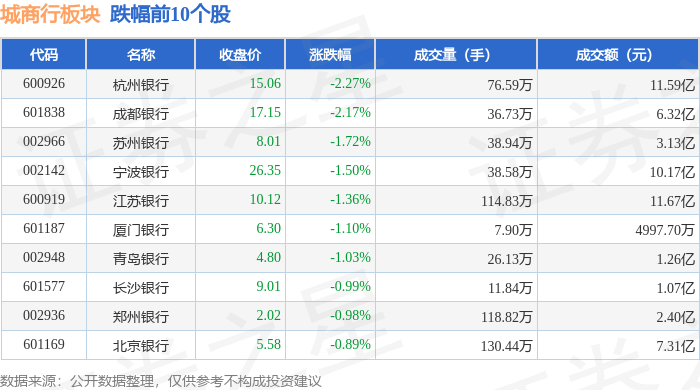
城商行板块9月22日跌1.17%,杭州银行领跌,主力资金净流出1.32亿元
Zheng Xing Xing Ye Ri Bao· 2025-09-22 08:47
Market Overview - On September 22, the city commercial bank sector declined by 1.17%, with Hangzhou Bank leading the drop [1] - The Shanghai Composite Index closed at 3828.58, up 0.22%, while the Shenzhen Component Index closed at 13157.97, up 0.67% [1] Individual Bank Performance - Hangzhou Bank's closing price was 15.06, down 2.27% with a trading volume of 765,900 shares and a transaction value of 1.159 billion yuan [1] - Chengdu Bank closed at 17.15, down 2.17%, with a trading volume of 367,300 shares [1] - Suzhou Bank closed at 8.01, down 1.72%, with a trading volume of 389,400 shares [1] - Ningbo Bank closed at 26.35, down 1.50%, with a trading volume of 138,580 shares [1] - Jiangsu Bank closed at 10.12, down 1.36%, with a trading volume of 1,148,300 shares [1] - Xiamen Bank closed at 6.30, down 1.10%, with a trading volume of 79,000 shares [1] - Qingdao Bank closed at 4.80, down 1.03%, with a trading volume of 261,300 shares [1] - Changsha Bank closed at 9.01, down 0.99%, with a trading volume of 118,400 shares [1] - Zhengzhou Bank closed at 2.02, down 0.98%, with a trading volume of 1,188,200 shares [1] - Beijing Bank closed at 5.58, down 0.89%, with a trading volume of 1,304,400 shares [1] Capital Flow Analysis - The city commercial bank sector experienced a net outflow of 132 million yuan from institutional investors, while retail investors saw a net inflow of 132 million yuan [1] - The table shows the net capital flow for individual banks, indicating varying levels of institutional and retail investor activity [2] Individual Bank Capital Flow - Hangzhou Bank had a net inflow of 127 million yuan from institutional investors, but a net outflow of 15.3 million yuan from retail investors [2] - Shanghai Bank saw a net inflow of 7.31 million yuan from institutional investors, with a net outflow of 13.26 million yuan from retail investors [2] - Guiyang Bank had a net inflow of 4.12 million yuan from institutional investors, with a net outflow of 4.91 million yuan from retail investors [2] - Qilu Bank experienced a net inflow of 3.48 million yuan from institutional investors, but a significant net outflow of 30.56 million yuan from retail investors [2] - Changsha Bank had a net inflow of 1.00 million yuan from institutional investors, while retail investors saw a net outflow of 6.67 million yuan [2] - Other banks like Xiamen Bank, Qingdao Bank, and Zhengzhou Bank also showed varying trends in capital flow, with some experiencing net outflows from both institutional and retail investors [2]



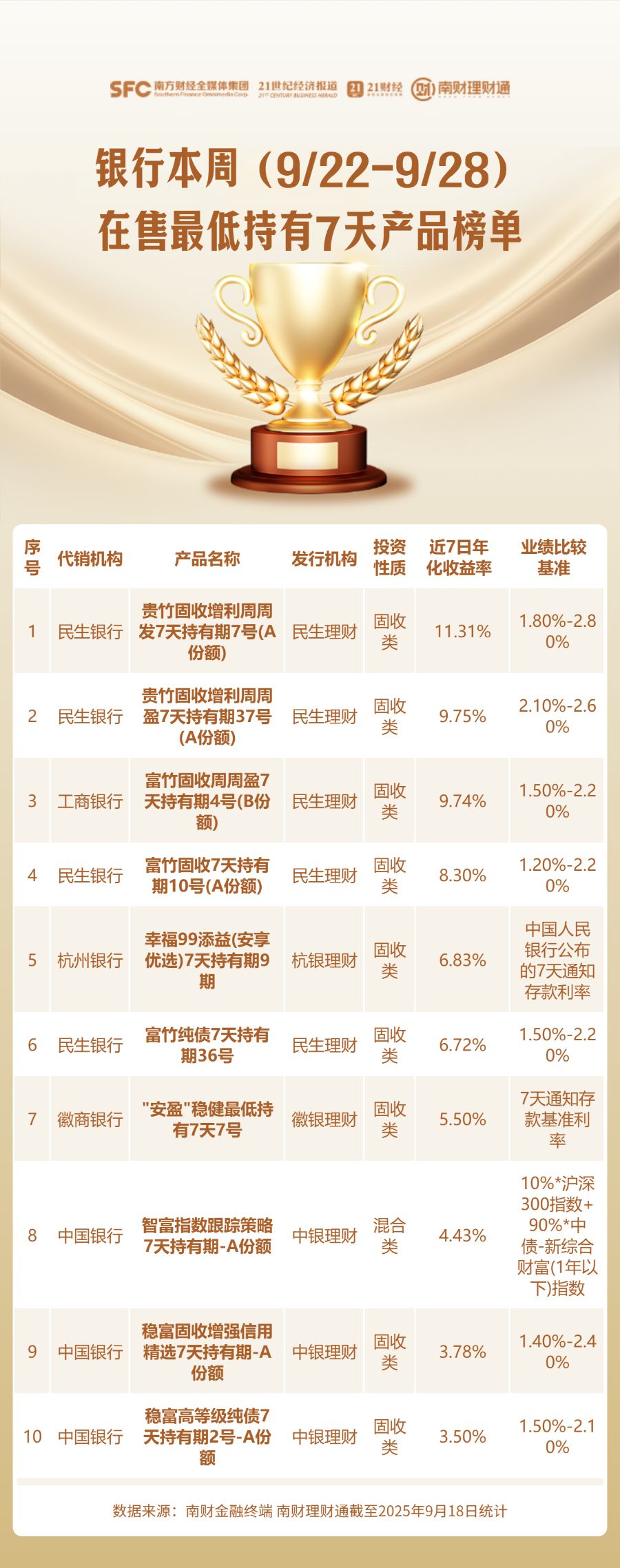
银行渠道本周在售最低持有期理财产品榜单(9/22-9/28)
2 1 Shi Ji Jing Ji Bao Dao· 2025-09-22 07:04
Core Viewpoint - The article emphasizes the importance of distinguishing between various bank wealth management products with similar names and characteristics, providing a weekly performance ranking of these products to assist investors in making informed choices [1][2]. Group 1: Product Performance Rankings - The article presents a ranking of wealth management products based on their annualized returns for different holding periods: 7 days, 14 days, 30 days, and 60 days [1]. - For the 7-day holding period, the top-performing product is from Minsheng Bank with an annualized return of 9.75% [4]. - The 14-day holding period rankings show Minsheng Bank's product achieving an annualized return of 8.34% [6]. - In the 30-day holding period, Hangzhou Bank leads with a return of 24.26% [11]. - For the 60-day holding period, China Bank's product tops the list with a return of 26.21% [15]. Group 2: Investment Institutions - The ranking includes products from 28 distribution institutions, such as Industrial and Commercial Bank of China, Bank of China, Agricultural Bank of China, and others [1]. - The performance data is sourced from the Nanfang Financial Terminal, ensuring a comprehensive overview of available products [4][11][15]. Group 3: Methodology and Data Collection - The performance metrics are calculated based on the annualized yield over the respective holding periods, with the same institution and product series retained for comparison [1]. - The article advises investors to refer to the actual product listings on the banks' apps, as availability may vary due to factors like quota exhaustion [1].