Bank of Ningbo(002142)

Search documents
上市银行不良出清与拨备压力观察
Guoxin Securities· 2025-09-29 02:04
Investment Rating - The industry is rated as "Outperform the Market" [2][3] Core Viewpoints - The stability of asset quality in the banking sector is attributed to the gradual clearing of non-performing loans across various sectors over the past 15 years, which has mitigated the impact on bank financial statements [1][2] - Banks have proactively adjusted their loan structures to reduce risk exposure, particularly by decreasing the proportion of loans to sectors experiencing rising non-performing loans [1][2] - The impact of non-performing loans on profit statements has been minimized due to banks' preemptive provisioning strategies, which have allowed for smoother profit reporting [1][2] - Non-credit areas of non-performing assets have also been cleared or are at a minimal level, contributing to the overall stability of bank risk profiles [1][2] Summary by Sections Non-Performing Loan Exposure and Clearing - The banking sector has experienced a 15-year process of risk resolution, with non-performing loans being gradually exposed and cleared [12] - The manufacturing and retail sectors have seen significant reductions in non-performing loans, achieving a return to levels similar to those seen in 2010 [26][30] Real Estate Sector - The real estate sector's non-performing loan ratio peaked in 2023 but has since shown signs of recovery, although it remains elevated [35][37] - The overall impact of real estate risks on bank loan portfolios is limited due to the relatively small proportion of real estate loans compared to total loans [37][38] City Investment Loans - The non-performing loan ratio for city investment loans has been declining since 2023, aided by debt reduction efforts [41][44] Retail Loans - Retail loan categories, including personal housing loans and credit card loans, are currently experiencing rising non-performing rates, indicating ongoing risk exposure [50][53] Other Loan Categories - Other loan categories, such as utilities and miscellaneous public loans, have minimal impact on overall bank risk due to their low non-performing rates [60][63] Loan Structure Adjustments - Banks have actively adjusted their loan structures in response to risk exposures, shifting focus towards lower-risk personal loans [66][68] Provisioning Strategies - Banks have utilized provisioning to smooth profit impacts from non-performing loans, with historical data indicating a capacity to release significant net profits from existing provisions [81][82] Investment Recommendations - The report suggests focusing on banks with strong asset quality and low provisioning pressure, such as Chengdu Bank and Changsha Bank, while also recommending cyclical stocks like Ningbo Bank and Changshu Bank for potential recovery [105]

上市银行“十四五回望”之资负结构与息差变迁
CMS· 2025-09-28 15:09
Investment Rating - The report maintains a recommendation for the banking industry [3] Core Insights - The report provides a comprehensive analysis of the asset-liability structure and interest margin changes of 42 A-share listed banks during the "14th Five-Year Plan" period, highlighting a shift towards corporate loans on the asset side and a stronger retail focus on the liability side [12][14] - The asset-liability structure indicates a significant increase in the proportion of corporate loans, rising from 57.02% to 63.22% from the end of 2020 to mid-2025, while the proportion of demand deposits decreased from 41.94% to 30% [12][14] - The report notes a decline in both asset yield and interest margin, with the yield on interest-earning assets dropping from 4.43% to 3.32% and the net interest margin decreasing from 2.23% to 1.53% during the same period [14][15] Summary by Sections Overall Asset-Liability Structure and Interest Margin Changes - The asset-liability structure shows an increase in loan-to-earning asset ratio from 54.19% to 56.49%, with corporate loans making up a larger share of total loans [14][15] - The average yield on interest-earning assets decreased significantly, with the loan yield falling from 5.34% to 3.82% [15] - The net interest margin for listed banks remains higher than that of commercial banks, despite a decline [14][15] Changes in Each Banking Sector's Asset-Liability Structure and Interest Margin - City commercial banks experienced a more significant increase in the proportion of corporate loans, with their interest margin narrowing less compared to other banks [18] - The report highlights that the proportion of deposits in interest-bearing liabilities for state-owned banks decreased, while it increased for rural commercial banks [18] - The decline in interest-bearing liabilities' cost rate was most pronounced in city commercial banks, leading to a smaller reduction in their interest margin [18]





金融行业周报(2025、09、28):险资配置动作活跃,看好银行股中长期修复空间-20250928
Western Securities· 2025-09-28 08:20
Investment Rating - The report maintains a positive outlook on the insurance sector, suggesting it is a growth area within the financial industry due to supply-side reforms and benefits from rising equity assets [2][17] - The securities sector is viewed as relatively undervalued with high growth potential, particularly in light of ongoing industry improvements and potential mergers and acquisitions [3][19] - The banking sector is expected to see a medium to long-term valuation recovery, with limited downside risk due to strong fundamentals [4][20] Core Insights - The non-bank financial index experienced a slight decline of -0.09%, underperforming the CSI 300 index by 1.16 percentage points [1][11] - The insurance sector has made significant progress in cost reduction, achieving a cumulative cost reduction of 350 billion yuan since 2024, with the lowest comprehensive cost and expense ratios in nearly a decade for property insurance [2][14] - The securities sector is projected to achieve a net profit of 67 billion yuan in Q3 2025, reflecting an 86% year-on-year increase, supported by a favorable market environment [3][19] - The banking sector's price-to-book (PB) ratio stands at 0.53, indicating substantial room for valuation recovery, with a focus on banks with high growth and low non-performing loans [4][20] Summary by Sections Insurance Sector - The insurance sector's index rose by 0.46%, but still underperformed the CSI 300 index by 0.61 percentage points [2][14] - The sector is benefiting from regulatory support and a focus on cost efficiency, with significant reductions in operational costs [2][15] - Investment recommendations include China Pacific Insurance (A+H), New China Life Insurance (A+H), and Ping An Insurance (A) [2][17] Securities Sector - The securities index fell by 0.18%, underperforming the CSI 300 index by 1.25 percentage points [3][18] - The sector is characterized by ongoing digital transformation and potential for mergers, with a projected net profit of 67 billion yuan for Q3 2025 [3][19] - Recommended stocks include Huatai Securities (A+H), GF Securities (A+H), and Dongfang Securities (A+H) [3][19] Banking Sector - The banking index declined by 0.48%, underperforming the CSI 300 index by 1.55 percentage points [4][20] - The banking sector's PB ratio is at 0.53, indicating a favorable valuation environment for long-term investments [4][20] - Investment focus should be on banks with diversified operations and stable performance, such as Hangzhou Bank and China CITIC Bank (H) [4][21]




固收深度报告20250927:从42家上市银行半年报解读银行债券投资“攻守道”





Soochow Securities· 2025-09-27 14:32
1. Report Industry Investment Rating No information about the report industry investment rating is provided in the given content. 2. Core Viewpoints of the Report - External environment factors such as interest rate fluctuations, bond supply - demand, and policy orientation jointly impact bond investment returns. In H1 2025, the bond investment of 42 listed banks showed certain characteristics in scale, structure, and profit and loss, but there are still challenges in maintaining stable returns in the future [1]. - The overall bond investment scale of 42 listed banks expanded steadily in H1 2025. There were differences in the investment structure among different types of banks, with state - owned banks and city commercial banks having stable growth in the bond allocation portfolio, while joint - stock banks and rural commercial banks increased their efforts in the bond trading portfolio. The bond investment portfolio generally presented a pattern of "stable foundation and flexible gain" [1]. - The coupon income of 42 listed banks was generally stable in H1 2025 but showed a slight year - on - year decline. The fair value change loss was significant, and the investment income increased. However, the bond investment of the banking industry still faces pressure to maintain stable returns [1]. 3. Summary According to the Table of Contents 3.1 42 Listed Banks' Bond Investment Volume - **Overall Bond Investment Scale: Steady Expansion**: In H1 2025, the total scale of the three types of bond - type financial assets of 42 listed banks showed a steady expansion trend. The growth of debt investment - type financial assets measured at amortized cost was relatively slow, while the growth of trading financial assets measured at fair value and included in current profits and losses was relatively large, indicating that banks increased the proportion of trading positions [9]. - **Differentiated Bond Investment Distribution Structures among Different Bank Types**: In H1 2025, state - owned banks and city commercial banks showed stable growth in the bond allocation portfolio, which may be related to their participation in the primary - market issuance of important national and regional bond varieties. Joint - stock banks and rural commercial banks slightly weakened their bond allocation power but significantly increased their efforts in the bond trading portfolio, showing a differentiated feature of "stable allocation by large banks and prominent trading flexibility by small and medium - sized banks" [13]. - **Bond Investment Allocation Tilted towards Government - Related Bonds**: In H1 2025, commercial banks increased their allocation of government - related bonds, with an average month - on - month increase of about 10% for state - owned banks, joint - stock banks, and city commercial banks, and a slightly smaller increase for rural commercial banks. The allocation of financial bonds and other bonds was differentiated. All banks held a relatively large scale of government - related bonds, followed by financial bonds and credit - related bonds [18]. - **Correlation between Financial Asset Types and Bond Variety Structures**: The banking industry maintained a stable growth of interest - rate bonds in the bond allocation portfolio and increased the allocation of credit bonds, while the allocation of financial bonds was relatively weak. In the bond trading portfolio, interest - rate bonds and financial bonds were the core varieties, with a more significant increase than credit bonds, showing a "stable foundation and flexible gain" pattern [22]. 3.2 42 Listed Banks' Bond Investment Profit and Loss - **Coupon Income: Generally Stable and Still the Main Source of Income**: In H1 2025, the total coupon income of 42 listed banks decreased slightly year - on - year. Although the scale of held - to - maturity bonds increased, the decline in the coupon rate of newly issued bonds led to a decrease in coupon income. In the future, coupon income is still expected to be the main source of bond investment income for commercial banks [26]. - **Fair Value Change Loss: Losses in the Trading Level**: In H1 2025, the total fair value change loss of 42 listed banks decreased significantly year - on - year, indicating that it was difficult to obtain capital gains through short - term trading in the volatile bond market, and there were floating losses in bond trading [28]. - **Investment Income: Growth in All Bank Types**: In H1 2025, the actual investment income of 42 listed banks in the bond field increased significantly year - on - year. Although the book value appreciation of bond - type trading financial assets and other debt investment - type financial assets was not as good as that of the previous year, banks could still increase their investment income by selling floating - profit old bonds and waiting for the maturity of high - coupon bonds [31]. 3.3 Attribution and Summary - **External Environment Driving Factors: Interest Rate Fluctuations, Bond Supply - Demand, and Policy Orientation Jointly Impact Bond Investment Returns**: In H1 2025, the "more adjustments and fewer opportunities" bond market environment led to a general decline in the prices of existing bonds, resulting in a significant year - on - year decline in the fair value change loss of listed banks' bond investment. The supply of national bonds, local government bonds, and policy - based financial bonds increased, but the coupon rate of newly issued bonds decreased, leading to a decline in coupon income. Regulatory policies indirectly affected bond investment performance [35]. - **Banking Industry's Bond Investment Pressure and Future Outlook** - Overall Income Shows a Positive Trend but There Are Still Hidden Concerns: In H1 2025, the actual bond investment income of 42 listed banks increased slightly year - on - year, but the coupon income faced downward pressure in the interest - rate downward cycle, and it was more difficult to obtain spread income through band trading. Since H2 2025, the "stock - strong and bond - weak" pattern has emerged, and the loss caused by fair value change will be more obvious [3]. - Different Bank Types Show Differentiated Performance, and State - owned Banks' Pressure Is Relatively Controllable: State - owned banks can maintain a certain profit - making ability in the low - interest - rate volatile bond market due to their advantages in bond allocation and trading portfolios. Joint - stock banks, city commercial banks, and rural commercial banks are more vulnerable, and they may increase their capital allocation in the equity market, commodity market, and related structured fixed - income products in the future [3].
多家银行下调存款利率!应对零售存款流失,加码“固收+”
券商中国· 2025-09-26 03:20
Core Viewpoint - Since September, local small and medium-sized banks have been continuously lowering deposit interest rates to alleviate net interest margin pressure and follow the lead of larger banks [1][3]. Group 1: Deposit Rate Adjustments - On September 25, several banks in Henan, including Luoyang Rural Commercial Bank, announced reductions in RMB deposit rates, with the highest cut reaching 35 basis points [2][3]. - The new rates for fixed-term deposits at Luoyang Rural Commercial Bank are now 0.75% for three months, 1.00% for six months, 1.30% for one year, and 1.35% for two years, reflecting a reduction of 15 basis points [3]. - Other banks, such as Jieyang Rural Commercial Bank and Shanghai Huarui Bank, have also lowered rates across various deposit products, indicating a broader trend among local banks to adjust rates following national banks [3]. Group 2: Retail Deposit Trends - There is a noticeable outflow of retail deposits as customers shift to investment products with higher returns, such as cash management and fixed-income bank wealth management products, which offer annual yields of 2% to 3% [2][5]. - Retail deposit growth has significantly slowed, with banks facing challenges in attracting new customers and retaining existing deposits [5][6]. - Data shows that major banks like China Merchants Bank and Ping An Bank experienced a decline in retail deposit growth rates in the first half of 2025 compared to the same period in 2024, with decreases of 3.43 and 3.73 percentage points, respectively [8]. Group 3: Wealth Management Strategies - In response to declining retail deposits, banks are focusing on expanding their wealth management services, leveraging the recent bullish trends in capital markets [9][10]. - Wealth management products, particularly those linked to equity funds, are becoming key revenue drivers for banks as they seek to retain customer assets [9]. - The "fixed income plus" product category is seen as a new pathway for banks to attract deposits in a low-interest-rate environment, highlighting the need for diversified investment options [10].



银行投资基金:现状洞察、费改破局与逻辑重塑
KAIYUAN SECURITIES· 2025-09-25 14:41
Investment Rating - The investment rating for the banking industry is "Positive" (maintained) [1] Core Insights - The banking sector is experiencing a shift in fund investment behavior, with banks redeeming low-yield money market funds and increasing their holdings in credit bond funds to enhance returns [5][57] - The total fund holdings of listed banks reached approximately 6.37 trillion yuan, accounting for 2.03% of total assets as of the end of the first half of 2025 [15][18] - The proportion of fund investments in the fair value through profit or loss (FVTPL) category is 48.5%, with city commercial banks showing even higher ratios [15][22] Summary by Sections 1. Fund Investment Participation and Scale - The self-managed fund holdings of listed banks as of June 2025 were approximately 6.37 trillion yuan, with shareholding banks and city commercial banks having significant investment scales of 2.84 trillion yuan and 1.72 trillion yuan, respectively [15][18] - The investment in money market funds decreased to 9.10%, while the proportion of passive index bond funds increased to 7.90% [23][25] 2. Changes in Fund Investment Behavior - Banks are redeeming money market funds and low-yield rate bond funds while increasing their investment in credit bond funds [5][57] - The redemption pressure for money market funds was primarily concentrated in the first quarter of 2025, driven by liquidity management needs and yield enhancement [49][55] 3. Future Expansion and Impact of Redemption Fee Reform - Smaller banks have greater expansion potential in fund investments, driven by the need for redundant fund screening and tax-exempt income [3][3] - The implementation of redemption fee reforms may catalyze preventive redemptions by banks, leading to a preference for customized bond funds and bond ETFs [3][3]


宁波银行:科技赋能 筑牢风控 积极推进外汇展业改革实践
Zhong Guo Jing Ji Wang· 2025-09-25 07:01
Core Insights - The State Administration of Foreign Exchange has introduced the "Bank Foreign Exchange Business Management Measures (Trial)" to provide a regulatory framework for the reconstruction of bank foreign exchange business processes [1] - Ningbo Bank has actively implemented a full-process management approach, balancing cross-border facilitation and risk prevention, and has created a foreign exchange service ecosystem tailored for small and medium-sized private enterprises [1] Group 1: Matrix Management and Risk Control - Ningbo Bank has innovatively established a three-tier matrix management system to strengthen the organizational foundation for foreign exchange business reform, ensuring efficient collaboration and information sharing across the bank [2] - A strict qualification mechanism for positions has been implemented, requiring compliance and risk management personnel to obtain professional certifications, thus ensuring business compliance and integrating foreign exchange operations into daily activities [2] Group 2: Full-Process Innovation - The bank has shifted its business model to a customer lifecycle management system, enhancing due diligence processes and implementing differentiated reviews based on customer risk levels [3] - A dual monitoring approach has been adopted, combining on-site visits and intelligent risk engines to enhance risk management's foresight and precision [3] Group 3: Technology Empowerment - The deep application of financial technology has significantly improved efficiency and accuracy in customer due diligence by automating data collection and reducing manual processes [4] - Artificial intelligence models have been introduced for customer classification, providing a scientific basis for differentiated services [4] Group 4: Business Environment Optimization - The reforms have led to a 75% increase in efficiency for cross-border transactions for first-class clients, significantly reducing institutional transaction costs [5] - Ningbo Bank has served over 1,200 import and export enterprises, involving amounts exceeding $18.6 billion, providing strong financial support for the real economy [6]
基金9月24日参与18家公司的调研活动
Zheng Quan Shi Bao Wang· 2025-09-25 03:12
Group 1 - On September 24, a total of 26 companies were investigated by institutions, with 18 companies being surveyed by funds, indicating a strong interest in these firms [1] - Among the companies surveyed, Mintai Aluminum (601677) received the most attention, with 12 funds participating in the investigation, followed by Antai Technology (000969) and Dongsheng Technology (300073), each with 9 funds [1] - The surveyed companies are distributed across various sectors, with the most represented industries being electric equipment, automotive, and non-ferrous metals, each having three companies listed [1] Group 2 - In terms of market performance, 7 out of the surveyed stocks increased in value over the past five days, with Jin Tai Yang (300606) leading with a rise of 12.67%, followed by New Coordinates (603040) at 10.47% and Honghua Digital Science (9.68%) [2] - Conversely, 11 stocks experienced declines, with Yun Aluminum (000807) dropping by 7.46%, followed by Jingjin Electric and Shuangjie Electric (300444) with declines of 6.91% and 3.66% respectively [2] - Notably, Dongsheng Technology saw a net inflow of funds amounting to 291 million yuan over the past five days, indicating strong institutional interest [2]




银行行业9月24日资金流向日报
Zheng Quan Shi Bao Wang· 2025-09-24 09:37
Market Overview - The Shanghai Composite Index rose by 0.83% on September 24, with 28 out of 41 sectors experiencing gains. The leading sectors were power equipment and electronics, with increases of 2.88% and 2.76% respectively. Conversely, the banking, coal, and telecommunications sectors saw declines of 0.36%, 0.29%, and 0.01% respectively, with the banking sector being the largest decliner [1]. Capital Flow Analysis - The net inflow of capital in the two markets was 19.725 billion yuan, with 14 sectors experiencing net inflows. The electronics sector led with a net inflow of 13.046 billion yuan and a daily increase of 2.76%. The computer sector followed with a net inflow of 5.021 billion yuan and a daily increase of 2.52% [1]. - In contrast, 17 sectors experienced net outflows, with the automotive sector leading at a net outflow of 2.064 billion yuan, followed by telecommunications with a net outflow of 1.670 billion yuan. Other sectors with significant outflows included public utilities, food and beverage, and banking [1]. Banking Sector Performance - The banking sector declined by 0.36% on the same day, with a net outflow of 795 million yuan. Out of 42 stocks in this sector, 20 rose while 21 fell. Notably, 19 stocks had net inflows, with the highest being China Merchants Bank, which saw a net inflow of 109 million yuan. Other banks with significant inflows included Ningbo Bank and Shanghai Pudong Development Bank, with net inflows of 55.414 million yuan and 32.761 million yuan respectively [2]. - The stocks with the largest net outflows included Agricultural Bank of China, China Bank, and China Construction Bank, with net outflows of 295 million yuan, 170 million yuan, and 140 million yuan respectively [2]. Individual Stock Performance in Banking - The following table summarizes the performance of selected banking stocks: - Agricultural Bank of China: -1.20% change, net outflow of 295.23 million yuan - China Bank: -0.38% change, net outflow of 170.08 million yuan - China Construction Bank: -1.13% change, net outflow of 139.90 million yuan - Industrial and Commercial Bank of China: +0.95% change, net outflow of 108.01 million yuan - Minsheng Bank: -0.24% change, net outflow of 67.54 million yuan [2][3].

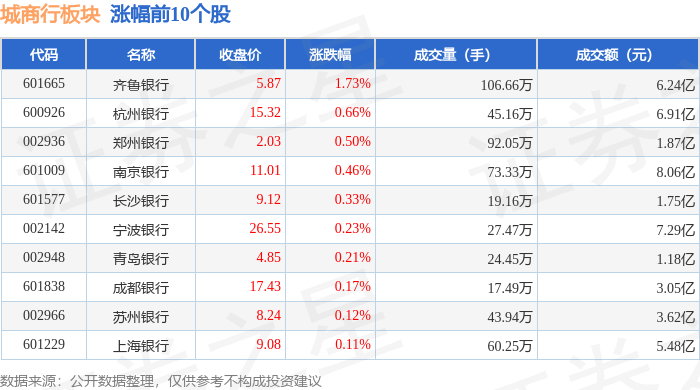
城商行板块9月24日涨1.64%,齐鲁银行领涨,主力资金净流出6917.64万元
Zheng Xing Xing Ye Ri Bao· 2025-09-24 08:46
Market Performance - The city commercial bank sector increased by 1.64% on September 24, with Qilu Bank leading the gains [1] - The Shanghai Composite Index closed at 3853.64, up 0.83%, while the Shenzhen Component Index closed at 13356.14, up 1.8% [1] Individual Stock Performance - Qilu Bank closed at 5.87, with a rise of 1.73% and a trading volume of 1.0666 million shares, amounting to a transaction value of 624 million yuan [1] - Hangzhou Bank closed at 15.32, up 0.66%, with a trading volume of 451,600 shares and a transaction value of 691 million yuan [1] - Zhengzhou Bank closed at 2.03, up 0.50%, with a trading volume of 920,500 shares and a transaction value of 18.7 million yuan [1] - Nanjing Bank closed at 11.01, up 0.46%, with a trading volume of 1.7333 million shares and a transaction value of 806 million yuan [1] - Other banks such as Changsha Bank, Ningbo Bank, and Qingdao Bank also showed slight increases in their stock prices [1] Capital Flow Analysis - The city commercial bank sector experienced a net outflow of 69.1764 million yuan from institutional investors, while retail investors saw a net inflow of 55.8208 million yuan [2] - The overall capital flow indicates a mixed sentiment, with institutional investors withdrawing funds while retail investors continued to invest [2] Detailed Capital Flow for Selected Banks - Ningbo Bank had a net inflow of 74.388 million yuan from institutional investors, but a net outflow of 51.098 million yuan from speculative funds [3] - Shanghai Bank saw a net inflow of 17.1761 million yuan from institutional investors, while retail investors had a net outflow of 30.1701 million yuan [3] - Chengdu Bank experienced a net inflow of 16.3117 million yuan from institutional investors, with a net outflow from retail investors [3]