TOPRAYSOLAR(002218)

Search documents
"太空光伏"概念走热,部分企业触发交易异常,业内: 目前仍处于0到1阶段
Di Yi Cai Jing· 2026-02-02 07:45
Core Viewpoint - The "space photovoltaic" concept has become a major focus in the secondary market, significantly influenced by Tesla CEO Elon Musk's endorsements, with the relevant index rising 19.83% in the past month, outperforming the CSI 300 index's 1.18% increase [1] Group 1: Market Performance - The space photovoltaic concept index has seen a substantial increase, with notable stocks such as JunDa Co., Ltd. rising by 84.62%, Mingyang Smart Energy increasing by 60.22%, and Jiejia Weichuang up by 44.04% over the past 20 days [1] - Several photovoltaic companies have experienced significant stock price surges, triggering trading anomalies, with stocks like Dongfang Risen and Laplace exceeding a cumulative price deviation of 30% over multiple trading days [3] Group 2: Technology and Feasibility - Space photovoltaic energy involves utilizing solar photovoltaic technology in outer space to generate and supply energy, with the potential for direct power transmission to Earth or powering satellites and space stations [3] - The feasibility of space photovoltaic technology is supported by the abundant sunlight in space and the ability to deploy photovoltaic components on satellites, with near-Earth orbit satellites experiencing over 60% sunlight exposure [3] - Despite the market enthusiasm, the industry faces significant uncertainties regarding the maturity and long-term reliability of the technology, as well as the economic viability required for large-scale commercialization [4][5] Group 3: Industry Insights - Industry insiders indicate that the application scenarios for space photovoltaic technology are still in the exploratory phase, with many companies in the secondary market not yet supplying products to commercial space satellite companies [4] - Analysts emphasize that space photovoltaic technology is currently in the early stages, requiring validation of technical routes and economic benefits for large-scale commercial applications [5] - The current cost of space photovoltaic energy is estimated to be around $2-3 per kilowatt-hour, significantly higher than ground photovoltaic costs of $0.03-0.05 per kilowatt-hour, highlighting the economic challenges ahead [6] Group 4: Future Outlook - Companies like Trina Solar and HaiMuxing express optimism about the future of space photovoltaic technology, with ongoing collaborations with leading aerospace institutions to accumulate practical experience [6] - The commercial viability of space photovoltaic technology is projected to gradually materialize over the next 10 to 15 years, driven by decreasing launch costs and breakthroughs in battery technology [7]






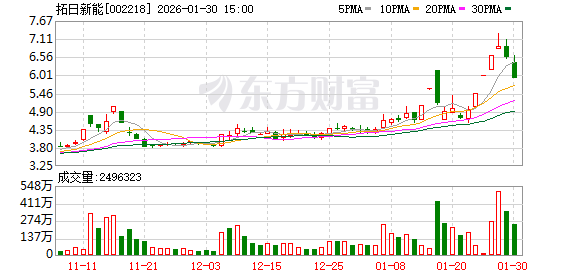
太空光伏板块走强 拓日新能涨幅居前
Xin Lang Zheng Quan· 2026-02-02 05:25
声明:市场有风险,投资需谨慎。本文基于第三方数据库自动发布,不代表新浪财经观点,任何在本文 出现的信息均只作为参考,不构成个人投资建议。如有出入请以实际公告为准。如有疑问,请联系 biz@staff.sina.com.cn。 责任编辑:小浪快报 02月02日消息,截止13:20,太空光伏板块走强,拓日新能等个股涨幅居前。 ...
深圳市拓日新能源科技股份有限公司 2025年度业绩预告
Zheng Quan Ri Bao· 2026-01-30 23:35
登录新浪财经APP 搜索【信披】查看更多考评等级 证券代码:002218 证券简称:拓日新能 公告编号:2026-007 本公司及董事会全体成员保证公告内容的真实、准确和完整,不存在虚假记载、误导性陈述或重大遗 漏。 一、本期业绩预计情况 1.业绩预告期间:2025年1月1日至2025年12月31日 2.业绩预告情况:预计净利润为负值 深圳市拓日新能源科技股份有限公司 董 事 会 深圳市拓日新能源科技股份有限公司(以下简称"公司")已就本次业绩预告与为公司提供审计服务的会 计师事务所进行了初步沟通,公司与会计师事务所在业绩预告相关财务数据方面不存在分歧。本次业绩 预告相关财务数据未经会计师事务所预审计。 三、 业绩变动原因说明 2025年,光伏行业仍面临阶段性供需失衡,产业链各环节主要产品价格仍处在低位徘徊,报告期内,公 司光伏玻璃和组件业务全年盈利能力较上年同期均有所下滑;叠加公司光伏发电业务受市场化交易政策 和限电因素的影响,公司光伏发电业务全年营业收入和毛利率较上年同期也有所下降。同时,基于谨慎 性原则,公司根据相关会计政策规定对相关资产计提减值准备,也对本报告期业绩产生一定影响。 尽管光伏行业面临周期 ...
“太空光伏”概念走热,业内:目前仍处于0到1阶段
Di Yi Cai Jing Zi Xun· 2026-01-30 13:27
Core Insights - The "space photovoltaic" concept has gained significant attention in the secondary market, largely influenced by Tesla CEO Elon Musk's endorsements [2] - The Wind Space Photovoltaic Index has risen by 19.83% over the past month, outperforming the Shanghai and Shenzhen 300 Index, which increased by 1.18% [2] - Several photovoltaic companies have experienced substantial stock price increases, with JunDa Co., Ltd. rising by 84.62% and Mingyang Smart Energy increasing by 60.22% in the last 20 days [2] Market Performance - The stock prices of companies like Dongfang Risen and Laplace have shown abnormal fluctuations, with price deviations exceeding 30% over consecutive trading days [3] - The space photovoltaic sector is characterized by its potential to harness solar energy in outer space, providing power to satellites and space stations [3] Industry Challenges - Despite the market enthusiasm, the commercialization of space photovoltaics faces significant uncertainties related to technology maturity and economic viability [4] - Industry insiders indicate that the application scenarios for space photovoltaics are still in the exploratory phase, with many companies not yet supplying products to commercial satellite firms [4] Technological Considerations - Current leading materials for space photovoltaics include gallium arsenide, which is costly at approximately 1000 RMB per watt, and perovskite, which faces stability issues in extreme space conditions [5] - The cost of electricity generated from space photovoltaics is estimated to be 2-3 USD per kilowatt-hour, significantly higher than the ground-based photovoltaic cost of 0.03-0.05 USD per kilowatt-hour [5] Future Outlook - Several A-share listed companies express optimism about the future of space photovoltaics, with potential market size reaching trillions as technology advances [5] - Companies like Trina Solar and HaiMuxing are actively collaborating with leading aerospace institutions to develop practical applications for space solar energy [5] - The commercialization of space photovoltaics is projected to gradually occur over the next 10 to 15 years as launch costs decrease and battery technologies improve [6]

“太空光伏”概念走热 部分企业触发交易异常 业内:目前仍处于0到1阶段
Di Yi Cai Jing· 2026-01-30 12:05
Core Viewpoint - The "space photovoltaic" concept has become a major focus in the secondary market, significantly influenced by Tesla CEO Elon Musk's endorsements, with the relevant index rising 19.83% in the past month, outperforming the CSI 300 index by 18.65% [1] Market Performance - The space photovoltaic concept index has shown strong performance, with notable stock increases: JunDa Co., Ltd. up 84.62%, Mingyang Smart Energy up 60.22%, Jiejia Weichuang up 44.04%, Dier Laser up 41.54%, and Tuori New Energy up 35.94% over the past 20 days [1] - Several photovoltaic companies have experienced significant stock price surges, triggering trading anomalies, such as Dongfang Risheng and Laplace, both exceeding a cumulative price deviation of 30% within a short period [2] Industry Insights - Space photovoltaic energy refers to utilizing solar photovoltaic technology in outer space to generate and supply energy, with the potential to transmit power wirelessly to Earth or supply satellites and space stations [2] - The rationale for space photovoltaics includes abundant sunlight in space and the feasibility of deploying photovoltaic components on satellites, with near-Earth satellites experiencing over 60% sunlight exposure [2] Challenges in Industrialization - Despite the rising stock prices, the industry faces significant uncertainties regarding the industrialization of space photovoltaics, including technological maturity and economic viability for large-scale commercialization [3] - Current applications of space photovoltaics are still exploratory, with many companies in the secondary market not yet supplying products to commercial space satellite companies [3] - Analysts indicate that space photovoltaics are in the early stages of development, requiring validation of technology and economic benefits for large-scale applications [3] Technological Considerations - Gallium arsenide is the mainstream material for space photovoltaics, but its high cost (approximately 1000 RMB per watt) poses challenges for large-scale deployment [4] - Perovskite technology shows promise but has stability concerns in extreme space conditions, necessitating further validation [4] - Multiple technological routes are being explored, with a focus on solving power and cost issues as critical for the commercialization of space energy solutions [4] Cost Analysis - Current estimates suggest that the cost of electricity from space photovoltaics is around $2-3 per kilowatt-hour, compared to $0.03-0.05 per kilowatt-hour for ground-based photovoltaics, indicating a potential cost disparity of up to 100 times [5] - Companies like Trina Solar and HaiMuxing express optimism about the future of space photovoltaics, citing collaborations with leading aerospace institutions and advancements in reusable rocket technology [5] Commercialization Timeline - Predictions indicate that space photovoltaics may gradually commercialize over the next 10 to 15 years, contingent on decreasing launch costs and breakthroughs in battery technology [6]
“太空光伏”概念走热,部分企业触发交易异常,业内:目前仍处于0到1阶段
Di Yi Cai Jing Zi Xun· 2026-01-30 11:37
Core Viewpoint - The "space photovoltaic" concept has gained significant attention in the secondary market, largely influenced by Tesla CEO Elon Musk's endorsements, with the relevant index rising 19.83% in the past month, outperforming the CSI 300 index by 18.65% [1] Market Performance - The space photovoltaic concept index has seen a notable increase, with specific stocks like JunDa Co., Ltd. rising by 84.62%, Mingyang Smart Energy by 60.22%, and Jiejia Weichuang by 44.04% over the past 20 days [1] - Several photovoltaic companies have experienced stock price surges, triggering trading anomalies, such as Dongfang Risheng and Laplace, which saw price deviations exceeding 30% [3] Technology and Feasibility - Space photovoltaic energy involves utilizing solar photovoltaic technology in outer space to generate and supply energy, with the potential for direct power transmission to Earth [3] - The advantages of space photovoltaic systems include abundant sunlight and reduced atmospheric interference, making them a viable option for satellite power supply [3] Industry Challenges - Despite the market enthusiasm, the space photovoltaic industry faces significant uncertainties regarding technological maturity, long-term reliability, and economic viability for large-scale commercialization [4][5] - Current applications are still in the exploratory phase, with many companies not yet supplying products to commercial space satellite firms [5] Technological Development - Various technological routes are being explored, with gallium arsenide being the mainstream material, but its high cost poses challenges for large-scale deployment [5][6] - The cost of space photovoltaic energy is currently estimated at $2-3 per kilowatt-hour, significantly higher than ground-based photovoltaic costs of $0.03-0.05 per kilowatt-hour, indicating a need for cost reduction and efficiency improvements [6] Future Outlook - Companies like Trina Solar and HaiMuxing express optimism about the future of space photovoltaic technology, citing collaborations with leading aerospace institutions and advancements in reusable rocket technology [6][7] - The commercial viability of space photovoltaic systems is projected to develop over the next 10 to 15 years, contingent on decreasing launch costs and breakthroughs in battery technology [7]
拓日新能:预计2025年净利润亏损2.18亿元至1.38亿元
Jing Ji Guan Cha Wang· 2026-01-30 10:36
经济观察网2026年1月30日,拓日新能(002218)发布2025年度业绩预告,预计2025年净利润亏损2.18 亿元至1.38亿元。扣除非经常性损益后的净利润亏损2.1亿元至1.3亿元。 ...
拓日新能:2025年预亏1.38亿元~2.18亿元
Mei Ri Jing Ji Xin Wen· 2026-01-30 10:25
(文章来源:每日经济新闻) 每经AI快讯,拓日新能(002218)1月30日发布2025年业绩预告,预计2025年归母净利润亏损1.38亿元 ~2.18亿元,上年同期净利润1078.78万元。报告期内,公司光伏玻璃和组件业务全年盈利能力较上年同 期均有所下滑;叠加公司光伏发电业务受市场化交易政策和限电因素的影响,公司光伏发电业务全年营 业收入和毛利率较上年同期也有所下降。 ...
拓日新能(002218) - 2025 Q4 - 年度业绩预告
2026-01-30 10:05
证券代码:002218 证券简称:拓日新能 公告编号:2026-007 深圳市拓日新能源科技股份有限公司 2025 年度业绩预告 深圳市拓日新能源科技股份有限公司(以下简称"公司")已就本次业绩预告与 为公司提供审计服务的会计师事务所进行了初步沟通,公司与会计师事务所在业绩预 告相关财务数据方面不存在分歧。本次业绩预告相关财务数据未经会计师事务所预审 计。 三、业绩变动原因说明 2025 年,光伏行业仍面临阶段性供需失衡,产业链各环节主要产品价格仍处在低 位徘徊,报告期内,公司光伏玻璃和组件业务全年盈利能力较上年同期均有所下滑; 叠加公司光伏发电业务受市场化交易政策和限电因素的影响,公司光伏发电业务全年 营业收入和毛利率较上年同期也有所下降。同时,基于谨慎性原则,公司根据相关会 计政策规定对相关资产计提减值准备,也对本报告期业绩产生一定影响。 尽管光伏行业面临周期性挑战,但是公司财务状况稳健,长期以来资产负债率保 持在行业较低的水平,资金储备充裕,具有良好的抗风险能力;未来公司将继续坚持 技术创新,强化降本增效,做好风险管控,有效应对市场周期性波动。 四、其他相关说明 本公司及董事会全体成员保证公告内容的真实 ...
马斯克的“太空光伏梦”,离不开中国供应链
3 6 Ke· 2026-01-28 11:06
Core Viewpoint - The emergence of "space photovoltaics" is reshaping the value proposition for Chinese solar companies, positioning them as essential players in Elon Musk's space energy vision [1][4]. Group 1: Market Dynamics - The recent surge in the A-share market for solar stocks is driven by Musk's announcement at the Davos Forum about SpaceX and Tesla's plan to establish a solar production base with an annual capacity of 200GW, which is projected to meet nearly a quarter of the U.S. electricity demand [1][3]. - The excitement in the capital market is not merely speculative; it reflects a structural shift in the global energy landscape, with China having a significant role due to its established solar manufacturing capabilities [4][6]. Group 2: Industry Challenges and Opportunities - The solar industry has faced significant challenges over the past two years, including overcapacity and price wars, leading to widespread losses among companies, with projected losses totaling around 400 billion yuan [7]. - Musk's focus on space photovoltaics offers a new growth narrative for the industry, potentially alleviating some of the pressures from the current overcapacity situation [7][8]. Group 3: Technological Advancements - The global space photovoltaic market is expected to reach between $500 billion and $1 trillion by 2030, driven by the removal of traditional constraints faced by ground-based solar [3]. - The technology roadmap for space photovoltaics is anticipated to evolve through three phases, starting with GaAs cells for high-value applications, followed by HJT technology for low Earth orbit satellites, and eventually transitioning to perovskite tandem cells for large-scale deployments [9][10]. Group 4: Chinese Supply Chain Advantage - Chinese companies dominate over 70% of the global solar manufacturing supply chain, making them indispensable for any large-scale space photovoltaic initiatives, regardless of where the production is localized [5][11]. - The integration of space photovoltaics into China's existing energy infrastructure and policy frameworks positions the country favorably for future developments in this sector [5][12]. Group 5: Competitive Landscape - Various companies are exploring different technological pathways in the space photovoltaic sector, with some focusing on efficiency breakthroughs and others leveraging existing aerospace supply chain experience [11][12]. - The competition in space photovoltaics will involve not only technological advancements but also the ability to meet stringent aerospace certification requirements, which can create significant barriers to entry for new players [11][12].