
PRCO(002225)

Search documents
濮耐股份(002225) - 第七届董事会第六次会议决议公告
2025-11-27 12:00
证券代码:002225 证券简称:濮耐股份 公告编号:2025-091 濮阳濮耐高温材料(集团)股份有限公司 第七届董事会第六次会议决议公告 本公司及董事会全体成员保证信息披露内容的真实、准确和完整,没有虚假记载、误导 性陈述或重大遗漏。 一、董事会会议召开情况 濮阳濮耐高温材料(集团)股份有限公司(以下简称"公司")第七届董事 会第六次会议通知于2025年11月21日以电子邮件形式发出,于2025年11月26日下 午在公司四楼会议室召开了现场结合通讯会议。本次会议应参会董事9名,亲自 参会董事9名,其中以通讯方式出席会议的董事有:孔志远先生、刘连兵先生、 曹阳先生、刘诚先生、李永全先生、梁永和先生、王广鹏先生。本次会议由董事 长刘百宽先生主持,部分高级管理人员及监事列席了会议,会议的召开符合《公 司法》、《公司章程》及《董事会议事规则》的有关规定。 二、董事会会议审议情况 本次会议经过认真讨论,采取记名投票方式,审议通过了如下议案: 1、以9票赞成、0票反对、0票弃权审议通过了《关于调整公司治理架构并 修订<公司章程>的议案》 本议案需提交股东会审议。 2、逐项审议通过了《关于修订、废止、制定部分治理制度的 ...

濮耐股份:截至11月20日股东人数46397户
Zheng Quan Ri Bao Wang· 2025-11-26 11:12
Core Points - The company Puyang Nair (002225) reported that as of November 20, 2025, the number of shareholders is 46,397 [1] Summary by Category - **Company Information** - Puyang Nair has a total of 46,397 shareholders as of the specified date [1]
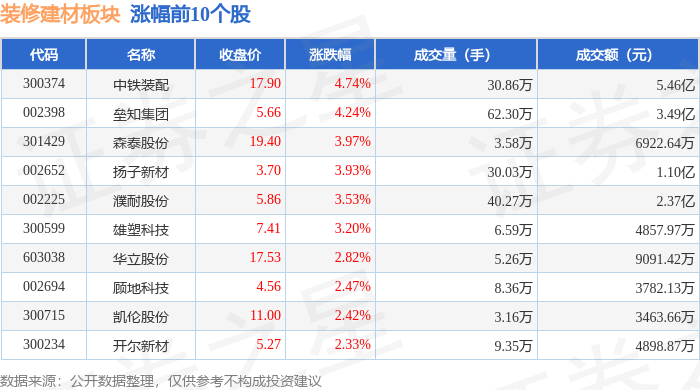
装修建材板块11月24日涨0.64%,中铁装配领涨,主力资金净流出7998.45万元
Zheng Xing Xing Ye Ri Bao· 2025-11-24 09:13
Core Insights - The renovation and building materials sector saw an increase of 0.64% on November 24, with China Railway Construction leading the gains [1] - The Shanghai Composite Index closed at 3836.77, up 0.05%, while the Shenzhen Component Index closed at 12585.08, up 0.37% [1] Sector Performance - China Railway Construction (300374) led the sector with a closing price of 17.90, up 4.74%, and a trading volume of 308,600 shares, amounting to 546 million yuan [1] - Other notable performers included: - Leizhi Group (002398) at 5.66, up 4.24% with a trading volume of 623,000 shares [1] - Sentai Co., Ltd. (301429) at 19.40, up 3.97% with a trading volume of 35,800 shares [1] - Yangzi New Materials (002652) at 3.70, up 3.93% with a trading volume of 300,300 shares [1] Fund Flow Analysis - The renovation and building materials sector experienced a net outflow of 79.98 million yuan from institutional investors, while retail investors saw a net inflow of 32.39 million yuan [2] - Key stocks with significant fund flows included: - Oriental Yuhong (002271) with a net inflow of 56.09 million yuan from institutional investors [3] - Leizhi Group (002398) with a net inflow of 29.50 million yuan from institutional investors [3] - China Railway Construction (300374) with a net inflow of 22.57 million yuan from institutional investors [3]




濮耐股份股价跌5.01%,诺安基金旗下1只基金重仓,持有152.26万股浮亏损失45.68万元
Xin Lang Cai Jing· 2025-11-21 02:55
Core Viewpoint - Puyang Refractories Co., Ltd. experienced a 5.01% decline in stock price, closing at 5.69 CNY per share, with a total market capitalization of 6.596 billion CNY [1] Company Overview - Puyang Refractories Co., Ltd. was established on January 28, 2002, and went public on April 25, 2008. The company is located in Puyang City, Henan Province, and specializes in the research, production, and sales of shaped and unshaped refractory materials, functional refractory materials, and related services [1] - The revenue composition of the company includes: shaped refractory materials (38.37%), functional refractory materials (22.43%), other categories (19.71%), and unshaped refractory materials (19.49%) [1] Fund Holdings - According to data, one fund under Nuoan Fund holds a significant position in Puyang Refractories. The Nuoan Emerging Industries Mixed Fund (008328) held 1.5226 million shares in the third quarter, accounting for 2.73% of the fund's net value, making it the fourth-largest holding [2] - The estimated floating loss for the fund today is approximately 456,800 CNY [2] Fund Manager Information - The fund manager of Nuoan Emerging Industries Mixed Fund (008328) is Yang Kun, who has a cumulative tenure of 11 years and 171 days. The total asset size of the fund is 1.377 billion CNY, with the best fund return during his tenure being 149.33% and the worst being -19.36% [3]
濮耐股份:截至11月10日股东人数为39076户
Zheng Quan Ri Bao Wang· 2025-11-17 11:12
Core Viewpoint - Puyang Nayi Co., Ltd. (002225) reported that as of November 10, the number of shareholders reached 39,076 [1] Company Summary - Puyang Nayi Co., Ltd. has engaged with investors through an interactive platform, providing updates on shareholder numbers [1]
濮耐股份(002225):联合研究|公司点评|濮耐股份(002225.SZ):濮耐股份(002225):期待活性氧化镁有更多订单突破
Changjiang Securities· 2025-11-16 23:30
Investment Rating - The investment rating for the company is "Buy" and is maintained [7]. Core Views - The company reported a revenue of 4.176 billion yuan for the first three quarters of 2025, representing a year-on-year increase of 4.34%. However, the net profit attributable to shareholders was 94.8659 million yuan, a decrease of 22.81% year-on-year. The net profit after deducting non-recurring gains and losses was 73.5099 million yuan, down 4.63% year-on-year. In Q3 2025, the company achieved a quarterly revenue of 1.38 billion yuan, up 5.9% year-on-year, and a net profit of 26 million yuan, a significant increase of 353% year-on-year [2][4]. Summary by Sections Company Overview - The company is a leader in the refractory materials industry in China and is actively expanding overseas, with plans to establish factories in the United States and Serbia. This expansion is expected to enhance growth due to better competitive conditions and profitability in overseas markets compared to domestic ones [5]. Product Development - The company is focusing on the active magnesium oxide product line, leveraging high-quality magnesium ore from Tibet. This product is applicable in nickel and cobalt deposition, which is anticipated to create new growth opportunities. A recent agreement with GEM Co., Ltd. includes a commitment to purchase approximately 500,000 tons of active magnesium oxide from the company between 2025 and 2028 [5][11]. Financial Performance - In Q3 2025, the company reported a gross margin of 18.35%, a slight year-on-year increase, attributed to ongoing product structure optimization. The company also recognized a credit impairment loss of 10.26 million yuan during this quarter [6]. Future Outlook - The company expects significant growth in revenue from active magnesium oxide, with projected earnings of 190 million yuan and 490 million yuan for 2025 and 2026, respectively. The corresponding price-to-earnings ratios are estimated to be 39 and 15 times [11].
建材行业年度策略:关注反内卷、出海、AI电子布机遇
NORTHEAST SECURITIES· 2025-11-13 01:48
Group 1: Cement Industry - The cement production in China for Q1-Q3 2025 decreased by 5% year-on-year, with a narrowing decline, and the annual production is expected to be around 1.73 billion tons, which is a 30% drop from the peak in 2014 [15][32] - The SW cement manufacturing industry revenue for Q1-Q3 2025 was 252.1 billion yuan, a year-on-year decrease of 9%, with a sales net profit margin of 3.3%, an increase of 1.0 percentage points compared to the full year of 2024 [32][33] - The future support for domestic cement prices mainly depends on the optimization process on the supply side, with a focus on completing the target of limiting overproduction by the end of the year [35][45] Group 2: Glass Industry - The flat glass production in China for Q1-Q3 2025 was 730 million weight cases, a year-on-year decrease of 5%, with prices continuing to decline [57] - The SW glass manufacturing industry achieved a total revenue of 34.4 billion yuan in Q1-Q3 2025, a year-on-year decrease of 11%, with a sales net profit margin of 0.6% [74] - The overall profitability of the glass manufacturing industry is under pressure, with major companies like Xinyi Glass and Qibin Group experiencing significant declines in net profit margins [74][78] Group 3: Fiberglass Industry - The fiberglass manufacturing industry saw a significant recovery in profitability in Q1-Q3 2025, with revenue reaching 49.2 billion yuan, a year-on-year increase of 24%, and a sales net profit margin of 10.8%, up 4.3 percentage points from 2024 [83][84] - The demand for high-performance electronic fabrics is expected to continue growing due to advancements in AI and high-frequency communication technologies [84][89] - Companies like Zhongcai Technology and Honghe Technology are recommended for their focus on high-end products and significant growth in revenue and profit margins [89][94] Group 4: Consumer Building Materials - The transaction volume of commercial housing and second-hand housing prices in China continued to decline, but the rate of decline has narrowed [2] - The sales of waterproof materials and coatings have shown significant improvement compared to 2024, with companies like Sankeshu and Hanhai Group recommended for investment [2][4]


濮耐股份(002225) - 关于2024年员工持股计划锁定期届满的提示性公告
2025-11-11 08:15
本次员工持股计划所获标的股票的锁定期为 12 个月,自公司公告最后一笔 标的股票过户至员工持股计划名下之日起计算。上述股票已按照规定予以锁定, 锁定期将于 2025 年 11 月 11 日届满。 证券代码:002225 证券简称:濮耐股份 公告编号:2025-090 濮阳濮耐高温材料(集团)股份有限公司 关于 2024 年员工持股计划锁定期届满的提示性公告 本公司及董事会全体成员保证信息披露内容的真实、准确和完整,没有虚假记载、误 导性陈述或重大遗漏。 濮阳濮耐高温材料(集团)股份有限公司(以下简称"公司")分别于 2024 年 9 月 5 日召开第六届董事会第二十一次会议和第六届监事会第十六次会议, 2024 年 9 月 23 日召开 2024 年第三次临时股东大会,审议通过了《关于公司<2024 年员工持股计划(草案)>及其摘要的议案》、《关于公司<2024 年员工持股计划 管理办法>的议案》等相关议案,同意公司实施 2024 年员工持股计划(以下简称 "本次员工持股计划"),同时股东大会授权董事会办理公司 2024 年员工持股计 划有关事宜。 根据《关于上市公司实施员工持股计划试点的指导意见》、《深圳证 ...
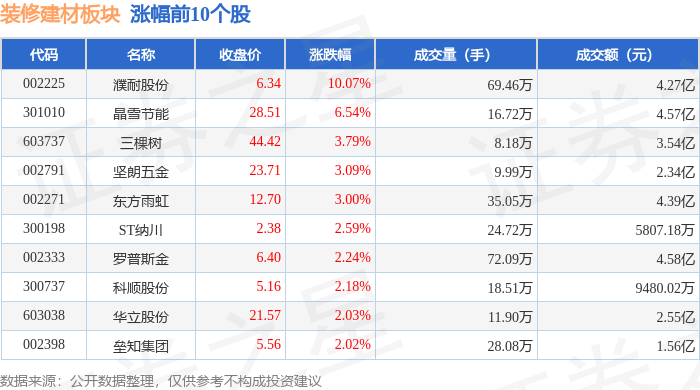
装修建材板块11月10日涨1.53%,濮耐股份领涨,主力资金净流入187.56万元
Zheng Xing Xing Ye Ri Bao· 2025-11-10 08:48
Market Performance - The renovation and building materials sector increased by 1.53% compared to the previous trading day, with Puxin Co., Ltd. leading the gains [1] - The Shanghai Composite Index closed at 4018.6, up 0.53%, while the Shenzhen Component Index closed at 13427.61, up 0.18% [1] Stock Highlights - Puxin Co., Ltd. (002225) closed at 6.34, with a rise of 10.07%, and a trading volume of 694,600 shares, resulting in a transaction value of 427 million yuan [1] - Other notable stocks included Jingxue Energy (301010) with a closing price of 28.51, up 6.54%, and Sankeshu (603737) at 44.42, up 3.79% [1] Capital Flow - The renovation and building materials sector saw a net inflow of 1.8756 million yuan from institutional investors, while retail investors contributed a net inflow of 87.0166 million yuan [2] - However, there was a net outflow of 88.8922 million yuan from speculative funds [2] Individual Stock Capital Flow - Puxin Co., Ltd. had a net inflow of 87.8019 million yuan from institutional investors, while it experienced a net outflow of 58.7137 million yuan from speculative funds [3] - Other companies like Huali Co., Ltd. (603038) and Luopusi Gold (002333) also showed significant net inflows from institutional investors, indicating strong interest in these stocks [3]


今日228只个股突破半年线
Zheng Quan Shi Bao Wang· 2025-11-10 08:22
Market Overview - The Shanghai Composite Index closed at 4018.60 points, above the six-month moving average, with an increase of 0.53% [1] - The total trading volume of A-shares reached 2,194.371 billion yuan [1] Stocks Breaking the Six-Month Moving Average - A total of 228 A-shares have surpassed the six-month moving average today [1] - Notable stocks with significant deviation rates include: - Shengli Precision (002426) with a deviation rate of 7.83% and a daily increase of 10.09% [1] - Puhua Co., Ltd. (002225) with a deviation rate of 7.49% and a daily increase of 10.07% [1] - Zhongyuan He (600645) with a deviation rate of 6.98% and a daily increase of 8.86% [1] Additional Stocks with Smaller Deviation Rates - Stocks that have just crossed the six-month moving average with smaller deviation rates include: - Hengtai Lighting (recently above the six-month line) [1] - Yilida (recently above the six-month line) [1] - Fuanna (recently above the six-month line) [1] Summary of Stocks with Deviation Rates - A detailed ranking of stocks that broke the six-month moving average includes: - Haida Co., Ltd. (300320) with a deviation rate of 6.74% and a daily increase of 8.77% [1] - Shanxi Fenjiu (600809) with a deviation rate of 6.32% and a daily increase of 6.35% [1] - Kuaiyi Elevator (002774) with a deviation rate of 6.12% and a daily increase of 7.53% [1]


