
ZHONGSHENGYAOYE(002317)

Search documents
流感药“新老混战”:2元一粒的奥司他韦仿制药和200元一粒的原研药同场竞技
第一财经· 2025-11-30 12:41
Core Viewpoint - The current flu season in China is marked by a significant increase in drug demand due to a larger infected population, with a competitive landscape emerging as multiple domestic innovative flu drugs are launched, challenging traditional imported and older medications [2][17]. Group 1: Flu Season Trends - The flu season is peaking in northern China while southern regions are still rising, with a national flu positivity rate exceeding 40% [5][6]. - Increased flu cases are particularly noted among children, with hospitals reporting a significant rise in infections [7][5]. - Experts predict that some provinces may reach flu peak by mid-December, with a nationwide decline expected by early January [6]. Group 2: Rise of Domestic Flu Medications - The market for flu medications is becoming increasingly diverse, with various approved treatments available, including neuraminidase inhibitors and RNA polymerase inhibitors [9][8]. - 2025 is referred to as the "Year of Domestic Flu New Drugs," with several innovative flu medications launched this year, intensifying market competition [9][8]. - New drugs like Isodaz (Mashurashave) and Anruwei (Anglave) have been approved, representing significant advancements in flu treatment [10][9]. Group 3: Market Dynamics and Pricing - The price of new RNA polymerase inhibitors is comparable to imported drugs, with significant sales growth observed for both classic and innovative flu medications [12][11]. - Sales data indicates a substantial increase in demand for flu medications, with Oseltamivir sales reaching 5.9 billion yuan in 2024, marking a 237% increase in recent weeks [14][12]. - The competitive landscape is shifting, with traditional flu drugs losing their competitive edge post-collective procurement, emphasizing the need for innovative high-quality drugs [18][17]. Group 4: Investment and Market Outlook - The flu medication market in China is projected to grow at a compound annual growth rate of 20.2%, potentially reaching 26.9 billion yuan by 2028 [18][17]. - Companies are responding to rising stock prices in the flu drug sector, with some developing new generation neuraminidase inhibitors and focusing on innovative drug development [18][17]. - The influx of domestic companies into the flu drug market is driven by the market's high certainty and relatively safe research environment [19][17]. Group 5: Challenges and Recommendations - The influx of similar products raises concerns about market saturation and price wars, prompting calls for diversified and personalized flu vaccine products [20][19]. - There is a notable gap in pediatric flu medications, despite children having a significantly higher infection rate compared to adults [20][19]. - E-commerce platforms are enhancing their flu product offerings, indicating a strong potential for growth in online sales channels for flu medications [20][19].



流感药“新老混战”:2元一粒的奥司他韦仿制药和200元一粒的原研药同场竞技
Di Yi Cai Jing· 2025-11-30 09:44
Core Insights - The flu season is currently peaking, with a significant increase in infection rates leading to a surge in medication demand. Unlike previous years, the market is now seeing a competition between imported drugs and a variety of newly launched domestic innovative flu medications [1][5][12] - The market for flu medications is projected to grow significantly, with an expected compound annual growth rate of 20.2% from 2024 to 2028, potentially reaching a market size of 26.9 billion yuan by 2028 [12] Market Dynamics - The flu medication market is experiencing a "new vs. old" battle, as multiple new domestic drugs enter the market, challenging the dominance of traditional medications like oseltamivir, which has seen its price drop to under 2 yuan per pill due to collective procurement [1][9] - The introduction of new antiviral drugs, such as RNA polymerase inhibitors, is changing the treatment landscape, with some new drugs priced similarly to imported options, thus increasing competition [8][10] Product Launches - Several innovative flu medications have been approved for clinical use in China, including: - Isodaz (Mashurashave tablets) by Qingfeng Pharmaceutical, targeting influenza A and B [7] - Anruwei (Angladi tablets) by Zhongsheng Pharmaceutical, the first global PB2 protein inhibitor for flu treatment [7] - Jikeshou (Maseilashave tablets) by Zhengxiang Pharmaceutical, another RNA polymerase inhibitor [7] - The first year of sales for these new drugs has shown significant growth, with Mabalosave achieving 630 million yuan in sales, marking an 800% increase [10] Consumer Behavior - There is a notable increase in the sales of flu medications, with oseltamivir's sales volume rising by 237% in a week, while new drugs like Mabalosave also saw an increase of 180% [8][10] - Despite the high price of new medications, awareness and adoption among consumers remain low, with less than 5% of those aware of their flu diagnosis opting for the new generation of drugs [10] Competitive Landscape - The influx of domestic pharmaceutical companies into the flu medication market is driven by the high certainty of market demand and relatively safe R&D prospects [13] - However, this has led to concerns about product homogeneity and potential price wars, as many companies pursue similar targets in drug development [13] Future Outlook - The flu medication market is expected to continue evolving, with ongoing innovations and potential price reductions as more products enter the market and negotiations for inclusion in national insurance schemes progress [11][12]
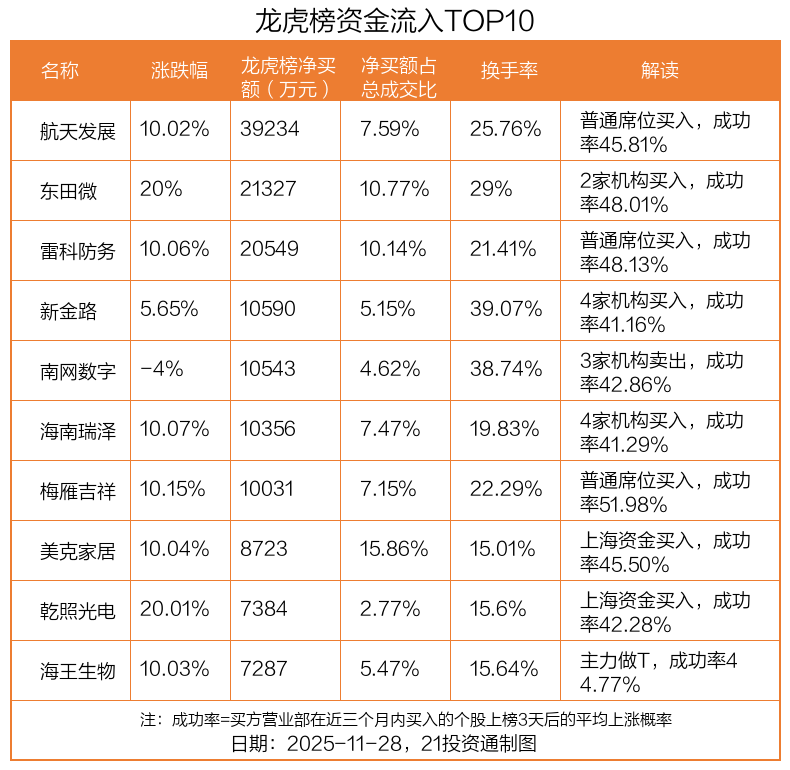
3.92亿资金抢筹航天发展,机构狂买新金路丨龙虎榜
2 1 Shi Ji Jing Ji Bao Dao· 2025-11-28 10:52
Core Viewpoint - On November 28, the Shanghai Composite Index rose by 0.34%, the Shenzhen Component Index increased by 0.85%, and the ChiNext Index went up by 0.7%. The most significant net inflow of funds was into Aerospace Development (000547.SZ), amounting to 392 million yuan, while the largest net outflow was from Zhongsheng Pharmaceutical (002317.SZ), totaling 277 million yuan [1][3]. Group 1: Stock Performance - Aerospace Development saw a closing price increase of 10.02% with a turnover rate of 25.76% and a net buying amount of 392.34 million yuan, accounting for 7.59% of the total trading volume [3][4]. - Zhongsheng Pharmaceutical experienced a closing price drop of 10% with a turnover rate of 18.78% and a net selling amount of 276.59 million yuan, representing 7.84% of the total trading volume [4][10]. Group 2: Institutional Activity - A total of 25 stocks appeared on the trading leaderboard, with institutions participating in 18 stocks, resulting in a net buying amount of 505 million yuan [4][5]. - The stock with the highest institutional net buying was New Jin Road (000510.SZ), which closed up by 5.65% and had a turnover rate of 39.07% [5][6]. Group 3: Northbound Capital - Northbound capital participated in 18 stocks, with a total net outflow of 93.56 million yuan, where the most significant net buying was in Aerospace Development, amounting to 92.68 million yuan [10][13]. - The stock with the highest net selling by northbound capital was Shida Group (600734.SH), with a net outflow of 102 million yuan, closing down by 8.3% [10][14]. Group 4: Divergence in Institutional and Northbound Capital - There was a divergence in the trading of certain stocks, such as Haiwang Biological, where institutions sold 22.34 million yuan while northbound capital bought 442.09 million yuan [13][14]. - In the case of Wanrun New Energy, institutions net bought 32.63 million yuan, while northbound capital net sold 51.75 million yuan [13][14].


主力资金净流入108.40亿元,电子最受青睐
Zheng Quan Shi Bao Wang· 2025-11-28 10:51
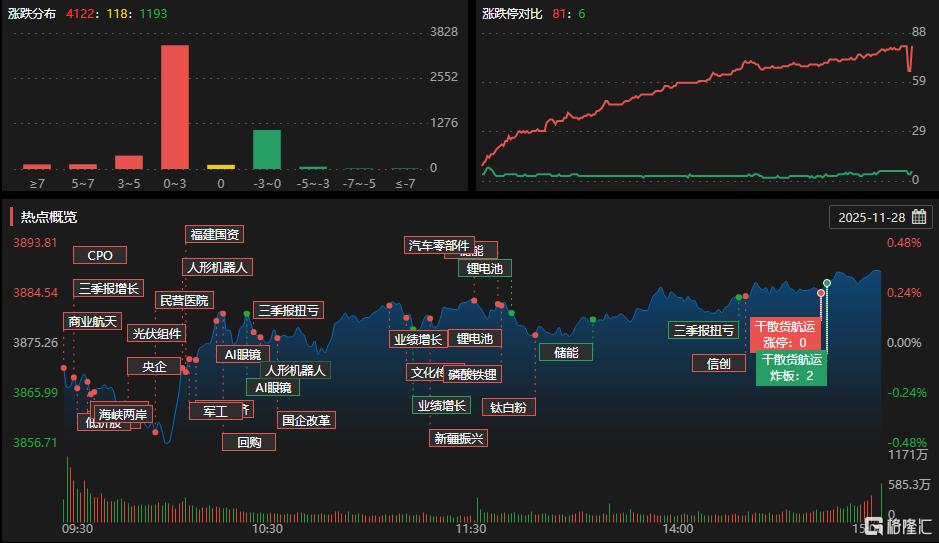
Market Overview - On November 28, the Shanghai Composite Index rose by 0.34%, the Shenzhen Component Index increased by 0.85%, the ChiNext Index went up by 0.70%, and the CSI 300 Index gained 0.25% [1] - Among the tradable A-shares, 4,122 stocks increased, accounting for 75.87%, while 1,193 stocks declined [1] Capital Flow - The main capital saw a net inflow of 10.84 billion yuan throughout the day [1] - The ChiNext had a net inflow of 467 million yuan, and the Sci-Tech Innovation Board saw a net inflow of 320 million yuan, while the CSI 300 component stocks experienced a net outflow of 1.38 billion yuan [1] Industry Performance - Out of the 29 first-level industries classified by Shenwan, the top-performing sectors were Steel and Agriculture, Forestry, Animal Husbandry, and Fishery, both with a rise of 1.59% [1] - The sectors with the largest declines were Banking and Coal, with decreases of 0.83% and 0.14%, respectively [1] Industry Capital Flow - A total of 19 industries experienced net inflows, with the Electronics sector leading at a net inflow of 3.423 billion yuan and a daily increase of 1.30% [1] - The Non-ferrous Metals sector followed with a daily increase of 1.44% and a net inflow of 3.051 billion yuan [1] - Conversely, 12 industries saw net outflows, with the Pharmaceutical and Biological sector leading at a net outflow of 2.334 billion yuan despite a slight increase of 0.14% [1] - The Communication sector had a net outflow of 1.311 billion yuan with a daily increase of 0.12% [1] Individual Stock Performance - A total of 2,360 stocks had net inflows, with 786 stocks seeing inflows exceeding 10 million yuan, and 115 stocks with inflows over 100 million yuan [2] - The stock with the highest net inflow was Aerospace Development, which rose by 10.02% with a net inflow of 1.073 billion yuan [2] - Other notable inflows included Shannon Chip Creation and Duofu Duo, with net inflows of 902 million yuan and 778 million yuan, respectively [2] - Conversely, 67 stocks experienced net outflows exceeding 100 million yuan, with the highest outflows from Zhongji Xuchuang, ZTE Corporation, and Zhongsheng Pharmaceutical, with outflows of 797 million yuan, 695 million yuan, and 684 million yuan, respectively [2]



众生药业(002317) - 2025年11月28日投资者关系活动记录表
2025-11-28 10:34
Group 1: Company Overview and Financial Performance - The company is a high-tech enterprise engaged in drug research, production, and sales, with a focus on continuous shareholder returns through cash dividends totaling over 2 billion CNY since its listing [4]. - The company has a diverse product pipeline covering major disease areas such as cardiovascular, respiratory, ophthalmology, and digestive diseases, ensuring steady growth in performance [4]. - The company has maintained R&D investment exceeding 8% of revenue for several years, with the last three years seeing R&D investment surpassing 10% of revenue [5]. Group 2: R&D and Product Development - The company actively conducts post-marketing evaluations of traditional Chinese medicine (TCM) products, enhancing their clinical application and driving sales growth [5]. - The company is advancing the revival of dormant TCM products, with several products expected to become new performance growth points [7]. - The company is exploring the development of classic TCM formulas and hospital preparations, leveraging national policies encouraging TCM innovation [7]. Group 3: New Drug Approvals and Clinical Trials - The new drug Angladiwe tablets have been approved for market, with a comprehensive marketing strategy focusing on academic ecosystem building and data-driven service upgrades [8][9]. - Angladiwe tablets are the first oral drug targeting the PB2 site of the RNA polymerase for treating influenza, showing strong efficacy and low resistance [10]. - The company is conducting clinical trials for Angladiwe granules aimed at children and adolescents, with promising results indicating effective symptom relief [13][15]. Group 4: Future Directions and Market Expansion - The company is committed to international collaboration for its innovative drugs, aiming to enhance global R&D capabilities and brand influence [20]. - The company is focusing on metabolic diseases and respiratory diseases, with ongoing clinical trials for innovative drugs like RAY1225 and ZSP1601, which show promising efficacy and safety [16][17][18]. - The company is exploring various potential drug development pathways, including GLP-1 receptor agonists and multi-target therapies, to meet unmet clinical needs [19].
维生素概念下跌0.39%,10股主力资金净流出超千万元
Zheng Quan Shi Bao Wang· 2025-11-28 10:11
Group 1 - The vitamin sector experienced a decline of 0.39%, ranking among the top losers in the concept sector, with companies like Zhongsheng Pharmaceutical and Guangji Pharmaceutical hitting the daily limit down [1][2] - Notable gainers in the vitamin sector included Haiwang Biological, *ST Zhongji, and Zhenhua Co., which rose by 10.03%, 5.01%, and 4.99% respectively [1][4] - The vitamin sector saw a net outflow of 706 million yuan from major funds, with 43 stocks experiencing net outflows, and 10 stocks seeing outflows exceeding 10 million yuan [2][3] Group 2 - The top net outflow stock was Zhongsheng Pharmaceutical, with a net outflow of 684 million yuan, followed by Xinhua Pharmaceutical and Guangji Pharmaceutical with net outflows of 58.33 million yuan and 50.49 million yuan respectively [2][3] - Conversely, the stocks with the highest net inflow included Haiwang Biological, Zhenhua Co., and Xinhecheng, with net inflows of 145 million yuan, 67.37 million yuan, and 24.76 million yuan respectively [2][4] - The trading volume for Zhongsheng Pharmaceutical was notably high, with a turnover rate of 18.78% despite a price drop of 10% [3][4]


龙虎榜 | 章盟主狂抛1.58亿,东北猛男亿元接盘!流感概念遭“大逃亡”
Ge Long Hui A P P· 2025-11-28 10:09
Market Overview - On November 28, A-shares saw a collective rise in the three major indices, with the Shanghai Composite Index up 0.34% to 3888 points, the Shenzhen Component Index up 0.85%, and the ChiNext Index up 0.7% [1] - Over 4100 stocks in the market experienced gains, with market hotspots focusing on titanium dioxide, Hainan, satellite internet, and commercial aerospace sectors, while traditional Chinese medicine stocks declined and flu-related stocks corrected [1] Key Stocks - Guosheng Technology (603778) rose by 9.96%, marking its 10th consecutive trading day of gains, driven by solid-state batteries and photovoltaic technology [2] - Dream Home (603216) increased by 10.02%, with its stock price rising due to the termination of acquisition plans and chip concepts [2] - Jinfu Technology (003018) saw a 10.03% rise, planning to acquire Lanyuan Technology [2] - Aerospace Development (002413) surged by 10.06%, benefiting from commercial aerospace and radar technology [2] - The top net buying stocks on the day included Aerospace Development, Dongtian Micro (301183), and LeiKe Defense (002413), with net purchases of 3.92 billion, 2.13 billion, and 2.05 billion respectively [2][4] Sector Performance - The commercial aerospace sector showed strong performance, with Aerospace Development achieving a 10.02% increase and a trading volume of 51.71 billion [4][10] - The military industry sector faced declines, with stocks like Jianglong Shipbuilding dropping over 10% and Aerospace Development hitting the daily limit [10] - The semiconductor and technology sectors also saw significant movements, with stocks like Dongtian Micro and Qian Zhao Optoelectronics experiencing gains of 20% and 20.01% respectively [10][15] Trading Dynamics - The top net selling stocks included Zhongsheng Pharmaceutical, Te Yi Pharmaceutical, and Xinhua Du, with net sales of 2.77 billion, 1.90 billion, and 1.53 billion respectively [5][6] - The trading volume and turnover rates for several stocks were notably high, with some stocks like Dongtian Micro and Qian Zhao Optoelectronics achieving turnover rates of 29.00% and 15.60% respectively [6][15] - The market showed a mix of strong buying interest in certain sectors while facing selling pressure in others, indicating a diverse trading environment [6][10]


医药生物行业11月28日资金流向日报
Zheng Quan Shi Bao Wang· 2025-11-28 10:08
Market Overview - The Shanghai Composite Index rose by 0.34% on November 28, with 29 out of 31 sectors experiencing gains, led by the steel and agriculture sectors, both up by 1.59% [1] - The pharmaceutical and biological industry saw a modest increase of 0.14% [1] - The banking and coal sectors faced declines, down by 0.83% and 0.14% respectively [1] Capital Flow Analysis - The net inflow of capital in the two markets reached 10.84 billion yuan, with 19 sectors experiencing net inflows [1] - The electronics sector led the net inflow with 3.423 billion yuan and a daily increase of 1.30% [1] - The non-ferrous metals sector followed with a net inflow of 3.051 billion yuan and a daily increase of 1.44% [1] - Conversely, 12 sectors experienced net outflows, with the pharmaceutical and biological sector seeing the largest outflow of 2.334 billion yuan [1] Pharmaceutical and Biological Sector Performance - Within the pharmaceutical and biological sector, 477 stocks were tracked, with 260 stocks rising and 201 stocks falling [2] - The top three stocks with the highest net inflow were Haiwang Biological (1.45 billion yuan), Baihua Pharmaceutical (977.51 million yuan), and Tailong Pharmaceutical (801.56 million yuan) [2] - The sector's outflow was dominated by Zhongsheng Pharmaceutical (6.84 billion yuan), WuXi AppTec (1.65 billion yuan), and Te Yi Pharmaceutical (1.12 billion yuan) [2] Top Gainers in Pharmaceutical Sector - Haiwang Biological saw a significant increase of 10.03% with a turnover rate of 15.64% and a net inflow of 145.23 million yuan [4] - Baihua Pharmaceutical increased by 10.01% with a net inflow of 97.75 million yuan [4] - Tailong Pharmaceutical rose by 5.37% with a net inflow of 80.16 million yuan [4] Top Losers in Pharmaceutical Sector - Zhongsheng Pharmaceutical experienced a decline of 10.00% with a net outflow of 683.65 million yuan [4] - WuXi AppTec fell by 1.10% with a net outflow of 164.72 million yuan [4] - Te Yi Pharmaceutical decreased by 6.41% with a net outflow of 112.06 million yuan [4]


禽流感概念下跌0.76%,主力资金净流出18股
Zheng Quan Shi Bao Wang· 2025-11-28 10:06
Core Insights - The avian influenza concept sector experienced a decline of 0.76%, ranking among the top losers in the market, with major stocks like Zhongsheng Pharmaceutical hitting the limit down, while a few stocks like Wens Foodstuff and Weilan Biology saw gains of 1.80% each [1][2] Market Performance - The top-performing concept sectors included Titanium Dioxide with a gain of 4.31%, and Hainan Free Trade Zone with a gain of 3.54%, while the avian influenza sector was among the worst performers [1] - The avian influenza sector saw a net outflow of 784 million yuan, with 18 stocks experiencing net outflows, led by Zhongsheng Pharmaceutical with a net outflow of 684 million yuan [1] Stock Performance - Stocks with significant net outflows included: - Zhongsheng Pharmaceutical: -10.00% with a turnover rate of 18.78% and a net outflow of 683.65 million yuan - Yiling Pharmaceutical: -2.40% with a net outflow of 35.71 million yuan - Lianhuan Pharmaceutical: -1.79% with a net outflow of 25.69 million yuan - Hualan Biological: -6.60% with a net outflow of 18.13 million yuan [1] - Conversely, stocks with net inflows included: - Tiankang Biological: +1.26% with a net inflow of 16.52 million yuan - Shanghai Kaibao: -1.70% with a net inflow of 5.06 million yuan - Jinhai Biological: +0.16% with a net inflow of 3.82 million yuan [2]


流感概念下跌0.49%,5股主力资金净流出超5000万元
Zheng Quan Shi Bao Wang· 2025-11-28 10:03
Group 1 - The flu concept sector declined by 0.49%, ranking among the top declines in concept sectors, with companies like Zhongsheng Pharmaceutical and Guangji Pharmaceutical hitting the limit down [1][2] - Major stocks in the flu concept sector that saw significant declines include Zhongsheng Pharmaceutical (-10.00%), Guangji Pharmaceutical (-9.98%), and Hainan Haiyao (+2.34%) [2][3] - The flu concept sector experienced a net outflow of 1.24 billion yuan, with Zhongsheng Pharmaceutical leading the outflow at 684 million yuan [2][3] Group 2 - The top gainers in the flu concept sector included Haiwang Biological (+10.03%), Baihua Pharmaceutical (+10.01%), and Tailong Pharmaceutical (+5.37%) [1][7] - The overall market saw a mixed performance, with 63 stocks in the flu concept sector rising while others fell significantly [1][2] - The concept sectors with the highest gains included Titanium Dioxide (+4.31%) and Hainan Free Trade Zone (+3.54%), contrasting with the flu concept sector's decline [2]