HIKVISION(002415)

Search documents
花旗:海康威视_加拿大政府对其本地运营的禁令;营收影响可能有限
花旗· 2025-07-02 15:49
Investment Rating - The investment rating for Hangzhou Hikvision Digital Technology is Neutral, with a target price of Rmb30.000, indicating an expected share price return of 8.5% and an expected total return of 11.6% including a dividend yield of 3.1% [2][15]. Core Insights - The Canadian government's ban on Hikvision's operations is expected to have a limited revenue impact, as current revenue exposure from Canada is less than 1%, and developed markets account for approximately 10% of total revenue [1][4]. - The valuation target of Rmb30 is based on a 20.2x NTM PE, reflecting the company's leading position in the surveillance camera market and its growing innovation business, while also considering uncertain growth in the SMBG segment and geopolitical risks [4][1]. Summary by Sections Revenue Impact - The Canadian government's request for Hikvision to cease operations is primarily due to national security concerns, but the overall revenue impact is expected to be limited due to low exposure in Canada and developed markets [1]. Valuation - The target price of Rmb30 is justified by the company's historical average PE ratio and its strong market position, despite potential risks from competition and geopolitical factors [4]. Market Position - Hikvision maintains a leading position in the surveillance camera market, supported by ongoing innovation, which is crucial for sustaining growth amid external challenges [4].

中证物联网主题指数下跌1.66%,前十大权重包含中际旭创等
Jin Rong Jie· 2025-07-02 12:09
Core Viewpoint - The CS Internet of Things Index (CS IoT, 930712) experienced a decline of 1.66%, closing at 2889.9 points, with a trading volume of 43.852 billion yuan, indicating a volatile market environment for IoT-related stocks [1] Group 1: Index Performance - The CS IoT Index has increased by 5.70% over the past month, decreased by 1.97% over the last three months, and has seen a slight increase of 0.23% year-to-date [1] - The index was established on June 29, 2012, with a base point of 1000.0 [1] Group 2: Index Composition - The top ten weighted stocks in the CS IoT Index are: Luxshare Precision (8.64%), Zhongji Xuchuang (6.2%), Huichuan Technology (6.1%), OmniVision Technologies (5.33%), ZTE Corporation (5.18%), Midea Group (4.98%), Haier Smart Home (4.82%), Hikvision (4.78%), iFlytek (4.77%), and Zhaoyi Innovation (4.03%) [1] - The index's holdings are primarily listed on the Shenzhen Stock Exchange (69.63%) and the Shanghai Stock Exchange (30.37%) [1] Group 3: Sector Allocation - The sector allocation of the CS IoT Index includes: Information Technology (63.41%), Communication Services (17.77%), Consumer Discretionary (9.80%), and Industrials (9.02%) [1] Group 4: Index Adjustment and Tracking Funds - The index samples are adjusted biannually, with adjustments occurring on the next trading day after the second Friday of June and December [2] - Public funds tracking the CS IoT Index include: E Fund CS IoT Theme Connection A, E Fund CS IoT Theme Connection C, Huaxia CS IoT Theme Connection A, Huaxia CS IoT Theme Connection C, and several ETFs [2]





被加拿大无理要求关停分公司 海康威视回应:做法罔顾事实
Xi Niu Cai Jing· 2025-07-02 09:25
Core Viewpoint - The Canadian government has ordered Hikvision Canada to cease operations, citing "national security" concerns, which Hikvision strongly opposes, claiming the decision is based on misinterpretations of Chinese laws and lacks evidence [2] Group 1: Company Response - Hikvision asserts that the Canadian government's actions are discriminatory and lack procedural fairness, emphasizing its commitment to ethical business practices and compliance with local laws [2] - The company calls for the Canadian government to respect the rule of law and create a fair, non-discriminatory environment for global enterprises [2] Group 2: Diplomatic Reactions - The Chinese embassy in Canada has expressed strong dissatisfaction with the Canadian government's actions, stating that it undermines the legitimate rights of Chinese companies and disrupts normal economic cooperation between China and Canada [2] - The embassy urges Canada to stop politicizing economic issues and to provide a fair operating environment for Chinese enterprises [2] Group 3: Market Impact - Following the announcement, Hikvision's stock experienced some volatility on June 28, but most investors remain optimistic about the company's long-term prospects, believing in its technological strength and market competitiveness [3]


90天宽限到期,加拿大率先向美低头!将中企驱逐出境,向特朗普表忠心
Sou Hu Cai Jing· 2025-07-02 04:19
Group 1 - Canada has succumbed to U.S. pressure by expelling Chinese company Hikvision, reflecting the challenges smaller nations face in the geopolitical landscape [1][3] - The Canadian government, citing "national security," ordered Hikvision to cease operations within 120 days, a decision influenced by the economic impact of U.S. tariffs [1][3] - The U.S. imposed a 25% tariff on Canadian automobiles, significantly affecting Canada's economy, which relies heavily on exports to the U.S. [1][3] Group 2 - Canada's cancellation of the planned digital services tax against U.S. tech giants demonstrates the economic disparity and pressure from the U.S. [3][5] - The expulsion of Hikvision is seen as a political gesture rather than a legitimate security concern, as no concrete evidence has been provided [5][8] - The move aligns with the U.S. strategy to isolate Chinese technology firms, indicating a broader trend of geopolitical alignment among allies [5][8] Group 3 - China's Ministry of Commerce condemned Canada's actions, asserting that it would take necessary measures to protect the rights of Chinese companies [7][8] - The situation may trigger a ripple effect among other nations, as seen with the EU's willingness to accept U.S. tariffs while seeking exemptions in specific sectors [7][8] - Despite short-term concessions by some countries, the fundamental market dynamics suggest that reliance on Chinese manufacturing will persist [7][8]

不敢对美国动手,加拿大又对中企“下黑手”,中方第一时间亮明态度
Sou Hu Cai Jing· 2025-07-02 03:46
Group 1 - The core issue revolves around Canada's implementation of a "digital services tax" targeting U.S. tech companies, prompting President Trump to halt all trade negotiations with Canada [1][3] - Canadian officials are urging the government to diversify trade relationships to reduce reliance on the U.S., with British Columbia Premier David Eby advocating for building new global partnerships [1][3] - The digital services tax is set to take effect in June, with Canadian Finance Minister Chrystia Freeland asserting that there will be no negotiations to cancel it, signaling a firm stance against U.S. pressure [3][4] Group 2 - The trade conflict is not new, as it stems from a tax law passed by Canada last year, which aims to address the perceived market dominance of U.S. tech firms in Canada and their tax avoidance practices [4] - Canada has also taken actions against Chinese companies, such as Hikvision, citing national security concerns, which has drawn criticism from China for lacking transparency and fairness [4][5] - The economic relationship between Canada and the U.S. is deeply intertwined, with Canada exporting three-quarters of its goods to the U.S., indicating the potential economic ramifications of escalating trade tensions [8]
研判2025!中国智能后视镜行业发展历程、产业链、发展现状、代表品牌及未来前景展望:智能后视镜增长势头强劲,行业规模超600亿元[图]
Chan Ye Xin Xi Wang· 2025-07-02 01:19
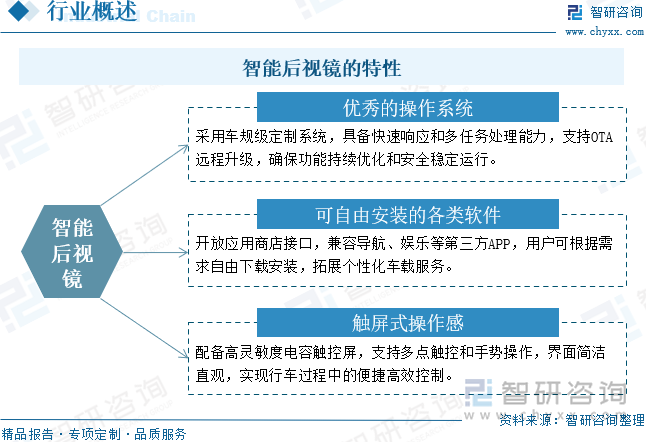
Core Insights - The Chinese automotive market is experiencing rapid growth, leading to a booming automotive parts industry, particularly in smart rearview mirrors, which are becoming essential safety features in vehicles [1][15] - The smart rearview mirror market in China is projected to reach approximately 65.3 billion yuan in 2024, with a year-on-year growth of 22.1% [1][15] - Advancements in technology are expanding the functionalities and applications of smart rearview mirrors, with potential integration with navigation and autonomous driving systems in the future [1][15] Industry Overview - Smart rearview mirrors are defined as mirrors with independent operating systems that allow users to install various applications, providing features such as driving records, GPS positioning, and real-time entertainment [3][5] - The industry has evolved through three phases: initial exploration (2010-2015), functional upgrades (2016-2019), and the current phase of connected intelligence (2020-present) [7][15] Market Dynamics - The demand for smart rearview mirrors is closely linked to the growth in vehicle ownership, which has increased from 172 million vehicles in 2015 to an estimated 353 million by 2024, reflecting a compound annual growth rate of 8.32% [12][15] - The smart rearview mirror industry is characterized by a diverse competitive landscape, with both international giants and local brands competing for market share [17][18] Key Players - Major companies in the smart rearview mirror market include Hikvision, Luochang Technology, and 70mai, among others, with established market positions and a range of product offerings [17][18] - Emerging brands such as Puno, Ruizhun, and others are also gaining traction in the market [17] Industry Trends - The smart rearview mirror industry is witnessing trends towards increased intelligence, with features like blind spot monitoring and voice control becoming more prevalent [23] - There is a clear shift towards high-definition and multifunctional designs, enhancing user experience and safety [24] - The industry is also moving towards lightweight and electric designs to improve fuel efficiency and reduce emissions [25]

拿中企当投名状?被特朗普威胁加关税后,加拿大将枪口指向中国
Sou Hu Cai Jing· 2025-07-01 23:34
Group 1 - Canada quickly retracted its proposal to tax US tech companies after a trade warning from the US, demonstrating its economic dependence on the US market, which accounts for over 70% of its exports [3][6][12] - The proposed 3% digital services tax was seen as a direct challenge to US tech giants like Amazon, Google, and Facebook, prompting a strong reaction from the US government [5][10] - In a sudden shift, Canada announced the cessation of operations for Chinese company Hikvision in Canada, citing national security concerns, which appeared to be a political gesture to appease the US [12][15] Group 2 - The Canadian government's decision to target Hikvision was interpreted as a "sacrificial" move to demonstrate loyalty to the US, despite lacking substantial evidence of security threats posed by the company [15][18] - China's response included strong diplomatic statements against Canada's actions, warning of potential retaliatory measures, which could impact Canadian exports to China [18][20] - The situation reflects a broader trend where smaller nations, like Canada, may find themselves caught in the geopolitical struggles of larger powers, often compromising their own interests [22][24]

海康威视(002415):加拿大业务禁令影响有限,公司全球化进程势头良好
Orient Securities· 2025-07-01 08:58
Investment Rating - The report maintains a "Buy" rating for the company with a target price of 42.09 CNY based on a projected PE ratio of 23 times for 2026 [2][5][11]. Core Views - The Canadian government's ban on Hikvision's operations is expected to have a limited impact, as the Canadian market accounts for less than 0.3% of the company's revenue. The company continues to focus on global operations and aims to provide services to Canadian clients despite the ban [1][10]. - The company reported a 10.1% year-on-year growth in overseas revenue for 2024, reaching 31.895 billion CNY, which constitutes 34.5% of total revenue. This indicates a strong momentum in international markets [10]. - The company is committed to its globalization strategy, implementing localized management across various regions to enhance competitiveness and drive growth [10]. Financial Forecasts - The company is projected to achieve earnings per share (EPS) of 1.57 CNY, 1.83 CNY, and 2.12 CNY for the years 2025 to 2027, respectively [2][11]. - Revenue is expected to grow from 89.341 billion CNY in 2023 to 130.399 billion CNY by 2027, reflecting a compound annual growth rate (CAGR) of approximately 12% [4][14]. - Operating profit is forecasted to increase from 16.040 billion CNY in 2023 to 23.268 billion CNY in 2027, with a notable recovery in profit margins after a dip in 2024 [4][14]. Key Financial Metrics - The company's gross margin is projected to remain stable around 44% from 2025 to 2027, indicating effective cost management [4][14]. - The net profit margin is expected to improve from 12.9% in 2024 to 15.0% in 2027, showcasing enhanced profitability [4][14]. - The return on equity (ROE) is anticipated to rise from 15.3% in 2024 to 18.4% in 2027, reflecting better utilization of equity capital [4][14].
强烈反对!加拿大政府命令海康威视加拿大有限公司停止在加运营
仪器信息网· 2025-07-01 08:21
Core Viewpoint - The Canadian government's decision to order Hikvision Canada Ltd. to cease operations is seen as a significant infringement on the legitimate rights of Chinese enterprises and disrupts normal economic and trade cooperation between China and Canada [1][2][3]. Summary by Sections Canadian Government's Action - The Canadian government has mandated Hikvision Canada to stop its operations under the pretext of "national security," continuing a trend of Western countries targeting Chinese tech firms without providing clear evidence for their claims [2]. Response and Attitude of the Chinese Government - The Chinese Embassy in Canada has expressed strong opposition to Canada's actions, criticizing the broad interpretation of national security and the discriminatory practices against Chinese companies, emphasizing the commitment to protect the legitimate rights of Chinese enterprises [3]. Hikvision's Response - Hikvision has not publicly disclosed specific strategies in response to the situation but may consider legal avenues to protect its rights and assess the impact on its business to formulate future market adjustment plans [4]. International Community's Attention and Impact - The incident has drawn international attention to China-Canada economic relations, with many viewing Canada's actions as detrimental to healthy trade cooperation and potentially negatively affecting other Chinese companies looking to operate in Canada [5]. Future of China-Canada Economic Relations - The event casts a shadow over normal economic cooperation between China and Canada, with China urging Canada to rectify its actions. Continued unreasonable policies from Canada could lead to further tensions in bilateral economic relations [6]. Hikvision's Position and Influence in Overseas Markets - Hikvision is the world's largest supplier of video surveillance equipment, holding approximately 30% of the global market share as of 2023, and has operations in over 150 countries, with overseas revenue accounting for about 30%-40% of total revenue [8]. Extensive Overseas Market Layout - Hikvision has subsidiaries in major regions including Europe, Southeast Asia, and North America, serving a diverse clientele from government agencies to small businesses, and has significant technological capabilities in AI and IoT [9]. Participation in International Standard Setting - Hikvision is a member of several international organizations and has participated in setting international standards for video surveillance and data security, facing market access restrictions in countries like the U.S. and Canada due to the broad application of "national security" concepts [10].

盘前必读丨深交所发布创业板“轻资产、高研发投入”认定标准;纳指、标普再创新高
Di Yi Cai Jing· 2025-06-30 23:42
Group 1 - The US stock market indices collectively rose, with the Dow Jones up 0.63%, Nasdaq up 0.47%, and S&P 500 up 0.52%, both Nasdaq and S&P 500 reaching historical closing highs [3] - In the first half of the year, the Nasdaq increased by 5.48%, the Dow Jones by 3.64%, and the S&P 500 by 5.5% [3] - Technology stocks saw collective gains, with Microsoft, Meta, and Netflix slightly rising and reaching intraday historical highs, while Apple rose by 2% [3] Group 2 - The Shenzhen Stock Exchange issued guidelines to support technology companies with "light assets and high R&D investment" for refinancing, aiming to enhance fundraising efficiency and promote technological innovation [4] - The Ministry of Finance, State Administration of Taxation, and Ministry of Commerce announced a tax credit policy for foreign investors reinvesting distributed profits in China from January 1, 2025, to December 31, 2028 [4] Group 3 - Suzhou Bank announced that Guofazhong Group has become its controlling shareholder, with plans to increase its stake by at least 400 million yuan over the next six months [6] - Changcheng Military Industry reported significant stock price volatility, indicating a "hot market sentiment" and potential irrational speculation, warning of high trading risks [7] Group 4 - Sinopec's chairman Ma Yongsheng resigned due to age reasons, and he will ensure a smooth transition before leaving the company [8] Group 5 - Guotai Junan Securities noted that the Chinese stock market's valuation logic is driven by domestic industrial innovation and a systematic reduction in market discount rates, suggesting that there is still room for short-term growth after the recent index rise [9] - The focus for investment should shift towards structural performance, particularly in new technology trends and new consumption sectors, as well as financial and high-dividend sectors [9]