单边主义和保护主义

Search documents
中国诉美《通胀削减法》世贸争端案,美国败诉又指责裁决错误
Nan Fang Du Shi Bao· 2026-02-05 11:17
Core Viewpoint - The WTO ruling on China's case against the U.S. Inflation Reduction Act indicates that U.S. clean energy subsidies violate WTO rules, and the U.S. is urged to comply with the ruling [1][2] Group 1: WTO Ruling and U.S. Response - The WTO expert panel ruled that the U.S. clean energy subsidy measures are in violation of WTO rules and rejected the U.S. defense of these measures as protecting "public morals" [1] - The U.S. Trade Representative's office acknowledged the loss but criticized the WTO ruling as erroneous, claiming it highlights the inability of current WTO rules to address issues like "overcapacity" [1] Group 2: China's Position and Call for Compliance - China's spokesperson emphasized the objectivity and fairness of the WTO ruling, urging the U.S. to respect the decision and adhere to international treaty obligations [1] - The spokesperson highlighted that the current WTO rules were established through negotiations involving all members, including the U.S., and criticized the U.S. for using the ruling as an excuse for its own protectionist practices [1] - The spokesperson called for the maintenance of a multilateral trade system centered around the WTO, urging the U.S. to correct its violations of WTO rules [2]
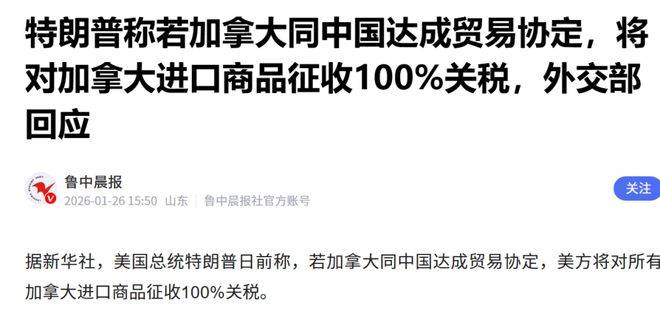
美威胁加拿大征100%关税,中国外交部做出回应
Sou Hu Cai Jing· 2026-01-28 06:42
Core Viewpoint - The recent threat from U.S. President Trump to impose a 100% tariff on all imports from Canada if Canada engages in a trade agreement with China has escalated tensions between the U.S. and Canada, highlighting the U.S.'s use of tariffs as a tool for geopolitical leverage rather than as an economic instrument [1][3][5]. Group 1: U.S.-Canada Relations - Trump's warning places Canada in a precarious position, potentially doubling the prices of Canadian goods in the U.S. market, which could devastate Canadian exporters [1]. - The U.S. has a history of using threats and tariffs to influence the actions of its allies, as seen in previous instances involving Denmark and Iran [5]. - Canadian Prime Minister Carney's response indicates a desire for trade diversification and a move away from reliance on the U.S., as he encourages citizens to buy domestic products and seeks new trade partnerships [7]. Group 2: China-Canada Cooperation - The recent visit of Prime Minister Carney to China resulted in the signing of the "China-Canada Economic and Trade Cooperation Roadmap," which outlines 28 cooperative measures across various sectors, emphasizing mutual benefit [7][9]. - The negotiation dynamics between Canada and China contrast sharply with the U.S. approach, as both parties are willing to make concessions, indicating a cooperative rather than confrontational relationship [9]. - The roadmap supports a multilateral trade system based on rules, opposing unilateral measures, which aligns with the broader global trade discourse [12]. Group 3: Global Trade Implications - The situation reflects a larger question facing the global trade system: whether to maintain a multilateral trade framework or revert to unilateralism and protectionism [11][12]. - The U.S.'s actions have prompted other nations to reconsider their alliances and the implications of following U.S. policies, as many countries seek to assert their economic independence [12]. - The contrasting approaches of the U.S. and China highlight a growing divide in international relations, with many countries favoring cooperation and mutual respect over coercion and dominance [12].

中方在世贸组织呼吁加强贸易措施监督 提升贸易政策透明度
Xin Hua She· 2025-12-02 21:57
Core Viewpoint - The Chinese government emphasizes the need for WTO members to fulfill their trade notification obligations to enhance trade policy transparency and maintain the stability of the multilateral trading system [1][2]. Group 1: Global Trade Environment - The WTO Director-General highlighted that the global trading system is experiencing its most severe turmoil in 80 years, characterized by a significant increase in unilateral tariff measures, geopolitical tensions, and regional conflicts [1]. - Approximately 72% of global trade continues to operate under the Most-Favored-Nation principle, indicating a degree of resilience in the trading system despite the turmoil [1]. Group 2: Trade Measures and Transparency - The latest trade measures monitoring report indicates that member countries have implemented a substantial number of new trade measures, with the trade coverage of import-related measures increasing over fourfold compared to the previous report, reaching $2.64 trillion, which accounts for 11.1% of global imports [2]. - The Chinese government criticized the United States for not timely notifying the WTO of its trade measures, which adversely affects the effective operation of the WTO's supervisory functions [2]. - Other WTO members, including the European Union, support the call for enhanced transparency and the strengthening of trade monitoring functions to help members better address the risks and challenges facing global trade [2].
商务部:全球供应链安全稳定需要世界各国共同维护
Qi Huo Ri Bao Wang· 2025-10-16 17:42
Core Viewpoint - The Chinese government has expressed strong dissatisfaction with the recent unilateral trade measures imposed by the United States, particularly the "301" investigation and related restrictions, which are seen as detrimental to both Chinese industries and global supply chain stability [1][2]. Group 1: Trade Relations and Measures - The Chinese side has actively engaged in discussions with the U.S. regarding the "301" investigation, maintaining a constructive stance and proposing cooperation suggestions, but the U.S. has remained uncooperative [1]. - The U.S. has implemented 20 measures against China in a short span of 20 days, severely harming Chinese interests and disrupting the atmosphere of economic talks [2]. - The U.S. has extended its export control entity list to include thousands of Chinese companies, which has further escalated tensions [2]. Group 2: Impact on Industries - The U.S. claims that China's recent measures will broadly affect multiple industries, including semiconductors, AI, smartphones, and defense [3]. - China's export control measures on rare earths are aimed at preventing illegal use in weapons and maintaining national security, rather than targeting specific countries [4]. Group 3: Response and Future Actions - China emphasizes that its export control measures are lawful and necessary for national security, and it is willing to facilitate compliant trade through optimized licensing processes [4]. - The Chinese government has communicated its policy objectives to various countries to reduce misunderstandings and is open to dialogue to address mutual concerns [2][3].
世贸组织服务贸易理事会召开2025年第三次会议
Shang Wu Bu Wang Zhan· 2025-10-10 04:08
Core Points - The WTO Services Council held its third meeting of 2025 to discuss the outcomes of the 13th Ministerial Conference and the e-commerce work plan [1] - The Chinese representative criticized the US's unilateralism and protectionism regarding "reciprocal tariffs," highlighting the misleading nature of focusing solely on goods trade while ignoring benefits from services trade [1] - China introduced its latest policies and best practices on cross-border data flow and raised concerns about the US and India's misuse of national security measures to restrict Chinese enterprises and products [1]
多国积极呼应中方!
Sou Hu Cai Jing· 2025-10-04 15:41
Core Viewpoint - China criticizes the US's "reciprocal tariff" measures at the WTO, urging all parties to jointly maintain the global service trade order [1][2] Group 1: China's Position - China actively set the agenda at the WTO meeting, highlighting the unilateralism and protectionism of the US's "reciprocal tariff" measures [1] - The Chinese position paper emphasizes that service trade is becoming a crucial engine for global trade growth, providing developing countries with more opportunities to integrate into the global value chain [1] - The US's measures are causing global trade turmoil, with negative impacts spilling over into the service trade sector [1] Group 2: US Trade Practices - China points out that the US has the largest service trade surplus globally and has been misleadingly framing its trade narrative by only discussing losses in goods trade while ignoring gains in service trade [1] - The unilateral measures from the US are undermining global business confidence, disrupting supply chains, and severely harming the legitimate interests of WTO members [1] Group 3: International Response - Other WTO members, including India, Brazil, Egypt, and Pakistan, echoed China's statements, emphasizing the importance of a multilateral trade system for global trade operations [2] - The collective sentiment is that an open, inclusive, stable, and non-discriminatory multilateral trade order is crucial for the sustainable development of all countries [2] - The service sector is recognized as a vital component of global supply chains and the future of global trade, necessitating cooperation to ensure regulatory stability and predictability [2]
中方在世贸组织批评美国“对等关税”措施 呼吁各方共同维护全球服务贸易秩序
Xin Hua She· 2025-10-04 10:43
Core Points - The World Trade Organization (WTO) held its third annual meeting of the Services Trade Council in Geneva, where China criticized the U.S. for its unilateral "reciprocal tariffs" and protectionist measures, highlighting their negative spillover effects on global services trade [1] - China emphasized that services trade is becoming a crucial engine for global trade growth, providing developing countries with more opportunities to integrate into global value chains, while U.S. measures are causing turmoil in global trade [1] - The U.S. is the largest services trade surplus country globally, yet it selectively discusses trade losses in goods while ignoring gains in services, demonstrating a double standard [1] - China called for the U.S. to adhere to WTO rules and engage in dialogue and cooperation to maintain the prosperity and stability of global services trade [1] Responses from Other Members - Countries such as India, Brazil, Egypt, and Pakistan echoed China's statements, emphasizing the importance of a multilateral trade system for global trade operations and the need for an open, inclusive, stable, and non-discriminatory trade order [2] - The services sector is highlighted as a vital component of global supply chains and the future of global trade, with a call for collaborative efforts to ensure regulatory stability and predictability [2]
A股盘前市场要闻速递(2025-09-26)
Jin Shi Shu Ju· 2025-09-26 01:50
Industry News - The China Nonferrous Metals Industry Association opposes "involution" competition in the copper smelting industry, emphasizing that it harms national and industry interests and deviates from high-quality development goals [1] - The Ministry of Commerce of China has added three US companies to the unreliable entity list and three others to the export control list, prohibiting them from engaging in import and export activities related to China [2] - The Ministry of Commerce calls for countries to jointly oppose unilateralism and protectionism, stressing that third-party interests should not be sacrificed due to coercion from others [2] - The total scale of public funds in China has surpassed 36 trillion yuan, marking the fifth historical high this year, with significant growth in stock and mixed funds [3] Company News - The stock of Upwind New Materials will be suspended for verification after rising over 1800% this year, marking its second suspension since a change in control was disclosed [4] - Ganfeng Lithium plans to introduce investors for a capital increase of up to 2.5 billion yuan for its subsidiary, Ganfeng Lithium Battery [4] - Jingfeng Mingyuan has entered mass production of its second-generation DrMos chips, which have been adopted by multiple clients, driving business growth [5] - Pingmei Shenma Group is undergoing a strategic restructuring, which will not significantly impact Pingmei Co.'s operations [5] - Lvtian Machinery clarifies that it has no relationship or business cooperation with Zhuhai Lvtian Machinery Co., Ltd. [6] - Xiamen International Trade holds a 0.67% stake in Mohr Thread through its investment fund [7] - Yuexiu Capital confirms that Mohr Thread is one of its investment projects, with no significant impact on current operating performance [8] - Dazhihui announces a share swap with Xiangcai Co., with a swap price of 9.53 yuan per share for Dazhihui [9] - Putailai has delivered dry and solid-state battery equipment to major domestic and international clients [10] - Hailunzhe's investment in Suzhou Yisheng Robotics is expected to positively impact future performance due to increased demand from Apple [11] - Hanyu Pharmaceutical plans to raise up to 968 million yuan for the development of semaglutide and other projects [12] - Tianen Kang's subsidiary has received approval for clinical trials of a new drug for rosacea, a first in the domestic market [12] - Baili Tianheng's innovative drug has been included in the list of breakthrough therapies by the National Medical Products Administration [13]





中国对墨西哥相关涉华限制措施启动贸易投资壁垒调查
Zhong Guo Xin Wen Wang· 2025-09-25 18:45
Core Viewpoint - The Chinese Ministry of Commerce has initiated a trade and investment barrier investigation against Mexico due to proposed increases in import tariffs on products from non-free trade partners, including China, which could severely harm Chinese enterprises' trade and investment interests [1][2] Group 1: Investigation Announcement - The Ministry of Commerce announced the investigation based on preliminary evidence indicating that Mexico plans to raise import tariffs on products from non-free trade partners as per a proposal published on September 9, 2025 [1] - The proposed tariff increases are seen as a unilateral action that could undermine the interests of related trade partners, including China, and negatively impact the business environment in Mexico [1] Group 2: Response and Principles - The Ministry emphasized the importance of opposing unilateralism and protectionism, especially in the context of the U.S. imposing tariffs, and stated that third-party interests should not be sacrificed due to external pressures [1] - The investigation will adhere to principles of fairness, justice, and transparency, inviting participation from all stakeholders affected by Mexico's measures, including domestic industries and enterprises in China [2]
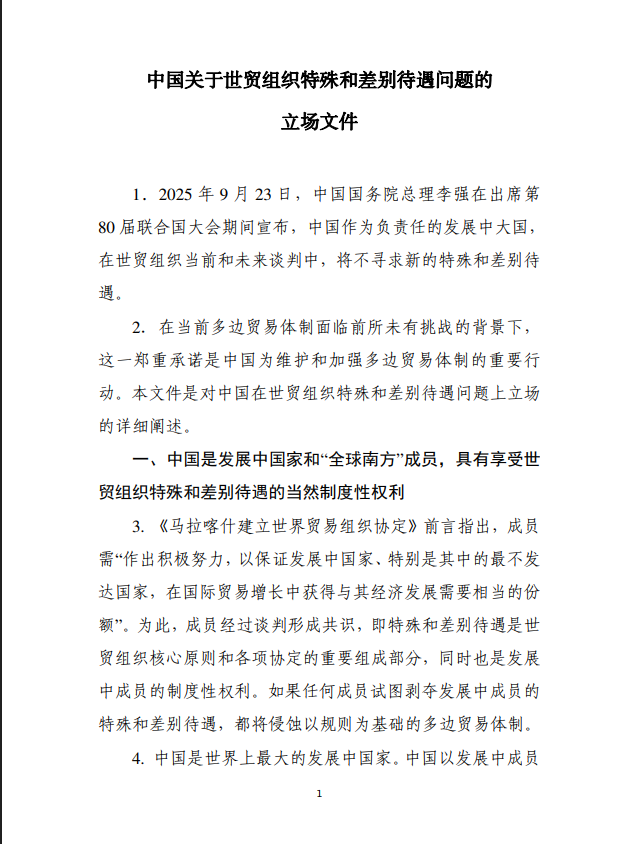
中国关于世贸组织特殊和差别待遇问题的立场文件
Xin Jing Bao· 2025-09-25 13:07
Core Viewpoint - China submitted a position paper on special and differential treatment to the WTO, emphasizing its rights as a developing country and its commitment to multilateral trade systems [1][4]. Group 1: China's Position on Special and Differential Treatment - China's accession to the WTO in 2001 under the Marrakech Agreement granted it less special and differential treatment compared to other developing members [4]. - China has actively contributed to the WTO negotiations and global trade liberalization, aligning its obligations with its development stage and economic level [4]. Group 2: China's Pragmatic Approach in WTO Negotiations - In negotiations, China has adopted a pragmatic approach, not requesting Category C measures in the Trade Facilitation Agreement, with 94% of measures being Category A [5]. - China did not seek special and differential treatment in discussions on service trade regulations and COVID-19 vaccine intellectual property exemptions, contributing significantly to concluding negotiations [5]. - China announced it would not pursue special and differential treatment as proposed by the G90 group and continues to support negotiations based on that proposal [5]. Group 3: Commitment to Multilateral Trade System - China's decision not to seek new special and differential treatment underscores its support for the multilateral trade system amid rising unilateralism and protectionism [6]. - This decision aims to facilitate the 14th WTO Ministerial Conference in March 2026 and contribute to substantial progress in WTO reforms [6]. - The decision does not affect China's status as a developing member in the WTO or its rights under existing agreements [6]. Group 4: China's Role in Global Trade - China remains a part of the "Global South" and will continue to support genuine multilateralism and the rules-based multilateral trade system [7]. - The country is committed to participating in WTO reform processes and protecting the legitimate rights of developing members [7].