
WANDA FILM(002739)

Search documents
8部影片锁定“史上最长春节档” 多家上市公司参与
Shang Hai Zheng Quan Bao· 2026-02-09 18:21
Group 1 - The 2026 Spring Festival film season has 8 films scheduled for release, with pre-sales exceeding 700 million yuan as of February 9 [2][3] - The total box office for this year's Spring Festival is projected to be between 6.5 billion and 8.5 billion yuan, with the performance of leading films significantly impacting the final outcome [2][6] - Major films expected to perform well include "Fast Life 3" and "Boon of the Year," which are anticipated to attract family audiences [2][4] Group 2 - The films cover a diverse range of genres, including drama, comedy, crime, action, martial arts, animation, fantasy, adventure, and documentary [3] - "Fast Life 3," directed by Han Han, is expected to resonate with audiences due to its connection to modern life, potentially making it a leading film in this season [4] - "The Silent Awakening," directed by Zhang Yimou, focuses on contemporary national security themes and is expected to be a supplementary viewing option for audiences [4] Group 3 - The film "Panda Plan: Tribal Adventure" is entering the Spring Festival market for the first time and is characterized by its family-friendly attributes [5] - The "Boon of the Year" series has consistently performed well, with previous installments accumulating over 8.1 billion yuan in total box office revenue [5] - The 2026 Spring Festival is expected to have a longer holiday period of 9 days, providing a more extended window for box office growth [6] Group 4 - The Chinese film market has shown significant growth over the past decade, with box office figures increasing from 1.451 billion yuan in 2014 to 9.514 billion yuan in 2025 [6] - The 2025 Spring Festival set a new record for box office performance, demonstrating the explosive potential of the Chinese film market [6] - Analysts predict that the 2026 Spring Festival may see a return to a "multi-strong competition" format, contrasting with the previous year's "one strong, many strong" dynamic [6] Group 5 - The film industry is currently facing a "film shortage" issue, with fewer new projects being initiated in recent years, indicating a need for improved investment conditions [7] - Several publicly listed companies in the film industry, such as Wanda Film and Huayi Brothers, have reported a turnaround in net profits, indicating a recovery in the sector [8] - The market is increasingly focused on companies involved in the production of films for the Spring Festival, with investors eager to see which companies will achieve both box office success and stock price increases [8]


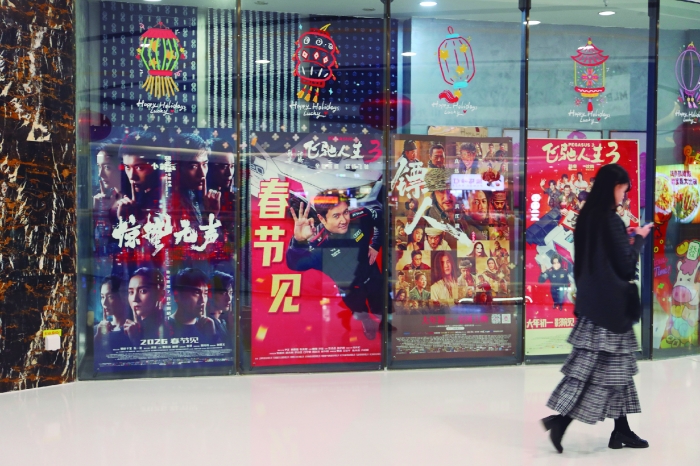
最长春节档蓄势:三四线城市与女性观众捧出票房黑马?
第一财经· 2026-02-09 15:10
Core Viewpoint - The 2026 Spring Festival film market is expected to shift from a "one strong, many strong" pattern in 2025 to a "multi-strong competition" landscape, with a focus on lower-tier markets and female audiences as key competitive factors [4][10]. Film Lineup - Eight films have been scheduled for the 2026 Spring Festival, with total box office revenue (including previews) exceeding 540 million yuan as of February 9 [3][4]. - The films set to release include "Fast Life 3," "Boonie Bears: Year of the Bear," "The Bounty Hunter: Winds Rise in the Desert," "Silent Awakening," "Star River in Dream," and "Panda Plan: Tribal Adventures," with a documentary "Return to the Wolf Pack" re-releasing on the third day of the new year [3]. Market Trends - The Spring Festival box office has seen significant growth, from 1.451 billion yuan in 2014 to 9.514 billion yuan in 2025, reflecting a more than 5.5 times increase [4]. - The 2025 Spring Festival set a new record for box office revenue, driven by "Ne Zha," confirming the explosive potential of the Chinese film market [4]. Audience Insights - Audience preferences for new films vary significantly, with "Silent Awakening" appealing to younger and female viewers, while "The Bounty Hunter: Winds Rise in the Desert" attracts male audiences [4]. - Lower-tier cities have contributed over half of the box office revenue for three consecutive years, with regions like Shanxi, Henan, Shandong, and Hebei being key battlegrounds [10]. Government Initiatives - The Ministry of Commerce launched the "Happy New Year" campaign to stimulate holiday consumption, encouraging local governments to offer viewing discounts during the Spring Festival [5]. Industry Participation - Numerous listed companies, including Maoyan Entertainment, Bona Film Group, China Film, Wanda Film, Hengdian Film, and Light Media, have heavily invested in the Spring Festival films [7][8]. Challenges Ahead - The 2026 Spring Festival may face challenges due to the high box office base set in 2025, with cautious scheduling and marketing strategies from domestic film producers [11][12]. - The overall audience demand is showing a trend towards concentration at the top, with potential for surprise hits in a market with low expectations [11].

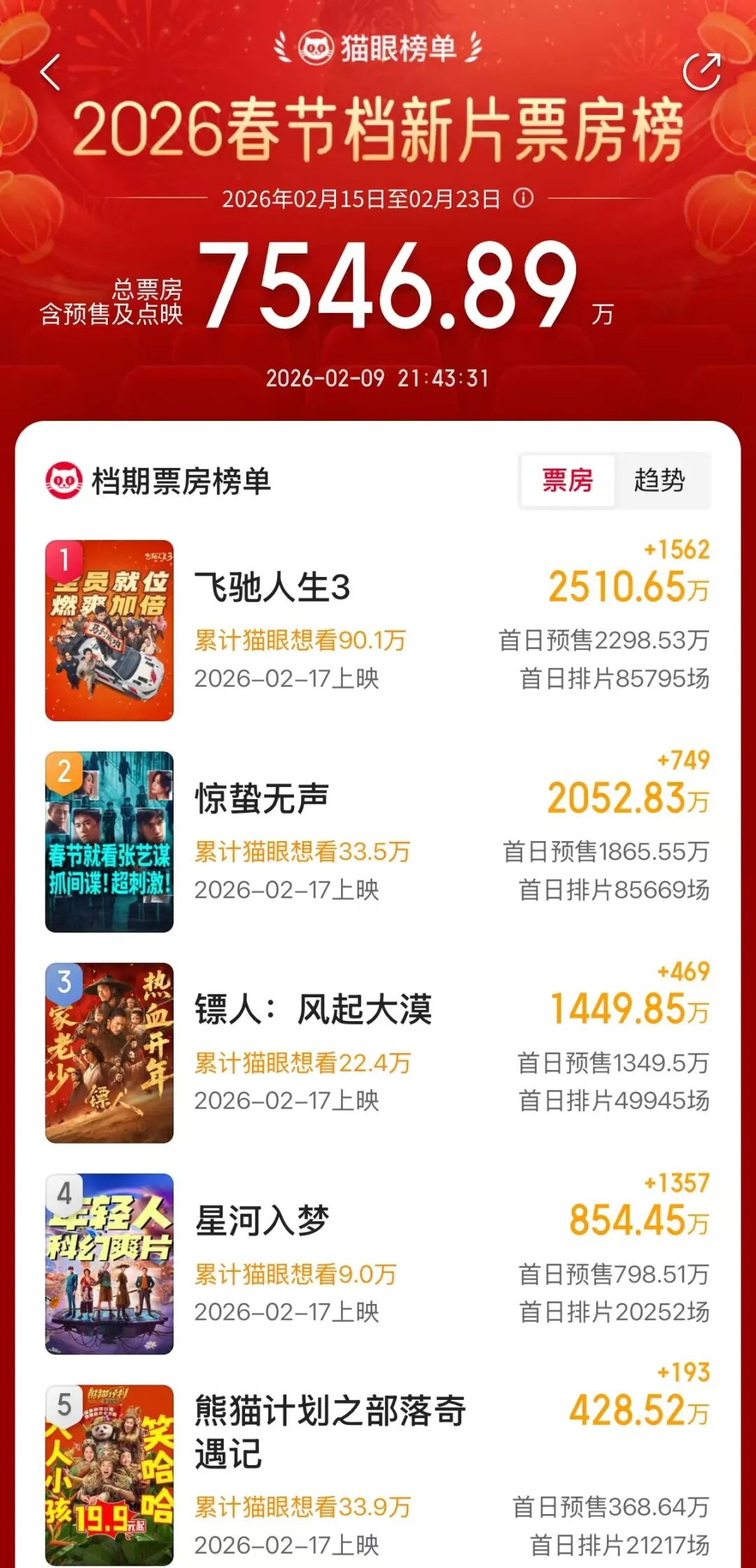
春节档新片预售总票房,突破7500万元!
Zhong Guo Zheng Quan Bao· 2026-02-09 14:57
Group 1 - The 2026 Spring Festival film market is expected to perform well due to a 9-day holiday, which is anticipated to activate movie consumption potential [1] - As of February 9, 2026, the total pre-sale box office for new films in the Spring Festival has exceeded 750 million yuan, with "Flying Life 3" leading at 251.065 million yuan [1] - The film lineup includes six confirmed titles, showcasing a diverse range of genres such as racing, comedy, and martial arts, which is expected to cater to various audience preferences [2][3] Group 2 - "Flying Life 3" is the top contender for the Spring Festival, with over 900,000 people expressing interest on the Maoyan platform, and it has attracted multiple listed companies as co-producers [3][4] - The film "Silent Awakening," directed by Zhang Yimou, is also highly anticipated, with major companies like Maoyan Entertainment and China Film participating in its production [4][5] - The Spring Festival box office has historically exceeded 6 billion yuan since 2021, accounting for over 12% of the annual total box office, with expectations for this year to reach between 7 billion and 8 billion yuan [5][6] Group 3 - Analysts believe that the performance of the Spring Festival will significantly impact the financial results and market valuations of the film industry [6] - Despite the absence of a blockbuster hit, the overall pre-sale performance is stable, with several films showing promising results as the festival approaches [6][7] - The A-share film and cinema sector saw a significant rise on February 9, with multiple companies hitting the daily limit up, indicating positive market sentiment ahead of the Spring Festival [7]

公司互动丨这些公司披露在光伏、商业航天等方面最新情况
Di Yi Cai Jing· 2026-02-09 14:33
Group 1: Robotics - Yingzi Network's revenue from intelligent service robots is relatively small [1] Group 2: Photovoltaics - Nanfang A has the capability to produce 9-11N polycrystalline silicon, primarily for the solar photovoltaic industry [1] - Zhongli Group's photovoltaic business has not yet involved space photovoltaic fields [1] - Sungrow Power has not yet engaged in space photovoltaic products [1] Group 3: Batteries - Shuanghuan Technology's sodium-ion battery cathode material pilot base has recently produced its first batch of products [1] Group 4: Commercial Aerospace - Juguang Technology does not have products applied in the commercial aerospace field [1] - Fengmao Co. has not made substantial progress in business expansion within the commercial aerospace sector [1] Group 5: Other Developments - Xinyi Semiconductor's 1.6T optical module products have achieved mass delivery and are in the process of increasing production capacity [1] - China Merchants Shekou has engaged in duty-free business with positive results, covering duty-free services for high-speed passenger ships on Hong Kong-Macau routes and outbound ports [1] - Wanda Film has invested in and produced the film "Fast and Furious 3," scheduled for release during the Spring Festival [1] - Dalian Electric Porcelain's Jiangxi company has a production plan for 2026 that is nearly full [1] - iFlytek's brain science research is still in the exploratory stage, with the company maintaining attention and appropriate investment [1] - Jingyan Technology's Vietnam operations have commenced and received the first batch of orders [1] - Haiguang Information's business layout has not yet involved TPU chips [1] - Haohua Technology has not yet achieved mass production of trifluoromethanesulfonic lithium [1]





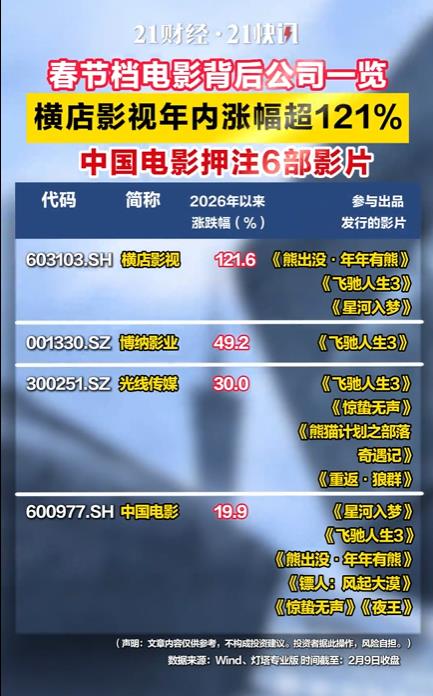
春节档电影背后公司一览,中国电影押注6部影片
2 1 Shi Ji Jing Ji Bao Dao· 2026-02-09 12:56
2026年春节档,多部影片背后有上市影企参与。 (文章来源:21世纪经济报道) 资本市场已提前反应,横店影视年内涨幅达到121.6%。 其中中国电影参与了6部影片的出品或发行引进环节,采取多元化投资策略,分散风险的同时确保收益 覆盖。猫眼娱乐以主投或联合出品身份覆盖多家定档影片,博纳影业、万达电影、横店影视等亦参与其 中。 ...
万达电影(002739.SZ):投资出品影片《飞驰人生3》等已定于春节档上映
Ge Long Hui· 2026-02-09 07:16
格隆汇2月9日丨万达电影(002739.SZ)在投资者互动平台表示,公司投资出品影片《飞驰人生3》《惊蛰 无声》《熊出没·年年有熊》及联合出品影片《镖人》已定于春节档上映。 ...
8部影片定档2026年春节档
第一财经· 2026-02-09 06:26
多家上市公司参与投资了本次的春节档电影,包括猫眼娱乐(01896.HK)、博纳影业(001330.SZ)、 中国电影(600977.SH)、万达电影(002739.SZ)、横店影视(603103.SH)、光线传媒 (300251.SZ)等。 作者 | 第一财经 揭书宜 截至2月9日,已有8部影片定档2026年春节档。截至发稿,2026年春节档新片总票房(含点映及预 售)破2400万元。 在春节(大年初一)当天上映的影片分别是《飞驰人生3》《熊出没·年年有熊》《镖人:风起大 漠》《惊蛰无声》《星河入梦》和《熊猫计划之部落奇遇记》。此外,电影纪录片《重返狼群》将在 大年初三重映,喜剧《夜王》将在大年初四上映。 值得注意的是,IMAX成为近几年春节票房提升的板块,选择高端观影体验已成为市场显著趋势, 2025年,高格式影厅总票房攀至历史高点。2026年春节《飞驰人生3》、《镖人:风起大漠》、 《惊蛰无声》三部电影在春节将登陆IMAX影院。 灯塔专业版前瞻分析认为,2026年春节档电影市场或从2025年春节档的"一超多强"回归"多强争 霸" 的格局。灯塔专业版分析师陈晋分析称,十多年来,春节档票房节节攀升,从2014 ...

万达电影:公司投资出品影片《飞驰人生3》《惊蛰无声》等已定于春节档上映
Mei Ri Jing Ji Xin Wen· 2026-02-09 05:24
万达电影(002739.SZ)2月9日在投资者互动平台表示,公司投资出品影片《飞驰人生3》《惊蛰无声》 《熊出没·年年有熊》及联合出品影片《镖人》已定于春节档上映,欢迎前往万达影城观影。 (文章来源:每日经济新闻) 每经AI快讯,有投资者在投资者互动平台提问:请问公司参与的2026年春节贺岁片有哪些? ...
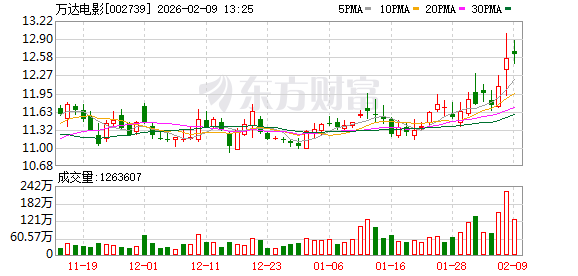
8部影片定档春节档 受益公司有哪些?
2 1 Shi Ji Jing Ji Bao Dao· 2026-02-09 04:46
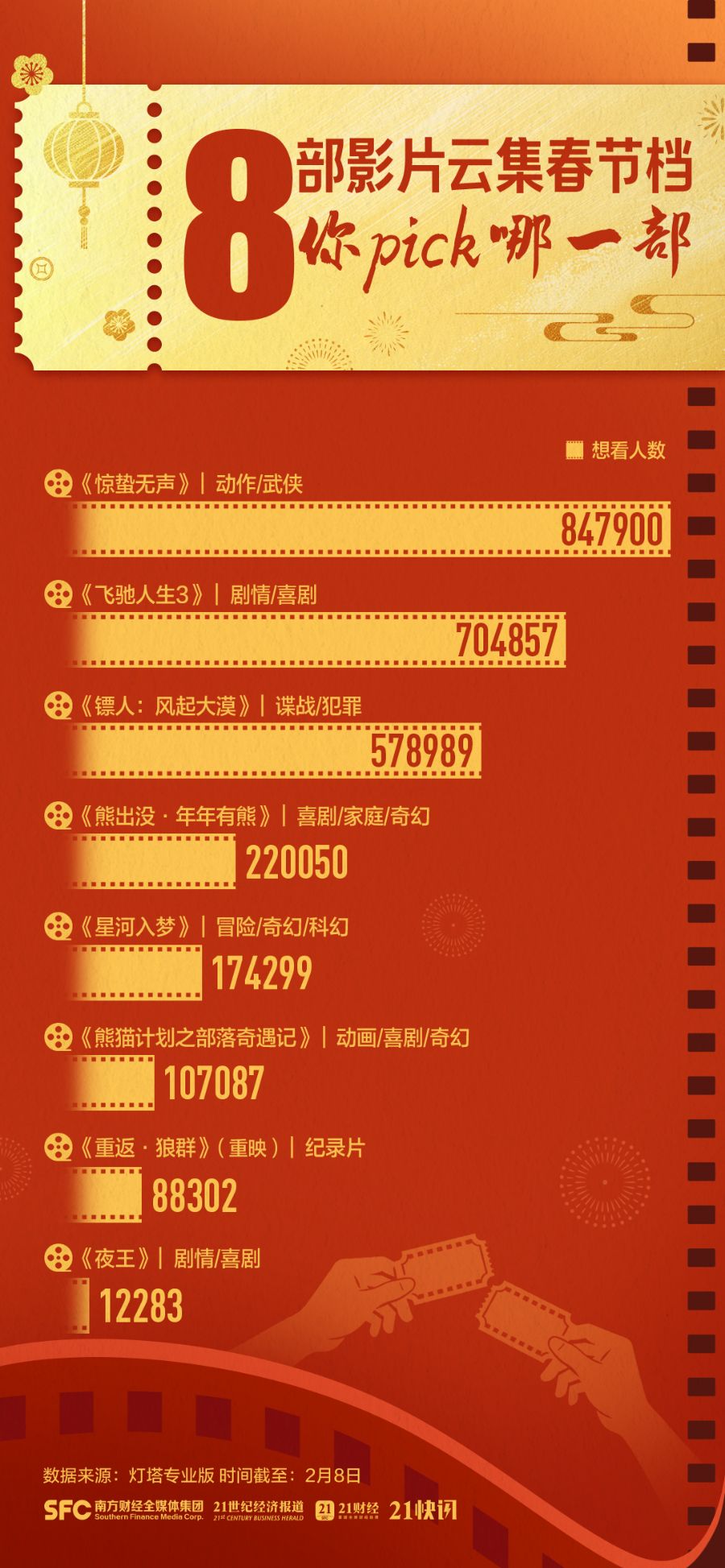
春节将近,春节档作为全年流量最大、竞争最激烈的黄金档期,一直是头部影视公司推出年度重磅影片的必争之地。值得关注 的是,2026年春节档长达9天,创下史上最长春节档纪录。 今年一共有8部电影定档春节档,影片题材丰富,涵盖喜剧、谍战、犯罪、动画、奇幻、家庭、纪录片等类型。还有沈腾、易烊 千玺、王鹤棣等知名演员扎堆加盟。 春节档是一年中最重要的档期之一,灯塔专业版分析称,中国影史单日票房TOP5中,有4次出现在大年初一。业内专家指出, 近年来,春节档的马太效应将愈加明显,头部影片预计将贡献超过70%的票房。 据猫眼专业版上映日历,除了纪录片《重返·狼群》于2月19日重映,黄子华、郑秀文等港星主演的喜剧电影《夜王》于2月20日 在两广(广东、广西)地区限定上映外,其他6部影片均定档大年初一(2月17日)上映。 8部影片云集春节档 《惊蛰无声》想看人数暂列第一 据灯塔专业版数据,目前《惊蛰无声》想看人数暂列第一,与《飞驰人生3》《镖人:风起大漠》构成这个春节档的头部主力阵 营,《熊出没·年年有熊》《星河入梦》及《熊猫计划之部落奇遇记》则各守类型基本盘。 灯塔专业版6日发布的《2026年春节档前瞻》显示,《惊蛰无声》年轻 ...
万达电影:公司投资出品影片《飞驰人生3》《惊蛰无声》等定于春节档上映
Mei Ri Jing Ji Xin Wen· 2026-02-09 03:46
每经AI快讯,2月9日,万达电影(002739)在投资者互动平台表示,公司投资出品影片《飞驰人生3》 《惊蛰无声》《熊出没.年年有熊》及联合出品影片《镖人》已定于春节档上映。 ...