
EASTONE(300310)

Search documents
“追首恶”“打帮凶”并重 司法对并购造假亮剑
Zheng Quan Ri Bao· 2025-11-20 16:05
Core Viewpoint - Yitong Century Technology Co., Ltd. has received a criminal judgment from the Guangzhou Intermediate People's Court regarding a long-standing merger and acquisition financial fraud case, marking a significant step in judicial accountability against financial fraud in China [1][2]. Group 1: Case Background - In 2016, Yitong Century initiated a major asset restructuring, acquiring 100% of Shenzhen Beitai Health Measurement Analysis Technology Co., Ltd. for a total consideration of 1 billion yuan, with a commitment from the sellers to achieve a cumulative net profit of no less than 311 million yuan from 2016 to 2019 [2]. - The fraud involved the fabrication of orders by Beitai Health, leading to financial misstatements in Yitong Century's 2017 annual report, resulting in administrative penalties from the China Securities Regulatory Commission [2]. Group 2: Judicial Outcomes - The court sentenced Xu Mouqun to five years in prison and imposed a fine of 500,000 yuan for his role in the fraud, which included providing funds and assisting in financial deception, causing significant economic losses to Yitong Century [1][3]. - The court also ordered the recovery of 40 million yuan in illegal gains from Xu, with provisions for further compensation if the recovery was insufficient [1]. Group 3: Regulatory Environment - The case reflects a broader trend in China's regulatory environment, emphasizing a dual approach of targeting both the principal offenders and accomplices in financial fraud cases, thereby enhancing market integrity and protecting investors' rights [1][4]. - The China Securities Regulatory Commission has reinforced its stance on punishing accomplices in financial fraud, indicating a shift towards a more comprehensive accountability framework [4][6]. Group 4: Industry Implications - The increasing severity of penalties for financial fraud, including criminal charges against accomplices, aims to deter potential fraudsters and purify the market environment [8][9]. - The establishment of a multi-dimensional accountability system is intended to create clear behavioral boundaries for market participants, thereby safeguarding investors' legitimate rights and interests [8][9].

通信服务板块11月20日涨0.57%,宜通世纪领涨,主力资金净流入5501.34万元
Zheng Xing Xing Ye Ri Bao· 2025-11-20 09:16
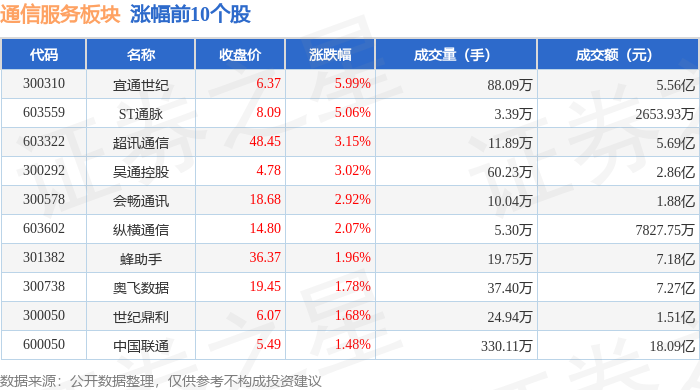
Market Overview - On November 20, the communication services sector rose by 0.57% compared to the previous trading day, with Yitong Century leading the gains [1] - The Shanghai Composite Index closed at 3931.05, down 0.4%, while the Shenzhen Component Index closed at 12980.82, down 0.76% [1] Stock Performance - Yitong Century (300310) closed at 6.37, up 5.99% with a trading volume of 880,900 shares and a transaction value of 556 million [1] - ST Tongmai (603559) closed at 60.8, up 5.06% with a trading volume of 33,900 shares [1] - Chaoxun Communication (603322) closed at 48.45, up 3.15% with a trading volume of 118,900 shares and a transaction value of 569 million [1] - Other notable gainers include Jingtong Holdings (300292) and Huichang Communication (300578), with increases of 3.02% and 2.92% respectively [1] Fund Flow Analysis - The communication services sector saw a net inflow of 55.01 million from institutional investors, while retail investors contributed a net inflow of 157 million [2] - However, speculative funds experienced a net outflow of 212 million [2] Individual Stock Fund Flow - China Unicom (600050) had a net inflow of 217 million from institutional investors, but a net outflow of 107 million from speculative funds [3] - Yitong Century (300310) saw a net inflow of 108 million from institutional investors, with a significant net outflow from retail investors amounting to 97.79 million [3] - Aofei Data (300738) experienced a net inflow of 10.2 million from institutional investors, while retail investors had a net outflow of 65.31 million [3]




许冠群获刑5年但已提起上诉,宜通世纪有望追回4000万元
Mei Ri Jing Ji Xin Wen· 2025-11-19 07:13
Core Viewpoint - The court ruling against Xu Guanqun for contract fraud has significant implications for Yitong Century, which is currently awaiting the outcome of the appeal process [1][2]. Group 1: Legal Proceedings - On November 18, Yitong Century received a criminal judgment from the Guangzhou Intermediate People's Court, sentencing Xu Guanqun to five years in prison and a fine of 500,000 RMB for contract fraud [1]. - The court found that Xu Guanqun's actions during the asset acquisition process led to Yitong Century overpaying for the acquired entity, resulting in substantial economic losses [2]. - Xu Guanqun has appealed the ruling, leaving the final judgment and its execution uncertain [2]. Group 2: Historical Context - The case traces back to a 2016 acquisition where Yitong Century paid 1 billion RMB to acquire 100% of Beitai Health, with a commitment from the sellers for a minimum net profit of 311 million RMB from 2016 to 2019 [4]. - Beitai Health's performance deteriorated over time, revealing hidden debt issues and leading to the investigation of its executives for alleged criminal activities [4][5]. - Yitong Century reported a significant goodwill impairment of over 500 million RMB in its 2018 half-year results due to the underperformance of Beitai Health [5]. Group 3: Financial Implications - The acquisition of Beitai Health resulted in a goodwill of approximately 756 million RMB, which poses a risk of substantial impairment for Yitong Century if further losses are confirmed [4]. - The hidden debt of 70 million RMB associated with Beitai Health was uncovered, leading to legal actions for repayment [6]. - Yitong Century has initiated legal proceedings to rescind the purchase agreement and recover the cash paid for the acquisition [7].
“协助财务造假,让上市公司高价购买被并购标的”!许冠群获刑5年但已提起上诉,公司有望追回4000万元
Mei Ri Jing Ji Xin Wen· 2025-11-19 06:41
Core Viewpoint - The court ruling against Xu Guanqun for contract fraud has significant implications for Yitong Century, which is currently awaiting the outcome of the appeal process [1][2]. Group 1: Legal Proceedings - On November 18, Yitong Century received a criminal judgment from the Guangzhou Intermediate People's Court, sentencing Xu Guanqun to five years in prison and a fine of 500,000 RMB for contract fraud [1]. - The court found that Xu Guanqun's actions during the asset acquisition process led to Yitong Century overpaying for the acquired entity, resulting in substantial economic losses [2]. - Xu Guanqun has appealed the ruling, leaving the final judgment and subsequent execution uncertain [2]. Group 2: Historical Context - The case traces back to September 30, 2016, when Yitong Century acquired 100% of Beitai Health for 1 billion RMB, with an additional 482 million RMB raised for supporting funds [4]. - Beitai Health's performance fell short of expectations, revealing hidden debt issues and leading to legal troubles for its executives [4][5]. - The acquisition resulted in goodwill of approximately 756 million RMB, which poses a risk of significant impairment for Yitong Century if the situation worsens [4]. Group 3: Financial Impact - Following the legal issues, Yitong Century anticipated a goodwill impairment of about 500 million to 550 million RMB, projecting a net loss of 468 million RMB for the first half of 2018 [5][6]. - The hidden debt of 70 million RMB from Beitai Health, which was not disclosed during the acquisition, further complicates the financial outlook for Yitong Century [7]. - Yitong Century has initiated legal action against the shareholders of Beitai Health to recover the cash consideration paid during the acquisition [8].

牵涉10亿并购案!协助财务造假,一审获刑五年
Zhong Guo Zheng Quan Bao· 2025-11-19 04:17
宜通世纪(300310)11月18日晚发布关于收到《刑事判决书》的公告。根据公告,2016年公司收购倍泰 健康相关的合同诈骗案一审宣判,被告人许冠群因在并购过程中协助财务造假、造成公司重大损失,被 广州市中级人民法院以合同诈骗罪判处有期徒刑五年,并处罚金50万元。 一审获刑五年并被追缴4000万元 牵涉并购纠纷案件 据公告,上述案件牵涉的是此前宜通世纪在收购倍泰健康过程中遭遇合同诈骗的案件。 2016年10月,宜通世纪通过发行股份及支付现金的方式购买倍泰健康100%股权,交易对价为10亿元。 在收购完成后,宜通世纪发现,方炎林在并购中存在涉嫌犯罪行为,遂向广州市公安机关报案,公安机 关依法以涉嫌合同诈骗犯罪立案。 为维护公司和全体股东的合法权益,宜通世纪向广州市中院提起诉讼,请求撤销公司在并购倍泰健康时 与交易对方签署的资产购买协议及补充协议,判令各交易对方返还其因该购买协议所获得的财产给公 司,并且赔偿公司因此受到的损失。 2023年7月7日,广州市中院出具《民事判决书》,驳回了宜通世纪的全部诉讼请求以及所有被告的反诉 请求。2024年11月,宜通世纪向广东省高级人民法院提起上诉。 2025年11月3日,宜 ...
宜通世纪:收到《刑事判决书》
Xin Lang Cai Jing· 2025-11-18 08:28
宜通世纪公告,公司于2025年11月18日收到广东省广州市中级人民法院出具的《刑事判决书》。根据判 决书,被告人许冠群犯合同诈骗罪,判处有期徒刑五年,并处罚金人民币五十万元。同时,追缴被告人 许冠群的违法所得人民币4000万元,发还被害单位宜通世纪科技股份有限公司;追缴不足,责令被告人 许冠群退赔。 ...
宜通世纪(300310) - 关于收到《刑事判决书》的公告
2025-11-18 08:14
证券代码:300310 证券简称:宜通世纪 公告编码:2025-047 宜通世纪科技股份有限公司 关于收到《刑事判决书》的公告 本公司及董事会全体成员保证信息披露的内容真实、准确、完整,没有虚假 记载、误导性陈述或者重大遗漏。 宜通世纪科技股份有限公司(以下简称"公司"或"宜通世纪")于 2025 年 11 月 18 日收到广东省广州市中级人民法院出具的《刑事判决书》【(2021)粤 01 刑初 274 号】。现将相关情况公告如下: 一、本次诉讼的基本情况 (一)诉讼当事人 1、公诉机关:广东省广州市人民检察院 2、被告人:许冠群 3、被害人:宜通世纪科技股份有限公司 (二)诉讼基本情况 证券代码:300310 证券简称:宜通世纪 公告编码:2025-047 确实、充分,罪名成立,本院予以支持。在共同犯罪中,被告人许冠群起辅助作 用,是从犯,依法应当减轻处罚。被告人许冠群在本院审理期间脱逃,且归案后 拒不认罪,应酌情予以考虑。根据被告人许冠群在本案中的具体犯罪事实、犯罪 的性质、情节和对于社会的危害程度,依照《中华人民共和国刑法》第二百二十 四条、第二十五条、第二十七条、第五十二条、第五十三条、第六十四条之规 ...
宜通世纪:与特斯拉没有业务合作

Mei Ri Jing Ji Xin Wen· 2025-11-18 03:53
(记者 胡玲) 宜通世纪(300310.SZ)11月18日在投资者互动平台表示,公司与特斯拉没有业务合作。 每经AI快讯,有投资者在投资者互动平台提问:公司和特斯拉有什么关系? ...
11月12日晚间重要公告一览
Xi Niu Cai Jing· 2025-11-12 10:24
Group 1 - Longjian Co., Ltd. won a bid for a highway maintenance project in Heilongjiang with a contract value of 483 million yuan, accounting for 2.64% of the company's expected revenue for 2024 [1] - Transsion Holdings plans to issue H-shares and list on the main board of the Hong Kong Stock Exchange [1] - Good Home's controlling shareholder intends to reduce its stake by up to 2.7%, equivalent to no more than 39.4468 million shares [1][2] Group 2 - Xinhua Insurance reported a cumulative premium income of 181.973 billion yuan from January to October, representing a year-on-year growth of 17% [2][4] - Zhejiang Jiaokao is part of a consortium that plans to bid for a new urbanization project with an estimated total investment of 11.103 billion yuan [4] Group 3 - Changchun High-tech received approval for clinical trials of a vaccine for adolescents and adults [6] - XinNuoWei's application for the listing of Pertuzumab injection has been accepted, targeting HER2-positive breast cancer [8] - Dash Smart won a bid for an intelligent project at the new Huanggang Port inspection building, valued at 55.056 million yuan, which is 1.74% of its expected revenue for 2024 [8] Group 4 - Electronic City is involved in a lawsuit for debt recovery, with the amount in dispute estimated at 777 million yuan [9] - Haibo Technology signed a strategic cooperation agreement with CATL for a cumulative procurement of no less than 200 GWh of electricity from 2026 to 2028 [10] Group 5 - Renfu Pharmaceutical's HW231019 tablets have entered the second phase of clinical trials for postoperative pain relief [11] - Tonghua Dongbao received a drug registration certificate for Aspart Insulin injection from the Dominican Republic [11] Group 6 - Shaanxi Construction reported winning major projects worth a total of 1.016 billion yuan in October [12] - Fuzhou Environmental Protection plans to change its stock name to "Fuzhou Technology" [12] Group 7 - Panlong Pharmaceutical's gel patch for knee osteoarthritis has received approval for clinical trials [15] - Zhongyida's application for a specific stock issuance has been terminated by the Shanghai Stock Exchange [16] Group 8 - Zhizhong Home's controlling shareholder reduced its holdings of convertible bonds by 905,000 units, accounting for 13.51% of the total issued [19] - Haibo Co., Ltd. plans to establish a subsidiary with an investment of 1 billion yuan for high-end component projects [21] Group 9 - Caina Co. plans to use 57 million yuan of idle funds to purchase structured deposits [23] - Zhendong Pharmaceutical's new drug for acute ischemic stroke has entered the IIa phase of clinical trials [25] Group 10 - Weiman Sealing's overseas subsidiary plans to lease a factory in Saudi Arabia for 5 years at a total rent of approximately 54.039 million yuan [26] - Yiling Pharmaceutical's application for Memantine Hydrochloride has been approved for market entry [28] Group 11 - Dongfang Zhizao plans to acquire 70% of Saifu Machinery for 27.4887 million yuan [30] - JianKai Technology's actual controller intends to transfer 3% of the company's shares through inquiry [31] Group 12 - Rejing Bio plans to repurchase shares worth between 100 million and 200 million yuan [32] - Bangji Technology has decided to terminate a major asset restructuring project due to failure to reach an agreement [34] Group 13 - Huadong Pharmaceutical's application for the marketing license of a new drug has been accepted [36] - Zhonggu Logistics' shareholder plans to reduce its stake by up to 3% [38] Group 14 - Bohui Innovation's subsidiary received approval for a clinical trial of a vaccine for invasive infections [40] - Shannon Chip's shareholder pledged 0.27% of the company's shares for financing [42] Group 15 - Shanghai Petrochemical appointed a new general manager [44] - Jiaojian Co. plans to reduce the holdings of some directors and executives by up to 0.35% [46] Group 16 - Weiting Electric plans to raise no more than 300 million yuan through a private placement [47] - Zhongjin Irradiation plans to invest approximately 200 million yuan in an electronic accelerator manufacturing project [49] Group 17 - Tongxing Technology signed a framework agreement to invest 3.2 billion yuan in a sodium battery project [50] - Hongri Da plans to establish a subsidiary focused on semiconductor packaging [51] Group 18 - Shanghai Kaibao's new drug for acute ischemic stroke has received approval for clinical trials [53] - Yitong Century announced a change in its control structure, becoming a company without a controlling shareholder [55]


美方暂停实施出口管制穿透性规则 商务部回应……盘前重要消息有这些
Zheng Quan Shi Bao Wang· 2025-11-12 00:10
Group 1 - The U.S. Department of Commerce announced a one-year suspension of the export control penetration rule, which will prevent sanctions on companies with over 50% ownership by entities on the U.S. export control list during the specified period [1] - The Chinese government expressed willingness to engage in dialogue with the U.S. to manage differences and promote mutual cooperation between enterprises [1] Group 2 - The People's Bank of China emphasized the need for a balanced approach in monetary policy, focusing on both short-term and long-term goals, while enhancing macroeconomic governance effectiveness [2] - The National Development and Reform Commission highlighted the importance of integrating innovation and industry, particularly in the context of the 14th Five-Year Plan [2] Group 3 - The Ministry of Industry and Information Technology announced plans to establish a systematic layout for pilot testing platforms in key industries, including AI, quantum technology, and clean energy [3] - The Ministry of Commerce is set to implement detailed measures to boost consumption and expand trade and investment cooperation [5] Group 4 - The China Association of Automobile Manufacturers reported that from January to October, the production and sales of new energy vehicles (NEVs) saw significant growth, with NEV sales surpassing 50% of total vehicle sales in October [7] - NEV exports reached 2.014 million units from January to October, marking a 90.4% year-on-year increase [7] Group 5 - The China Securities Index Company announced the launch of the China Securities New Exchange Asia Select 100 Index and the Asia Select 100 Dividend Focus Index, aimed at providing investment benchmarks for major Asian markets [8] Group 6 - Investment firms are focusing on the recovery of the domestic market driven by policy support, particularly in the medical equipment sector, which is expected to see a performance turnaround [9] - Companies like Moen Electric and Furi Shares reported no significant changes in their operating environments, while others are planning stock buybacks and fundraising initiatives [10]



