Amazon(AMZN)

Search documents
Is Amazon.com (AMZN) Mason Morfit’s Top Pick?
Yahoo Finance· 2026-02-15 22:47
Core Insights - Amazon.com, Inc. (NASDAQ:AMZN) is a significant holding for billionaire Mason Morfit, representing 12.96% ($768.60 million) of his portfolio [1] - The company plans to launch a content marketplace for publishers to sell content to AI companies, aligning with its AWS products [2] - Following Q4 earnings, Amazon's stock fell 5.5% due to concerns over slowing cloud growth and competition, leading to a downgrade in price target from $300 to $175 [3] Group 1: Company Developments - Amazon is introducing a content marketplace for publishers, which will complement its AWS offerings like Bedrock and Quick Suite [2] - The initiative comes in response to Microsoft's similar announcement and ongoing discussions about usage-based fees for AI training data [2] - Amazon emphasizes its commitment to innovation and maintaining strong partnerships with publishers [2] Group 2: Financial Performance and Market Position - Amazon's stock experienced a 5.5% decline following Q4 earnings, raising investor concerns about its cloud growth and high capital expenditures [3] - Analyst Gil Luria downgraded Amazon's stock from 'Buy' to 'Hold' and reduced the price target significantly, citing slower growth in AWS compared to competitors [3] - The company may need to invest $50 billion to remain competitive in the advanced AI sector, particularly in light of emerging technologies like Gemini and ChatGPT [3] Group 3: Business Overview - Amazon operates in online retail and cloud services, offering a wide range of products and services including consumer goods, advertising, subscriptions, and enterprise computing solutions [4]
Is Wall Street Wrong About Amazon Stock?
Yahoo Finance· 2026-02-15 17:35
Core Viewpoint - Amazon has underperformed compared to stock market indexes in recent years, with a cumulative stock increase of only 22% over the last five years, while the S&P 500 has returned 87% [1] Group 1: Financial Performance - Amazon's fourth-quarter earnings report has led to negative sentiment among investors due to ambitious capital spending plans that may result in negative free cash flow by 2026 [2] - AWS revenue grew 24% year over year to $35.6 billion, with expectations for further acceleration in 2026 [4] - Operating earnings reached a record high of $85 billion over the last 12 months, driven by rising AWS revenue and margin expansion in retail operations [8] Group 2: Capital Expenditures - Amazon plans to spend $200 billion on capital expenditures this year, significantly up from $132 billion last year and $83 billion the year before [4] - This level of spending exceeds Amazon's projected operating cash flow of $140 billion for 2025, raising concerns about future free cash flow [5] Group 3: Long-term Outlook - The heavy upfront investments in data center infrastructure are expected to lead to negative free cash flow in the short term, but this is viewed as a bullish sign for long-term growth and revenue expansion [5][6] - The consolidated operating margin was 11.8% in 2025, with expectations that it could reach 15% or higher over the next decade due to trends in AI infrastructure and high-margin business growth [9]
This Key Metric for Amazon and Alphabet Will Take a Huge Hit in 2026 Thanks to Massive AI Spending. Here's What It Means for Investors.
Yahoo Finance· 2026-02-15 16:52
Core Insights - Amazon and Alphabet announced significant increases in their AI-related capital expenditures for 2026, with Alphabet planning to spend between $175 billion and $185 billion, while Amazon aims for approximately $200 billion [1][2]. Group 1: Investment Plans - Both companies are heavily investing to meet the rising demand for computing power from AI developers, including their own projects [2]. - The substantial capital expenditures will likely lead to a decline in free cash flow for both companies, potentially approaching $0 or becoming negative in 2026 [4]. Group 2: Financial Health - Alphabet may avoid negative free cash flow in 2026, having generated $165 billion in operating cash flow in 2025, with growth expected as its cloud business scales [5]. - Alphabet ended the year with $127 billion in cash equivalents and marketable securities, but plans to raise $32 billion in debt for data center expansion, adding to its existing long-term debt of $36 billion [6]. - Amazon is expected to experience negative free cash flow, with its operating cash flow of $140 billion not growing as rapidly as Alphabet's, making it unlikely to achieve the necessary growth to cover its $200 billion capital expenditures [7].

A stock market doom loop is hitting everything that touches AI
Fortune· 2026-02-15 15:55
The stock market turmoil unleashed by the artificial-intelligence industry reflects two fears that are increasingly at odds. One is that AI is poised to disrupt entire segments of the economy so dramatically that investors are dumping the stocks of any company seen at the slightest risk of being displaced by the technology. The other is a deep skepticism that the hundreds of billions of dollars that tech giants like Amazon.com Inc., Meta Platforms Inc., Microsoft Corp. and Alphabet Inc. are pouring into AI ...



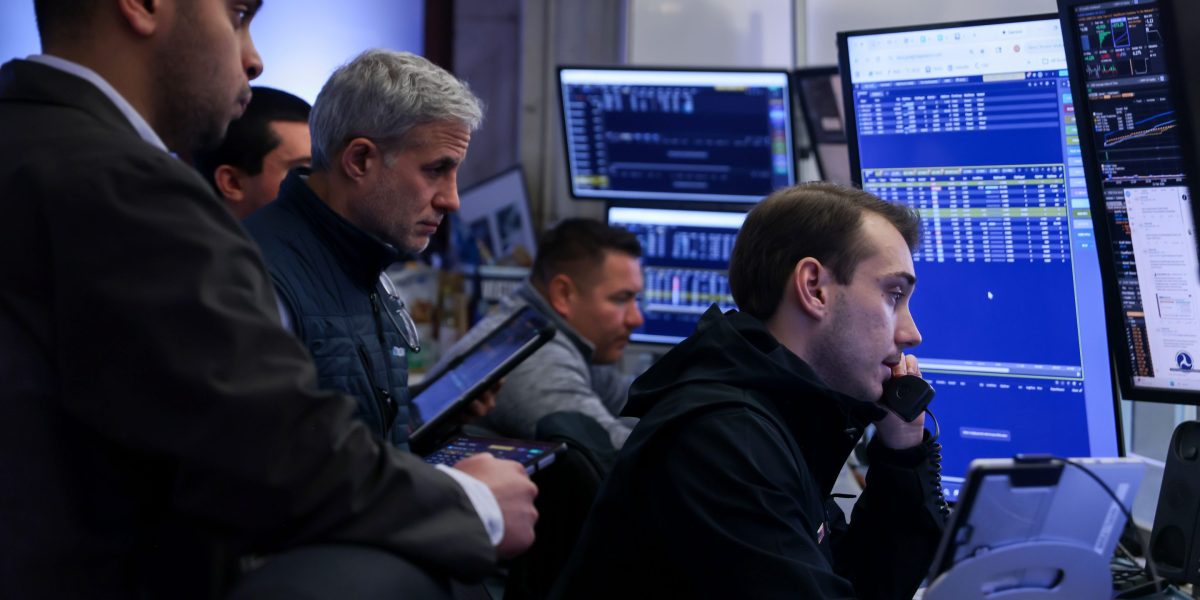
视频丨九连跌创纪录!继微软后,亚马逊成第二家跌入熊市的科技七巨头!

Xin Lang Cai Jing· 2026-02-15 14:03
炒股就看金麒麟分析师研报,权威,专业,及时,全面,助您挖掘潜力主题机会! 责任编辑:尉旖涵 炒股就看金麒麟分析师研报,权威,专业,及时,全面,助您挖掘潜力主题机会! 责任编辑:尉旖涵 ...
ResMed Inc. (RMD) Gains Analyst Confidence as Price Targets Rise on Strong Earnings
Insider Monkey· 2026-02-15 11:53
Core Insights - Generative AI is viewed as a transformative technology by Amazon's CEO Andy Jassy, indicating its potential to significantly enhance customer experiences across the company [1] - Elon Musk predicts that humanoid robots could create a market worth $250 trillion by 2040, representing a major shift in the global economy driven by AI innovation [2] - Major firms like PwC and McKinsey acknowledge the multi-trillion-dollar potential of AI, suggesting a broad consensus on its economic impact [3] Company and Industry Analysis - A breakthrough in AI technology is believed to be redefining work, learning, and creativity, attracting significant interest from hedge funds and top investors [4] - There is speculation about an under-owned company that may play a crucial role in the AI revolution, with its technology posing a threat to competitors [4] - Prominent figures in technology and investment, including Bill Gates and Warren Buffett, recognize AI as a major technological advancement with the potential for substantial social benefits [8] Market Trends - The AI ecosystem is expected to reshape how businesses, governments, and consumers operate globally, indicating a shift in market dynamics [2] - The investment landscape is becoming increasingly competitive, with major tech companies like Tesla, Nvidia, Alphabet, and Microsoft being closely watched, while a smaller company is suggested to hold greater potential [6]




Globus Medical Inc. (GMED) Gains Positive Attention Amid Improving Outlook
Insider Monkey· 2026-02-15 11:53
When Jeff Bezos said that one breakthrough technology would shape Amazon’s destiny, even Wall Street’s biggest analysts were caught off guard. Fast forward a year and Amazon’s new CEO Andy Jassy described generative AI as a “once-in-a-lifetime” technology that is already being used across Amazon to reinvent customer experiences. At the 8th Future Investment Initiative conference, Elon Musk predicted that by 2040 there would be at least 10 billion humanoid robots, with each priced between $20,000 and $25,000 ...

财报后,美国四大云厂市值蒸发1万亿美元,市场甚至寻求对冲“大厂风险”
华尔街见闻· 2026-02-15 10:56
最新一轮财报披露后,美国四大超大规模云厂商合计市值回吐逾1万亿美元 ,投资者对AI基础设施投入失控、现金流承压与债务上行的担忧,正在同时压低股 价并推高信用对冲需求。 微软股价较近期高点下跌 27%,亚马逊下跌 21%,Meta下跌 16%,Alphabet下跌 11% 。市场的核心疑问从"AI值不值"转向"资本开支撑不撑得住",担心投入 过快导致产能过剩和回报周期拉长。 这股情绪也外溢至债市。债务投资者担忧科技巨头为争夺更强AI能力而持续加杠杆, 债券信用利差扩大,同时带动单一公司信用违约互换(CDS)交易升温。 据报道,围绕Meta和Alphabet等发行人的单名CDS在过去一年明显活跃, 目前Alphabet的CDS合约规模约有8.95亿美元,Meta约有6.87亿美元。 在资本开支指引持续抬升的背景下,高盛预计超大规模云厂商 2025年至2027年的资本开支合计接近1.4万亿美元。 摩根士丹利则预计超大规模云厂商今年 借款规模将达到4000亿美元,高于2025年的1650亿美元。 股权端的"万亿美元回撤"与信用端的"对冲热",正在共同重 估"大厂风险"的定价。 投资者加速撤离科技股 四大超大规模云厂商 ...

Is Amazon Stock Going to $260?
The Motley Fool· 2026-02-15 09:35
Core Viewpoint - Amazon's stock has declined over 5% since the beginning of 2026, primarily due to a negative market reaction following its fourth-quarter earnings report, which led to a 10% sell-off and a current price approximately 20% below its all-time high of nearly $260 [1][2]. Financial Performance - Amazon reported Q4 revenue of $213.4 billion, a 14% year-over-year increase, and operating income of $25 billion, exceeding expectations [4]. - Amazon Web Services (AWS) experienced a 24% growth, marking its best growth rate in over three years, significantly driven by in-house designed custom chips that saw triple-digit revenue growth [5]. Market Sentiment - The stock's decline is attributed to skepticism regarding Amazon's capital expenditure guidance, which is projected to reach $200 billion for 2026, a substantial increase from the $132 billion spent in the past year [7]. - The market is currently in a "show-me" mood, indicating that investors are looking for tangible returns on Amazon's significant spending [9]. Future Outlook - If AWS continues to show strong growth and Amazon can deliver better-than-expected quarterly results throughout 2026, there is potential for the stock to recover and surpass its previous all-time high [10]. - Conversely, if AWS revenue growth falters, the stock may face downward pressure [10].

LPL Financial Holdings Inc. (LPLA) Delivers Growth and Analyst Support
Insider Monkey· 2026-02-15 09:09
Core Insights - Generative AI is viewed as a transformative technology by Amazon's CEO Andy Jassy, indicating its potential to reinvent customer experiences across the company [1] - Elon Musk predicts that humanoid robots could create a market worth $250 trillion by 2040, representing a significant shift in the global economy driven by AI innovation [2][3] - Major firms like PwC and McKinsey acknowledge the multi-trillion-dollar potential of AI, suggesting a broad consensus on its economic impact [3] Company and Industry Analysis - A breakthrough in AI technology is redefining work, learning, and creativity, leading to increased interest from hedge funds and top investors [4] - There is speculation about an under-owned company that may play a crucial role in the AI revolution, with its technology posing a threat to competitors [4][6] - Prominent figures in technology and investment, including Bill Gates and Warren Buffett, recognize AI as a significant technological advancement with the potential for substantial social benefits [8] Market Dynamics - The AI ecosystem is expected to reshape how businesses, governments, and consumers operate, indicating a broad and deep impact across various sectors [2] - The investment landscape is becoming increasingly competitive, with major players like Oracle investing heavily in AI technologies [8]