Bank of America(BAC)

Search documents
Stock Index Futures Slip With Focus on U.S. Retail Sales and PPI Data, More Big Bank Earnings on Tap
Yahoo Finance· 2026-01-14 11:14
Economic Data - The U.S. consumer prices rose +0.3% month-over-month in December, with annual inflation at +2.7%, consistent with expectations [1] - Core CPI, excluding food and fuel, increased by +0.2% month-over-month and +2.6% year-over-year, which was below expectations of +0.3% and +2.7% respectively [1] - U.S. new home sales fell -0.1% month-over-month to 737K in October, surpassing expectations of 716K [1] Market Performance - Wall Street's major indexes closed lower, with software stocks declining after Anthropic's new tool announcement, leading to Salesforce dropping over -7% and Adobe falling more than -5% [2] - Credit card companies also saw declines, with Visa down over -4% and Mastercard dropping more than -3% following President Trump's proposal for a cap on credit card interest rates [2] - Moderna's shares surged over +17% after the CEO announced plans for a combined flu and COVID-19 vaccine launch within two years [2] Corporate Earnings - The fourth-quarter corporate earnings season is underway, with major U.S. banks like Bank of America, Wells Fargo, and Citigroup set to report [7] - S&P 500 companies are expected to see an average quarterly earnings increase of +8.4% for Q4 compared to the previous year [7] Federal Reserve Insights - The Federal Reserve is expected to maintain current interest rates, with a 97.2% probability of no change and a 2.8% chance of a 25 basis point cut at the January meeting [6] - Fed officials expressed that inflation risks are easing, with expectations for prices to align with the central bank's target later this year [5] International Market Developments - The Euro Stoxx 50 Index decreased by -0.10% amid cautious sentiment ahead of U.S. economic data and bank earnings [13] - Japan's Nikkei 225 Index reached a new record high, driven by potential political changes and strong performances in healthcare, energy, and banking sectors [17][18] - China's trade surplus hit a record $1.19 trillion in 2025, with exports rising +5.5% year-over-year, indicating robust manufacturing strength [15]


特朗普施压反成降息阻力?美银警告:调查鲍威尔或引发鹰派逆反!
Jin Shi Shu Ju· 2026-01-14 10:29
Core Viewpoint - The U.S. Department of Justice has initiated a criminal investigation into Federal Reserve Chairman Jerome Powell's testimony regarding office renovations, adding uncertainty to monetary policy outlook, although market reactions have been relatively calm [2]. Group 1: Market Reactions - Market response to the investigation has been muted, with the 30-year U.S. Treasury yield rising only about 2 basis points [2]. - This contrasts sharply with last summer's market volatility when President Trump suggested he might dismiss Powell, leading to a significant yield increase of 8 basis points on July 11 and 11 basis points on July 16 [2]. - The probability of Powell leaving the Federal Reserve Board by the end of the year has decreased from 83% to 57% according to Polymarket data [2]. Group 2: Implications for Monetary Policy - The investigation may embolden hawkish members of the Federal Open Market Committee (FOMC), complicating the prospects for a more dovish stance from the next Federal Reserve Chair [3]. - The U.S. Supreme Court is set to hold a hearing on January 21 regarding a case involving Fed Governor Lisa Cook, which may have significant implications for future policy direction [3]. - A negative ruling against Cook could increase the risk of Powell facing removal [3]. Group 3: Economic Indicators and Predictions - Recent lower-than-expected inflation data has raised market expectations for a rate cut by the Federal Reserve, with traders anticipating a cut at the June policy meeting, though the likelihood of a cut in January remains low [3]. - The health of the job market will be crucial in determining whether further rate cuts are necessary, as evidenced by the unexpected drop in the U.S. unemployment rate in December [4]. - Major Wall Street banks, including Morgan Stanley, Barclays, and Citigroup, have pushed back their rate cut predictions to late 2026, while JPMorgan no longer expects a cut in 2026 and anticipates a rate hike in 2027 [4].


Dow Falls Around 400 Points Following Inflation Data: Investor Sentiment Declines, Fear & Greed Index Remains In 'Greed' Zone - Bank of America (NYSE:BAC), Citigroup (NYSE:C)
Benzinga· 2026-01-14 09:08
Market Sentiment - The CNN Money Fear and Greed index showed a decline in overall market sentiment, remaining in the "Greed" zone with a current reading of 56.3, down from 58.6 [1][4] - U.S. stocks settled lower, with the Dow Jones index falling almost 400 points during the session, closing at 49,191.99 [1][3] Economic Indicators - The Consumer Price Index (CPI) rose 2.7% year over year in December, matching prior readings and economist estimates, while core CPI came in at 2.6% year over year, slightly below expectations [1] Company Earnings - JPMorgan Chase & Co. shares fell more than 4% despite beating earnings estimates, as investors were concerned about weaker investment-banking fees and cautious commentary on loan growth [2] - Delta Air Lines Inc. shares slid over 2% after issuing soft forward guidance, citing cost pressures and normalization in post-pandemic travel demand [2] Sector Performance - Most sectors on the S&P 500 closed positively, with energy, consumer staples, and real estate stocks recording the biggest gains, while consumer discretionary and financial stocks closed lower [3]



Bank of America, Citigroup And 3 Stocks To Watch Heading Into Wednesday - Bank of America (NYSE:BAC), Citigroup (NYSE:C)
Benzinga· 2026-01-14 08:57
Core Viewpoint - U.S. stock futures are trading lower, with several companies expected to report quarterly earnings, drawing investor attention [1] Company Earnings Expectations - Bank of America Corp (NYSE:BAC) is anticipated to report quarterly earnings of 96 cents per share on revenue of $27.87 billion, with shares slipping 0.1% to $54.51 in after-hours trading [1] - Citigroup Inc (NYSE:C) is expected to post quarterly earnings of $1.68 per share on revenue of $20.53 billion, with shares falling 0.1% to $116.15 in after-hours trading [1] - Wells Fargo & Co (NYSE:WFC) is projected to report quarterly earnings of $1.67 per share on revenue of $21.65 billion, with shares decreasing 0.2% to $93.38 in after-hours trading [1] Company Updates - TG Therapeutics, Inc. (NASDAQ:TGTX) provided preliminary fourth quarter revenue estimates, expecting U.S. net product revenue of approximately $182 million for Q4 and $594 million for the full year of 2025, with total global revenue for 2025 expected to be around $616 million [1] - Gelteq Ltd. (NASDAQ:GELS) reported positive preclinical results for its cannabinoid oral gel delivery platform, leading to a significant share price increase of 69.3% to $1.41 in after-hours trading [1]

Bank of America (NYSE:BAC) Receives Bullish Outlook from CICC
Financial Modeling Prep· 2026-01-14 08:00
CICC initiated coverage on Bank of America (NYSE:BAC) with an "Outperform" grade and a stock price of $54.54.Bank of America has consistently beaten earnings estimates, with a recent earnings surprise of 12.77%.The bank's stock has shown volatility with a yearly high of $57.55 and a low of $33.07, and it remains a significant player in the financial sector with a market capitalization of approximately $398.3 billion.On January 13, 2026, CICC initiated coverage on Bank of America (NYSE:BAC) with a bullish ou ...
Why Did XCF Global (SAFX) Jump Nearly 51% In After-Hours Trading? - Bank of America (NYSE:BAC), XCF Global (NASDAQ:SAFX)
Benzinga· 2026-01-14 05:13
Core Viewpoint - XCF Global Inc. (NASDAQ:SAFX) experienced a significant share price increase of 50.93% in after-hours trading, reaching $0.25, following a SEC filing and the announcement of expansion financing plans [1] Group 1: Financing and Shareholder Changes - Randy Soule and Encore DEC LLC converted $28 million in invoices into XCF common stock, resulting in Encore acquiring 36,779,193 shares (17.6% ownership) and Soule acquiring 78,901,648 shares (49.6% ownership) [2] - The shares acquired are subject to a six-month trading restriction [2] - XCF has engaged Bank of America to structure potential debt financing for its New Rise Reno 2 facility, aimed at expanding its Sustainable Aviation Fuel (SAF) and renewable fuel platform [3] Group 2: Strategic Partnerships and Market Outlook - The company signed a non-binding Memorandum of Understanding with BGN INT US LLC to establish global distribution and marketing frameworks across Europe, the Middle East, and other markets [4] - CEO Chris Cooper emphasized the importance of expanding SAF production in light of increasing sustainability commitments from governments and airlines worldwide [5] - The global SAF market is projected to exceed $25 billion by 2030, with demand expected to surpass 5.5 billion gallons, potentially reaching $250 billion by 2050 if decarbonization targets are met [6] Group 3: Trading Metrics and Technical Analysis - XCF Global has a Relative Strength Index (RSI) of 23.37, indicating a potential oversold condition [7] - The stock has a market capitalization of $34.12 million, with a 52-week trading range between a high of $44.65 and a low of $0.14 [7] - Over the past 12 months, the stock has declined by 98.37%, reflecting a longer-term bearish trend [7]

Credit Card Rate Cap Undermines Bank ETFs After Year of Strong Growth
Yahoo Finance· 2026-01-14 05:03
Core Viewpoint - President Trump's remarks about capping credit card interest rates at 10% have created uncertainty in the banking sector, leading to declines in bank stocks and financial-sector ETFs [1][2]. Group 1: Impact on Financial Sector - Major credit card issuers experienced significant stock declines, with Capital One down over 10%, Citigroup down 5%, JPMorgan Chase down 6%, American Express down 7%, and Bank of America down 4% over five days [4]. - The Invesco KBW Bank ETF (KBWB) slid 3% over five days, despite returning over 32% in 2025, which was more than double the 15% return of the S&P 500 Financials Index [4]. - The Financial Select Sector SPDR ETF (XLF) dropped 4% after a 15% gain in 2025, while Vanguard's Financials ETF (VFH) declined 3% after a 15% climb last year [6]. Group 2: Legislative Context and Market Reactions - There is skepticism regarding the feasibility of implementing a credit card interest rate cap without Congressional approval, raising questions about the actual threat to banks [2][5]. - The pressure from the White House on the Federal Reserve and proposals to limit financial institutions' investments in single-family homes are contributing to market volatility and the need for diversification among financial services holdings [5].


Wall Street slumps as bank and tech stocks fall
Yahoo Finance· 2026-01-14 04:09
Market Performance - Several banks and Big Tech stocks contributed to a decline in indexes, with the S&P 500 falling 0.5% for its second consecutive loss after reaching an all-time high [1] - The Dow Jones Industrial Average decreased by 42 points, or 0.1%, while the Nasdaq composite dropped by 1% [1] Company-Specific Developments - Wells Fargo's stock fell 4.6% due to weaker-than-expected profit and revenue, attributed to lower trading fees and miscellaneous items [2] - Bank of America experienced a 3.8% decline despite reporting stronger-than-expected profits, with concerns regarding upcoming expenses [2] - Citigroup's stock decreased by 3.3% following its profit report amid a turnaround effort under CEO Jane Fraser [2] - Biogen's stock sank 5% as the company anticipates a profit hit in Q4 2025 due to increased research and development expenses [4] Industry Trends - Companies are under pressure to demonstrate strong profit growth to justify high stock prices, with analysts expecting S&P 500 earnings per share to rise approximately 8% year-over-year for the final three months of 2025 [3] - Technology stocks faced selling pressure, with Nvidia falling 1.4% and Broadcom declining 4.2%, as concerns arose over their high valuations following significant gains from AI technology [4][5] Oil Market Insights - Exxon Mobil and Chevron provided some support to the S&P 500, with Exxon Mobil rising 2.9% and Chevron climbing 2.1% as U.S. oil prices increased by 1.4% to settle at $62.02 per barrel [5][6] - Oil prices have recently rallied due to protests in Iran, which may disrupt production and affect crude supply [6] - Brent crude rose 1.6%, bringing its year-to-date gain to nearly 10% before prices fell back later in the day [7]


Asian stocks today: Markets rise after Wall Street tumbles; HSI adds 180 points, Nikkei up 1%
The Times Of India· 2026-01-14 03:35
Market Performance - Hong Kong's HSI traded at 27,037, up 188 points or 0.7% [2][4] - Nikkei increased by 864 points or 1.6% to 54,413 [2][4] - Shanghai and Shenzhen indices rose by 1.11% and 1.83% respectively [2][4] - South Korea's Kospi was down 4 points around 9 am IST [2][4] US Market Influence - US stocks retreated on Tuesday, with the S&P 500 pulling back from a record high [2][4] - Losses were primarily driven by banking shares after JPMorgan Chase & Co. reported investment-banking fees below guidance [2][4] - December inflation data did not significantly alter expectations for the Federal Reserve's interest-rate cuts [2][4] Bank Earnings Outlook - A heavy slate of bank earnings is being tracked, with results from major banks like Bank of America, Wells Fargo, Citigroup, Goldman Sachs, and Morgan Stanley expected soon [3][4] - The banking group is projected to achieve its second-highest annual profit on record, aided by policy changes under the Trump administration [3][4] Tariff Ruling Risks - The potential US Supreme Court ruling on President Trump's global tariffs is a key risk factor [3][4] - An unfavorable ruling could lead to a negative market response, although the administration has alternative legal routes to enforce tariffs [3][4] Commodity Market Trends - Brent crude prices extended gains, marking the largest four-day rise since June due to heightened rhetoric around Iran [3][4] - Silver prices continued to rise, achieving the strongest three-day rally on record [3][4]


全球资本2026年开年布局中国:股票与人民币成“双重押注”核心标的
Jin Shi Shu Ju· 2026-01-14 03:33
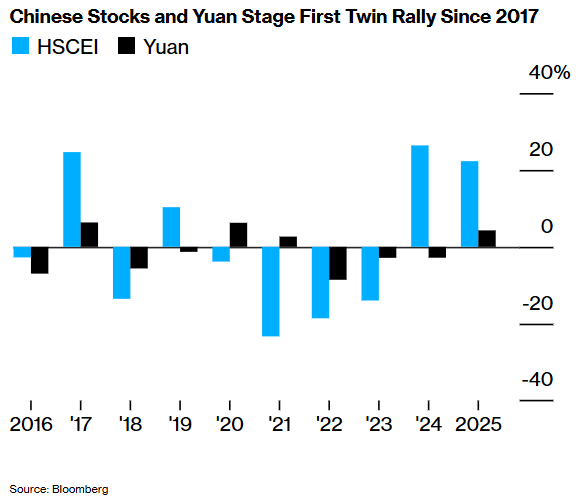
Core Viewpoint - Investors are increasingly betting on Chinese stocks and currency as global uncertainty rises, with major investment firms raising their assessments of China's stock market due to attractive valuations, supportive industrial policies, and optimistic profit outlooks [1][6]. Group 1: Stock Market Performance - The Chinese stock market and the Renminbi have experienced their first simultaneous rise since 2017, with a key index tracking Hong Kong-listed Chinese companies rising over 22% last year, marking it as one of the best-performing major indices globally [4][5]. - The A-share market has reached a four-year high, with the recent trading volume hitting a record 3.65 trillion yuan (approximately 523 billion USD), significantly above the past five-year average daily trading volume of 1.13 trillion yuan [10]. - Goldman Sachs has raised its year-end target for the CSI 300 index to 5,200 points, indicating a potential 9% upside from recent closing prices, and has increased its profit growth forecast for China from 4% in 2025 to 14% in 2026 and 2027 [7]. Group 2: Currency Outlook - The Renminbi is expected to strengthen, with predictions of it reaching 6.25 against the USD by the end of 2026, supported by strong exports and trade surpluses [11][12]. - Major financial institutions, including Citigroup and Bank of America, are optimistic about the Renminbi, with forecasts suggesting it could appreciate to 6.8 against the USD this year [11]. - The recent rise in the Renminbi has been linked to improved risk sentiment and returns calculated in USD, which could further support the stock market [4][11]. Group 3: Sectoral Insights - Analysts remain optimistic about various sectors, including healthcare, battery supply chains, and agriculture, with a renewed focus on underperforming sectors like real estate and real estate credit [11]. - The narrative around Chinese artificial intelligence has shifted investor sentiment positively, leading to a potential structural bull market despite economic fundamentals not fully supporting a broad bull run [10][11].