
Citi(C)

Search documents
花旗本周两次上调甲骨文目标价 最新升至410美元
Xin Lang Cai Jing· 2025-09-11 10:29
Group 1 - Citigroup upgraded Oracle Corporation's rating from Neutral to Buy [1] - The target price for Oracle was raised from $240 to $410 [1] - Previously, on September 9, Citigroup had increased Oracle's target price from $196 to $240 [1]
花旗上调甲骨文评级至买入 目标价升至410美元

Ge Long Hui A P P· 2025-09-11 10:16
格隆汇9月11日|花旗集团将甲骨文公司评级从中性上调至买入,将目标价格从240美元上调至410美 元。 ...
花旗在紫金矿业的多头仓位增至6.78%
Ge Long Hui· 2025-09-11 10:12
Group 1 - Citigroup's long position in Zijin Mining (2899.HK) increased to 6.78% on September 5, up from 6.19% previously [1] - Citigroup's short position in Zijin Mining rose to 1.33% on September 5, compared to 0.64% before [1]

Citi CEO Sees Pickup in Dealmaking With Recession Unlikely
Yahoo Finance· 2025-09-11 10:09
Core Insights - Merger activity is rebounding as US companies gain confidence from clearer policy signals, with a recession appearing unlikely in the US economy [1][3] - Clients have become significantly more active in capital markets, driven by greater clarity on taxes, tariffs, and deregulation [2] - Citigroup's CEO forecasts a decade of strong growth in the Middle East, fueled by investment flows and the creation of new industries [7][8] Market Activity - Companies globally have announced over $1 trillion in deals since June, defying the typical summer slowdown [3] - Goldman Sachs forecasts approximately $3.1 trillion in deal flow for this year and a record $3.9 trillion for 2026, indicating strong momentum in the market [3] - Citigroup has benefited from increased client activity due to market volatility following tariff announcements [4] Economic Outlook - While Citigroup maintains a positive outlook on the US economy, it is closely monitoring the labor market, acknowledging that not all indicators are favorable [3] - Some industry peers express caution regarding the impact of global tariffs on the US economy and inflation, complicating forecasts for Federal Reserve policy [5] - Expectations for a reduction in interest rates by the Federal Reserve are prevalent, but there is uncertainty about the pace of future policy adjustments [6] Regional Focus - The Middle East is viewed as an attractive region for investment, with Gulf states diversifying away from oil and drawing in global financial firms [7][8] - Citigroup anticipates significant growth in the Middle East, supported by expanding business ties with India and China [8]
当美联储“极度鸽派”,黄金和美股同涨的可能性被低估了
Hua Er Jie Jian Wen· 2025-09-11 08:30
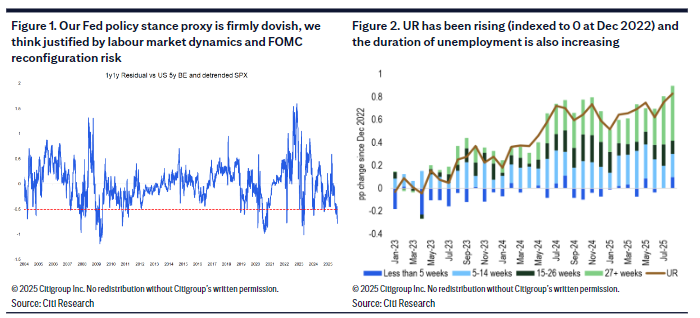
Core Viewpoint - The Federal Reserve is expected to announce its first interest rate cut of the year during the upcoming monetary policy meeting, indicating a shift towards a dovish stance in response to economic risks [1][3]. Group 1: Federal Reserve's Dovish Stance - Citi's analysis indicates that the current market pricing of the terminal interest rate is below levels suggested by inflation and growth indicators, reflecting a clear dovish policy stance from the Federal Reserve [1][2]. - The constructed Federal Reserve policy stance indicator is currently at a low level, suggesting that the market's pricing is "overly accommodative" relative to the fundamentals [2][3]. Group 2: Economic Risks and Labor Market - The dovish stance is based on concerns regarding future economic risks, particularly signs of weakness in the labor market, including rising unemployment rates and longer durations of unemployment [3]. Group 3: Gold and Risk Assets Correlation - In a policy-driven "fiscal dominance" environment, the correlation between gold and risk assets (such as the S&P 500 and Nikkei indices) is expected to become more positive than currently priced in by the market [5]. - There is a significant deviation between the implied correlation of gold and risk assets in the options market and the historical realized correlation during similar dovish environments, indicating that the market has not fully absorbed this shift [5]. Group 4: Gold as a Hedge - Gold is often misperceived as a traditional safe-haven asset; however, its relationship with bond yields is structurally unstable, which undermines its role as a pure hedge [7]. - In the current context of the Federal Reserve's accommodative stance to address potential economic risks, gold's properties make it likely to perform well, supporting the rationale for a "gold up + stocks up" combination [7].

?花旗掌舵者看好美国经济韧性与并购市场动能 押注中东“强劲十年”
Zhi Tong Cai Jing· 2025-09-11 08:28
Group 1: U.S. Economic Outlook - Citi's CEO Jane Fraser expresses optimism about the resilience of the U.S. economy, attributing it to clearer monetary policy signals that have boosted corporate confidence [1] - The likelihood of a recession in the U.S. is considered very low, with a rebound in merger and acquisition activities in the financial markets [1] - Fraser notes that clients are becoming more active in capital markets and large transactions due to stronger clarity in tax, tariffs, and deregulation policies [1] Group 2: Middle East Growth Potential - Fraser predicts a strong growth period of about ten years for the Middle East, driven by investment flows and the emergence of new industries [4] - Gulf countries are expected to invest billions domestically and internationally to diversify their economies away from oil dependence [1][4] - The region is becoming increasingly attractive for global financial giants, with Citi being one of the banks expanding its presence in the Gulf [4] Group 3: Market Reactions and Predictions - The volatility in global financial markets has been beneficial for banks like Citi, as increased client trading activity has resulted from the U.S. trade tariffs [2] - Some financial leaders, like UBS's CEO Sergio Ermotti, remain cautious about the U.S. economy and the impact of tariffs on inflation and monetary policy [2] - Barclays economists have adjusted their predictions, now expecting the Federal Reserve to implement three rate cuts this year, reflecting a shift in focus from combating inflation to addressing potential economic slowdown [3]
花旗掌舵者看好美国经济韧性与并购市场动能 押注中东“强劲十年”
智通财经网· 2025-09-11 08:13
Group 1: Economic Outlook - Citigroup's CEO Jane Fraser indicates that the U.S. economy will continue to show resilience due to clearer monetary policy signals, with a low likelihood of recession [1] - Fraser expects a strong growth period of about ten years in the Middle East, driven by investment flows and emerging industries, as Gulf countries invest billions to diversify their economies away from oil dependence [1][4] Group 2: Market Activity - Following the announcement of tariffs by former President Trump, volatility in global financial markets has increased, benefiting financial institutions like Citigroup from heightened client trading activity [2] - Fraser notes that clients are becoming more active in capital markets and large transactions due to stronger clarity in tax, tariffs, and deregulation policies [1] Group 3: Monetary Policy - There is a divergence in views among financial leaders regarding the U.S. economy and Federal Reserve monetary policy, with some expressing caution about the impact of tariffs on the economy and inflation [2] - Barclays economists have adjusted their predictions, now expecting three rate cuts of 25 basis points each this year, reflecting a shift in focus from combating inflation to addressing potential economic slowdown [3] Group 4: Middle East Investment - The Middle East is becoming one of the busiest IPO markets globally, with Gulf region issuers raising over $5 billion through IPOs this year [5] - Citigroup is among the international banks expanding in the Gulf region, attracted by the area's growing business ties with India and China [4]
花旗:韩3500亿美元对美投资或加剧韩元贬值压力
Xin Hua Cai Jing· 2025-09-11 07:17
Core Viewpoint - South Korea's commitment to invest $350 billion in the U.S. may exert pressure on the Korean won [1] Financing Needs - Due to lessons learned from the 1997-1998 financial crisis, South Korea is unlikely to utilize its $416 billion foreign exchange reserves [1] - Public institutions may need to raise $20 billion to $30 billion in foreign currency annually [1] Bond Market Impact - The remaining financing requirement of $86 billion to $96 billion may need to be sourced from the bond market [1] - Large-scale bond issuance could increase financing costs and put additional pressure on the Korean won [1] Currency Risk - Even if private enterprises share part of the financing burden, the shift of dollar export revenues to won may lead to depreciation risks [1] U.S. Engagement - Citi expects South Korea to seek solutions from the U.S. for potential foreign exchange shocks and to request an extension of the investment commitment timeline [1]
摩根士丹利:美国投资者对中国市场兴趣升至三年高位
第一财经· 2025-09-11 06:22
Core Viewpoint - Recent trends indicate a significant increase in interest from international investors towards Chinese assets, with the Nasdaq Golden Dragon China Index reaching a six-month closing high, driven by factors such as advancements in technology and supportive government policies [3][4]. Group 1: Market Performance - The Nasdaq Golden Dragon China Index rose by 1.5% to 8230.86 points on September 9, marking a near six-month closing high [3]. - Alibaba's American Depository Receipts (ADR) increased by 4.18%, with a year-to-date gain approaching 75% [3]. Group 2: Investor Sentiment - Morgan Stanley reported that U.S. investor interest in the Chinese market has reached its highest level since 2021, with over 90% of investors expressing willingness to increase exposure to China [3][4]. - Interest is expanding beyond internet and ADR sectors to include Hong Kong stocks and onshore A-shares, focusing on areas like artificial intelligence, semiconductors, and new consumption [4]. Group 3: Future Projections - Citigroup forecasts that the Hang Seng Index could reach 26,800 points by the end of 2025, with further increases expected in 2026 [4]. - The focus of China's "14th Five-Year Plan" (2026-2030) will include economic development, technological innovation, and green development, with key industries identified as artificial intelligence, data centers, and renewable energy [4].



花旗:将法国股市评级下调至“中性”
Ge Long Hui A P P· 2025-09-11 06:00
格隆汇9月11日|花旗:将法国股市评级从"增持"下调至"中性",将荷兰股市评级从低于标配上调至增 持。 ...