
Citi(C)

Search documents
现代汽车大涨 花旗因机器人技术和关税压力缓解上调公司目标价
Xin Lang Cai Jing· 2026-01-07 00:57
现代汽车股价一度飙升7.8%,至盘中高点。之前花旗上调现代汽车目标价,理由是看好该公司 2026 年 销量目标及机器人业务前景。鉴于机器人业务商业化机遇有望获得更高估值倍数,且自明年一季度起关 税压力将逐步缓解,花旗将现代汽车目标价从 33 万韩元上调至 38 万韩元,同时维持 "买入" 评级。该 机构研报还提及,现代汽车旗下控股子公司波士顿动力于 2026 年国际消费电子展(CES)期间发布了 人形机器人发展路线图。据韩联社报道,现代汽车负责人于本届 CES 展会期间会晤了英伟达首席执行 官黄仁勋。现代汽车设定 2026 年全球销量目标为 420 万辆,同比微增 0.5%;其中韩国本土市场销量预 计同比下滑 2%,海外市场销量预计同比增长 1%。花旗分析师认为,这一销量目标 "具备合理性"。 ...


Citigroup Stock Reaches New 52-Week High: Hold or Fold Now?
ZACKS· 2026-01-06 17:01
Key Takeaways C shares touched a 52-week high after a market rally, strategic asset sales and improving investor confidence.Citigroup is exiting non-core markets, cutting jobs and simplifying operations to aid long-term growth.C expects higher NII, stronger investment banking fees and $2-2.5B in annualized savings by 2026.Shares of Citigroup, Inc. (C) touched a new 52-week high of $124.06 during yesterday’s trading session, closing slightly lower at $123.30. The rally was driven by expectations that the cap ...

花旗:维持1月澳门赌收预测为215亿澳门元
Xin Lang Cai Jing· 2026-01-06 04:49
Core Viewpoint - Citigroup's research report indicates that Macau's gaming revenue for the first four days of January is projected to reach approximately 3.2 billion MOP, reflecting a daily average of about 800 million MOP, which is an increase of approximately 19% compared to December 2025 and about 36% compared to January 2025, driven by the influx of travelers during the New Year holiday [1] Revenue Forecast - The company conservatively maintains its gaming revenue forecast for January at 21.5 billion MOP [1] - Considering the Lunar New Year factor, the combined gaming revenue for January and February is expected to be 42 billion MOP, indicating a year-on-year growth of 10.5% [1]
中国白银净出口年化规模达全球供应的 7% 及影响-Global Metals Mining China net exports of silver annualizing 7 of world supply and implications
2026-01-06 02:23
05 Jan 2026 08:00:14 ET │ 9 pages Global Metals & Mining Vi e w p o i n t | China net exports of silver annualizing 7% of world supply and implications CITI'S TAKE Silver's 'melt up' during holiday period can be largely attributed to fears around supply as China tightened license regime restricting export licenses only to large players with extensive credit lines. While China mines c.14% of world's silver it refines over 60% of it, as >70% of silver is a byproduct/coproduct – usually of zinc and copper. Chi ...
Markets Risk-On with Venezuela News, Deregulation
ZACKS· 2026-01-06 00:00
Market Overview - Major market indexes experienced a "risk on" trading sentiment, with the Dow reaching a record high of 48,977, gaining 594 points (+1.23%) [2][7] - The S&P 500 and Nasdaq also saw gains, with the S&P up 43 points (+0.64%) and the Nasdaq up 160 points (+0.69%) [2][7] - The small-cap Russell 2000 led the gains, increasing by 39 points (+1.58%) [2] Oil & Gas Sector - The U.S. invasion of Venezuela, aimed at controlling its vast oil reserves, has positively impacted the oil & gas sector [1] - Notable performers included Valero and SLB, both up 9%, and Phillips 66, which rose 7% [3] - Chevron, a major player in the sector, increased by 5.1% [3] - Venezuela is reported to have $17 trillion in oil reserves, attracting significant investor interest [3] E-commerce Sector - MercadoLibre, a leading Latin American e-commerce company, rose by 8.8%, driven by positive sentiment regarding Venezuela [4] Banking Sector - Bank stocks are on the rise due to anticipated deregulation in 2026, with Citigroup shares up 3.9% and a total gain of 65% over the past year [5] - Other banks also showed strong performance: Goldman Sachs (+53%), Morgan Stanley (+41%), and JPMorgan (+34%) [5] - The easing of regulatory standards is expected to benefit both large Wall Street firms and smaller regional banks [5] Manufacturing Sector - The ISM Manufacturing index for December reported a decline to 47.9%, the lowest since October, falling short of the expected 48.3% [9] - Production and inventories decreased, while new orders and backlogs showed improvement, indicating a mixed outlook for the manufacturing sector [9]

Citigroup: Priced For Perfection, But More Cuts Can Be Made (NYSE:C)
Seeking Alpha· 2026-01-05 19:51
Citigroup Inc. ( C ) is scheduled to release its Q4 2025 results on January 14, 2026. There are other better-placed analysts with a line into the company to make the top- and bottom-line forecasts that moveMarty Popoff has over 20 years of capital markets experience, as a trader, marketer and in a pinch, structurer, primarily in the fields of Government and Corporate Bonds, Interest Rate Derivatives, Credit Derivatives, and Securitization. He has spoken at many conferences and taught Risk Management at the ...
Citigroup: Priced For Perfection, But More Cuts Can Be Made
Seeking Alpha· 2026-01-05 19:51
Citigroup Inc. ( C ) is scheduled to release its Q4 2025 results on January 14, 2026. There are other better-placed analysts with a line into the company to make the top and bottom-line forecasts thatMarty Popoff has over 20 years of capital markets experience, as a trader, marketer and in a pinch, structurer, primarily in the fields of Government and Corporate Bonds, Interest Rate Derivatives, Credit Derivatives, and Securitization. He has spoken at many conferences and taught Risk Management at the gradua ...

Citi cites $1.2B loss on Russia sale
Yahoo Finance· 2026-01-05 12:12
Core Viewpoint - Citi is expected to incur a pre-tax loss of approximately $1.2 billion in the fourth quarter of 2025 due to the sale of its remaining operations in Russia, which is seen as a step towards resolving legacy issues and transforming the bank [1][3]. Financial Impact - The total loss from the sale to Renaissance Capital amounts to $1.6 billion, but this will be partially offset by $200 million in expected proceeds and another $200 million from the derecognition of Citi's fully reserved net investment [2]. - As of September 30, Citi had about $1.8 billion of exposure to Russia, significantly reduced from $9.8 billion at the time of the Ukraine invasion in 2022 [5]. Strategic Moves - Citi's board approved the sale on December 29, with the expectation that the deal will close in the first half of 2026. The remaining Russia business will be reclassified as "held for sale" [3][4]. - The loss related to the sale is attributed to currency translation adjustments, which will not affect Citi's common equity tier 1 capital [6].
华尔街大行财报季即将来袭 花旗警告摩根士丹利(MS.US)回调将至:拥挤多头迎来高门槛预期
智通财经网· 2026-01-05 08:51
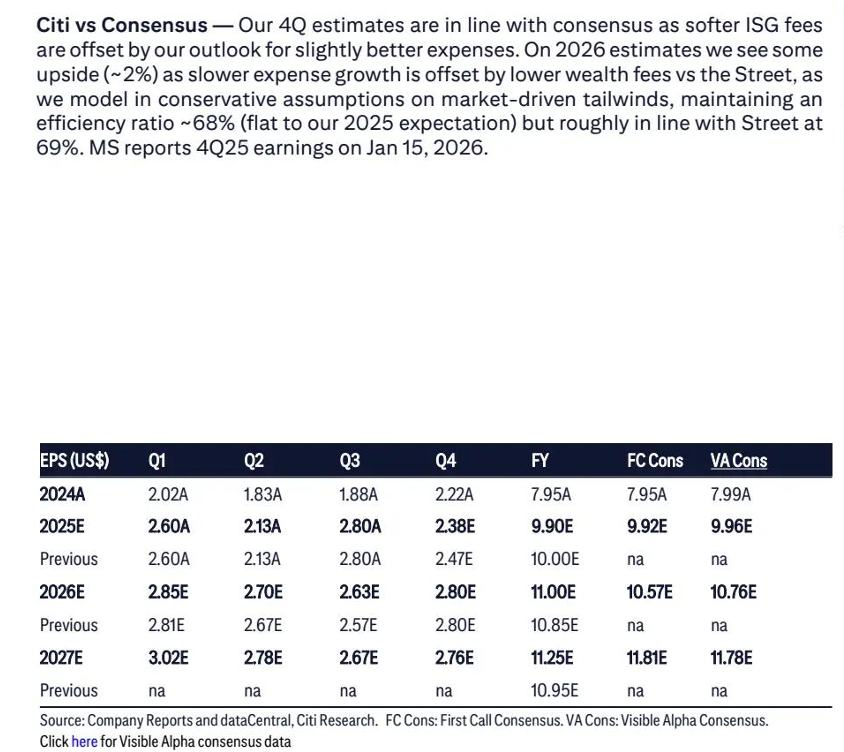
Core Viewpoint - Citigroup's recent report indicates that Morgan Stanley (MS.US) is increasingly positioned as a "high-end/premium" bank and investment banking financial complex, but the current valuation reflects the market's consensus on optimal investment returns, leading Citigroup to maintain a "neutral" rating with a target price of $170, suggesting a significant price correction in the short to medium term [1] Group 1: Valuation and Market Expectations - The market has priced in "best-in-class returns," resulting in a significant premium on Morgan Stanley's stock price under the "implied cost of equity capital" framework, making the risk/reward ratio less favorable compared to other investment opportunities in the financial sector [2] - Citigroup believes that Morgan Stanley's profit elasticity is primarily driven by cost discipline rather than aggressive market-driven assumptions, with an expected 2% upward revision in overall earnings for 2026 due to slower expense growth and better cost management [2][5] Group 2: Earnings Projections - Earnings per share (EPS) projections for Morgan Stanley are as follows: 2024A at $7.95, 2025E at $9.90, and 2026E at $11.00, with a slight upward revision for 2026 compared to previous estimates [3] - The report highlights that Morgan Stanley remains one of the most crowded consensus longs within Citigroup's coverage, indicating high sensitivity of the stock price to "slightly below stringent expectations" in the short to medium term [3] Group 3: Business Model and Risk Factors - Citigroup's assessment of Morgan Stanley's current stock price and valuation can be summarized as "high-quality company + fundamentally sound business model, but valuation and positioning significantly lower investment success rates" [4] - The implied cost of equity capital is estimated at approximately 8.7%, indicating that the current price reflects a fully priced return, while the target price model uses a 9.3% cost of equity capital, suggesting that the current valuation is not cheap [5] - Citigroup emphasizes that Morgan Stanley's cyclical exposure remains significant, particularly in investment banking and capital markets, with core risks including a downturn in capital market activities and valuations, which could severely impact profitability if economic growth and volatility fall below expectations [5]

亚洲外汇与利率策略_亚洲资金流动概览-Asia FX and Rates Strategy_ Asia Flow Overview
2026-01-04 11:35
Vi e w p o i n t | 30 Dec 2025 23:24:00 ET │ 18 pages Asia FX and Rates Strategy Asia Flow Overview CITI'S TAKE December saw broad based inflows into Korean and Indonesian assets while India and Taiwan saw outflows. Foreign investments in Chinese fixed income declined for a seventh consecutive month, the trend was predominantly driven by the substantial sell-off in NCDs, whereas reduction in CGBs remained measured. Overall, aggregate portfolio inflows into EM Asia for 2025 totaled USD 59bn, characterizing t ...