Citi(C)

Search documents
特朗普“去监管”推动,美国银行股市值今年涨了6000亿美元
Hua Er Jie Jian Wen· 2025-12-25 03:51
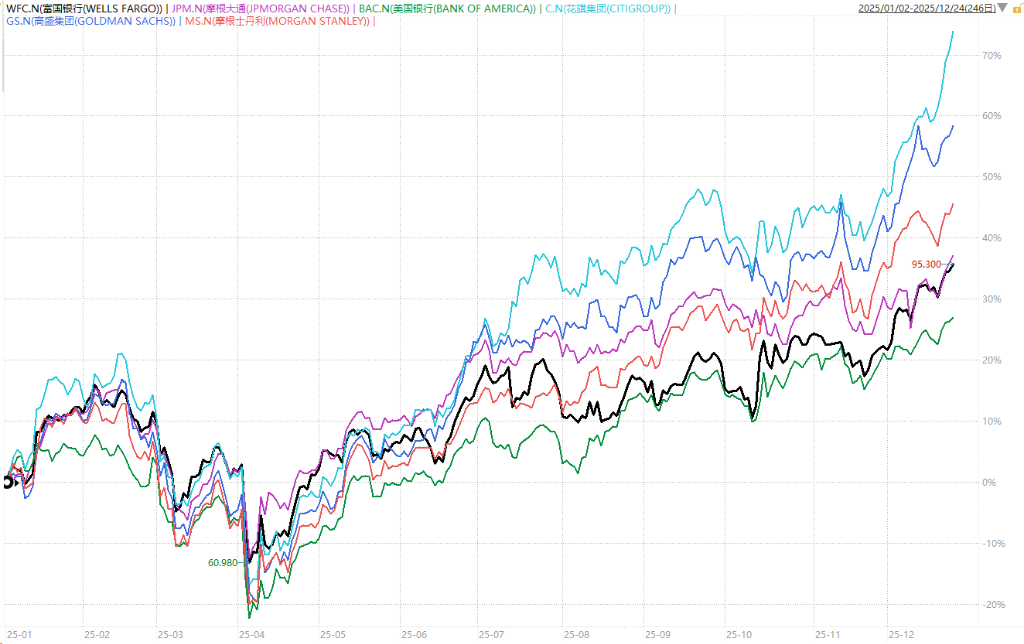
Group 1 - The financial deregulation pushed by the Trump administration has led to a recovery in investment banking and an increase of $600 billion in market value for the six largest U.S. banks this year [1] - As of Wednesday's close, the total market capitalization of JPMorgan Chase, Bank of America, Citigroup, Wells Fargo, Goldman Sachs, and Morgan Stanley exceeded $2.38 trillion, a significant rise from $1.77 trillion at the end of last year, and they are expected to outperform the S&P 500 for the second consecutive year [1][2] - In contrast, the total market capitalization of the six largest European banks is only $1 trillion, highlighting the growing divergence between U.S. and European banking sectors since the 2008 financial crisis [2] Group 2 - Regulatory policy shifts have been a key factor driving stock price increases, with U.S. regulators proposing to allow the largest banks to increase leverage and reforming capital requirements [2][4] - Strong recovery in investment banking has further boosted market confidence, with Citigroup's stock rising over 70% this year, leading the six major banks, and Goldman Sachs' stock climbing nearly 60% to reach an all-time high [2][7] - Analysts predict that bank stock and fixed income trading revenues will exceed historical peaks this year, with projected trading revenues of $92 billion for equities and $163 billion for fixed income [8] Group 3 - The deregulation measures introduced by the Trump administration have directly enhanced bank stock performance, with analysts emphasizing the importance of regulatory changes on stock prices [4] - Banks are expected to have excess capital available for business expansion, stock buybacks, and dividends, as they have been holding more capital than necessary under previous proposals [5] - Despite concerns from some lawmakers regarding the risks of deregulation, investors have shown minimal apprehension towards the increased risk-taking by banks [6]


Citigroup Seizes Japan's M&A Boom, Plans to Expand IB Team
ZACKS· 2025-12-24 19:36
Core Insights - Citigroup Inc. is accelerating its investment banking growth plans in Japan to capitalize on a significant boom in merger and acquisition activity, aiming for a 30% increase in its Japan IB headcount by the first half of 2026 [1][10] Group 1: M&A Market Dynamics - Japan's M&A market is projected to reach around $350 billion by the end of 2025, marking the highest level on record [2][10] - Companies in Japan are increasingly engaging in strategic acquisitions while divesting non-core assets, leading to a steady pipeline of large-scale deals [3] - Innovative financing structures are being utilized, combining equity and traditional debt with private credit from long-term investors, which helps preserve credit ratings and reduce funding costs [3][4] Group 2: Citigroup's Strategic Positioning - The growing use of innovative financing strategies is expected to further boost Japan's M&A activity, reinforcing Citigroup's decision to expand its market presence [4] - Citigroup's expansion is part of a broader strategy to deepen its presence in Asia's advanced economies, leveraging global investment capabilities with localized execution [5] Group 3: Competitive Landscape - Other global players like Goldman Sachs and BlackRock are also strengthening their positions in Japan's market [6] - Goldman Sachs is gaining momentum by offering integrated solutions across traditional and alternative asset classes, reaffirming Japan as a strategic market [7] - BlackRock has been expanding its offerings tailored to Japanese investors, focusing on global fixed income, private assets, and thematic strategies [8] Group 4: Performance Metrics - Citigroup's shares have increased by 68.2% over the past year, outperforming the industry's growth of 37.5% [9]

3 Bank Stocks to Keep on Your Radar as They Reach New 52-Week Highs
ZACKS· 2025-12-24 18:51
Core Insights - The article discusses the significance of stocks reaching new 52-week highs, indicating positive momentum and attracting investor interest [1][2]. Group 1: Market Performance and Economic Factors - Major banks like Citigroup Inc., U.S. Bancorp, and Bank of America have reached new 52-week highs, with all three stocks rising over 10% in the past year [3]. - The rally in bank stocks is supported by overall market strength and improved economic data, with the U.S. GDP growing at an annualized rate of 4.3% in Q3 2025, surpassing the previous quarter's 3.8% growth [4][7]. - Investor sentiment is bolstered by monetary policy support, with the Federal Reserve reducing interest rates by a cumulative 75 basis points this year, expected to further cut rates in 2026 [8]. Group 2: Company-Specific Developments - Citigroup has received regulatory relief, allowing for greater strategic flexibility and supporting its growth initiatives, with projected total revenues exceeding $84 billion in 2025 [10][11]. - Bank of America anticipates a 5-7% year-over-year increase in net interest income (NII) for 2026, driven by fixed-rate asset repricing and a strong lending environment [16][19]. - U.S. Bancorp is expanding its digital capabilities and has made several acquisitions to diversify revenue streams, with a focus on enhancing fee-based businesses [23][24]. Group 3: Earnings Estimates and Growth Projections - Citigroup's earnings are projected to grow by 27.4% and 32.6% for 2025 and 2026, respectively, with a Zacks Consensus Estimate indicating a current quarter estimate of $1.77 [12][13]. - Bank of America's earnings are expected to grow by 15.9% and 13.9% for 2025 and 2026, with a current quarter estimate of $0.96 [19][20]. - U.S. Bancorp's earnings are projected to grow by 14.3% and 7.5% for 2025 and 2026, with a current quarter estimate of $1.19 [25][27].



3 Banks Poised to Benefit Most From Declining Interest Rates
ZACKS· 2025-12-24 18:51
Core Viewpoint - The Federal Reserve has shifted its monetary policy by cutting interest rates in response to slowing economic activity and easing inflation pressures, with the target range now at 3.50-3.75% as of December 2025, marking the third consecutive rate reduction this year aimed at supporting economic expansion while targeting a 2% inflation rate [1][10]. Banking Industry Outlook - The banking industry is expected to benefit from falling interest rates, with banks like Wells Fargo, Bank of America, and Citigroup likely to gain the most as lower borrowing costs stimulate loan demand [2][10]. - Future interest rate moves by the Fed will depend heavily on incoming economic data, suggesting a cautious but optimistic outlook for the banking sector in 2026 [2]. Impact of Interest Rate Cuts on Banks - Lower interest rates generally stimulate loan demand across consumer and commercial segments, leading to increased borrowing for mortgages, refinancing, and business expansion [3]. - Improved credit quality is anticipated as lower debt servicing costs help borrowers meet obligations, reducing delinquencies and defaults, which supports bank profitability [4]. - Falling rates are expected to enhance fee-based and market-related income streams for banks, benefiting investment banking, trading, and wealth management divisions [5]. Wells Fargo (WFC) Strategy - Wells Fargo plans to stabilize funding costs through interest rate cuts, focusing on aggressive growth in consumer and corporate loan assets, especially after being freed from its asset cap [7]. - The bank aims to leverage its expanded balance sheet to grow fee-rich franchises, essential during a rate-cutting cycle [8]. - WFC's strategy includes prioritizing organic growth, competing for deposits, and selectively increasing lending while remaining cautious amid economic uncertainty [9]. Bank of America (BAC) Strategy - Bank of America is positioned to benefit from fixed-rate asset repricing and higher loan and deposit balances, with management expecting net interest income (NII) to grow by 5-7% in 2026 [12][14]. - The bank is focusing on organic growth through the expansion of its physical and digital presence, planning to open over 150 financial centers by 2027 [13]. - BAC aims for over 12% earnings growth and a return on tangible common equity (ROTCE) between 16% and 18% over the next three to five years [14]. Citigroup Strategy - Citigroup has seen a compound annual growth rate (CAGR) of 8.4% in net interest income over the past three years, with expectations for continued growth supported by stabilizing funding costs and loan growth [16]. - The company is streamlining its consumer banking operations globally, which will free up capital for investments in wealth management and investment banking, enhancing fee income growth [17]. - Management projects total revenues to exceed $84 billion in 2025, with a revenue CAGR of 4-5% through 2026 [17].


S&P 500 Hits All-Time Highs On Christmas Eve, VIX Drops To One-Year Low - Apple (NASDAQ:AAPL)
Benzinga· 2025-12-24 16:35
Market Performance - The S&P 500 reached a new record, climbing past 6,920 points with a year-to-date gain of 17% [1] - Other major indices also saw modest gains, indicating a potential fifth consecutive session of increases as the year ends [2] - The CBOE Volatility Index (VIX) fell to 13.7, the lowest level since mid-December 2024, reflecting reduced market anxiety [2] Notable Stock Movements - Top gainers in the S&P 500 included Sandisk Corp. and Nike Inc., both rising approximately 5% [2] - Nike shares increased following Apple CEO Tim Cook's purchase of 50,000 shares at $58.97 each [3] - Micron Technology extended its post-earnings rally to 27% over the past five sessions, gaining an additional 4% [3] Banking Sector Highlights - Major banks like Citigroup, J.P. Morgan Chase, Wells Fargo, and Bank of America reached record levels, with Citigroup marking its sixteenth gain in the past seventeen sessions [3][4] Precious Metals and Crypto Markets - Precious metals experienced a pause in their rally, with gold slipping 0.4% after reaching an intraday high of $4,525 per ounce, and silver falling 0.8% after hitting $72.69 [4] - In the crypto market, Bitcoin decreased by 0.9% to around $87,000, marking a 7% decline year-to-date [5] ETF Performance - The Vanguard S&P 500 ETF rose 0.2% to $633.80, while the SPDR Dow Jones Industrial Average ETF gained 0.4% to $486.07 [7]


特朗普的资本重构:一场万亿美元级别的资金流向大转移
华尔街见闻· 2025-12-24 04:01
Core Viewpoint - The article discusses the significant policy shifts under the Trump administration that are reshaping capital flows in various sectors, particularly in banking, housing finance, cryptocurrency, and energy, indicating a major reallocation of investment opportunities and risks. Group 1: Banking Regulation and Liquidity Release - The Federal banking regulators are relaxing key capital rules, specifically lowering the "enhanced supplementary leverage ratio" (eSLR) from 5% to between 3.5% and 4.25%, effective in early 2026, which is expected to release up to $219 billion in capital for major banks like JPMorgan Chase & Co. and Citigroup Inc. [2] - Following the regulatory easing, the largest four U.S. banks nearly doubled their stock buybacks to $21 billion and increased dividend payments by about 10% in the first full quarter after passing the Federal Reserve's annual stress tests [2] - Concerns have been raised about the potential risks of this policy, with warnings that it could make the banking system more vulnerable and increase industry concentration [2] Group 2: Housing Finance Privatization - A controversial proposal aims to end government control over Fannie Mae and Freddie Mac, leading to a significant rise in their stock prices, with Fannie Mae's shares soaring from under $2 to over $15 [3] - Bill Ackman, a prominent hedge fund manager, advocates for the public listing of these companies, while the Treasury holds $360 billion in preferred equity, complicating the privatization discussions [5] - Research indicates that even if the conservatorship is not ended, an IPO could raise borrowing costs, potentially increasing mortgage rates by 0.2 to 0.8 percentage points, which could add $200,000 in interest costs over the life of a $1 million mortgage [5] Group 3: Institutionalization of Cryptocurrency - The Trump administration has shifted its stance on digital assets, signing the GENIUS Act to provide a legal framework for stablecoins, which is expected to mainstream their use [6] - Citigroup projects that the stablecoin market could grow from approximately $310 billion to $4 trillion by 2030, with major banks like JPMorgan actively entering this space [6] - The new law mandates stablecoin issuers to maintain reserves at a 1:1 ratio and allows the use of U.S. Treasury securities as reserve assets, which may increase demand for U.S. government bonds [6] Group 4: Energy Investment Landscape Shift - The Trump administration's "Big Beautiful" plan has led to the cancellation or postponement of clean energy projects worth nearly $29.3 billion by ending tax credits for electric vehicles and renewable energy [8] - Companies like Pine Gate Renewables have announced closures and layoffs, while Fortescue Ltd. has abandoned a $210 million battery factory project, reflecting the drastic capital flow reversal in the energy sector [8] - The federal government is refocusing its efforts on supporting fossil fuels and nuclear energy development, indicating a significant shift in energy investment priorities [8] Group 5: New Channels for Pension Fund Investment - The Trump administration is attempting to tap into the $13 trillion retirement savings market by requiring agencies to reassess guidelines on alternative asset investments in retirement plans [10] - This move is seen as a major benefit for the private equity industry, potentially releasing billions in new funds as traditional pension funds approach their investment limits in private markets [10] - Despite warnings from figures like Senator Elizabeth Warren about the risks to ordinary Americans, private equity firms argue that this will provide broader access to previously exclusive financial products [10]

华尔街巨头激辩2026:高盛押注上半年“高歌猛进”,花旗预警就业市场“暗雷”
智通财经网· 2025-12-24 02:33
Group 1 - Goldman Sachs and Citigroup have contrasting views on the U.S. economic outlook for 2026, with Goldman being more optimistic, predicting a growth rate of 2.6%, while Citigroup forecasts a lower rate of 2.1% [1][2] - Goldman Sachs expects strong GDP growth in the first half of next year, attributing this to the diminishing effects of tariffs and an additional $100 billion in tax refunds from fiscal plans, alongside a loose monetary environment from the Federal Reserve [1] - Citigroup is skeptical about the scale of additional tax refunds, estimating it to be between $30 billion and $50 billion, and believes that the supportive effects of a loose monetary environment are limited [2] Group 2 - Both banks anticipate further interest rate cuts by the Federal Reserve in 2026, with Goldman predicting a 50 basis point cut and Citigroup expecting a 75 basis point cut, highlighting a general dovish outlook [3] - Citigroup emphasizes that the biggest risk to their economic outlook is a rise in unemployment rates, noting that historically, prolonged increases in unemployment have led to significant economic downturns [3] - Goldman Sachs identifies the labor market's weaknesses as a major vulnerability, warning that persistent job market issues could trigger serious recession concerns [3]
日本经济-2026 年前景:稳定态势下是否会浮现动荡苗头-Japan Economics-Prospects for 2026:Will seeds of destabilization emerge amidst stability
2025-12-24 02:32
Summary of Key Points from the Conference Call Industry Overview - **Industry**: Japan's Economy - **Forecast Period**: 2026 Core Insights and Arguments - **GDP Growth**: Japan's GDP is expected to grow at +1.0% in 2026, a slight decrease from +1.3% in 2025, indicating resilience despite modest decline [1][4] - **Inflation Trends**: Headline inflation is projected to temporarily fall below 2%, with strong wage growth expected to ease consumer purchasing power headwinds [1][4] - **Bank of Japan (BoJ) Rate Hikes**: Anticipation of semiannual rate hikes by the BoJ, with the first expected in July 2026, and a terminal rate projected at +1.5% [5][6] - **Fiscal Policy Constraints**: Fiscal leeway is limited due to high government debt/GDP ratio and the JGB market's exit from quantitative easing, leading to moderate fiscal impulses [1][4][13] Additional Important Points - **Wage Growth**: Expected base pay increase of approximately 3.3% in spring negotiations, supported by labor shortages and corporate profits [20] - **Inflation Deceleration**: Core CPI is projected to decelerate to +1.7% in 2026 from +3.1% in 2025, influenced by government anti-inflation measures [22][23] - **Consumer Purchasing Power**: Recovery in purchasing power anticipated as food and energy inflation slows, allowing for higher service prices [23][24] - **Public Sector Price Adjustments**: Government considering price hikes in medical fees and other public services, which may impact CPI [25][26] - **Investment Trends**: Companies are increasingly investing in value-added products to manage rising costs, despite some sectors facing labor shortages [43][44] Risks and Considerations - **Exchange Rate Risks**: FX movements could impact the timing of rate hikes and overall economic stability [5][8] - **Geopolitical Tensions**: Recent tensions with China pose risks to service exports and tourism, which could affect GDP growth [56] - **Potential for Policy Missteps**: Concerns over unpredictable policy decisions may persist, particularly in the JGB market [1][4][13] This summary encapsulates the key insights and projections regarding Japan's economic outlook for 2026, highlighting growth expectations, inflation trends, fiscal policy constraints, and potential risks.
2 Red-Hot Bank Stocks Rallying Into 2026
Schaeffers Investment Research· 2025-12-23 20:16
Industry Overview - The banking sector has experienced a strong performance in 2025, with the Invesco KBW Bank ETF (KBWB) increasing by 31.6% and the SPDR S&P Regional Banking ETF (KRE) showing a year-to-date gain of 10.9% [1] Company Performance - Citigroup Inc (NYSE:C) has emerged as one of the top-performing bank stocks, boasting a year-to-date increase of 70.4%, attributed to successful restructuring efforts initiated in late 2023. The stock has reached a 17-year high of $120.27, with only two negative trading sessions since November 21 [2] - Fifth Third Bancorp (NASDAQ:FITB) has also shown significant gains, rising 10.8% since the beginning of December and achieving a year-to-date increase of 13.9%. The stock is currently priced at $48.17, close to its two-year high of $49.07 reached on November 25, 2024. The upcoming acquisition of Comerica (CMA) is expected to close in the first quarter of 2026, positioning Fifth Third as the ninth largest bank in the country [4]


Citigroup or Bank of America: Which Big Bank is the Better 2026 Bet?
ZACKS· 2025-12-23 13:51
Core Insights - Bank of America (BAC) and Citigroup (C) are major U.S. banks with significant exposure to interest rate cycles, loan growth, and global financial markets, providing a range of financial services [2] - BAC is more sensitive to U.S. interest rates and consumer health, while C is influenced by global trade and geopolitical trends [3] Bank of America (BAC) - BAC is expected to see a 5-7% year-over-year increase in net interest income (NII) for 2026, driven by fixed-rate asset repricing and improving lending conditions [4] - The bank's expansion strategy has added 170 new financial centers and $18 billion in incremental deposits since 2014, with plans to open more centers through 2028 [5] - A shift towards easier monetary policy is anticipated to support client activity and asset values, with a focus on using data and AI to enhance efficiency [6] - Lower interest rates are expected to improve BAC's asset quality and borrower solvency, although operating expenses may remain elevated due to expansion plans [7] Citigroup (C) - Citigroup's NII growth is projected to be under pressure as interest rates fall, but it expects a 5.5% NII growth for this year, indicating improved loan demand [8] - The company is executing a multi-year strategy to streamline operations, having exited consumer banking in nine countries, which will free up capital for investments in wealth management [9] - Citigroup's earnings are expected to increase by 32.3% in 2026, with cost-cutting measures projected to save $2-$2.5 billion annually [10] - The bank anticipates operating expenses to decline to below $53 billion in 2026, down from $56.4 billion in 2023 [13] Earnings Estimates - The Zacks Consensus Estimate for BAC indicates earnings growth of 15.9% for 2025 and 14% for 2026, with recent estimates revised lower [15] - In contrast, C's earnings estimates suggest a jump of 27.6% for 2025 and 32.3% for 2026, with recent estimates revised slightly upward [18] Price Performance and Valuation - Over the past six months, C shares have risen by 45.6%, compared to BAC's 19.8%, reflecting investor confidence in Citigroup's transformation [20] - Citigroup is currently trading at a forward P/E of 11.81X, while BAC is at 12.93X, indicating that C is trading at a discount compared to BAC [24][25] - Citigroup has a slight edge in dividend yield at 2.03% compared to BAC's 2.00%, with both banks having recently increased their dividends [26] Conclusion - While BAC offers stable growth potential, Citigroup is positioned as the better investment for 2026 due to its transformation strategy, cost-cutting measures, and stronger earnings growth expectations [31][32]