
CCB(CICHY)

Search documents
券商资管产品近一年收益出炉!股票型产品领跑!第一创业、浙商资管、银河金汇分别夺冠!
私募排排网· 2025-07-05 09:25
Core Insights - The article discusses the performance and structure of brokerage asset management products, particularly focusing on collective asset management plans, which are categorized into various types such as equity, bond, mixed, FOF, QDII, money market, and alternative investments [2][5]. Group 1: Overview of Brokerage Asset Management Products - As of the end of Q1 2025, there are 10,210 brokerage asset management products with a total scale of approximately 28,215 billion yuan [2]. - Among these, 31 firms have collective asset management plans exceeding 10 billion yuan, with CITIC Securities leading at 3,432 billion yuan [2]. Group 2: Performance of Asset Management Products - The average return for brokerage asset management products over the past year is 5.84%, with a median return of 3.51% [5][6]. - Equity products have shown the highest performance, with an average return of 20.97% and a median return of 18.92% [5][6]. Group 3: Performance by Product Type - Bond products, the most numerous with 1,898 products, have an average return of 3.51% [6]. - FOF products have an average return of 13.03%, while mixed products average 9.8% [6]. - The top-performing mixed products include "第一创业富显11号" and "安信资管同享收益1号" [7][9]. Group 4: Top Products in Each Category - The top five mixed products are led by "第一创业富显11号" with significant returns [9]. - In the equity category, "民生添益11号" and "财达成长6号" are the top performers [11][12]. - For FOF products, "浙商财富鑫汇中证1000与小市值增强型FOF1号" and "海通远见1号FOF" are the leading products [17]. - The top bond product is "银河稳盈20号" [20].




建设银行:深入推进重点领域腐败治理
Zhong Yang Ji Wei Guo Jia Jian Wei Wang Zhan· 2025-07-04 04:08
Group 1 - The central theme emphasizes the importance of comprehensive governance in combating corruption within the financial sector, particularly focusing on credit and procurement areas [1][2][3] - The approach includes a dual strategy of addressing both high-level corruption ("tigers") and lower-level misconduct ("flies") by investigating key personnel and critical processes [1][2] - The initiative aims to enhance the overall effectiveness of governance by integrating measures to reduce existing corruption and prevent new cases, while also protecting officials and mitigating financial risks [2][4] Group 2 - The strategy involves a thorough examination of significant violations and the establishment of a continuous management mechanism for major violations, focusing on key weak links in the credit and procurement processes [2][4] - The use of technology is highlighted to uncover corruption in complex procurement projects, including issues like inflated demand and collusion among suppliers [3] - The organization is committed to reforming governance structures to eliminate conditions that foster corruption, ensuring strict adherence to regulations and enhancing accountability [4][5] Group 3 - The initiative promotes a holistic approach to governance, integrating anti-corruption measures with reform efforts to close institutional loopholes and reduce opportunities for misconduct [4][5] - Continuous education and training for staff in key positions are emphasized to instill a culture of integrity and compliance within the organization [5] - The focus is on creating a dynamic monitoring system that allows for timely warnings and effective punishment of potential risks related to integrity [4][5]

【弘扬中国特色金融文化】建设银行山东省分行:以金融文化力量赋能高质量发展
Qi Lu Wan Bao· 2025-07-03 07:20
Core Viewpoint - The China Construction Bank Shandong Branch integrates red financial culture into modern financial systems, emphasizing historical legacy and contemporary relevance in its mission to support national development and social welfare [1][2]. Group 1: Cultural Development - The Shandong Branch promotes Chinese financial culture as a key support for high-quality financial development, deepening understanding of the "Five Musts and Five Must Nots" [2]. - A series of work plans and implementation guidelines have been established to align with the "14th Five-Year Plan" for corporate culture and integrity culture construction [2][3]. - Various educational activities, including the "Five Ones" campaign, have been launched to enhance engagement in promoting Chinese financial culture [3]. Group 2: Mechanism and Implementation - The branch has established a monthly reporting mechanism for cultural initiatives and integrated financial culture into training for new employees and party members [3][5]. - The implementation of the "Five Musts and Five Must Nots" is monitored through regular inspections to ensure adherence to central directives [5]. Group 3: Activities and Engagement - The Shandong Branch has organized numerous activities, such as essay contests and youth forums, to foster engagement with Chinese financial culture [4]. - Various branches have conducted unique activities, including competitions and lectures, to promote cultural understanding and participation [4]. Group 4: Integrity and Compliance - The branch emphasizes the integration of integrity culture with Chinese financial culture, creating a comprehensive framework for promoting ethical practices [5][6]. - Initiatives like the "Clean Wind" brand aim to enhance the integrity culture within the organization [5]. Group 5: Learning from Role Models - The Shandong Branch prioritizes learning from exemplary figures like Zhang Fuqing, embedding their values into corporate culture and operational practices [7][8]. - The establishment of numerous service teams named after Zhang Fuqing reflects the commitment to community service and financial support [8]. Group 6: Financial Support and Innovation - The Shandong Branch has provided significant financial support, including a credit approval of 4.35 billion yuan for sports equipment for the Paris Olympics [10]. - Innovative financial products and services, such as pollution rights pledge loans and specialized loans for technology enterprises, have been developed to support ecological and technological advancements [10].
建设银行积极参与科创债发行热潮 单笔300亿金融债创市场新高
Xi Niu Cai Jing· 2025-07-02 01:26
Core Viewpoint - The People's Bank of China and the China Securities Regulatory Commission have jointly announced measures to support the issuance of technology innovation bonds, aiming to enhance the product system and support mechanisms for the development of the tech bond market [1][2] Group 1: Policy and Market Development - The total issuance of technology innovation bonds in May reached 348.33 billion yuan, a year-on-year increase of 402.5%, marking the highest monthly issuance since 2022 [1] - As of June 27, the overall scale of newly issued tech innovation bonds was approximately 568.5 billion yuan, with banks accounting for the largest share, issuing a total of 219 billion yuan, nearly 40% of the total issuance [1] - The announcement of supportive policies has led to a rapid response from major issuers, including China Construction Bank and the National Development Bank, which have begun issuing or underwriting the first batch of technology innovation bonds [2] Group 2: Specific Issuances and Financial Impact - China Construction Bank issued its first technology innovation bond on May 22, with a total issuance of 30 billion yuan, making it the largest financial tech innovation bond in the market [3] - The 3-year bond had an issuance scale of 25 billion yuan with a coupon rate of 1.65%, and the 5-year bond had an issuance scale of 5 billion yuan with a coupon rate of 1.76% [3] - The funds raised from these bonds are targeted at technology enterprises and strategic emerging industries, maximizing the financial leverage to promote technological innovation and stimulate the real economy [5][6] Group 3: Case Studies and Sectoral Support - The Jiangsu Huai'an salt cavern gas storage project, supported by the Jiangsu Guoxin Group, successfully issued the first batch of technology innovation bonds, which are expected to reduce carbon emissions by approximately 3.69 million tons annually [6] - Suzhou Jinhesheng Holdings raised 600 million yuan through the issuance of technology innovation bonds, which will be used to support venture capital funds for technology enterprises [7] - Tianjin Pharmaceutical Group successfully issued technology innovation bonds to raise 300 million yuan, which will provide stable long-term capital for research and technological upgrades, saving over 4 million yuan in financing costs [8] Group 4: Overall Impact on the Economy - The issuance of technology innovation bonds is seen as a crucial financial tool to activate innovation momentum, enhance resource allocation efficiency, and support high-quality development of the real economy [8][9] - The initiative promotes a virtuous cycle between technology, industry, and finance, facilitating the flow of funds into high-tech sectors and strategic emerging industries [9]

川能动力: 四川省新能源动力股份有限公司公司债券受托管理事务报告(2024年度)
Zheng Quan Zhi Xing· 2025-06-30 16:44
Group 1: Company Overview - Sichuan New Energy Power Company Limited focuses on green energy, primarily engaging in renewable energy generation and lithium battery production [11][12] - The company operates wind power, photovoltaic power, waste incineration power generation, and lithium salt production [11][12] Group 2: Financial Performance - As of the end of 2024, the company reported a total installed capacity of 1.2977 million kW for photovoltaic projects and 1.2738 million kW for wind power projects, achieving a total electricity generation of 4.015 billion kWh, a year-on-year increase of 18.12% [14] - The company’s lithium salt production capacity reached 15,000 tons per year, with a total production of 11,300 tons in 2024 [15] - The company’s financial indicators showed a current ratio of 2.20 and a debt-to-asset ratio of 49.92% as of the end of 2024, indicating improved liquidity and financial stability [22] Group 3: Bond Issuance and Management - The company issued a bond named "24 Sichuan New Energy GCV01" with a total amount of 200 million yuan, which is fully allocated to green projects with carbon reduction benefits [18][20] - The bond has a fixed interest rate of 2.42% and is set to mature on November 4, 2027 [6][5] - The bond management is conducted by CITIC Securities, which has been actively monitoring the issuer's compliance with information disclosure and financial obligations [7][8] Group 4: Industry Outlook - The renewable energy sector, particularly wind and solar power, is expected to grow significantly due to China's commitment to carbon neutrality and the increasing demand for clean energy [12][13] - The lithium battery market is also projected to expand, driven by the global shift towards electric vehicles and renewable energy storage solutions [12][13]

南向资金6月30日净买入超52亿港元:加仓建设银行9.57亿港元
Jin Rong Jie· 2025-06-30 10:41
Summary of Key Points Core Viewpoint - The southbound capital flow on June 30 showed significant net inflows into certain stocks while others experienced substantial net outflows, indicating shifting investor sentiment in the Hong Kong market [1]. Group 1: Capital Flow Details - Southbound capital totaled HKD 1340.78 billion with a net inflow of approximately HKD 52.20 billion [1]. - The net inflow from the Shanghai-Hong Kong Stock Connect was about HKD 23.93 billion, while the Shenzhen-Hong Kong Stock Connect saw a net inflow of approximately HKD 28.26 billion [1]. Group 2: Major Net Buyers - Significant net purchases included: - China Construction Bank (00939.HK) with HKD 9.57 billion [1] - SMIC (00981.HK) with HKD 7.15 billion [1] - Meituan-W (03690.HK) with HKD 3.77 billion [1] - Kuaishou-W (01024.HK) with HKD 3.15 billion [2] - Innovent Biologics (01801.HK) with HKD 3.14 billion [3] - Yisou Technology (02550.HK) with HKD 347.16 million [1][4]. Group 3: Major Net Sellers - Significant net sales included: - Alibaba-W (09988.HK) with HKD 55.10 million [5] - Bank of China (03988.HK) with HKD 38.04 million [5] - Tencent Holdings (00700.HK) with HKD 32.57 million [5] - Pop Mart (09992.HK) with HKD 15.80 million [5]. Group 4: Stock Performance - China Construction Bank saw a decline of 1.37% with net buying of HKD 9.57 billion [1]. - SMIC experienced a slight drop of 0.33% with net buying of HKD 7.28 billion from Shenzhen-Hong Kong Stock Connect [1]. - Meituan-W fell by 3.17% despite net buying of HKD 5.11 billion from Shanghai-Hong Kong Stock Connect [1]. - Kuaishou-W increased by 0.80% with net buying of HKD 3.15 billion [2]. - Innovent Biologics rose by 1.36% with net buying of HKD 3.14 billion [3]. - Yisou Technology surged by 38.22% with net buying of HKD 54.90 million from Shanghai-Hong Kong Stock Connect [4]. - Alibaba-W dropped by 2.05% with significant net selling [5]. - Bank of China fell by 2.36% with net selling [5]. - Tencent Holdings decreased by 1.95% with net selling [5]. - Pop Mart increased by 3.41% despite net selling [5].



北水动向|北水成交净买入52.2亿 内银股再现分化 北水加仓建行(00939)、抛售中行(03988)
智通财经网· 2025-06-30 09:54
Group 1: Market Overview - On June 30, the Hong Kong stock market saw a net inflow of 5.22 billion HKD from Northbound trading, with 2.393 billion HKD from the Shanghai Stock Connect and 2.826 billion HKD from the Shenzhen Stock Connect [1] - The most bought stocks included China Construction Bank (00939), SMIC (00981), and Meituan-W (03690), while the most sold stocks were Alibaba-W (09988), Bank of China (03988), and Tencent (00700) [1] Group 2: Stock Performance - China Construction Bank received a net inflow of 9.57 billion HKD, while Bank of China faced a net outflow of 3.8 billion HKD [6] - SMIC saw a net inflow of 7.14 billion HKD, benefiting from the potential cancellation of semiconductor exemptions by the U.S., which could weaken the competitive edge of foreign manufacturers [6] - Meituan-W had a net inflow of 3.77 billion HKD, as the company focuses on core business areas and expands its delivery services [7] - Kuaishou-W (01024) received a net inflow of 3.14 billion HKD, with significant investments in AI technology [7] - Xinda Biopharmaceuticals (01801) had a net inflow of 3.13 billion HKD, planning to raise funds for R&D and operational expenses [8] Group 3: Notable Sell-offs - Xiaomi Group-W (01810) experienced a net outflow of 1.14 billion HKD, despite positive market expectations for its new vehicle model [9] - Guotai Junan International (01788) faced a net outflow of 516.8 million HKD, as it upgraded its trading license for virtual asset services [9] - Alibaba-W (09988) and Tencent (00700) saw net outflows of 5.51 billion HKD and 3.25 billion HKD, respectively [9]
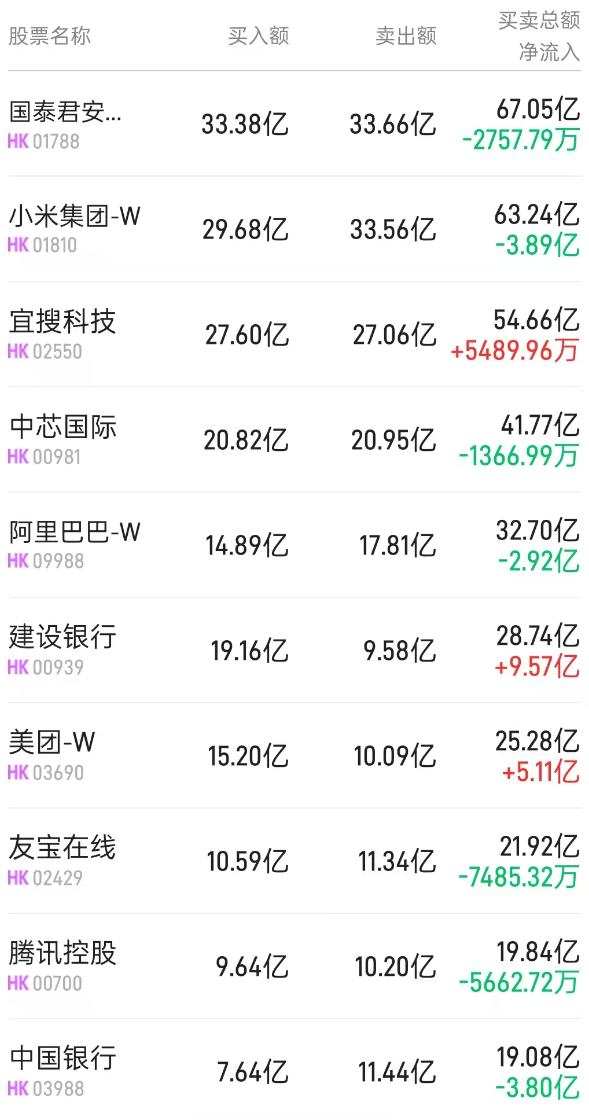
南向资金今日大幅净买入52.2亿元。港股通(沪)方面,建设银行、美团-W分别获净买入9.57亿港元、5.11亿港元;小米集团-W净卖出额居首,金额为3.89亿港元;港股通(深)方面,中芯国际、快手-W分别获净买入7.28亿港元、3.15亿港元;腾讯控股净卖出额居首,金额为2.69亿港元。
news flash· 2025-06-30 09:33
Group 1 - Southbound funds recorded a significant net purchase of 5.22 billion yuan today [1] - In the Hong Kong Stock Connect (Shanghai), China Construction Bank and Meituan-W received net purchases of 957 million HKD and 511 million HKD respectively [1] - Xiaomi Group-W had the highest net sell amount at 389 million HKD [1] Group 2 - In the Hong Kong Stock Connect (Shenzhen), SMIC and Kuaishou-W received net purchases of 728 million HKD and 315 million HKD respectively [1] - Tencent Holdings had the highest net sell amount at 269 million HKD [1]
博纳影业遭中信系和阿里系联合减持不超过5%股份 套现金额上限合计超3亿元
Xin Lang Zheng Quan· 2025-06-30 07:58
Core Viewpoint - Bona Film Group's major shareholders, including CITIC and Alibaba, plan to reduce their holdings by up to 68,315,264 shares, representing 5.0016% of the total share capital, with a maximum cash-out amount exceeding 300 million yuan [1][3]. Shareholder and Reduction Scale - CITIC Group, holding 10.34% of shares, plans to reduce up to 3% of its holdings (approximately 40.9764 million shares), with CITIC Securities alone reducing 1.06% [2]. - Alibaba Group, holding 6.22% of shares, plans to reduce up to 2.0016% of its holdings (approximately 27.3389 million shares), marking its first reduction since the IPO [2]. Timeframe and Method of Reduction - The reduction period is set from July 21, 2025, to October 20, 2025, starting 15 trading days after the announcement [4]. - The reduction will be executed through centralized bidding or block trading, with a price not lower than the net asset value of 3.84 yuan per share [5]. Underlying Reasons for Reduction - The primary motivation for the reduction is financial return needs, as both CITIC and Alibaba are financial investors. They face continuous losses from Bona Film Group, with cumulative losses nearing 1.5 billion yuan from 2022 to 2024, and a stock price decline of 18.27% within the year [6]. - Alibaba's recent strategy has involved divesting non-core assets, aligning with its cash flow optimization goals [7]. Signals of Deteriorating Company Fundamentals - Bona Film Group's performance has been declining, with revenue dropping from 2.012 billion yuan in 2022 to 1.461 billion yuan in 2024, and losses expanding from 72 million yuan to 867 million yuan. The first quarter of 2025 saw a net loss of 955 million yuan, a year-on-year decline of over 170 times, indicating a deepening operational crisis [8]. - The expanding losses have led to a loss of internal cash generation capability, compounded by a slow recovery in the film industry, resulting in shareholders lacking confidence in the company's short-term turnaround [8]. Regulatory Risks and Governance Issues - In May 2025, the Xinjiang Securities Regulatory Bureau issued a warning to Bona Film Group and its executives regarding the improper use of funds amounting to nearly 470 million yuan from 2022 to 2023, which, although returned, exposed failures in internal controls [9]. - Such violations undermine investor trust and increase the willingness of shareholders to reduce their holdings [10]. Market Impact and Potential Risks - The planned 5% reduction in shares is expected to exert significant pressure on the stock price, particularly in a weak market, potentially impacting liquidity in the secondary market [11]. - The first reduction by Alibaba signals a pessimistic outlook, and further reductions could trigger a chain reaction, shaking market confidence in governance stability despite claims that the reduction will not lead to a change in control [13]. Industry Challenges Reflected - The performance decline of Bona Film Group is indicative of broader challenges in the film industry, which is facing strict content reviews, high production costs, and competition from streaming services, with a 9% year-on-year decline in national box office revenue in 2024 [14]. - The reduction by shareholders reflects skepticism about the long-term profitability model of film assets amid these industry headwinds [14]. Capital Withdrawal Amid Multiple Challenges - The reduction is seen as a stop-loss action by financial investors in response to the deteriorating fundamentals of Bona Film Group, including expanding losses, shrinking revenue, governance failures, and industry headwinds [14]. - If the company fails to launch a successful content piece in 2025 or attract strategic capital through restructuring, it may enter a downward spiral of shareholder reductions, declining financing capabilities, and worsening operations [14].
建设银行江苏省分行打造“商投行一体化”服务科创企业样板间
Xin Hua Ri Bao· 2025-06-30 01:34
Core Viewpoint - The Jiangsu Branch of China Construction Bank (CCB) is implementing an integrated "commercial investment banking" strategy to support the growth of technology innovation enterprises, providing comprehensive financial services throughout their lifecycle [1][11]. Group 1: Integrated Financial Services - CCB Jiangsu Branch has established a "three libraries and one platform" system, including a cooperation library for equity institutions, a project library for technology innovation enterprises, and a comprehensive service product library, to offer all-encompassing services for technology enterprises [1][2]. - The bank is focusing on early-stage enterprises, facilitating equity financing and direct financing through a partnership with various institutions, thus creating an ecosystem for equity cooperation in Jiangsu [2][3]. Group 2: Case Studies of Support - A startup in Nanjing, focused on quantum security technology, received 20 million yuan in investment through a financing roadshow organized by CCB Jiangsu Branch, addressing its urgent funding needs [2]. - Another startup in Nanjing, specializing in 3D machine vision, was granted a credit limit of 40 million yuan and an additional 10 million yuan in loans to support its operational needs and expansion plans [2]. Group 3: Innovative Financial Products - CCB Jiangsu Branch has introduced inclusive financial products such as "Shanxin Loan," "Shanke Loan," and "Yunzhi Loan" to cater to the unique needs of early-stage technology enterprises, addressing their challenges in credit information accumulation [3]. - By May 2025, the cumulative issuance of these loans exceeded 30,000 clients, with a total amount nearing 20 billion yuan [3]. Group 4: Support for Growth Stage Enterprises - The bank has created a project library for growth-stage technology enterprises, identifying over 8,000 key clients for support, and effectively combining credit investment with equity investment [4][5]. - CCB Jiangsu Branch has established 29 specialized technology branches to provide tailored services for technology enterprises, enhancing their growth and operational efficiency [5]. Group 5: Capital Empowerment for Strategic Transformation - CCB Jiangsu Branch has engaged in significant debt-to-equity investments, such as over 900 million yuan in a leading new energy vehicle company, to support its strategic transformation [9]. - The bank has also facilitated nearly 40 billion yuan in supply chain financing for over 1,000 enterprises, enhancing the operational efficiency of the supply chain [9]. Group 6: Digital Innovation and Ecosystem Building - CCB Jiangsu Branch is developing a technology innovation evaluation system to address the challenges in assessing the value of scientific and technological achievements, becoming a pilot institution for the Ministry of Science and Technology [10]. - The bank has organized various thematic activities to connect financing projects with potential investors, enhancing the matching process between the two parties [10].