salesforce(CRM)

Search documents
AI业务加速放量但收入拐点仍待确认 华尔街对赛富时(CRM.US)持谨慎乐观态度
智通财经网· 2026-02-26 16:17
Core Viewpoint - Salesforce (CRM.US) continues to demonstrate double-digit growth in its latest earnings report, with a focus on the commercialization progress of its flagship AI product, Agentforce. However, several Wall Street investment banks remain cautious about whether the overall revenue growth can significantly rebound [1][2]. Group 1: Financial Performance - Salesforce's fourth-quarter performance shows robust growth, with Agentforce's annual recurring revenue (ARR) reaching $800 million, a 169% year-over-year increase [1]. - Data 360's ARR has grown to $1 billion, and Agentforce's quarterly transaction volume exceeded 29,000, reflecting a 50% quarter-over-quarter increase [1]. - Over 60% of orders for Agentforce and Data 360 come from existing customers, indicating a deepening customer engagement [1]. Group 2: Analyst Ratings and Price Targets - Morgan Stanley maintains an "Overweight" rating with a target price of $287, noting that the product cycle of Agentforce alone may not significantly enhance market valuation [2]. - JPMorgan also holds an "Overweight" rating but has lowered its target price from $365 to $320, highlighting a shift towards a consumption-based model with Flex Credits [2]. - Wells Fargo adopts a "Neutral" rating with a target price reduction to $210, citing that the highlights from Agentforce are overshadowed by overall underperformance [3]. Group 3: Strategic Initiatives - Salesforce announced a new $50 billion stock buyback plan, replacing all previously unused authorizations, which supports long-term growth objectives [3]. - The company reiterated its goal to achieve a revenue growth rebound in the second half of fiscal year 2027, providing a foundation for future growth [2].

Salesforce's record $50 billion stock-buyback plan is proving controversial on Wall Street
MarketWatch· 2026-02-26 16:02
Core Viewpoint - Salesforce has announced a record $50 billion stock buyback plan to counteract a significant stock selloff, raising questions among analysts about the effectiveness of this strategy compared to investing in artificial intelligence capabilities [1] Group 1: Stock Buyback Plan - Salesforce's $50 billion share-repurchase program is one of the largest in history, aimed at returning capital to shareholders amid a declining stock price [1] - The new buyback plan replaces previous authorizations, which were estimated to have about $18 billion remaining according to D.A. Davidson analyst Gil Luria [1] Group 2: Financial Performance - In the fourth quarter, Salesforce returned 99% of its free cash flow to shareholders, indicating a strong commitment to shareholder returns [1]

Salesforce Stock Has Substantial Upside, Says Mizuho's Moskowitz
Youtube· 2026-02-26 15:48
Core Viewpoint - Salesforce is experiencing a significant decline in stock value due to a soft outlook, raising investor concerns in the software sector, despite the potential for organic revenue reacceleration and a commitment to profitable growth [2][5]. Group 1: Company Performance and Outlook - Salesforce announced a major buyback authorization of $50 billion, indicating confidence in the intrinsic value of its stock, although this has not yet restored investor confidence [5][6]. - The company expects to see accelerating growth in the second half of the fiscal year, particularly in Q3 of fiscal 2027, which is three quarters away [8]. - Salesforce's productive sales representatives have increased by 15% year over year, compared to flat growth a year ago, suggesting a positive trend in investment behind growth [9]. Group 2: Revenue Drivers and Challenges - The "agent force" software, which includes autonomous agents for various business processes, has shown significant growth, increasing from $540 million to $800 million in annualized recurring revenue [10][11]. - The company faces challenges in its marketing and commerce segments, which are expected to continue decelerating, posing a risk to overall growth [14]. - Current remaining performance obligations (CRPO) grew by 13% on a constant currency basis, with a year-over-year growth of 30%, reflecting a mixed quarter performance [15][16]. Group 3: Market Sentiment and Analyst Perspectives - The prevailing narrative in the market is that AI will disrupt many software companies, contributing to decelerating growth, which is currently affecting Salesforce [6][7]. - Despite lowering the price target from $280 to $265, analysts remain optimistic about the potential for accelerating growth in 2026, indicating substantial upside potential from current stock levels [15][16].
These Stocks Are Today’s Movers: Nvidia, Sandisk, Paramount, IonQ, D-Wave Quantum, J.M. Smucker, Celsius, and More
Barrons· 2026-02-26 21:51
Nvidia, Sandisk, IonQ, D-Wave Quantum, Paramount, J.M. Smucker, Salesforce, and More Movers - Barron'sSkip to Main ContentThis copy is for your personal, non-commercial use only. Distribution and use of this material are governed by our Subscriber Agreement and by copyright law. For non-personal use or to order multiple copies, please contact Dow Jones Reprints at 1-800-843-0008 or visit www.djreprints.com.# These Stocks Are Today's Movers: Nvidia, Sandisk, IonQ, D-Wave Quantum, Paramount, J.M. Smucker, Sal ...

Salesforce Eases AI Fears With Strong Outlook and Big Buybacks
Yahoo Finance· 2026-02-26 15:36
Core Insights - Salesforce Inc. provided a robust long-term sales outlook, projecting $63 billion in annual revenue by fiscal year 2030, surpassing Wall Street's expectation of $60.3 billion [1] - The company announced a $50 billion stock buyback program and increased its quarterly dividend to 44 cents per share [1] Group 1: Financial Performance - Salesforce's revenue for the fiscal year ending January 2027 is projected to be approximately $46 billion, aligning with analysts' estimates [3] - The company reported a 12% increase in sales to $11.2 billion for the three months ending January 31, marking its fastest revenue growth in years, aided by $399 million from the acquisition of Informatica [6] Group 2: Market Position and AI Impact - Salesforce has faced significant share price declines over the past year due to investor concerns about AI's potential to disrupt established software vendors [2] - The company is promoting its AI tool, Agentforce, which has seen annual recurring revenue rise to over $800 million, up from $500 million in the previous quarter [5] Group 3: Customer Commitment and Growth - Salesforce's Executive Vice President stated that the company does not see a decline in customer commitments, despite perceptions that SaaS is declining, and noted record bookings [3] - The company anticipates "organic growth re-acceleration" in the second half of the year [3]
Salesforce涨3.3%,上季业绩表现稳健+拟回购500亿美元股票
Jin Rong Jie· 2026-02-26 15:30
Core Viewpoint - Salesforce reported strong fourth-quarter earnings, exceeding market expectations, and announced a significant stock buyback plan, indicating confidence in future growth [1] Financial Performance - Revenue for the fourth quarter increased by 12% year-over-year to $11.2 billion, slightly above market expectations of $11.18 billion [1] - Net profit rose by 13% year-over-year to $1.94 billion, with adjusted earnings per share of $3.81, surpassing market expectations of $3.04 [1] Key Metrics - Annual recurring revenue from Agentforce surged by 169% year-over-year to $800 million [1] - The company announced a $50 billion stock buyback plan and increased its quarterly dividend, which management characterized as an "excellent buying opportunity" [1]
Marc Benioff downplays software apocalypse fears: 'It may be eaten by the SaaS-quatch'
Business Insider· 2026-02-26 15:26
Core Viewpoint - Salesforce CEO Marc Benioff downplayed fears of an impending "SaaSpocalypse" due to AI advancements, suggesting that the demand for software-as-a-service (SaaS) is actually increasing with the introduction of AI agents [1][3] Group 1: Market Reaction and Demand - Salesforce is experiencing "incredible demand" for its Agentforce platform, indicating strong market interest in AI-driven solutions [3] - Following Benioff's comments, Salesforce shares rose by approximately 2% [3] Group 2: Industry Context and Historical Perspective - Concerns about a potential AI-driven recession have recently affected software stocks, including Salesforce and Asana, particularly after the launch of new AI tools by Anthropic [2] - Benioff reminded investors that Salesforce has previously navigated challenges in the SaaS industry, referencing past "SaaSpocalypses" and emphasizing the company's resilience [4]

Jim Cramer is Shocked By Reports of Slow Salesforce (CRM) Agentforce
Yahoo Finance· 2026-02-26 15:22
We recently published 12 Stocks on Jim Cramer’s Radar. Salesforce Inc (NYSE:CRM) is one of the stocks on Jim Cramer's radar. SaaS firm Salesforce Inc (NYSE:CRM) is a stock that’s been constantly on Jim Cramer’s radar in today’s AI era. Enterprise software firms have come under investor scrutiny due to AI’s ability to enable companies to develop software without extensively relying on experienced software engineers. Most of Cramer’s comments about Salesforce Inc (NYSE:CRM) have focused on the split in the ...
美股异动丨Salesforce涨3.3%,上季业绩表现稳健+拟回购500亿美元股票
Ge Long Hui· 2026-02-26 15:13
Core Viewpoint - Salesforce reported strong fourth-quarter earnings, exceeding market expectations, which led to a 3.3% increase in its stock price to $198.08 [1] Financial Performance - Revenue for the fourth quarter increased by 12% year-over-year to $11.2 billion, slightly above market expectations of $11.18 billion [1] - Net profit rose by 13% year-over-year to $1.94 billion, with adjusted earnings per share of $3.81, surpassing the market forecast of $3.04 [1] Key Metrics - Annual recurring revenue from Agentforce surged by 169% year-over-year to $800 million [1] - The company announced a $50 billion stock buyback plan and increased its quarterly dividend, which management characterized as a "fantastic buying opportunity" [1]
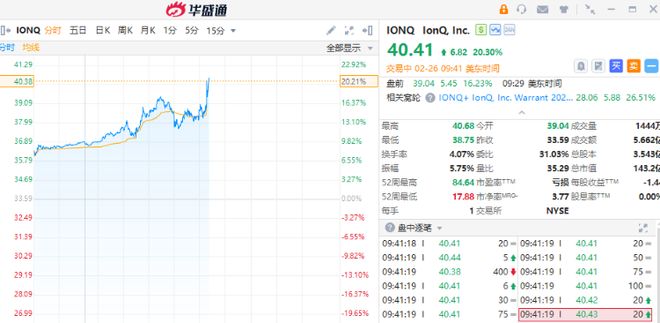
美股异动 | IonQ绩后暴涨20%带飞量子计算股!英伟达绩后跌超2%,博通跌超3%
Xin Lang Cai Jing· 2026-02-26 15:09
Market Overview - The U.S. stock market indices experienced a decline in early trading, with investors awaiting the resumption of the third round of negotiations regarding the U.S.-China trade talks, scheduled to resume later in the evening (Beijing time 23:30) [1] Company Performance - Nvidia's stock fell over 2% following its earnings report, contributing to a broader weakness in the semiconductor sector, with Broadcom down over 3%, AMD down over 2%, and both TSMC and ASML down over 1% [1] - IonQ's stock surged by 20% post-earnings, positively impacting quantum computing stocks, with RGTI and QUBT both rising over 4% [1] - Software stocks showed resilience, with Now Services up over 3%, and both ServiceTitan and CrowdStrike increasing by over 2% [1]