
Dell Technologies(DELL)

Search documents
2月27日你需要知道的隔夜全球重要信息
Sou Hu Cai Jing· 2026-02-26 23:43
Market Performance - US stock market closed with Dow Jones slightly up, S&P 500 down by 0.5%, and Nasdaq Composite down by 1.18% [1] - Nvidia shares fell by 5.5% post-earnings, while AMD and Intel dropped by 3% [1] - Nasdaq Golden Dragon China Index decreased by 1.78%, with Alibaba down by 2.7% and Baidu down by 5.6% [1] - Dell's stock rose by 12% in after-hours trading, and Netflix surged nearly 8% [1] Economic Developments - Significant progress in US-Iran negotiations, with plans for technical discussions in Vienna next week [1] - Federal Reserve's Goolsbee indicated that interest rates could be lowered, but not before inflation eases [1] - US 30-year mortgage rates fell below 6% for the first time since 2022 [1] Geopolitical Events - Six US aerial refueling aircraft are en route to Israel to join military deployments in the region [1] - US-Ukrainian talks in Geneva concluded without specific outcomes [1] - Saudi Aramco canceled liquefied petroleum gas shipments from Juaymah terminal for February and March due to structural damage [1] Industry News - Meta's internal chip design efforts are reportedly facing obstacles [1] - Spot gold prices fell below $5200 per ounce, influenced by US-Iran negotiation progress affecting oil prices [1]


AI Infrastructure and Regulatory Shifts Drive 2026 Market Momentum
Stock Market News· 2026-02-26 23:38
Group 1 - Meta Platforms (META) has entered a multibillion-dollar agreement with Alphabet (GOOGL) to utilize Google's Tensor Processing Units (TPUs) for developing generative AI models, indicating a strategic shift away from reliance on Nvidia (NVDA) [2][9] - This partnership is part of a broader trend among tech companies to diversify their AI hardware sources, following Meta's $60 billion commitment to Advanced Micro Devices (AMD) [3][9] - Dell Technologies (DELL) reported a 39% increase in sales, primarily driven by its AI server business, with an infrastructure backlog reaching $18.4 billion [4][5][9] Group 2 - JPMorgan Chase (JPM) has a positive outlook for the cryptocurrency market, predicting a significant boost in H2 2026 if the Clarity Act is passed, which would provide regulatory certainty [6][7][9] - The Clarity Act is expected to end "regulation by enforcement" and promote the tokenization of traditional financial assets, potentially reshaping the industry's structure [7][9] - Big Tech companies are increasing capital expenditures, focusing on custom silicon and AI infrastructure to support next-generation model development [9]




Dell Technologies (DELL) Beats Q4 Earnings and Revenue Estimates
ZACKS· 2026-02-26 23:31
分组1 - Dell Technologies reported quarterly earnings of $3.89 per share, exceeding the Zacks Consensus Estimate of $3.54 per share, and up from $2.68 per share a year ago, representing an earnings surprise of +9.92% [1] - The company posted revenues of $33.38 billion for the quarter ended January 2026, surpassing the Zacks Consensus Estimate by 4.61%, compared to year-ago revenues of $23.93 billion [2] - Over the last four quarters, Dell Technologies has surpassed consensus EPS estimates three times and topped consensus revenue estimates three times [2] 分组2 - The stock has underperformed the market, losing about 1.9% since the beginning of the year, while the S&P 500 has gained 1.5% [3] - The current consensus EPS estimate for the coming quarter is $2.32 on revenues of $29.3 billion, and for the current fiscal year, it is $11.17 on revenues of $125.94 billion [7] - The Zacks Industry Rank for Computer - Micro Computers is currently in the bottom 6% of over 250 Zacks industries, indicating potential challenges for the sector [8]

华尔街见闻早餐FM-Radio | 2026年2月27日
Hua Er Jie Jian Wen· 2026-02-26 23:26
Market Overview - Nvidia's strong earnings report did not alleviate market concerns, leading to a nearly 5.5% drop in its stock, which negatively impacted the broader US stock market, AI concept stocks, and the semiconductor sector [2] - The Dow Jones Industrial Average saw a slight increase, while the Nasdaq Composite fell nearly 1.2%, almost erasing all gains from the previous day [2] - The yield on US Treasury bonds across various maturities fell by 3 to 4 basis points, with the 10-year yield reaching its lowest point since November 28 of last year [2] Company News - Baidu reported Q4 revenue of 32.74 billion yuan, with AI computing subscription revenue increasing by 143% year-on-year; the company anticipates AI cloud revenue to reach 30 billion yuan by 2025 [7] - CoreWeave's Q4 revenue doubled, with backlog revenue reaching 66.8 billion yuan, although losses unexpectedly widened, leading to a post-market drop in stock price [28] - Dell's earnings and guidance exceeded expectations, with AI server revenue expected to double this year, causing a stock price increase of over 12% in after-hours trading [29] - Netflix rejected a higher acquisition offer for Warner Bros. Discovery and announced a stock buyback plan, resulting in a 13% increase in after-hours trading [30] Industry Insights - The AI computing demand surge is driving significant growth in companies like Baidu and Chipone, with Chipone's revenue projected to grow by 35.77% year-on-year by 2025 [7][24] - The global AI model API aggregation platform OpenRouter reported that Chinese models surpassed US models in usage, indicating a strong growth momentum for Chinese AI firms [47] - SK Hynix and SanDisk are collaborating to standardize High Bandwidth Flash (HBF) technology, which aims to fill the storage gap between HBM and SSDs, expected to be integrated into major products by 2027-2028 [50]




盘后暴涨逾13%!戴尔(DELL.US)AI服务器需求爆棚 财测远超预期点燃市场
Zhi Tong Cai Jing· 2026-02-26 23:25
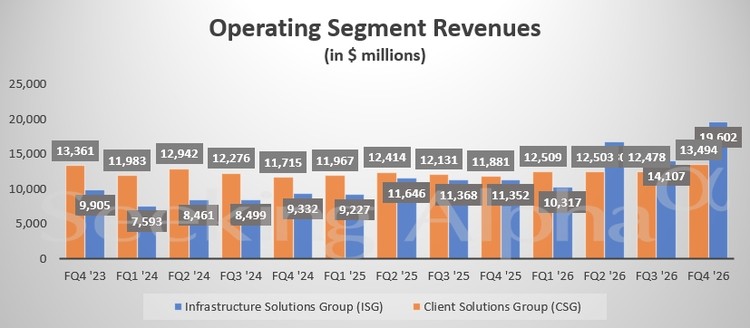
Core Insights - Dell Technologies (DELL.US) has reported a financial outlook that significantly exceeds Wall Street expectations, driven by strong demand for its AI servers, leading to a stock price increase of over 13% in after-hours trading [1] - The company anticipates AI server revenue to reach approximately $50 billion in the fiscal year ending January 2027, representing a year-over-year growth of 103% [1] - Dell's overall revenue forecast for fiscal year 2027 is between $138 billion and $142 billion, well above analyst expectations of $125.54 billion, with adjusted earnings per share projected at $12.90, exceeding the expected $11.59 [1] Financial Performance - Dell's fourth-quarter revenue grew by 39% year-over-year, reaching a record $33.4 billion, surpassing market expectations of $31.73 billion [2] - Adjusted earnings per share for the fourth quarter were $3.89, higher than the anticipated $3.53 [2] - The Infrastructure Solutions Group (ISG) revenue surged by 73% to $19.6 billion, while the Client Solutions Group (CSG) revenue increased by 14% to $13.49 billion [2] Market Dynamics - Dell has over 4,000 AI server customers, including notable companies like Elon Musk's xAI and CoreWeave, with major tech firms such as Google, Microsoft, Amazon, and Meta planning significant investments in AI infrastructure [4] - Despite the rapid growth in AI server business, rising storage chip prices are exerting pressure on profit margins across different segments [4] - The operating margin for the server and networking business was 14.8%, above the expected 12.9%, while the PC business margin was 4.7%, below the anticipated 6.18% [4] Industry Challenges - The current market environment is characterized by high uncertainty, with unprecedented AI demand leading to ongoing supply constraints and frequent price adjustments [7] - The rising costs of storage chips are forcing manufacturers like Dell and HP to increase product prices, which may suppress demand for consumer electronics, including PCs, smartphones, and gaming consoles [7] - Competitors such as HP and Lenovo have indicated potential challenges in their future performance due to pressures on PC shipment volumes [7]
盘后暴涨逾13%!戴尔(DELL.US)AI服务器需求爆棚 业绩指引远超预期点燃市场
智通财经网· 2026-02-26 23:25
Core Insights - Dell Technologies (DELL.US) has significantly exceeded Wall Street expectations in its financial outlook, driven by strong demand for AI servers, leading to a stock price increase of over 13% in after-hours trading [1] - The company anticipates AI server revenue to reach approximately $50 billion in the fiscal year ending January 2027, representing a year-over-year growth of 103% [1] - Dell's overall revenue forecast for fiscal year 2027 is between $138 billion and $142 billion, well above analyst expectations of $125.54 billion, with adjusted earnings per share projected at $12.90, exceeding the anticipated $11.59 [1] Financial Performance - Dell's fourth-quarter revenue grew by 39% year-over-year, reaching a record $33.4 billion, surpassing market expectations of $31.73 billion [2] - Adjusted earnings per share for the fourth quarter were $3.89, higher than the expected $3.53 [2] - The Infrastructure Solutions Group (ISG) revenue surged by 73% to $19.6 billion, while the Client Solutions Group (CSG) revenue increased by 14% to $13.49 billion [2] Market Dynamics - Dell has over 4,000 AI server customers, including notable companies like Elon Musk's xAI and CoreWeave, with major tech firms such as Google, Microsoft, Amazon, and Meta planning substantial investments in AI infrastructure [4] - Despite the rapid growth in AI server business, rising storage chip prices are exerting pressure on profit margins, with the operating margin for server and networking business at 14.8%, above the expected 12.9%, while the PC business margin was 4.7%, below the anticipated 6.18% [4] Industry Challenges - The current market environment is characterized by high uncertainty, with unprecedented AI demand leading to ongoing supply constraints and frequent price adjustments [7] - The rising costs of storage chips are forcing manufacturers like Dell and HP to increase product prices, which may suppress demand for consumer electronics, including PCs, smartphones, and gaming consoles [7] - Competitors such as HP and Lenovo have indicated potential challenges, with HP forecasting its fiscal 2026 performance at the lower end of previous estimates and Lenovo warning of increasing pressure on PC shipment volumes [7]
Dell's stock soars, as record earnings signal the company is managing memory shortages well
MarketWatch· 2026-02-26 23:15
Core Viewpoint - The company, a maker of servers and PCs, is increasing its dividend by 20% [1] Group 1 - The company is enhancing shareholder returns through a significant dividend increase [1]

英伟达市值一夜蒸发超1.7万亿元 什么情况?国际原油盘中直线拉升!美伊谈判 大消息
Mei Ri Jing Ji Xin Wen· 2026-02-26 23:09
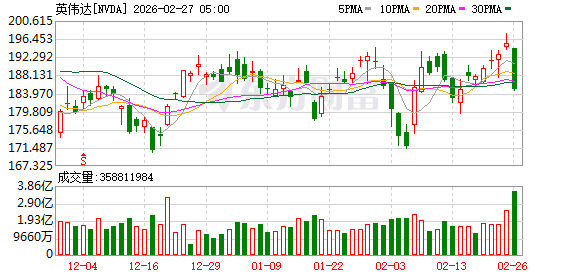
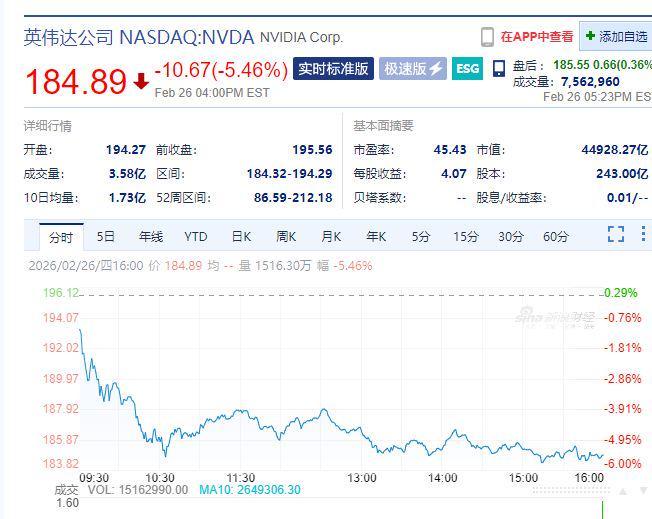
Group 1: Market Performance - On February 26, US stock indices closed mixed, with the Nasdaq down 1.18%, S&P 500 down 0.54%, and Dow Jones up 0.03% [2] - Major tech stocks mostly declined, with Nvidia dropping over 5%, marking its largest single-day decline since April 16 of the previous year, resulting in a market value loss of $259.3 billion (approximately 1773.9 billion RMB) [2] Group 2: Nvidia Analysis - Analysts noted that despite Nvidia's revenue, net profit, and guidance exceeding expectations, investors did not exhibit excessive enthusiasm due to concerns about the company's diminishing competitive edge in an evolving computing landscape [4] - There are worries regarding Nvidia's ability to maintain its impressive growth rate as core customers, particularly large-scale cloud service providers, are consuming most of their cash flow through AI-related capital expenditures [4][5] Group 3: Dell Technologies Performance - Dell Technologies reported a total net revenue of $33.38 billion for Q4, surpassing analyst expectations of $31.74 billion [5] - The company’s AI server shipments reached $9.5 billion in Q4, with a backlog of AI orders amounting to $43 billion [5] - Dell raised its annual stock dividend by 20% and expanded its stock buyback program by $10 billion, projecting revenues of $138 billion to $142 billion for FY2027, exceeding analyst expectations [5] Group 4: Other Market Movements - Intel fell over 3%, Tesla dropped more than 2%, and Google and Amazon declined over 1%, while Netflix rose over 2% and Microsoft and Meta saw slight increases [5] - The quantum computing sector saw significant gains, with IonQ Inc rising over 21% and Rigetti Computing increasing over 5% [5] Group 5: Commodities - Brent and New York crude oil prices experienced a sharp increase during trading [8] - Spot gold prices rose, while spot silver fell by over 1% [9]
英伟达市值一夜蒸发超1.7万亿元,什么情况?国际原油盘中直线拉升!美伊谈判,大消息
Mei Ri Jing Ji Xin Wen· 2026-02-26 23:01
还有分析师表示,"市场目前正处于与广泛的AI担忧抗争的阶段。令投资者深感不安的是,既然核心客 户——这些超大规模云服务商——正在通过AI相关的资本支出消耗掉大部分现金流,英伟达未来该如 何维持其惊人的增长率?" 英特尔跌逾3%,特斯拉跌超2%,谷歌、亚马逊跌超1%,苹果小幅下跌;奈飞涨超2%,微软、Meta小 幅上涨。美股量子计算板块普涨,IonQ Inc涨超21%,Rigetti Computing涨超5%,Arqit Quantum涨超 3%,SEALSQ Corp、D-Wave Quantum涨超2%。 戴尔科技财年四季度总体净营收333.8亿美元,分析师预期317.4亿美元;四季度基础设施解决方案集团 经营户艘196亿美元;四季度AI服务器发货95亿美元,分析师预期94.4亿美元;四季度AI订单积压430亿 美元,AI订单341亿美元;四季度经过AI优化之后的服务器营收90亿美元。公司将年度股票分红提高 20%,将股票回购规模扩大100亿美元。公司预计2027财年营收1380亿~1420亿美元,分析师预期1262.8 亿美元;预计2027财年经AI优化的服务器营收将达到约500亿美元;预计一季度营收3 ...
戴尔科技2026财年营收1135亿美元创历史新高,AI订单积压飙至430亿美元,股息上调20%加码百亿回购
Jin Rong Jie· 2026-02-26 23:01
Group 1 - Dell Technologies reported record high core metrics for Q4 and the full fiscal year 2026, with a net revenue of $33.38 billion, significantly exceeding the expected $31.74 billion [1] - The Infrastructure Solutions Group contributed $19 billion in revenue, with AI-related business showing remarkable performance: AI server shipments reached $9.5 billion, revenue from AI-optimized servers was $9 billion, and AI orders totaled $34.1 billion, with backlog reaching a historic high of $43 billion [1][2] - For the full fiscal year 2026, Dell's revenue reached $113.5 billion, a 19% year-over-year increase, with diluted earnings per share at $8.68, up 36%, and operating cash flow at $11.2 billion, all setting company records [1] Group 2 - Dell Technologies announced a 20% increase in annual cash dividends and a new $10 billion stock buyback authorization, indicating a commitment to enhancing shareholder returns [1] - The company provided a strong outlook for fiscal year 2027, projecting revenue between $138 billion and $142 billion, significantly higher than the previous expectation of $126.28 billion, with AI-optimized server revenue expected to reach approximately $50 billion [1] - In Q1 of fiscal year 2027, Dell anticipates revenue between $34.7 billion and $35.7 billion, also exceeding the previous expectation of $29.3 billion [1]