Alphabet(GOOG)

Search documents
谷歌想拿安卓来做PC,但这很可能是一步臭棋
3 6 Ke· 2026-02-09 12:51
Core Viewpoint - Google is reportedly planning to replace Chrome OS with a new operating system called "Aluminium OS," which is based on Android, raising concerns about the potential loss of Chrome OS's advantages as a cloud-based system [6][10]. Group 1: Chrome OS Characteristics - Chrome OS is fundamentally different from traditional PC operating systems, focusing on being a "cloud computer" that primarily runs web applications [3]. - The advantages of Chrome OS include low hardware requirements, allowing it to run on devices with lower specifications than mainstream smartphones, thus keeping device prices low [3]. - Its cloud-based nature makes Chrome OS ideal for educational and office environments, as it allows institutions to restrict access to specific online applications and limit local data storage [5]. Group 2: Concerns About Aluminium OS - The transition to Aluminium OS, which is based on Android, may compromise the cloud computing attributes of Chrome OS, as Android typically requires higher hardware performance [8]. - The new system aims to support more local applications, potentially enhancing productivity for tasks that require local processing, such as video editing and AI training [8]. - However, the shift to a more local storage-oriented system could lead to decreased security and manageability, raising concerns for existing Chrome OS users [10]. Group 3: Potential Benefits and Challenges - Aluminium OS is reported to be compatible with x86 hardware, which could enhance the performance of third-party Android emulators on Windows platforms [11]. - While there may be potential benefits in developing an "Android PC" ecosystem, the transition period could pose challenges for users accustomed to the security and simplicity of Chrome OS [11].



狂砸4万亿,美国四巨头“流血”搞AI,苹果:溜了溜了
3 6 Ke· 2026-02-09 12:44
Core Insights - In 2026, four major US tech giants—Meta, Amazon, Microsoft, and Google—are projected to spend over $600 billion (approximately ¥41,567 billion) on AI infrastructure, marking a more than 70% increase from the previous year, with estimates ranging between $630 billion and $670 billion [1][4]. Group 1: Capital Expenditure Trends - The projected capital expenditure of $670 billion would account for about 2.1% of the US GDP, comparable to the GDP of countries like Sweden ($662 billion) and Israel ($610 billion) [4]. - From 2023 to 2025, capital expenditures from these four companies are expected to show exponential growth, with Meta's spending potentially exceeding 50% of its sales for the first time in 2026 [8][11]. - Specific capital expenditure forecasts for 2026 include Meta at $135 billion, Google at $175 billion to $185 billion, Amazon at $200 billion, and Microsoft expected to exceed $114 billion [14][16]. Group 2: Market Reactions and Implications - The significant investments have raised concerns among investors, as companies like Amazon have seen substantial declines in market value following announcements of large expenditures, with Amazon losing $124 billion in market capitalization recently [16][19]. - The software and services sectors have also been impacted, with a total market value loss of nearly $1 trillion among US companies in these industries over the past week [19]. - Analysts suggest that Nvidia may emerge as a major beneficiary of this AI infrastructure spending, with projected sales exceeding $500 billion by 2025 [19]. Group 3: Apple's Unique Position - Apple stands out as the only major US tech company to reduce its capital expenditure, with a 19% year-over-year decline, while competitors like Microsoft and Google have seen increases of 89% and 95%, respectively [20][23]. - Apple's strategy involves a partnership with Google to utilize a hybrid model for AI, which allows it to access top-tier AI models at a low cost, estimated to incur about $1 billion annually [23][24]. - Despite not leading in AI model development, Apple's extensive ecosystem, including billions of iPhones and other devices, positions it as a potential key player in the AI era [24]. Group 4: Future Outlook - The ongoing AI infrastructure investment trend highlights the critical need for computational power among tech giants, as it becomes a focal point for competition in the AI landscape [25]. - Apple's approach of collaborating with AI model leaders may set a precedent for other consumer tech companies, indicating a shift in strategy within the industry [25].




AI 竞赛终局:电力说了算?
3 6 Ke· 2026-02-09 12:28
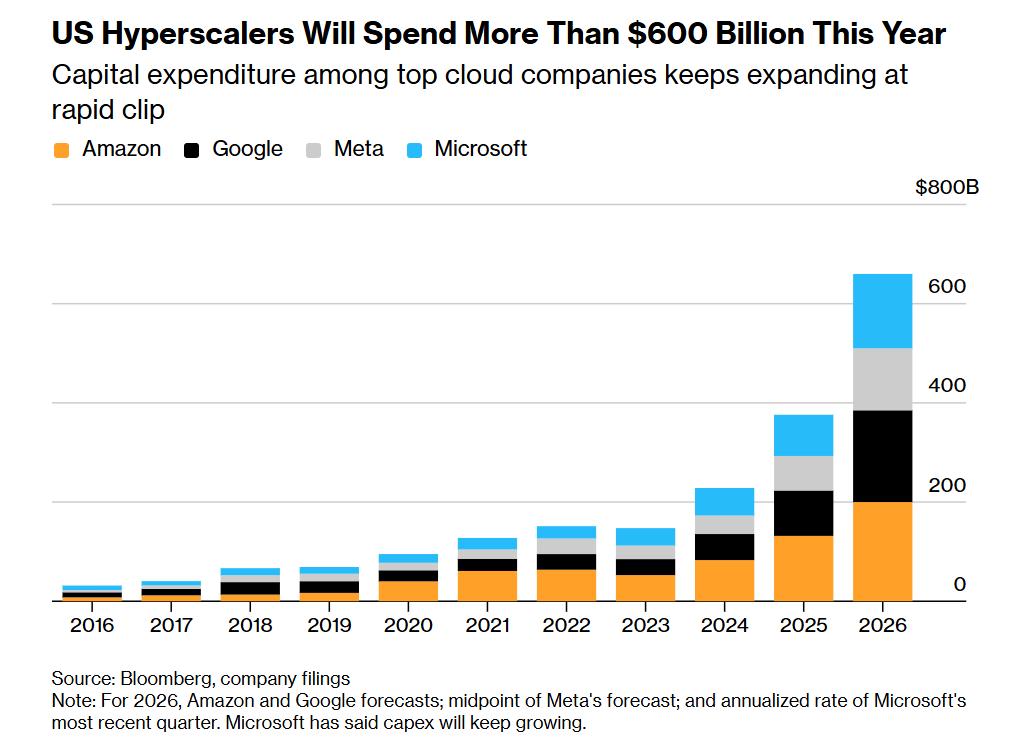
Core Insights - The article discusses the impending electricity shortage in North America due to the exponential increase in power demand driven by AI data centers and the limitations of the aging electrical infrastructure [2][5][91] Group 1: AI and Power Demand - By 2027, the power density of AI servers is expected to be 50 times that of typical cloud servers from five years ago, leading to a significant increase in energy consumption [1] - The demand for electricity is shifting from traditional manufacturing to AI data centers, with the latter becoming the primary driver of electricity consumption growth [4][11] - The capacity auction price for the largest regional grid in the U.S. surged from $28.92/MW-day to $269.92/MW-day, indicating a shift from risk premium to survival panic in the market [4] Group 2: Structural Issues in Electricity Supply - The U.S. faces a dual challenge of energy supply and aging infrastructure, with an average grid age exceeding 40 years and a transformer shortage rate of 30% [2][54] - The retirement of reliable energy sources like coal has led to a significant reduction in the capacity of traditional baseload power, exacerbating the electricity shortage [56][61] - The transition to intermittent energy sources like wind and solar has not compensated for the loss of reliable capacity, leading to a structural mismatch between supply and demand [63][68] Group 3: Future Projections and Investment Opportunities - The North American electricity demand is projected to increase significantly, with AI data centers expected to contribute 80 GW to 120 GW of new peak load over the next five years [52] - The total capital expenditure for major cloud service providers is expected to rise from approximately $150 billion in 2023 to $406 billion by 2025, indicating a massive investment in AI infrastructure [20][22] - The article suggests that the current electricity shortage is a structural issue rather than a temporary imbalance, highlighting the need for significant investment in both energy generation and grid infrastructure to meet future demands [91]

Forget the SpaceX IPO: 1 No-Brainer Stock to Buy Hand Over First for the Artificial Intelligence (AI) Space Economy
Yahoo Finance· 2026-02-09 12:20
Group 1 - The potential IPO of SpaceX is a significant financial storyline in 2026, with discussions ongoing between SpaceX and investment banks [1] - A merger between SpaceX and xAI has been announced, valuing the combined entity at $1.25 trillion, which adds intrigue to the potential IPO [2] - The merger is seen as strategically beneficial, aligning with Musk's long-term vision of integrating SpaceX with Tesla, which recently approved a $2 billion investment in xAI [3][4] Group 2 - The technological synergy between xAI and SpaceX is highlighted, as SpaceX's data collection capabilities can enhance AI applications, particularly in autonomous systems and predictive modeling [5][6] - Satellites and rockets are described as distributed processors, facilitating new use cases in AI execution, emphasizing the importance of space in the AI landscape [6] - Alphabet is identified as a top investment pick at the intersection of AI and space exploration, with a significant presence in the space economy alongside its diverse AI ecosystem [7]

资讯日报:日本自民党在众议院选举中取得胜利-20260209
Guoxin Securities Hongkong· 2026-02-09 11:30
Market Overview - The Hang Seng Index closed at 26,560, down 1.21% for the day and 3.02% for the week, but up 3.63% year-to-date[3] - The S&P 500 index rose by 1.97%, marking its largest single-day gain since May of the previous year[9] - The Nikkei 225 index increased by 0.81%, supported by expectations surrounding the upcoming House of Representatives election in Japan[13] Sector Performance - The lithium battery sector saw gains, with Zhongchuan Aviation rising over 5% and Ganfeng Lithium up over 2%[9] - The automotive sector also performed well, with NIO up nearly 7% and Li Auto increasing by over 3%[9] - The cryptocurrency sector faced significant declines, with New Fire Technology Holdings dropping over 7%[9] Economic Indicators - U.S. consumer credit increased by $24 billion in December, the largest rise in a year, exceeding all economists' expectations[13] - The semiconductor industry is projected to grow by 26% in revenue by 2026, surpassing $1 trillion for the first time[15] Investment Sentiment - There is a notable increase in risk appetite in the market, as evidenced by the rebound in silver prices by nearly 10% and Bitcoin rising close to 12%[9] - Concerns remain regarding the high capital expenditures in AI, with major tech companies like Amazon and Google experiencing stock declines despite overall market gains[10]
Big Tech stocks are treading water after $1 trillion sell-off week
CNBC· 2026-02-09 11:13
Core Viewpoint - Big Tech stocks experienced significant market cap losses, totaling over $1 trillion, leading to cautious trading in the premarket session Group 1: Market Performance - As of 6:12 a.m. ET, Oracle increased by 1.5% and Microsoft by 0.8%, while Meta decreased by 0.3%, Amazon by 0.1%, Alphabet by 0.6%, and Nvidia by approximately 1% after a previous rebound of 7.9% [1] Group 2: Capital Expenditure Trends - The market reacted negatively to rising expenditure outlooks from Big Tech companies, which reported a combined capital expenditure of around $120 billion for the fourth quarter, with projections reaching $660 billion by 2026, surpassing the GDP of nations like the UAE, Singapore, and Israel [2] Group 3: Industry Insights - Cloud companies are seeing increasing margins but face potential stock volatility due to macroeconomic challenges; however, management teams express confidence in their demand forecasting and capacity utilization by 2026 [3]


数据中心供配电设备行业跟踪:海外主要云厂商资本开支持续增长,DRAM价格小幅回落
Shanghai Aijian Securities· 2026-02-09 11:02
Investment Rating - The report rates the industry as "Outperform" [2] Core Insights - The data center industry has become the core incremental application scenario for the power equipment sector, directly driving demand growth and technological iteration for power equipment [5][2] - The report emphasizes the need to incorporate AI industry multidimensional indicators to accurately gauge the demand for power distribution equipment, given the capital expenditure scale and long investment return cycles in the data center sector [2][5] - Key indicators are constructed from three aspects: demand side (capital expenditure from leading cloud vendors), supply chain (GPU supply tracking), and AI application side (development of AI applications) [2][5] Summary by Sections Demand Side - Capital expenditure from overseas major cloud vendors reached $113.862 billion in Q4 2025, a year-on-year increase of 59.42% and a quarter-on-quarter increase of 14.30% [7] - Alibaba's capital expenditure in Q3 2025 was 31.5 billion yuan, a year-on-year increase of 80.10% but a quarter-on-quarter decrease of 18.55% [10] - Tencent's capital expenditure in Q3 2025 was 13 billion yuan, a year-on-year decrease of 24.05% and a quarter-on-quarter decrease of 32.05% [10] Supply Chain - NVIDIA's total revenue in Q3 2025 was $57.006 billion, with data center product revenue reaching $51.215 billion, marking a historical peak with a quarter-on-quarter growth of 24.62% and a year-on-year growth of 66.44% [15] - TSMC's revenue in December 2025 was 335 billion NTD, a year-on-year increase of 20.4% [22] - The CPU price index in December 2025 was 101.21, showing a slight increase from 99.04 in November [27] AI Application Side - The token call volume from January 27 to February 2, 2026, was 9.81 trillion, reflecting a quarter-on-quarter growth of 26.91% [36] - The price of tokens for models scoring over 40 on the Artificial Analysis Intelligence Index decreased by over 50% in Q3 2025 [45] - The report highlights the steady growth in the number of AI models and the increasing application deployment, which directly impacts the capital expenditure cycle of data centers [29]





大手笔AI投资之后:亚马逊、谷歌、Meta要花光现金流了?
美股研究社· 2026-02-09 10:46
以下文章来源于硬AI ,作者专注科技产研的 硬AI . AI时代,快人一步~ 来源 | 硬AI 随着AI基础设施建设的军备竞赛进入"深水区",一个令投资者不安的转折点已然浮现:为了支撑AI算力需求,亚马逊、谷歌和Meta正 面临自由现金流被耗尽甚至透支的风险。 根据摩根大通2026年2月5日发布的研究报告,美国四大云巨头——亚马逊、谷歌、Meta和微软,2026年总资本支出预计将达到6450 亿美元,同比激增56%,新增支出将达到惊人的2300亿美元。 对于投资者而言,2026年,或将是紧盯科技巨头资产负债表的一年。 谷歌97%的增速与亚马逊的"现金赤字" 在这场基建狂潮中,谷歌的投入非常激进。 2026年,谷歌的资本支出指引已上调至1750亿至1850亿美元,同比增速高达97%,其资金正疯狂涌向服务器和技术基础设施。 如果说谷歌还只是在"疯狂花钱",那么亚马逊则堪称"透支未来"。 2026年,亚马逊的资本支出指引约为2000亿美元(同比增长52%)。但问题的核心在于,亚马逊赚回来的现金已经盖不住支出了—— 据标普全球市场分析师预测,亚马逊2026年的运营现金流(OCF)约为1780亿美元。 这意味着,亚马逊 ...

看好太空算力带动太空光伏需求,关注SpaceX合并xAI
INDUSTRIAL SECURITIES· 2026-02-09 10:45
Investment Rating - The industry investment rating is "Recommended (Maintain)" [1] Core Insights - The report highlights the potential growth in the space photovoltaic sector driven by SpaceX's acquisition of xAI, which is expected to create significant demand for solar energy in space [9][18] - The AIDC (Artificial Intelligence Data Center) sector is experiencing a surge in capital expenditure from major cloud companies, indicating strong growth opportunities for related electrical equipment manufacturers [9][13] - The solid-state battery industry is advancing towards commercialization, with significant policy support and technological developments expected to enhance profitability and valuation in the lithium battery sector [17][18] - The energy storage sector is set to benefit from the newly implemented capacity pricing policy, which is anticipated to drive rapid growth in demand for energy storage solutions [19] - The wind power sector is witnessing significant overseas expansion, with Chinese companies successfully securing projects and increasing exports, particularly in the offshore wind segment [20][22] Summary by Sections AIDC Electrical Equipment - Continuous high growth in capital expenditure is observed, with major companies like Alphabet and Amazon significantly increasing their 2026 capital expenditure forecasts [9][13] - The demand for high-density power solutions is expected to rise, providing historical growth opportunities for domestic AIDC manufacturers [10][13] Robotics - The launch of the full-size humanoid robot "Bolt" and advancements in AI-driven robotics are expected to create new investment opportunities in the robotics sector [14] - Companies like Xiaomi and Huawei are positioned to leverage their existing technology in the robotics field, presenting potential investment avenues [14] Solid-State Batteries - The solid-state battery industry is moving towards mass production, with key technological breakthroughs and supportive policies expected to accelerate the commercialization process [17][18] - Companies with strong technological capabilities and production capacity in solid-state battery materials and equipment are likely to benefit [17] Photovoltaics and Energy Storage - The integration of space computing capabilities is projected to open new growth avenues for the photovoltaic industry, with significant investments planned by SpaceX and Tesla [18] - The newly established capacity pricing policy for energy storage is expected to enhance investment confidence and drive rapid growth in the sector [19] Wind Power - Chinese companies are making significant strides in overseas markets, particularly in offshore wind projects, with a notable increase in exports expected [20][22] - The wind power sector is anticipated to enter a new growth cycle, supported by favorable policies and technological advancements [20][22] Grid Investment - The State Grid's investment is set to increase significantly, marking the beginning of a new phase of high-quality development in China's grid infrastructure [21][22] - The demand for smart grid solutions is expected to rise, driven by the need for enhanced energy management and integration of renewable sources [21][22]


United States: TotalEnergies to Provide 1 GW of Solar Capacity to Power Google's Data Centers in Texas for 15 Years
Businesswire· 2026-02-09 10:43
Core Viewpoint - TotalEnergies has signed two long-term Power Purchase Agreements (PPA) to deliver 1 GW of solar capacity to supply Google's data centers in Texas, representing a significant commitment to renewable energy [1] Group 1: Agreements and Capacity - The new PPAs will provide 1 GW of solar capacity, equivalent to 28 TWh of renewable electricity over a 15-year period [1] - The solar power will be generated from TotalEnergies-owned sites currently under development in Texas, specifically Wichita (805 MWp) and Mustang Creek (195 MWp) [1] Group 2: Construction Timeline - Construction for the solar projects is scheduled to begin in Q2 2026, indicating a future commitment to expanding renewable energy infrastructure [1]