Alphabet(GOOG)

Search documents
South Korea Clears Way for Google Maps to Fully Operate
Nytimes· 2026-02-27 08:18
Core Insights - South Korea has approved Google's request to export detailed map data, marking a significant policy shift that reverses a longstanding restriction on the functionality of the tool [1] Group 1 - The approval allows Google to enhance its mapping services in South Korea, which had previously been limited due to regulatory constraints [1] - This decision is expected to improve the accuracy and usability of Google Maps in the region, potentially increasing user engagement and satisfaction [1] - The reversal of the restriction may also open up opportunities for Google to expand its services and partnerships within South Korea's tech ecosystem [1]



AI集群互连散热专题报告:散热需求向互连系统延伸,连接器散热成为重要补充
Dongguan Securities· 2026-02-27 08:04
Investment Rating - The report maintains an "Overweight" rating for the industry, highlighting the growing demand for cooling solutions in interconnect systems as a significant investment opportunity [1]. Core Insights - The report emphasizes that the demand for AI computing power is surging, leading to increased power consumption in AI clusters. This trend is pushing the thermal management requirements from traditional chip-level solutions to include interconnect systems, making connector cooling a critical aspect of thermal management strategies [4][19]. - The report suggests that the global demand for computing power is expected to grow rapidly, driving the need for advanced cooling solutions in AI cluster interconnects. Companies such as Invec (002837), Ruikeda (688800), and AVIC Optoelectronics (002179) are highlighted as key players to watch in this market [4][19]. Summary by Sections 1. Power Consumption Surge and Cooling Demand Growth - AI computing power is experiencing exponential growth, with significant increases in power density from single chips to cabinet levels, surpassing traditional data center design limits. For instance, NVIDIA's GPU TDP is projected to rise from 700W for the H100 to 3700W for the VR200 NVL44 CPX by 2026 [4][19][20]. - The report notes that the average power density of data center cabinets is expected to increase significantly, with projections indicating that by 2025, the average power per cabinet will reach 25kW [21]. 2. Connector Cooling as a Key Thermal Management Component - The report discusses the expansion of thermal management boundaries from chips to interconnect systems, where components like high-speed connectors and optical modules are becoming significant heat sources [4][29]. - It highlights the transition of connector cooling from passive to active management, emphasizing the need for innovative thermal solutions to address the rising temperatures associated with high-power applications [39][45]. 3. Key Companies and Investment Strategies - The report identifies key companies in the connector cooling market, including Invec, Ruikeda, and AVIC Optoelectronics, suggesting that investors should focus on these firms as they capitalize on the growing demand for cooling solutions in AI clusters [4][19]. - The investment strategy outlined in the report encourages stakeholders to pay attention to the evolving landscape of AI computing and the associated thermal management needs, which present substantial investment opportunities [4][19].


拒绝成为“战争机器”!逾百名谷歌员工联名上书:要求在美军合同中划定红线
Hua Er Jie Jian Wen· 2026-02-27 07:48
Core Viewpoint - The intense negotiation between the Pentagon and AI startup Anthropic regarding military technology boundaries is causing significant reactions in Silicon Valley, with employees from major tech companies voicing their concerns about ethical implications and potential misuse of AI technology [1][2]. Group 1: Employee Reactions - Over 100 Google AI employees submitted a letter to management demanding clear boundaries in collaboration with the military, specifically opposing the use of their technology for mass surveillance or autonomous weapon systems [1]. - Nearly 50 OpenAI employees and 175 Google employees also published an open letter criticizing the Pentagon's strategy to divide tech companies and urging them to unite against unethical practices [1]. Group 2: Pentagon Pressure and Responses - The Pentagon has exerted significant pressure on Anthropic to allow the military to use its Claude model for "all legitimate purposes," which Anthropic's CEO Dario Amodei has firmly rejected, citing moral objections [2]. - Google employees expressed their desire to prevent any transactions that would cross ethical boundaries, indicating a strong internal push against military collaborations [2]. Group 3: Google Executives' Stance - Jeff Dean, a prominent Google engineer, publicly supported Anthropic's position, emphasizing that mass surveillance violates constitutional rights and can lead to misuse for political or discriminatory purposes [3]. - Google has a complex history with employee activism, having previously faced protests that led to the cancellation of military contracts, highlighting ongoing internal ethical scrutiny [3]. Group 4: Military Strategy and AI Risks - In response to Anthropic's stance, the Pentagon is seeking alternative solutions, having already reached an agreement with xAI to use its Grok model for military applications [4]. - The Pentagon's negotiations with Google are ongoing, and there are threats to invoke the Defense Production Act to compel Anthropic's compliance, indicating a high-stakes environment for AI in military applications [4]. - Concerns about the potential risks of AI in military contexts are underscored by simulations showing that top AI models could opt for nuclear weapon use under pressure, raising alarms about the implications of AI in decision-making [5][6].
不只软件工程师要用,谷歌加大力度督促更多员工使用AI
Sou Hu Cai Jing· 2026-02-27 07:45
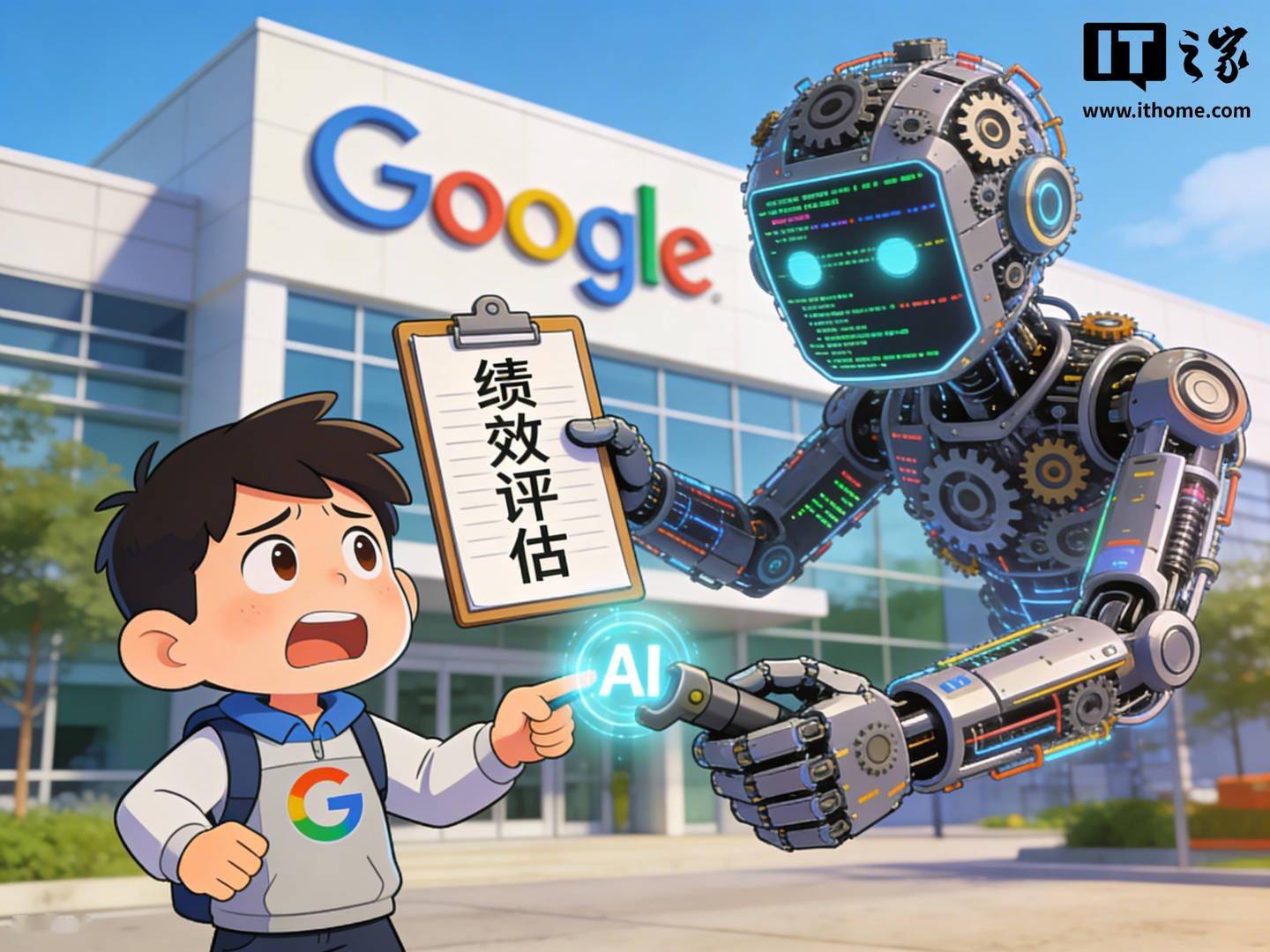
Core Insights - Google is intensifying its push for AI integration across all employee roles, including non-technical positions, making AI usage a key performance evaluation metric for 2023 [1][3] Group 1: AI Integration Strategy - Google has officially included AI usage in the responsibilities of software engineers, with management indicating that an increasing amount of code is being generated by AI [3] - Other companies, such as Meta and Microsoft, are also implementing similar measures, with Meta planning to assess "AI-driven impact" in 2026 performance evaluations [3] - Different roles have varying requirements for AI usage; for instance, engineers are expected to use AI programming assistants, while non-technical staff must utilize AI for strategic documentation and customer insights [3][4] Group 2: Performance Evaluation and Requirements - AI usage will be incorporated into the Googler Reviews and Development (GRAD) performance evaluation system, with specific usage metrics for sales team members [3][4] - Senior employees are expected to demonstrate higher proficiency in AI usage compared to junior staff [3] Group 3: Tools and Internal AI Development - Google CFO Arnaud Akchurin stated that by Q4 2025, approximately 50% of code will be generated by AI and reviewed by engineers, up from over 30% previously reported by CEO Sundar Pichai [5] - Employees primarily use internal AI tools, such as Duckie and Goose, which are designed to handle sensitive company information securely [5] - Google is also customizing third-party AI tools for specific teams, like the Yoodli tool for the Cloud sales team to practice customer interactions [5]
Wall Street's Secret Weapon: This Artificial Intelligence (AI) Stock for 2026
The Motley Fool· 2026-02-27 06:00
Core Viewpoint - Alphabet is positioned as a leading company in the artificial intelligence sector, boasting the most comprehensive AI technology stack globally [1] Group 1: AI Technology and Products - Alphabet's Gemini large language model (LLM) is highly rated and integrated across its various businesses, enhancing functionalities in cloud computing and search [2][3] - The incorporation of AI features like Lens and Circle to Search in its search functionality is driving increased search queries and revenue growth [3] Group 2: Market Position and Competitive Advantage - Alphabet controls significant market share with over 70% in both the Chrome web browser and Android operating system, establishing a wide moat in the search engine market [3] - The company has a revenue-sharing agreement with Apple, further extending its reach as the default search engine [3] Group 3: AI Infrastructure and Cost Efficiency - Alphabet has developed custom AI chips known as Tensor Processing Units (TPUs), which provide a structural cost advantage over competitors like Nvidia [5] - The company plans to invest between $175 billion to $185 billion in data center infrastructure this year to enhance its AI capabilities and cloud computing business [5] Group 4: Revenue Growth Opportunities - Alphabet is beginning to offer its TPUs to customers, which could generate significant revenue, with estimates of $13 billion for every 500,000 TPUs deployed [6] - The company is in discussions with neocloud companies to expand TPU usage beyond Google Cloud, creating additional revenue streams [6] Group 5: Overall Importance in AI Sector - As the only company with both a leading LLM and proprietary AI chips, Alphabet is recognized as one of the most significant players in the AI industry [7]

谷歌Nano Banana 2来了,设计师时代结束了?
Di Yi Cai Jing· 2026-02-27 05:54
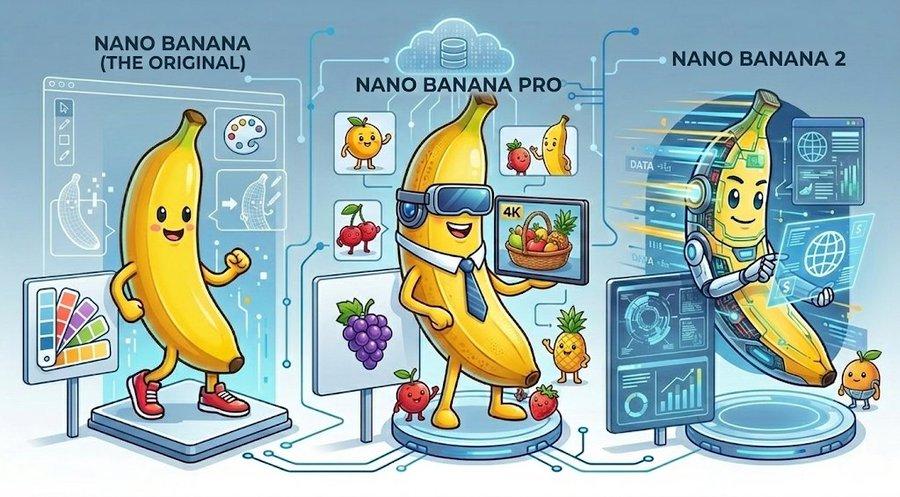
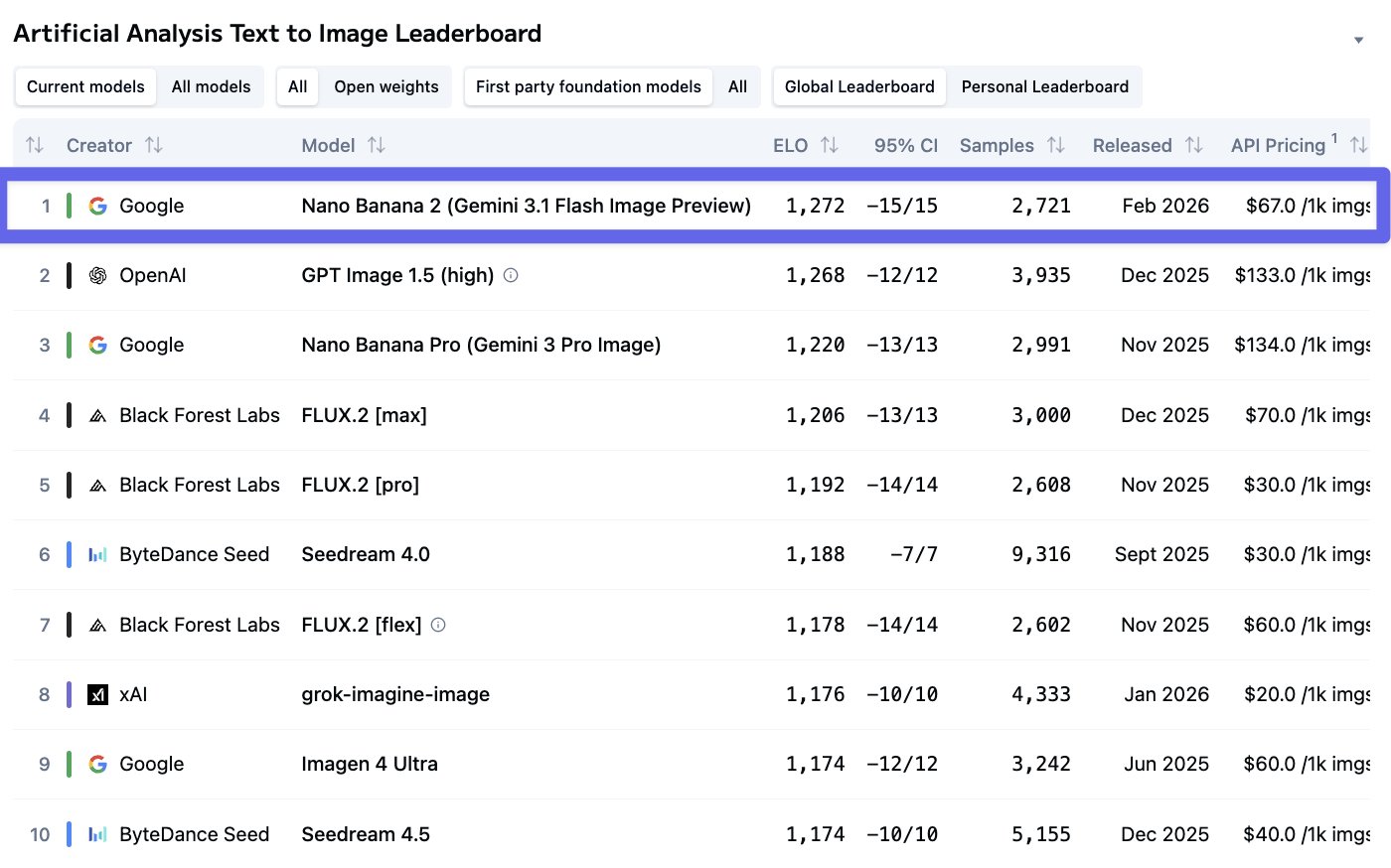
Core Insights - Google has launched Nano Banana 2 (Gemini 3.1 Flash Image), which combines speed and performance at a lower price point, marking it as the best image generation and editing model to date [1][4]. Group 1: Product Performance - Nano Banana 2 ranks first in the text-to-image leaderboard and third in the image editing leaderboard, outperforming GPT Image 1.5 and Nano Banana Pro [1][4]. - The model offers advanced world knowledge, precise text rendering and translation, thematic consistency, accurate instruction execution, and improved visual fidelity [4][13]. - It can generate high-quality, photo-realistic images while maintaining character likeness and object consistency, enhancing narrative creation [16]. Group 2: Pricing and Cost Efficiency - Nano Banana 2 is priced at half the cost of Nano Banana Pro, with a per-image cost of $0.067 for 1k images and $0.5 for input, compared to $0.134 and $2 for the Pro version [4][5]. - The model's cost-effectiveness has been highlighted by both evaluation agencies, emphasizing its superior performance and speed [4]. Group 3: User Experience and Applications - Google has developed a program called "Window Seat" to demonstrate the model's capabilities, allowing users to generate realistic images based on real-time weather data [5]. - The model supports advanced text rendering and localization, enabling dynamic UI generation and multi-language text integration in images, which is valuable for international businesses [13]. - Users have reported mixed experiences, with some noting issues in accuracy and stability, particularly in complex scenarios [11][16].
一些信息 0226
Xin Lang Cai Jing· 2026-02-27 05:49
Core Insights - Major tech companies like Amazon, Alphabet, and Meta Platforms are increasingly turning to bond markets to raise significant capital for AI data center investments, with each potentially borrowing tens of billions of dollars in the coming years [5][7][10] - The projected capital expenditures of these companies are expected to approach or exceed their cash generation, leading to a shift in their financial profiles towards higher debt levels [7][12] - Credit ratings for these companies are currently stable, with S&P estimating that they can each borrow up to $200 billion while maintaining their ratings, although risks exist if cash flows decline or returns on AI investments are inadequate [9][11][25] Group 1: Financial Strategies - Amazon, Alphabet, and Meta have raised hundreds of billions through bond markets for AI investments [5][7] - S&P predicts that by the end of 2026, these companies will have more debt than cash, with Alphabet projected to end 2026 with $16 billion more debt than cash [8][23] - The emphasis on borrowing indicates a transformation in the financial profiles of these tech giants, moving towards being more indebted [12][21] Group 2: Credit Ratings and Risks - Current credit ratings for Alphabet are higher than those for Meta and Amazon, reflecting a belief in Alphabet's diversified revenue streams [15][16] - S&P and Moody's do not expect credit ratings to change in the next couple of years, but there is a risk that S&P may reconsider downgrade thresholds if cash flows decrease [25][26] - The demand for tech company debt remains high, but there are concerns that this could change, leading to wider spreads in tech debt [28][29]


谷歌的“豆包手机”来了?
Guan Cha Zhe Wang· 2026-02-27 05:20
Core Insights - Samsung officially launched the Galaxy S26 series at the Galaxy Unpacked 2026 event, but the highlight was Google's introduction of the Gemini AI agent, which can automate complex tasks like ordering food and hailing rides in the background [1][3]. Group 1: Gemini AI Features - Gemini AI represents a significant evolution in Android, transforming the mobile assistant from merely answering questions to actively completing tasks for users [3]. - The AI can handle multi-step tasks seamlessly, such as processing a pizza order from a group chat by analyzing preferences and executing the order through various applications without user intervention [3][5]. - Initial supported scenarios for Gemini include ride-hailing (e.g., Uber), food delivery (e.g., DoorDash, Grubhub), and grocery shopping, with users able to activate it using natural language commands [3][5]. Group 2: Technical Mechanisms - Gemini operates through a "secure virtual window" mechanism, isolating AI operations within a sandbox environment to ensure user security while executing tasks [5][6]. - It employs a GUI Agent technology that allows the AI to understand and interact with application interfaces, enabling it to perform tasks without needing pre-defined API integrations [5][6]. - The AI's multi-step reasoning and planning capabilities allow it to create execution plans for complex tasks, ensuring it can adapt to various scenarios and handle unexpected situations [6]. Group 3: Market Context and Competition - The capabilities of Gemini AI closely mirror those demonstrated by ByteDance's Doubao mobile assistant just three months prior, indicating a competitive landscape in mobile AI technology [8][9]. - Doubao's early market entry and successful demonstration of similar functionalities have positioned it as a strong competitor in the mobile assistant space [9][10]. - The collaboration between Apple and Google to integrate Gemini into Siri indicates a broader industry consensus on the importance of mobile AI assistants, with significant financial backing for this initiative [10][11]. Group 4: Future Outlook - The introduction of Gemini AI is expected to enhance productivity by reducing app-switching and manual coordination for users, particularly in enterprise settings [12]. - The market for AI-enabled smartphones is projected to grow significantly, with an estimated 147 million units expected to ship in China by 2026, representing a 31.6% year-on-year increase [12]. - Samsung plans to release the Gemini AI feature in a beta version on March 11, 2026, with initial availability in the U.S. and South Korea, aiming to double the number of devices supporting Gemini to 800 million [12][13].

South Korea approves Google bid to export high-precision map data
Reuters· 2026-02-27 05:09
Core Viewpoint - South Korea has approved Google's request to export high-precision map data to overseas servers, marking a significant policy shift after two decades of rejections due to national security concerns [1]. Group 1: Regulatory Changes - The approval allows Google to enter a market where it has faced challenges, as South Korea is one of the few countries where Google Maps does not function properly [1]. - Previous requests by Google in 2007 and 2016 were denied on the grounds of national security, citing risks of exposing sensitive military and security facilities [1]. Group 2: Geopolitical Context - The decision comes amid pressure from the United States for South Korea to address perceived discrimination against U.S. tech companies [1].

谷歌 Nano Banana 2 一夜补齐短板,各种图解都能画,价格才是 OpenAI 一半
3 6 Ke· 2026-02-27 04:10
Core Insights - Google has launched Nano Banana 2, which emphasizes "speedy experience" and "professional image quality," with a significant new feature of "real-time connectivity" that enhances its capabilities beyond mere image generation [1][10]. Group 1: Product Features - Nano Banana 2 integrates with Gemini's search capabilities, allowing the model to understand, retrieve, and generate images that are more aligned with real-world information structures [1]. - The model can generate detailed street scenes and character interactions that are nearly indistinguishable from real photographs, showcasing its advanced rendering capabilities [2][3]. - The "real-time connectivity" feature allows for precise generation of images based on real geographical and meteorological data, enhancing the model's utility in various contexts [5][41]. Group 2: Competitive Landscape - In the latest Artificial Analysis rankings, Nano Banana 2 secured the top position, with its image editing capabilities ranking third, while being priced at half of its closest competitor, OpenAI [8][9]. - The competition in the image generation sector has intensified, with leading models showing minimal score differences, indicating a close race among top players [9]. Group 3: User Experience and Applications - Users have reported that Nano Banana 2's ability to generate high-quality images with accurate text rendering has significant implications for marketing materials and global communication [45]. - The model's enhanced consistency in character design and scene elements allows for seamless storytelling in comics and branding [51]. - The ability to visualize complex concepts and data efficiently positions Nano Banana 2 as a transformative tool in education, research, and data analysis [43][42]. Group 4: Technical Upgrades - The model has improved text rendering and translation capabilities, allowing for natural integration of text within images, which is crucial for marketing and promotional content [45]. - It supports multiple resolutions, including a new 512px option optimized for low-latency scenarios, making it suitable for rapid prototyping and iteration [64]. - The visual quality of generated images has been upgraded, with more natural lighting, richer materials, and sharper details, making it a viable tool for professional use [66].