Alphabet(GOOG)

Search documents
中国巨佬最新持仓!两家公司成最大共识
Xin Lang Cai Jing· 2026-02-22 04:21
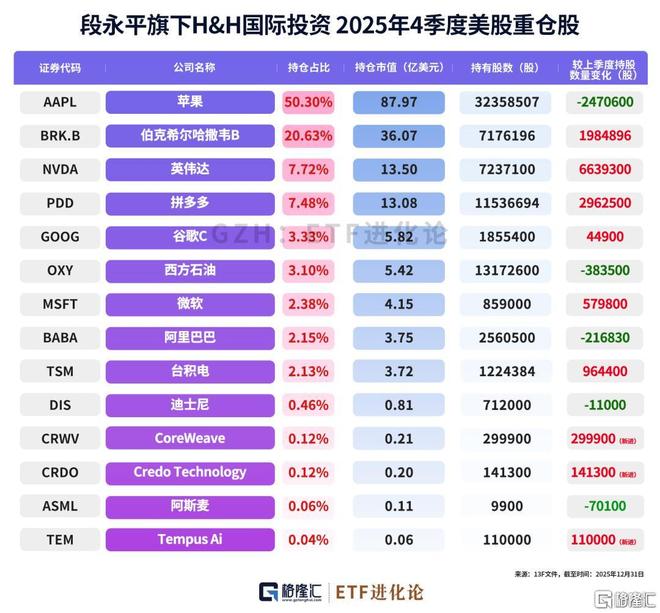
Core Insights - The latest holdings of top investment firms reveal a consensus on Pinduoduo and Google as major investments, with significant increases in their positions by several firms [1][2]. Group 1: Segment Analysis - **H&H Investment (Duang Yongping)**: - Total holdings exceed $17.49 billion (approximately 120.8 billion RMB) with 14 stocks. Major increases in positions for Berkshire, Nvidia, Pinduoduo, Google C, and Microsoft, while reducing Apple, Occidental Petroleum, Alibaba, Disney, and ASML [3][4]. - New investments in AI-related stocks include CoreWeave, Credo Technology, and Tempus AI, with respective holdings of 0.12%, 0.12%, and 0.04% [3]. - **Jinglin Asset**: - Total holdings valued at $4.045 billion, with Google becoming the largest position, replacing Meta. Significant reduction in Nvidia holdings by over 60% [5][6]. - **Himalaya Capital (Li Lu)**: - Total holdings of $3.57 billion, with a highly concentrated portfolio where the top five stocks account for 95.96%. Google is the largest holding at 43.86% [7][8]. - **Hillhouse Capital (HHLR)**: - Total holdings around $3.104 billion, focusing heavily on Chinese stocks, with Pinduoduo making up 39.17% of the portfolio [9][10]. - **Oriental Harbor (Dan Bin)**: - Total holdings of $1.316 billion, with significant increases in Google A and Nvidia, while reducing positions in several other stocks [11][12]. - **Gaoyi Asset**: - Total holdings of $683 million, with a concentrated portfolio where Huazhu and Pinduoduo account for 68.25% [13][14].




Morgan Stanley Lowers its Price Target on Oatly Group AB (OTLY) to $14.50 and Maintains an Equal Weight Rating
Insider Monkey· 2026-02-22 01:49
Core Insights - Generative AI is viewed as a transformative technology by Amazon's CEO Andy Jassy, indicating its potential to significantly enhance customer experiences across the company [1] - Elon Musk predicts that by 2040, humanoid robots could create a market worth $250 trillion, representing a major shift in the global economy driven by AI innovation [2][3] - Major firms like PwC and McKinsey acknowledge the potential of AI to unlock multi-trillion-dollar opportunities, reinforcing the optimistic outlook on AI's economic impact [3] Company and Industry Analysis - A breakthrough in AI technology is believed to be redefining work, learning, and creativity, leading to increased interest from hedge funds and top investors [4] - There is speculation about an under-owned company that may play a crucial role in the AI revolution, suggesting that it could be a significant investment opportunity [4][6] - Prominent figures in technology and finance, including Bill Gates and Warren Buffett, recognize AI as a major technological advancement with the potential for substantial social benefits [8]





硅谷的忠诚已死:只要价码足够高,任何人都可以被挖走
3 6 Ke· 2026-02-22 01:22
Core Insights - The alliance between founders and companies in Silicon Valley is deteriorating, replaced by lucrative offers and constant talent "transfers" [2][4] - Major tech giants like Meta, Google, and Nvidia have spent over $36 billion on "acquisition hiring" since mid-2025, directly poaching top talent rather than traditional acquisitions [2][5] - The concept of loyalty is collapsing, with founders leading the way in leaving their companies, and early employees becoming mere bargaining chips [2][12] Group 1: Talent Acquisition Dynamics - Compensation has no ceiling, with reports of Meta offering over $200 million total packages to top talent, making nine-figure offers commonplace [2][12] - "Legal poaching" has become mainstream, exemplified by Nvidia's $20 billion technology licensing deal with Groq, which is seen as a workaround for antitrust regulations [2][7] - The trend of "acquisition hiring" focuses on securing top talent and their technological contributions rather than acquiring products [5][7] Group 2: Impact on Company Culture - The massive salary disparities between new and existing employees are creating tensions within companies, as seen in Meta's attempts to mitigate the impact of high salaries on company culture [12][18] - The traditional narrative of loyalty and shared mission is being replaced by a transactional mindset, where founders prioritize personal financial gain over employee welfare [14][17] - The shift towards viewing teams as low-risk assets by investors reflects a changing landscape where talent acquisition is prioritized over product success [18][19] Group 3: The Future of Silicon Valley - The ongoing talent war is reshaping the industry, leading to more concentrated capital and income, as well as faster talent turnover [21] - The emergence of a new social contract for tech talent is anticipated, involving stricter confidentiality agreements and collective bargaining [20] - The long-term winners in this evolving landscape may be those companies that can foster team cohesion and create lasting value amidst the chaos [21]


再投12400亿!谷歌,冲击全球AI“王座”
Sou Hu Cai Jing· 2026-02-22 00:34
Core Insights - The valuation methods previously used for the internet may lead to missing significant opportunities in the AI large model sector, but not all companies in this space will receive premium valuations [1] - The gap between leading tech companies and smaller firms is widening, particularly in the AI sector, where competition is intensifying and requires substantial investment [3][11] Group 1: AI Industry Dynamics - The AI industry is characterized by a lack of belief in the ability of smaller companies to compete with giants like Google, OpenAI, and Amazon, due to their superior computational power and resources [3] - Current market valuations for some small AI companies are deemed irresponsible, especially when their revenues are below $1 billion yet they receive valuations in the hundreds of billions [3] - The competition in AI has reached a critical point, with leading tech companies increasing capital expenditures significantly, indicating a no-turning-back scenario [3][5] Group 2: Capital Expenditure Trends - Google’s parent company, Alphabet, plans to raise $20 billion through bond issuance, exceeding initial expectations, with significant investor interest [4] - Major tech companies, including Google, Meta, Microsoft, and Amazon, are projected to spend a total of $650 billion this year on AI infrastructure [5] - Alphabet's capital expenditures are expected to reach between $175 billion and $185 billion in 2026, significantly higher than previous analyst estimates [15] Group 3: Investment Movements - Berkshire Hathaway has made a significant investment in Google, marking a shift in its investment strategy towards tech stocks [8] - Other private equity firms, such as景林资产, have also increased their stakes in Google, indicating a trend of institutional investment in leading AI companies [9] - The focus on AI investments is expected to continue, with industry leaders emphasizing the long-term potential of AI technologies [11][12] Group 4: Financial Performance of Alphabet - Alphabet reported a fourth-quarter revenue of $113.83 billion, a year-on-year increase of 18%, surpassing market expectations [13] - The company’s cloud business revenue reached $17.66 billion in the fourth quarter, growing 48% year-on-year, driven by demand for AI infrastructure [15] - For the full year, Alphabet's revenue exceeded $400 billion for the first time, reaching $402.84 billion, with a net profit of $132.17 billion [14]
X @Cassandra Unchained
Cassandra Unchained· 2026-02-22 00:30
The total revenues of Amazon, Apple, Alphabet, Microsoft, Meta, and Nvidia together do not make up $2 trillion. So you see why leverage is being used to build those data centers. ...


Ray Dalio Sours On America And Sold These Tech Stocks
Yahoo Finance· 2026-02-21 19:12
Group 1: Economic Concerns - Legendary investor Ray Dalio has expressed concerns about the U.S. economy, highlighting unsustainable debt and geopolitical conflicts impacting long-term economic growth [1] - Bridgewater Associates reduced holdings in major tech stocks due to worries about artificial intelligence (AI) capital spending not justifying returns [6] Group 2: Microsoft Corporation - Dalio offloaded 113,078 shares in Microsoft, reducing its portfolio share from 2.23% to 1.74%, with MSFT stock experiencing a 4.25% decline over the past year [3][4] - Despite steady revenue growth driven by Azure and cloud segments, investor anxiety over AI margins versus spending has led to a sell-off, compounded by concerns over high valuation and potential market correction [4][6] Group 3: Meta Platforms - Bridgewater sold 193,218 shares of Meta Platforms, with the stock down 7.20% over the past year, currently trading at $644 [7] - Analysts remain bullish on Meta, but investor skepticism exists regarding excessive AI spending, with capital expenditures expected to rise due to heavy investments through 2026 [8] Group 4: Portfolio Rebalancing - Dalio added positions in Nvidia, Broadcom, Oracle, Adobe, and Micron while trimming major positions in Microsoft, Meta, and Alphabet, indicating a strategy of portfolio rebalancing rather than exiting the sector entirely [6]
Nvidia vs. Alphabet: Which Is the Best Artificial Intelligence (AI) Stock to Buy Now?
Yahoo Finance· 2026-02-21 19:02
Core Viewpoint - Nvidia and Alphabet are major players in the artificial intelligence sector, with Nvidia primarily providing GPUs and Alphabet developing its own TPU, which serves a specific niche in AI computing [1][3][4]. Group 1: Company Overview - Nvidia specializes in graphics processing units (GPUs) that are widely used for AI, cryptocurrency mining, drug discovery, engineering simulations, and gaming graphics [3]. - Alphabet has developed the Tensor Processing Unit (TPU) over the past decade in collaboration with Broadcom, positioning itself as a competitor in the AI computing space [4]. Group 2: Market Dynamics - While Nvidia's GPUs are versatile, they may not be fully utilized for specific workloads, leading to inefficiencies for clients [3]. - Alphabet's TPUs are available exclusively through Google Cloud, which may limit clients' flexibility in switching providers, thus encouraging a balanced use of both Nvidia's GPUs and Alphabet's TPUs [5]. Group 3: Revenue and Future Outlook - A significant portion of Nvidia's revenue is derived from AI, raising concerns about potential revenue impacts if AI spending declines in the future [6].
Alphabet (GOOG) Jumps 4% as Dividend Looms
Yahoo Finance· 2026-02-21 16:12
Core Viewpoint - Alphabet Inc. (NASDAQ:GOOG) has shown strong financial performance, with significant growth in both net income and revenues, leading to a positive market reaction and an upcoming dividend payment [1][2][3]. Financial Performance - In 2025, Alphabet's net income increased by 32% to $132 billion from $100 billion in 2024, while revenues surged by 15% to $402.8 billion from $350 billion year-on-year [2]. - For the fourth quarter, net income rose by 29.8% to $34.4 billion from $26.5 billion, and revenues jumped by 18% to $113.8 billion from $96.5 billion [3]. Dividend Announcement - Alphabet announced a dividend payment of $0.21 per share for Class A, B, and C shareholders, with the record date set for March 9, 2026, and payment scheduled for March 16 [1]. Business Growth and Innovations - CEO Sundar Pichai highlighted the launch of Gemini 3 as a significant milestone, indicating strong growth momentum across the business [4]. - YouTube's annual revenues exceeded $60 billion, with over 325 million paid subscriptions, while Google Cloud achieved an annual run rate of over $70 billion, driven by demand for AI products [5]. Upcoming Events - Chief Finance Officer Anat Ashkenazi is scheduled to participate in the Morgan Stanley Technology, Media and Telecom Conference on March 3, which is anticipated to provide insights for investors [6].
Why Smart Money Buys When AI Stocks Pull Back
Yahoo Finance· 2026-02-21 16:00
Core Viewpoint - The recent decline in tech and AI stocks, driven by high valuations and insufficient revenue growth, presents potential investment opportunities for long-term investors who focus on fundamentals rather than short-term price fluctuations [1][4][5]. Group 1: Market Trends - Over the past two years, AI stocks experienced a surge as investors sought to capitalize on the next tech boom, leading to rapidly climbing valuations [1]. - Recent selloffs in tech and AI stocks are attributed to heavy investments in AI that have pressured margins without generating adequate revenue or earnings growth [4]. - Factors contributing to the selloff include profit-taking by large funds, a market shift towards defensive and value stocks, and geopolitical uncertainties [4]. Group 2: Long-term Investment Perspective - Long-term investors recognize that market corrections do not undermine the long-term potential of established players like Alphabet [5]. - Alphabet's stock has shown a 745% return over the last decade, supported by consistent revenue and earnings growth, strong cash flow, and a clear long-term growth trajectory [6]. - The company's revenue increased from $74.9 billion in fiscal 2015 to a projected $402 billion in fiscal 2025, with earnings per share rising from $1.14 to $10.81 during the same period [6]. Group 3: Alphabet's AI Leadership - Despite the tech selloff, Alphabet reported a strong quarter, indicating robust growth in its AI initiatives across all major business lines [7]. - Alphabet has been integrating AI into its products since 2017, establishing itself as a full-stack AI leader with proprietary technology and a diverse range of AI-powered offerings [7].
Can normal people use OpenClaw?
Matthew Berman· 2026-02-21 15:30
When will OpenClaw go mainstream. It still feels to me that OpenClaw is far too complicated for the average person to set up. So Matt, where's the average person in terms of readiness to adopt OpenClaw and what's holding them back.>> I don't think it's quite there. This is really a tinkerer's dream right now. You have to install it locally. You're still trying to iterate.There's still so much discovery, but for the average person that just wants a one-click install and everything to just work, it's not quit ...