Goldman Sachs(GS)

Search documents
Donald Trump set to host Wall Street CEOs including Jamie Dimon for swanky White House dinner
New York Post· 2025-11-12 15:33
Core Points - President Trump is hosting a dinner for Wall Street executives to garner support for his economic agenda [2][4] - Attendees include prominent figures such as JPMorgan Chase CEO Jamie Dimon, Goldman Sachs CEO David Solomon, and BlackRock CEO Larry Fink [1][4] - The dinner follows increased scrutiny of the administration's economic policies, particularly after a Democratic Socialist won the New York mayoral race focusing on living costs [5] Group 1 - The dinner is seen as an effort by Trump to engage with top business leaders and strengthen ties with corporate America [2][5] - The event is scheduled for 7:30 p.m. ET in the White House's state dining room [4] - Previous similar events included a dinner with technology leaders, indicating a pattern of engaging with industry executives [10] Group 2 - Jamie Dimon has previously served as a "sounding board" for Trump's economic policies during the 2024 campaign [7][9] - Dimon warned Trump about the potential risks of undermining Federal Reserve Chair Jerome Powell amid criticism of Powell's renovation expenditures [6]



Goldman Says U.S. Stocks Will Continue to Underperform the Rest of the World
Barrons· 2025-11-12 15:26
Core Insights - U.S. stocks have rallied over 16% this year, but they are underperforming compared to global markets, with the MSCI global index up more than 19% and other indices like London's FTSE 100 returning 21% and BlackRock's iShares MSCI Emerging Markets ETF gaining over 32% [1][2] Group 1 - Goldman Sachs predicts that U.S. stocks will continue to underperform relative to other global markets over the next decade due to high valuations in the U.S. and stronger expected growth in other countries [2]
Where Goldman Sachs says the S&P 500 is headed next year and in the next decade
Yahoo Finance· 2025-11-12 15:09
Core Viewpoint - Goldman Sachs projects the S&P 500 to reach 7,600 by the end of 2026, indicating an 11% gain from current levels [1] Group 1: Long-term Forecast - A team led by chief global equity strategist Peter Oppenheimer anticipates a 6.5% annualized return for the S&P 500 over the next 10 years, which is lower than the 7.7% forecast for global equities [2] - The forecast includes a range of bearish and bullish cases for the S&P 500, estimating returns between 3% and 10% [3] Group 2: Economic Factors - The forecast incorporates corporate revenue growth aligned with nominal GDP growth, with a potential modest boost from a weakening U.S. dollar [5] - The current net profit margin for the index is at a record high of 13%, up from 5% in 1990, attributed to global supply chain integration, declining interest rates, and lower corporate taxes [5] Group 3: Valuation Insights - Goldman's valuation forecast assumes no significant change in corporate profitability over the next decade, leading to a forward price-to-earnings multiple of 21 times for the S&P 500, a 10% decline from the current multiple of 23 times [6] - The team believes U.S. equity valuations will likely remain above long-term averages unless there is a dramatic increase in interest rates or a sharp decline in corporate profitability [7] Group 4: Market Concentration Risks - A significant uncertainty in the long-term forecast is the extreme concentration of equity among the largest U.S. companies, whose strong earnings and valuations have inflated stock multiples and returns in recent years [7]
高盛:未来十年美股表现将全球垫底!资金宜转向中国等新兴市场
智通财经网· 2025-11-12 13:50
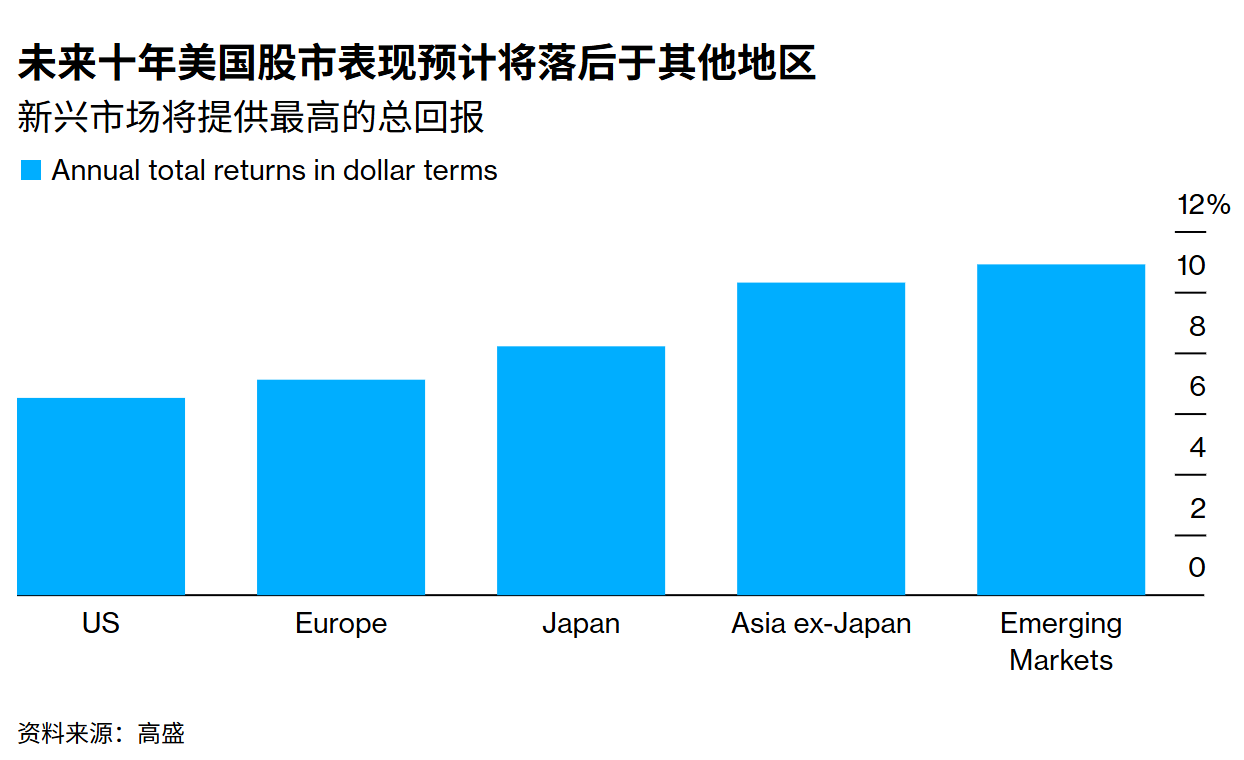
图1 智通财经APP获悉,此前准确预测今年美股跑输其他地区股市的高盛策略师彼得·奥本海默预计,未来十年美国股市将继续落后于全球其他主要市场。奥本 海默及其团队建议投资者提升美国以外市场的多元化配置比例,因当前美国股票估值处于高位,显著抑制了股价上行空间。他们预计标普500指数在未来十 年的年化收益率将达到6.5%,在所有地区中表现最弱。新兴市场预计将成为最强者,年化收益率为10.9%。 在科技股飙升与人工智能热潮的双重推动下,标普500指数虽在过去十年持续领跑全球市场,但2025年迄今已显著落后于全球主要股指同行。该基准指数上 涨了16%,而MSCI公司不含美国的全球指数则上涨了27%。 图2 "向美国以外地区进行多元化配置,重点倾向新兴市场,"奥本海默及其团队在一份报告中写道。"我们预计更高的名义GDP增长和结构性改革将利好新兴市 场,而人工智能的长期效益应该是广泛分布的,而非局限于美国科技领域。" 该行策略师们预计,未来几年新兴市场的收益将由中国和印度强劲的盈利增长推动。除日本外的亚洲地区被视为表现第二佳的地区,年化回报率为10.3%。 在政策驱动投资者分红优化与盈利增长的双重支撑下,日本股市有望实现8. ...
VisionWave Holdings Announces Filing of Schedule 13G by Goldman Sachs Reporting Beneficial Ownership of Approximately 5.2%
Globenewswire· 2025-11-12 13:30
Core Viewpoint - VisionWave Holdings, Inc. has reported that Goldman Sachs Group, Inc. has filed a Schedule 13G with the SEC, indicating beneficial ownership of approximately 798,260 shares, or about 5.2% of the company's outstanding shares as of September 30, 2025 [1][2]. Group 1: Filing Details - The filing was made under Rule 13d-1(b) of the Securities Exchange Act of 1934, which pertains to institutional investors acquiring securities in the ordinary course of business without the intent to influence control of the issuer [2]. - A Schedule 13G is a passive ownership report typically filed by large financial institutions holding positions in multiple public companies, reflecting Goldman Sachs's aggregate ownership across its asset-management and broker-dealer divisions [3]. Group 2: Company Response - Douglas Davis, Executive Chairman of VisionWave, stated that institutional ownership by respected financial firms signifies increasing recognition of VisionWave's technology roadmap and market positioning [4]. - The company remains focused on delivering value to shareholders through disciplined growth and innovation [4]. Group 3: Company Overview - VisionWave Holdings Inc. specializes in developing and commercializing next-generation defense technologies that integrate AI-based sensing, radar, and autonomous systems for various applications [5]. - The company's mission is to enhance situational awareness, safety, and decision-making for government, defense, and commercial customers globally [5].

What typically comes next when the stock market sputters at the start of November
Yahoo Finance· 2025-11-12 12:59
Santa Claus rallies still tend to arrive even when the stock market sputters to open November, Goldman Sachs analysts find. - Spencer Platt/Getty Images The S&P 500 slumped 1.6% last week — but bad first weeks in November usually don’t hang over the stock market through the holiday season. Goldman Sachs analysts led by Gail Hafif found that when the first week of November is down, the median gain for the rest of the year for the S&P 500 SPX is 1.6% and 1.5% for the Nasdaq 100 NDX. Most Read from MarketW ...
高盛:预计未来十年美股将落后于全球市场 建议投资者加大海外布局
Zhi Tong Cai Jing· 2025-11-12 12:17
在过去十年中,美股受科技股飙升及人工智能热潮推动持续领跑全球,但这一趋势今年出现逆转。截至 目前,标普500指数年内上涨约16%,而MSCI全球(不含美国)指数则上涨了27%,显著跑赢美股。 除新兴市场外,高盛预计,日本股市未来十年的年化回报率为8.2%,欧洲市场则预计可为投资者带来 7.1%的年化收益。报告指出,随着全球经济格局的调整与盈利增长来源的多元化,国际市场正迎来新 的投资机遇窗口。 高盛策略团队总结称:"过去十年是美国科技巨头的黄金时代,而下一个十年可能属于全球更广泛的增 长领域。" 高盛集团最新发布的投资展望报告显示,未来十年美国股市的表现可能将逊于其他主要市场。策略师彼 得.奥本海默及其团队指出,当前美股估值过高,将限制未来回报空间,建议投资者提高对美国以外资 产的配置比例,以实现更佳的风险收益平衡。 报告预计,标普500指数未来十年的年化回报率约为6.5%,为全球主要地区中最弱。而新兴市场有望凭 借中国与印度的强劲盈利增长实现约10.9%的年化回报率,成为表现最突出的区域市场。 ...
高盛:预计在未来十年 全球股市以美元计价的年均回报率将达7.7%
Ge Long Hui A P P· 2025-11-12 12:12
格隆汇11月12日|高盛:预计在未来十年,全球股市以美元计价的年均回报率将达到7.7%,接近历史 平均水平。 ...
高盛详解人形机器人“未获订单 先建产能”合理性
第一财经· 2025-11-12 12:08
Core Insights - Goldman Sachs recently released a research report on the humanoid robot industry, indicating that early capacity planning in this sector is reasonable and does not imply an imminent risk of oversupply [2] - The report predicts that global humanoid robot shipments will reach 1.38 million units by 2035, with an optimistic scenario projecting shipments of 11.57 million units, reflecting the early stage of industry development and various future possibilities [2] Group 1: Industry Outlook - Most supply chain companies in the humanoid robot sector are optimistic about future prospects and are actively planning production capacity both domestically and internationally [2][3] - Current capacity planning among Chinese supply chain companies corresponds to an annual production volume of approximately 100,000 to 1 million robots, with many companies intending to scale up after receiving actual orders [3] Group 2: Market Dynamics - The humanoid robot industry currently lacks substantial orders, primarily due to the absence of a significant order volume that can support a robust supply chain [3] - A minimum order volume of over 10,000 units is necessary to establish a viable supply chain system, as smaller orders cannot sustain industry growth [3] Group 3: Application and Demand - Demand for humanoid robots is emerging from technology companies, universities, and government procurement, with potential applications in large model training, factory use, and exhibition performances expected to see growth in the next one to two years [4] - The current application scenarios for humanoid robots are limited, but there is a consensus on the need for differentiated products and technological capabilities to attract investment, especially from overseas [4] Group 4: Market Performance - The humanoid robot sector has experienced a significant rise in the capital market this year, with strong performance in the A-share market reflecting future industry development expectations [4] - According to Gartner, by 2028, 80% of warehouses will utilize robotic technology, and by 2030, 30% of factory workers will interact with humanoid robots in real work environments, a significant increase from the current rate of less than 5% [5]
高盛详解人形机器人“未获订单 先建产能”合理性
Di Yi Cai Jing· 2025-11-12 11:20
Core Insights - Goldman Sachs recently released a research report on the humanoid robot industry, indicating that early capacity planning in this sector is reasonable and does not imply an imminent risk of oversupply [1][3] - The report predicts that global shipments of humanoid robots will reach 1.38 million units by 2035, with an optimistic scenario projecting shipments of 11.57 million units, reflecting the early stage of industry development and various future possibilities [3] Industry Capacity and Planning - Most supply chain companies in the humanoid robot sector are optimistic about future prospects and are actively planning production capacity both domestically and internationally, although no companies have confirmed large orders or specific production timelines [3][4] - Current capacity planning among Chinese supply chain companies translates to an annual production capacity of approximately 100,000 to 1 million robots, with most companies intending to scale up gradually upon receiving actual orders [3][4] Market Demand and Supply Chain Development - The humanoid robot market currently lacks substantial order volumes, with a threshold of over 10,000 units needed to establish a viable supply chain system [4] - Demand for humanoid robots is emerging from technology companies, universities, and government procurement, with potential applications in large model training, factory use, and exhibition performances expected to increase in the next one to two years [4] Investment Trends and Market Performance - The humanoid robot sector has seen a significant rise in capital market interest this year, with strong performance in the A-share market reflecting future industry development expectations [4] - Investors, particularly overseas, are looking for differentiated products and technological capabilities in humanoid robots, alongside ongoing technological breakthroughs and the establishment of practical application scenarios [4] Future Projections - According to Gartner, by 2028, 80% of warehouses will utilize robotic technology, and by 2030, 30% of factory workers will interact with humanoid robots in real work environments, a significant increase from the current rate of less than 5% [5] - Gartner also forecasts that by 2030, humanoid robots using open-source embodied AI technology will cost as low as $5,000, potentially replacing 30% of jobs in the service labor market [6]