
Goldman Sachs(GS)

Search documents
高盛孙祺:期待交易所债券回购业务进一步开放
Xin Lang Zheng Quan· 2025-11-12 10:36
Core Viewpoint - The Shanghai Stock Exchange International Investor Conference highlighted the importance of the bond repurchase market for domestic institutional investors, emphasizing its role as a liquidity management tool and a flexible investment strategy [1][3]. Group 1: Bond Repurchase Market - The bond repurchase market offers unique advantages in terms of collateral standards and central clearing models, facilitating easier access for investors [3]. - The arrangement of the exchange acting as a central counterparty enhances the trading experience in the repurchase market [3]. Group 2: Future Outlook - Many qualified domestic institutional investors are eagerly anticipating further opening measures in the market, indicating a strong willingness to engage in investment and trading once policies are implemented [3].



【环球财经】“AI泡沫论”再起 美股多项指标亮“红灯”
Xin Hua Cai Jing· 2025-11-12 05:43
Core Viewpoint - Concerns about the overvaluation of AI concept stocks are rising, with notable figures like Michael Burry shorting Nvidia and SoftBank liquidating its Nvidia holdings, leading to a decline in tech stocks and a nearly 10% drop in Nvidia's share price since November [1][2] Group 1: Market Dynamics - The total market capitalization of major US tech companies, including Nvidia, Microsoft, and Amazon, has surpassed $20 trillion, with Nvidia's market cap increasing from $4 trillion to $5 trillion in less than four months [2] - The concentration of market capitalization among the top tech companies has reached historical highs, with these firms accounting for over 30% of the S&P 500 index [2] - Since the beginning of 2023, over $500 billion has flowed into the information technology sector, representing more than 36% of the incremental capital [2] Group 2: Analyst Insights - Analysts suggest that the current AI investment frenzy may be reminiscent of the 2000 internet bubble, indicating a collective irrational enthusiasm that could lead to significant asset price deviations from intrinsic values [2][3] - Goldman Sachs CEO David Solomon predicts a potential 10% to 20% market decline within the next 12 to 24 months, while JPMorgan CEO Jamie Dimon warns that many assets appear to be entering a bubble phase [3] Group 3: Profitability Concerns - Michael Burry highlights that many tech companies are extending the useful life of their assets to understate depreciation expenses, potentially inflating profit figures by approximately $176 billion from 2026 to 2028 [3][4] - The AI hype has led to concerns about the sustainability of profits, with OpenAI signing deals worth around $1 trillion for computing power, raising fears of an "AI circular trade" [4] Group 4: Investment Sentiment - Despite concerns, investors continue to increase their bets on AI-related stocks, with Deutsche Bank reporting ongoing capital inflows into popular tech sectors [6] - The proportion of stock investments in American households has reached historical highs, indicating extreme market enthusiasm and risk appetite [6] Group 5: Valuation Metrics - The "Buffett Indicator," which measures the total market capitalization of US stocks against GDP, is at historical highs, with a ratio of 223 as of November 11, indicating potential overvaluation [7] - The shift in valuation metrics from traditional earnings-based models to sales ratios and potential market size reflects a growing reliance on future expectations rather than current performance [7]




高盛上调印度股市评级,看高至29000点
Huan Qiu Wang· 2025-11-12 01:35
Group 1 - Goldman Sachs upgraded the rating of the Indian stock market to "Overweight" with a target of 29,000 points by the end of 2026, citing growth recovery, supportive policies, corporate profit rebound, and foreign investment interest as key factors [1] - Despite a weak performance last year due to foreign capital outflows, Goldman Sachs believes sentiment has reversed, with improved valuations and growth factors such as interest rate cuts and liquidity improvements expected to boost domestic demand [1] - Sectors such as finance, durable consumer goods, and defense are anticipated to lead market gains, supported by low inflation, stable agricultural cycles, and reduced GST rates, which are expected to enhance demand and profits in consumer-related industries [1] Group 2 - On November 10, foreign hedge funds ended a six-day short-selling streak and turned to net buying of Indian stocks, with a net inflow of 45.81 billion Indian Rupees (approximately 5.21 billion USD) [3] - Domestic institutional investors also purchased Indian stocks worth 66.75 billion Indian Rupees [3]
美国政府即将重开,9月非农最早或在周五发布,10月非农可能“没了”,但高盛预期是“2020年12月以来最差”
Sou Hu Cai Jing· 2025-11-12 01:12
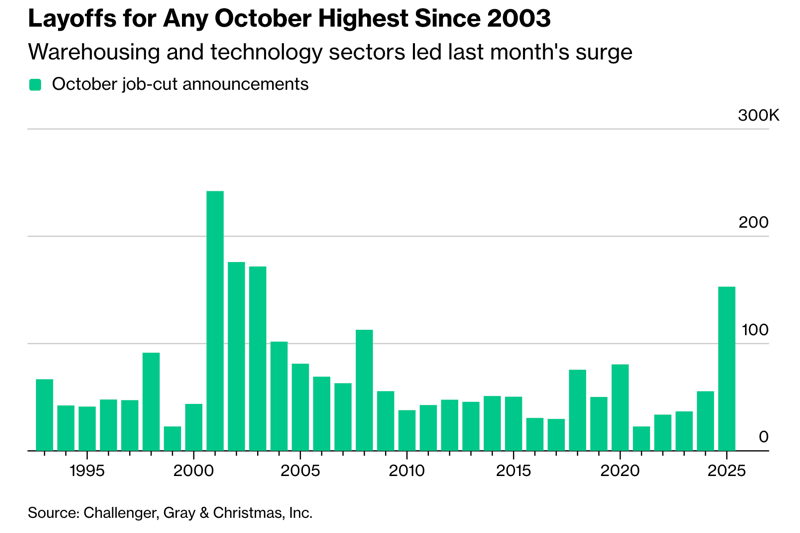
Core Insights - The U.S. government is expected to end its record shutdown, but investors face deteriorating labor data, with Goldman Sachs predicting a potential decline in non-farm payrolls for October, marking the first negative growth in nearly three years [1][2] Group 1: Government Shutdown and Data Collection - The Senate passed a bill to end the government shutdown, allowing key economic data to be released soon [1] - The Labor Department faces unprecedented challenges due to interrupted data collection during the shutdown, leading to potential permanent loss of some October data [2] Group 2: Labor Market Indicators - Private sector indicators show a sharp deterioration in the labor market, with announced layoffs in October reaching 153,000, nearly three times the number from the previous year and the highest for the month since 2003 [3][6] - Average weekly job losses in the private sector were 11,250 in the last four weeks of October, indicating struggles in job creation [7] - Goldman Sachs has adjusted its employment growth tracking indicator for October down to 50,000, a significant decrease from 85,000 in September [10] Group 3: Economic Outlook and Federal Reserve Implications - The interruption of data and the bleak labor market outlook place the Federal Reserve in a difficult position regarding interest rate decisions [15] - Goldman Sachs predicts a 20%-25% chance of a significant rise in the unemployment rate over the next six months, up from 10% six months ago [15][19] - The chaotic data release situation and negative private indicators complicate the risk assessment for investors, suggesting increased market volatility in the coming weeks [19]
美国银行:美低收入家庭“月光”比例升至29%
Zhong Guo Xin Wen Wang· 2025-11-12 00:48
Core Insights - The proportion of "moonlight" families among low-income households in the U.S. has risen to 29% by 2025, indicating that their income barely covers basic living expenses [1] - The report highlights that while the "moonlight" family ratio for high and middle-income households has remained stable, low-income families are experiencing increased economic pressure [1] - The increase in the "moonlight" family ratio among low-income households is attributed to a slowdown in wage growth for this group compared to high-income households [1] Summary by Category Economic Pressure - The "moonlight" family ratio among low-income households increased from 27.1% in 2023 to 28.6% in 2024, and is projected to reach 29% in 2025 [1] - Low-income individuals have been facing greater economic challenges, with wage growth lagging behind that of high-income individuals [1] Demographic Insights - The "Millennial" and "Generation X" groups among low-income families are experiencing the most significant economic pressure [1] Savings and Financial Risk - A Goldman Sachs report indicates that approximately 40% of Americans have no savings, with 74% of this group stating that urgent expenses hinder their ability to save for retirement [1] - The increasing pressure of basic living expenses may lead to greater financial risks for individuals in their later years [1]

华尔街大型银行迎利好!美联储等监管机构就放宽银行资本要求达成一致
智通财经网· 2025-11-12 00:20
Group 1 - The Federal Reserve and other banking regulators have reached an agreement on a final proposal to relax key capital requirements, submitting the "Supplementary Leverage Ratio" proposal for White House review [1] - The revised proposal significantly lowers the capital increase requirement for major Wall Street banks to between 3% and 7%, compared to the 19% increase proposed in 2023 and the 9% from last year's compromise [1] - Major banks like JPMorgan Chase, Bank of America, and Goldman Sachs are expected to benefit from the proposed changes, as they will be required to hold less capital relative to total assets [1] Group 2 - The Basel III final rules aim to clarify how much capital banks need to reserve to withstand economic downturns, with previous proposals facing strong opposition from Wall Street banks due to concerns over increased loan costs and competitive positioning [2] - The Federal Reserve plans to announce the new proposal as early as the first quarter of 2026, led by Vice Chair Michelle Bowman, who was appointed by Trump [2] - The final rules for the Supplementary Leverage Ratio and the Global Systemically Important Bank surcharge are expected to progress simultaneously by the end of 2025 [2]
2 Goldman Sachs ETFs That Are Turning Heads
247Wallst· 2025-11-11 23:19
Core Insights - Goldman Sachs is emerging as a significant player in the ETF market, despite not being the largest name in the industry [1] Company Overview - The investment bank offers unique traits in its ETF offerings, which may appeal to passive investors looking for competitive pricing [1]

Dow Jones Leader Goldman Sachs, Intuitive Stock In Or Near Buy Zones
Investors· 2025-11-11 17:57
Group 1 - Futures rose as the House voted to end the government shutdown, leading to a positive market reaction [1][2] - The Dow Jones Industrial Average reached a new high, indicating a rebound in key indexes [1][4] - Companies such as Intuitive Surgical, Goldman Sachs, and Valero Energy are highlighted as strong performers in the current market [1][4] Group 2 - Bank stocks showed strength, with major banks moving above buy points, suggesting potential investment opportunities [4] - Eli Lilly and AI-related stocks are leading the market, indicating sectors that may be worth monitoring for future growth [4] - The market is testing key levels, with companies like Palantir, Valero Energy, and MongoDB in focus for potential breakouts [4]


Job Losses Mounted In October As Employers 'Struggled'—And Wall Street Projects Grim Job Market
Forbes· 2025-11-11 16:35
Core Insights - The U.S. private sector has experienced a significant job loss, averaging over 11,000 jobs per week through late October, indicating a historic decline in the job market [1][2] - Earlier data suggested a temporary increase in private-sector payrolls in October, but recent reports indicate a sharp decline towards the end of the month [3] Job Market Trends - Private-sector employers shed an average of 11,250 jobs per week in the four weeks ending October 25, highlighting struggles in job creation during the latter half of the month [2] - This decline marks the first recorded job loss by ADP since August, when nearly 20,000 jobs were lost in the four weeks ending August 30 [2] Economic Projections - Analysts at Goldman Sachs predict a decline of 50,000 nonfarm payrolls in October, which would represent the largest single-month drop since late 2020 [4] - Dow Jones economists expect an even steeper decline of 60,000 jobs and a rise in the unemployment rate to 4.5% [4] - Indeed reported that job openings have fallen to their lowest level since February 2021, indicating a tightening job market [4]


高盛:三大结构性利好支撑中国出口持续稳健增长
Shang Hai Zheng Quan Bao· 2025-11-11 11:37
Core Viewpoint - Goldman Sachs' Asia Economic Team projects that China's actual exports are expected to achieve an annual growth rate of around 8% this year, with a forecast of double-digit growth in 2024, leading to an upward revision of the export growth forecast from 2%-3% to 5%-6% for the coming years [1] Group 1 - Structural advantages supporting China's export growth include a significant and expanding cost advantage, which is expected to continue driving an increase in global market share [1] - Increased investment in emerging economies by China is stimulating local demand for Chinese products, exemplified by the growth in capital goods exports to Africa [1] - Strong performance in high-tech product exports is attributed to policy support and robust overseas market demand, with expectations for continued strong growth driven by policy, technological advantages, and higher overseas profit margins [1]