Goldman Sachs(GS)

Search documents
华尔街有多悲观?高盛直接把“软件”类比“报纸”
Hua Er Jie Jian Wen· 2026-02-06 01:56
Group 1 - The core viewpoint of the article is that Wall Street's fear of AI's impact on software stocks has reached an extreme, with Goldman Sachs comparing the current software industry to the newspaper industry of the early 2000s and the tobacco industry of the late 1990s, indicating a fundamental doubt about the long-term growth and profitability of the software sector [1][2][7] - Goldman Sachs reports that software stocks have become the center of the AI impact narrative, experiencing a 15% drop in one week and a cumulative decline of 29% from their September 2025 peak, with their "AI risk exposure basket" down 12% year-to-date [2][3] - The report emphasizes that the current market discussions are not just about profit downgrades but whether the software industry is facing a long-term decline similar to that of the newspaper industry [2][4] Group 2 - Despite a significant drop in software stock valuations, Goldman Sachs highlights that the underlying assumptions behind these valuations are collapsing, with current profit margins and expected revenue growth still at their highest levels in 20 years, significantly above the S&P 500 average [3][5] - The forward P/E ratio for the software sector has decreased from approximately 35 times at the end of 2025 to around 20 times currently, marking a low not seen since 2014 [5][6] - Historical cases, such as the newspaper industry from 2002 to 2009, show that stock prices did not bottom out until profit expectations stabilized, not merely when valuations appeared cheap [4][7] Group 3 - There is a noticeable shift in market preference away from "AI risk" towards sectors perceived as less impacted by AI, such as industrials, energy, chemicals, transportation, and banking [8][9] - Funds have significantly reduced their exposure to software stocks, with hedge funds cutting back while large mutual funds began systematically underweighting software stocks since mid-last year [8][9] - The report indicates that while the overall sentiment is cautious, some sub-sectors still show defensive characteristics, but stability in profit expectations is crucial for stock price recovery [9][11]

T. Rowe Price: Goldman Sachs Partnership Helps This High-Yield Dividend Aristocrat
Seeking Alpha· 2026-02-05 15:10
I've been researching companies in-depth for over a decade, from commodities like oil, natural gas, gold and copper to tech like Google or Nokia and many emerging market stocks, which I believe could help me provide useful content for readers. After writing my own blog for about 3 years, I decided to switch to a value investing-focused YouTube channel, where I researched hundreds of different companies so far. I would say my favorite type of company to cover are metals and mining stocks, but I am comfortabl ...

一文读懂:华尔街“抛AI”妖风祸从何来?
Xin Lang Cai Jing· 2026-02-05 13:15
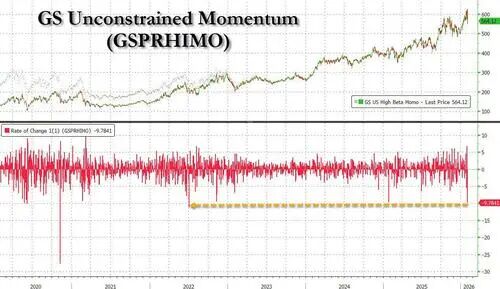
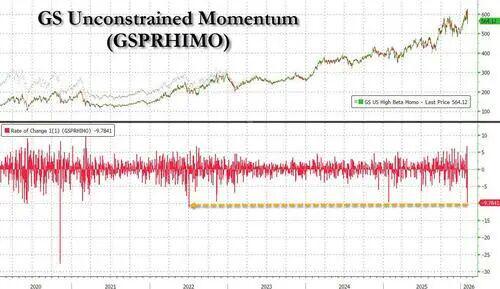
(来源:创业板观察) 自2022年年中以来,动量交易员曾以足以让沃伦·巴菲特感到汗颜的夏普比率统治着市场。然而周三, 这一切几乎遭遇了全线崩盘——他们蒙受了载入史册的损失。 动量交易简单说来就是"买入最近涨得最好的,卖出涨得最差的"。而根据业内的统计,高盛的"高贝 塔"或无约束动量组合(GSPRHIMO)刚刚创下了自2022年以来表现最糟糕的一天,超过了去年1月 Deepseek风暴之后的AI抛售潮。高贝塔股通俗而言就是指那些波动比大盘更剧烈的股票。 如果说,周二市场的跌幅源于软件股因人工智能颠覆风险引发的"投降式"抛售,那么周三的疲软则更集 中于基本面因素与仓位调整,使得大盘指数的变动相对于底层发生的剧烈动荡,显得具有欺骗性的平 稳。 这印证了高盛分析师Lee Coppersmith在上周末文章中的发现,即美股表面平静之下正波涛汹涌。统计显 示,标普500指数成分股平均的1周实际波动率,与整体标普500指数波动率之比在上周四刚刚达到6.88 ——处于2023年以来的第99个百分位。 来源:市场资讯 换句话说,标普500指数成分股的平均波动幅度大约是大盘指数的7倍,这就是为什么近几个交易日部分 个股的异动显得 ...


大摩量化警告:动量崩塌、杠杆ETF大量抛售美股,接盘的散户寥寥无几!
Hua Er Jie Jian Wen· 2026-02-05 13:04
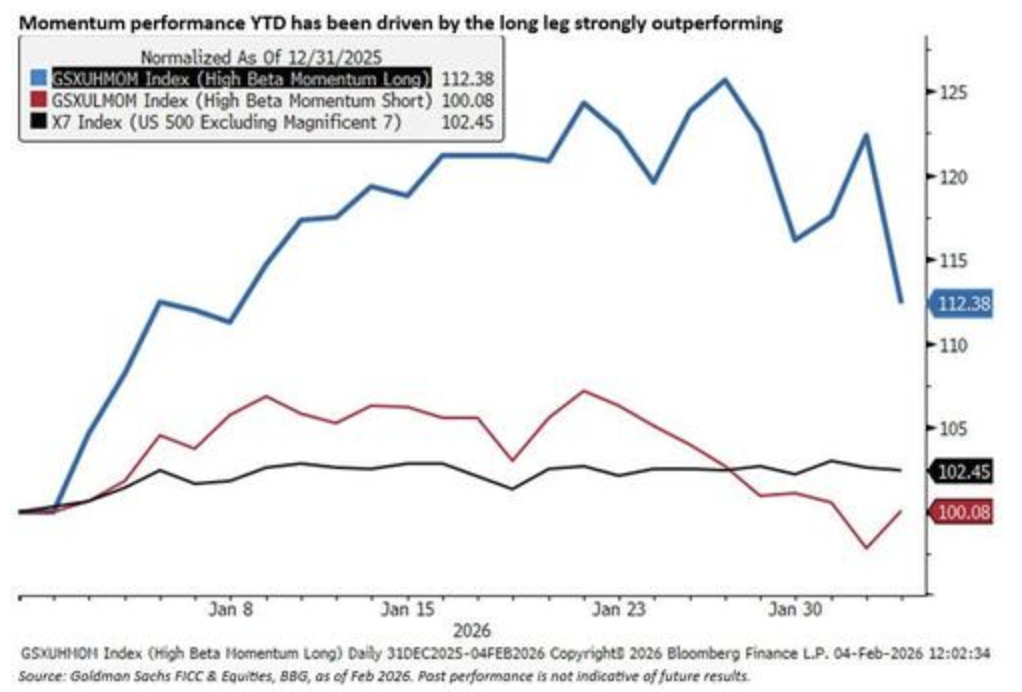
Core Viewpoint - Momentum consensus trading experienced a "collapse-like" reversal on February 5, driven by concentrated long position liquidation and passive selling from leveraged ETFs, leading to a rapid amplification of declines, with a notable absence of retail buying support [1][4][5] Group 1: Market Dynamics - The recent decline exhibited a structural characteristic of "index relative restraint, internal market volatility," with selling pressure concentrated in the Nasdaq, technology, and semiconductor sectors, which had previously led the market [1][4] - Approximately 75% of stocks outperformed the S&P 500 during the decline, indicating that the pain was concentrated in a few crowded momentum trades rather than a broad market downturn [2] - The momentum index MSZZMOMO fell about 7.7% in a single day, marking an extreme volatility event, primarily driven by long positions [4] Group 2: Sector Performance - Selling pressure was heavily focused on previously leading sectors such as AI, national security, and Bitcoin mining stocks, while cyclical, chemical, and banking sectors showed relative strength, indicating a rotation away from high-beta themes [4][5] - The leveraged ETF rebalancing contributed approximately $18 billion in selling pressure, particularly affecting the Nasdaq and technology sectors, with significant impacts on several popular stocks [5] Group 3: Retail Investor Behavior - Retail buying was notably absent, with net buying intensity at its lowest in the past year, primarily occurring during market rebound periods [6][7] - The lack of retail participation has directly suppressed momentum factors, as the stocks favored by retail investors overlap significantly with those used in momentum strategies [9] Group 4: Future Outlook - Short-term technical rebounds may occur, but Morgan Stanley suggests a "sell on the rebound" strategy due to ongoing deleveraging and weak retail demand ahead of the tax season, which could exacerbate future selling pressure [1][10][13] - Historical data indicates that after significant declines in the momentum index, stock performance tends to be negative in the following 1-2 months, with a median decline of approximately 22% [10]
HEDGE FLOW Hedge funds hit by AI sell-off, Goldman Sachs says
Reuters· 2026-02-05 12:50
Big hedge funds that trade in stocks had their worst day in almost a year on Wednesday as crowded trades lost value in the tech-driven selloff, Goldman Sachs said in a note to clients released after the market closed. ...
多家外资机构发布2026年市场展望 投资中国意愿持续提升
Zheng Quan Ri Bao Wang· 2026-02-05 12:25
富达国际亚洲经济学家刘培乾对《证券日报》记者表示,在政策稳定性与增长动能持续释放支撑下,中国宏观经济前景日 趋平衡且更具韧性,预计国内需求弱复苏与出口维持强劲的"双轨增长"格局仍将延续。 本报记者 吴晓璐 毛艺融 近日,多家外资机构发布2026年中国市场展望。外资机构普遍认为,基于强劲的制造业和出口,以及企业盈利持续改善和 产业升级,中国经济将更具韧性。与此同时,外资投资中国市场的意愿也在持续提升,科技、高端制造、出海产业链是重点布 局领域,其中,电力成为AI投资中确定性最高的投资方向。 中国宏观经济前景日趋平衡且更具韧性 今年1月份,国际货币基金组织(IMF)发布的《世界经济展望》预测,2026年全球经济增速将达3.3%,比去年10月份的 预测值上调0.2个百分点。IMF同时将2026年中国经济增速预测值上调0.3个百分点。 高盛首席中国股票策略分析师刘劲津表示,海外主动型共同基金大约低配中国股票300个基点,每提高1个基点,对应50亿 美元左右的资金。 贝莱德基金权益、量化及多资产首席投资官王晓京对《证券日报》记者表示,从长期趋势看,全球科技主线仍在演进,当 前仍处于AI硬件与软件发展阶段,尚未全面渗透至 ...

高盛:预计“沃什时代”美联储2026年6月、9月各降息25基点 不会大幅缩表
Sou Hu Cai Jing· 2026-02-05 11:37
美联储今年将完成领导层更迭,告别"鲍威尔时代"并迎来"沃什时代"。受沃什过往鹰派言论影响,市场 曾担忧降息进程或将中断。 高盛在最新报告中指出,市场对沃什的政策取向存在误判,其领导下的美联储仍将推进降息,且不会推 动资产负债表大幅缩减。高盛外汇策略师Mike Cahill表示,"愿意降息是他获得这份工作的先决条件"。 特朗普此前明确,提名的美联储主席人选若表达加息意愿,将无法获得该职位,他坚信利率很快就会下 调。 高盛预计,美联储2026年将实施两次降息,分别在6月和9月各下调25个基点。报告提到,沃什认为特朗 普政府2025年推行的放松管制政策与潜在支出削减,足以抵消关税对价格的一次性影响,抑制通胀上 行。同时沃什将人工智能视为重要的通缩力量,认为美联储不应仅因GDP强劲增长就维持高利率水平。 在资产负债表方面,尽管沃什长期批评大规模资产负债表扭曲市场、加剧不平等并推高通胀,曾反对 QE2并主张降息与缩表结合,但高盛预计其不会推动大幅缩表。原因在于美联储内部对充足准备金框架 存在广泛支持,激进缩表对风险资产破坏性过大。多数美联储决策者与工作人员认为,资产负债表随经 济规模增长是负债需求上升与充裕准备金框架的 ...
高盛推算“沃什时代”美联储:今年降息2次,不会大幅缩表!
Sou Hu Cai Jing· 2026-02-05 09:13
高盛外汇策略师Mike Cahill表示,仅凭沃什此前言论判断其政策取向是错误的,"愿意降息是他获得这 份工作的先决条件"。 智通财经2月5日讯(编辑 黄君芝)不出意外的话,美联储今年即将告别"鲍威尔时代",迎来"沃什时 代"。但鉴于沃什过去鹰派的言论,许多分析人士担心美联储的"降息之路"就此打住。 然而,高盛似乎并不这么认为。该行在最新报告中指出,市场可能再次误判了这位美联储新主席的实际 立场,沃什领导的美联储未必会导致利率抬高,降息和量化宽松政策仍在考虑之中。 众所周知,降低利率可以降低失业率,但会导致通货膨胀,反之亦然。正是由于这种动态,即将卸任的 鲍威尔去年直到9月份才对利率问题采取行动,他担心降息会加剧通货膨胀。沃什上任后的利率路径无 疑是市场最关心的问题,高盛预计美联储今年将降息2次。 特朗普周三也指出,若其提名的美联储主席人选曾表达过加息意愿,那么这个人就不会获得这一工作机 会。他毫不怀疑利率 "很快就会下调"。 缩表问题 高盛还指出,该行不认为沃什会推动资产负债表大幅缩减,因美联储内部对"充足准备金"框架有广泛支 持,并直言激进缩表对风险资产破坏性太大。 在资产负债表问题上,沃什是个长期批评者 ...
贵金属冰火两重天:黄金获投行力挺,白银遭集体谨慎对待
Jin Shi Shu Ju· 2026-02-05 09:07
Core Viewpoint - The recent volatility in precious metal prices, particularly gold and silver, has led investment banks to increase their bullish positions on gold while cautioning against heavy investments in silver [1][4]. Group 1: Gold Market Analysis - Gold prices experienced a significant drop, falling below $4,800, after a brief rebound earlier in the week [1]. - Despite the recent sell-off, many market observers, including UBS and Goldman Sachs, maintain a bullish outlook on gold, predicting prices could reach $6,200 next month and $5,900 by year-end [2][3]. - UBS identifies that the current sell-off is a normal fluctuation within a structural uptrend, with no signs of a bull market ending [2]. - Goldman Sachs forecasts a price of $5,400 per ounce by December 2026, supported by central banks increasing gold reserves and private investors boosting gold ETF purchases [2]. Group 2: Silver Market Analysis - Silver prices have seen a dramatic decline of over 30% from recent highs, with UBS suggesting that further declines are necessary for the metal to become attractive for investment [4][5]. - UBS highlights that silver's industrial demand complicates its price dynamics, as rising prices may suppress industrial usage [5]. - Analysts from Goldman Sachs express caution regarding silver due to liquidity issues in the London market, which exacerbate price volatility [5]. - American Bank also holds a cautiously optimistic view on silver but notes potential upward resistance from declining solar panel demand [5]. Group 3: Market Volatility and Investor Sentiment - The recent volatility in precious metals has created opportunities for investors seeking returns, despite the associated risks [2]. - UBS emphasizes the need for investors to carefully assess the expected returns on highly volatile assets like silver, which currently do not meet the required return thresholds [4]. - The market remains sensitive to geopolitical tensions and monetary policy changes, which could influence precious metal prices moving forward [1][3].


比DeepSeek风暴还惨烈,华尔街“抛AI”妖风祸从何来?
3 6 Ke· 2026-02-05 09:02
自2022年年中以来,动量交易员曾以足以让沃伦·巴菲特感到汗颜的夏普比率统治着市场。然而周三, 这一切几乎遭遇了全线崩盘——他们蒙受了载入史册的损失。 动量交易简单说来就是"买入最近涨得最好的,卖出涨得最差的"。而根据业内的统计,高盛的"高贝 塔"或无约束动量组合(GSPRHIMO)刚刚创下了自2022年以来表现最糟糕的一天,超过了去年1月 Deepseek风暴之后的AI抛售潮。高贝塔股通俗而言就是指那些波动比大盘更剧烈的股票。 这印证了高盛分析师Lee Coppersmith在上周末文章中的发现,即美股表面平静之下正波涛汹涌。统计 显示,标普500指数成分股平均的1周实际波动率,与整体标普500指数波动率之比在上周四刚刚达到 6.88——处于2023年以来的第99个百分位。 换句话说,标普500指数成分股的平均波动幅度大约是大盘指数的7倍,这就是为什么近几个交易日部分 个股的异动显得异常尖锐,即便标普500指数表面相对平滑的行情掩盖了底层波动的剧烈程度。 市场发生了什么? 如果说,周二市场的跌幅源于软件股因人工智能颠覆风险引发的"投降式"抛售,那么周三的疲软则更集 中于基本面因素与仓位调整,使得大盘指数的变 ...