Micron Technology(MU)

Search documents
A股开盘:沪指微涨0.06%、创业板指涨0.09%,文化传媒、燃气及金属板块走高,存储芯片概念股调整
Jin Rong Jie· 2026-01-20 01:39
Market Overview - On January 20, A-shares opened slightly higher, with the Shanghai Composite Index rising by 2.37 points (0.06%) to 4116.37 points, the Shenzhen Component Index up by 13.5 points (0.09%) to 14307.55 points, and the CSI 300 Index increasing by 2.45 points (0.05%) to 4736.91 points [1] - The gas and energy metal sectors led the gains, while the cultural media sector also opened high, with Zhejiang Wenhu Internet hitting the daily limit [1] - Focus stocks included Fenglong Co., which reached a limit up on its 14th trading day, and Jiamei Packaging, which opened 10% higher on its 22nd trading day [1] Company News - Yidian Tianxia announced that its stock will resume trading on January 20, 2026, after completing a self-examination related to stock price fluctuations [2] - Hualing Cable terminated its acquisition agreement with Hunan Xingxin Aerospace New Materials Co., due to a lack of consensus on specific terms [2] - Jiangbolong set the inquiry transfer price at 212.09 yuan per share, with 12,574,358 shares fully subscribed by 54 institutional investors [2] - Tianjian Technology expects a net loss of 170 million to 242 million yuan for 2025, with a revenue forecast of -140 million to -201 million yuan [2] Financial Performance - Trina Solar anticipates a net loss of 6.5 billion to 7.5 billion yuan for 2025, citing supply-demand imbalances and increased competition in the photovoltaic industry [3] - Chengdu Huamei expects a net profit of 213 million to 255 million yuan for 2025, a year-on-year increase of 74.35% to 108.73% [3] - Jiangxi Copper plans to issue debt financing tools, including medium-term notes up to 15 billion yuan and short-term financing bills up to 10 billion yuan [3] Sector Insights - Water Well Square forecasts a net profit of 392 million yuan, a 71% decrease year-on-year, with revenue expected to drop by 42% [4] - Dingtong Technology projects a net profit of 242 million yuan for 2025, a 119.59% increase year-on-year [4] - Hunan Yuneng expects a net profit of 1.15 billion to 1.4 billion yuan for 2025, a growth of 93.75% to 135.87% year-on-year [4] Industry Trends - Micron Technology reported a worsening shortage of memory chips, driven by surging demand for AI infrastructure [6] - The Hainan Free Trade Port has seen a 46.8% year-on-year increase in duty-free shopping amounts, indicating strong consumer enthusiasm [7] - The Chinese aviation engine group announced successful evaluations of several gas turbine innovation projects, promoting the commercialization of the gas turbine industry [8] - The upcoming Spring Festival holiday is expected to boost travel, with domestic travel bookings up nearly 20% year-on-year and outbound travel bookings up nearly 80% [9]




Micron stock: is MU headed for $450 after Barclays' price-target hike?
Invezz· 2026-01-19 18:42
Core Viewpoint - Barclays has raised its 12-month price target on Micron stock to $450 from $275, indicating a significant bullish outlook on the company's future performance [1] - Wells Fargo has also increased its target for Micron stock to $410, reflecting a positive sentiment in the market [1] Company Summary - The new price target set by Barclays represents a substantial increase of approximately 63.64% from the previous target [1] - Wells Fargo's revised target indicates a notable increase, suggesting confidence in Micron's growth potential [1]

Top AI Stocks to Boost Returns and Reignite Portfolio Growth
ZACKS· 2026-01-19 17:22
Industry Overview - Artificial intelligence (AI) is transforming various sectors by enabling machines to analyze large datasets, identify patterns, and make sophisticated decisions, leading to increased productivity and operational efficiency [2] - Global AI spending is projected to reach $2.5 trillion by 2026, reflecting a 44% growth from 2025, while AI infrastructure spending is expected to hit $758 billion by 2029 [3] - The rapid adoption of generative AI and multimodal learning is being driven by advancements in hardware such as GPUs and TPUs, impacting industries like healthcare, finance, and e-commerce [2][3] Key Companies and Developments - Major tech companies like Microsoft, Adobe, Alphabet, and Meta Platforms are leading advancements in AI technology, supported by AI chip manufacturers like NVIDIA, Analog Devices, and Micron Technology [3] - OpenAI's partnerships with AMD and NVIDIA highlight the increasing demand for AI chips, with NVIDIA predicting that spending on AI infrastructure by cloud service providers will reach $600 billion in 2026, an increase of over $200 billion from early 2025 estimates [3] Company-Specific Insights - Micron Technology is experiencing growth due to rising demand for high-bandwidth memory (HBM) and a recovery in DRAM pricing, driven by AI server demand [6][7] - Micron's new LPCAMM2 memory is designed for AI-ready laptops and workstations, positioning the company to benefit from AI-related infrastructure spending [7] - Analog Devices is capitalizing on growth in automation, AI infrastructure, and automotive electrification, with a strong market position in high-performance analog solutions [9][10] - Microsoft is enhancing its AI capabilities through investments in OpenAI and acquisitions, including the recent acquisition of Osmos, which will improve its autonomous data engineering capabilities [12] - Microsoft's Azure platform supports over 11,000 AI models and has a significant customer base, including 80% of the Fortune 500, indicating strong enterprise adoption [13]


美光警告:AI引发的存储芯片短缺“前所未有”,将持续到2026年以后
Hua Er Jie Jian Wen· 2026-01-19 15:29
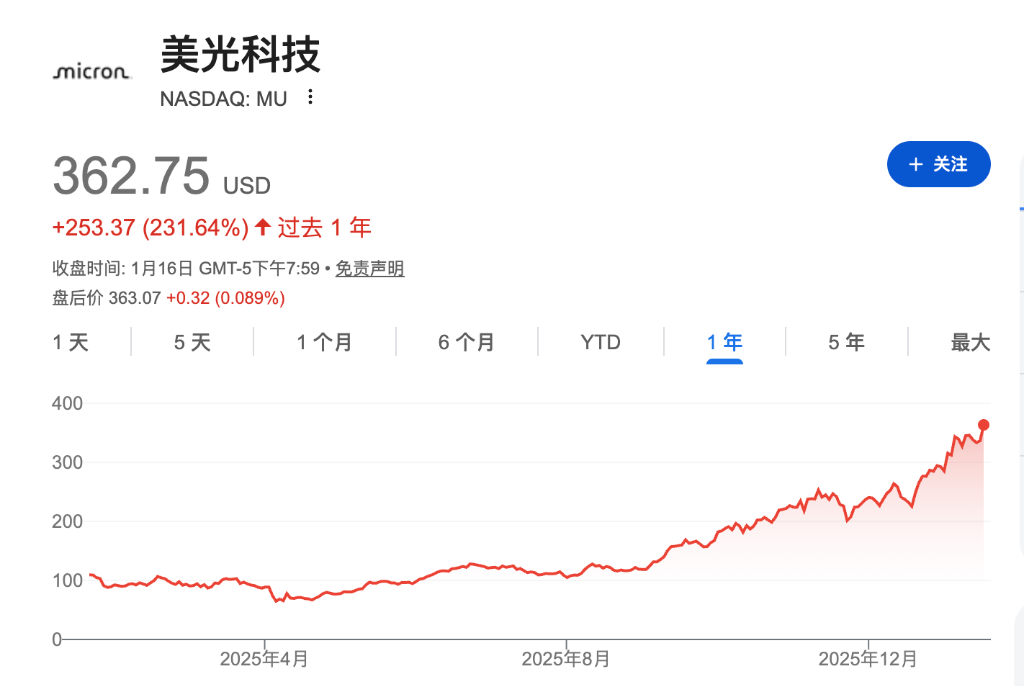
Group 1: Core Insights - Micron Technology highlights an unprecedented shortage of memory chips driven by surging demand for AI infrastructure, which is expected to persist beyond 2026 [1] - The high bandwidth memory (HBM) required for AI accelerators is consuming a significant portion of the industry's available capacity, leading to severe shortages in traditional sectors like smartphones and personal computers [1] - Major smartphone manufacturers, including Xiaomi and Oppo, have revised their 2026 shipment targets downward due to rising memory costs, with Oppo predicting a reduction of up to 20% [1] Group 2: Market Dynamics - The global memory chip giants, including Micron, SK Hynix, and Samsung Electronics, are experiencing substantial stock price increases due to the AI demand explosion, with Micron's stock rising over 231.6% in the past year [2] - SK Hynix has reported that its chip production capacity for 2026 is already sold out, while Micron's AI-focused high-end memory products have been fully booked for the year [2] Group 3: Strategic Moves - To prioritize supply for strategic clients like NVIDIA, Micron announced the termination of its popular consumer memory brand, Crucial, to focus on DRAM, which is essential for AI accelerator performance [4] - Micron is accelerating its capacity expansion in the U.S. and Asia, planning to invest $1.8 billion to acquire an existing factory site in Taiwan, which is crucial for its production capabilities [5] - The company is also advancing multiple large-scale factory projects, including a $100 billion investment in New York to build four DRAM wafer fabs, with the first wafers expected to be produced by 2030 [5]
Micron to acquire Taiwan chip fab from Powerchip for $1.8B
Proactiveinvestors NA· 2026-01-19 14:46
Company Overview - Proactive provides fast, accessible, informative, and actionable business and finance news content to a global investment audience [2] - The company operates in key finance and investing hubs with bureaus and studios located in London, New York, Toronto, Vancouver, Sydney, and Perth [2] Market Focus - Proactive specializes in medium and small-cap markets while also covering blue-chip companies, commodities, and broader investment stories [3] - The news team delivers insights across various sectors including biotech and pharma, mining and natural resources, battery metals, oil and gas, crypto, and emerging digital and EV technologies [3] Technology Utilization - Proactive is recognized as a forward-looking technology adopter, utilizing automation and software tools, including generative AI, to enhance workflows [4][5] - All content published by Proactive is edited and authored by humans, ensuring adherence to best practices in content production and search engine optimization [5]
NVIDIA vs. Micron: Which AI Chip Stock Is a Better Investment Option?
ZACKS· 2026-01-19 14:06
Core Insights - NVIDIA Corporation (NVDA) and Micron Technology, Inc. (MU) are pivotal in the AI semiconductor ecosystem, driven by increasing demand for data center and AI computing [1] - Both companies present different risk-reward profiles for investors in the semiconductor sector [2] NVIDIA Overview - NVIDIA is central to the AI boom, with its GPUs utilized in cloud data centers and self-driving vehicles, dominating the AI infrastructure market [3] - In Q3 of fiscal 2026, NVIDIA's revenues increased by 62% year-over-year to $57 billion, and non-GAAP EPS rose by 60% to $1.30 [3] - The Data Center segment generated $51.22 billion in revenues, accounting for 89.8% of total sales, with a 66% year-over-year increase and 25% sequential growth [5] - NVIDIA's partnership with OpenAI is expected to enhance long-term demand for its GPUs, solidifying its position as a leading AI chip supplier [6] Micron Overview - Micron Technology is well-positioned for long-term growth due to its involvement in AI, high-performance data centers, and industrial IoT [7] - The company reported a 57% year-over-year revenue increase to $13.64 billion in Q1 of fiscal 2026, with non-GAAP EPS rising by 167% to $4.78 [9] - Micron's diversification strategy has led to a more stable revenue base, focusing on resilient sectors like automotive and enterprise IT [8] - Micron's HBM3E products are in high demand, with supply already sold out for 2026, indicating strong market interest [11] Growth Outlook Comparison - Micron's growth profile appears stronger in the near term, with projected fiscal 2026 revenues and EPS expected to surge by 94.7% and 297.5%, respectively, compared to NVIDIA's 92.9% revenue growth and 55.9% EPS increase [13] - Analysts are increasingly bullish on Micron, as reflected in the earnings estimate revision trends [14] Price Performance and Valuation - Over the past year, Micron's stock has surged by 243%, significantly outperforming NVIDIA's 35.2% gain [17] - Micron trades at a lower forward P/E multiple of 9.84 compared to NVIDIA's 25.78, indicating a more attractive valuation despite higher growth projections for Micron [18] Conclusion - Micron Technology is identified as the better investment option due to its higher EPS growth projection and lower valuation compared to NVIDIA [21]

Micron: Like 2023 Nvidia (But Better)
Seeking Alpha· 2026-01-19 13:57
Core Insights - The article highlights the expertise of James Foord, an economist with a decade of experience in analyzing global markets, and his leadership role in The Pragmatic Investor, which focuses on building diversified investment portfolios to preserve and increase wealth [1] Group 1: Company Overview - The Pragmatic Investor is designed to guide investors of all levels through various investment strategies, covering global macro, international equities, commodities, technology, and cryptocurrencies [1] Group 2: Features and Offerings - The Pragmatic Investor offers a portfolio, weekly market update newsletters, actionable trades, technical analysis, and a chat room for investor engagement [1]

美光警告内存大缺货、三星发放超额奖金 存储上市公司业绩爆棚
Zheng Quan Shi Bao Wang· 2026-01-19 13:44
1月16日美光科技打造全球最先进的存储半导体制造中心,该项目将包含多达四个工厂,将有助于满足 人工智能系统日益增长的需求,项目总投资约1000亿美元,将成为美国纽约州投资当地历史上最大的私 人投资项目。 在AI算力强劲需求驱动下,全球存储缺货涨价愈演愈烈。 日前,美光科技高管称内存芯片短缺愈演愈烈,并重申供应紧张状况将持续到2026年之后;另一家存储 巨头三星电子将发放2025年度超额绩效奖,比例将首次接近半年的工资水平。1月19日,A股存储板块 指数上周冲高后回落,部分存储上市公司业绩预增。 内存大缺货 美光运营执行副总裁Manish Bhatia日前在纽约州一个生产基地奠基仪式后接受采访时表示,内存芯片短 缺在过去一个季度愈演愈烈,并重申供应紧张状况将持续到今年之后,原因是人工智能(AI)基础设施建 设对高端半导体的需求激增。 "我们当前看到的短缺程度的确前所未见。"Manish Bhatia指出,"制造AI加速器所需的高带宽内存"正在 占用整个行业如此之多的可用产能,以至于手机和个人电脑等传统领域面临严重短缺。" 行业机构Counterpoint Research在今年1月指出,存储市场已进入"超级牛市 ...
AI快把存储芯片抽干了
3 6 Ke· 2026-01-19 12:35
Core Insights - The storage chip price trend has moved beyond the typical consumer electronics understanding, with significant price increases expected in the coming years [1][2][3] Group 1: Price Trends and Market Dynamics - Memory prices are projected to surge by 50% in Q4 2025 and an additional 40%-50% by the end of Q1 2026 [2] - In the retail market, SSD and memory prices have doubled or tripled, with DDR5 memory prices increasing by 3-4 times compared to August 2025 [4] - The average memory price has risen to over 344% compared to September 2025, with major brands facing shortages or price hikes [4] Group 2: AI Demand Impact - AI data center demand is rapidly consuming the memory market, with predictions that traditional and AI data centers will account for over 70% of high-end memory chip consumption by 2026 [8] - The memory requirements for AI data centers are significantly higher than for consumer electronics, leading manufacturers to prioritize high-end memory production [9][10] - As AI demand increases, memory prices are soaring, leading to inventory declines and affecting prices in consumer electronics and automotive sectors [11] Group 3: Structural Changes in Supply - The current shortage is not merely cyclical but may represent a permanent strategic reallocation of global silicon wafer capacity [12] - IDC forecasts that DRAM and NAND supply growth will fall below historical averages, with expected increases of only 16% and 17% respectively by 2026 [12] - Major manufacturers are warning of price increases for PCs and servers, with Lenovo, Dell, HP, Acer, and Asus indicating a more challenging future [16][17] Group 4: Stock Market Reactions - Companies like SanDisk and Micron Technology have seen stock prices soar, with SanDisk's stock rising over 100% and Micron's by over 250% in the past year [20][22] - The market views memory as a critical resource in the AI era, prompting companies to consider strategic shifts, including potential IPOs [22] Group 5: Business Adjustments and Capacity Expansion - Storage manufacturers are shifting focus towards higher-margin AI and data center markets, with SK Hynix and Micron announcing plans to reduce consumer-grade production [23] - Significant investments are being made to expand production capacity, with Micron investing $100 billion in a new facility and SK Hynix planning a $19 trillion KRW investment for HBM production [24][25] - However, most new capacities will not be operational until 2027, delaying any substantial impact on supply [26] Group 6: Conclusion - The current memory market is experiencing extreme fluctuations, driven by AI data center demands, with price signals affecting various sectors [27] - The ability of manufacturers to ramp up production will determine short-term price stability, while long-term implications may lead to a new normal in supply distribution [27]
美光股价暴涨背后
Guo Ji Jin Rong Bao· 2026-01-19 11:23
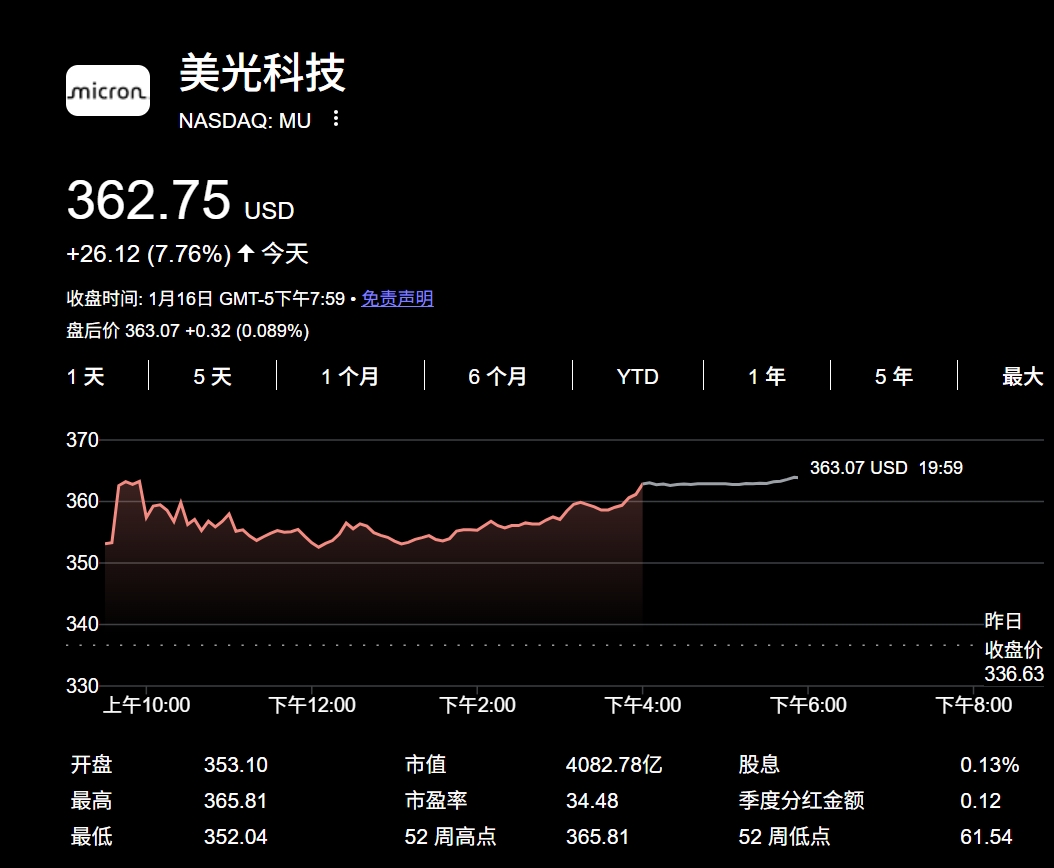
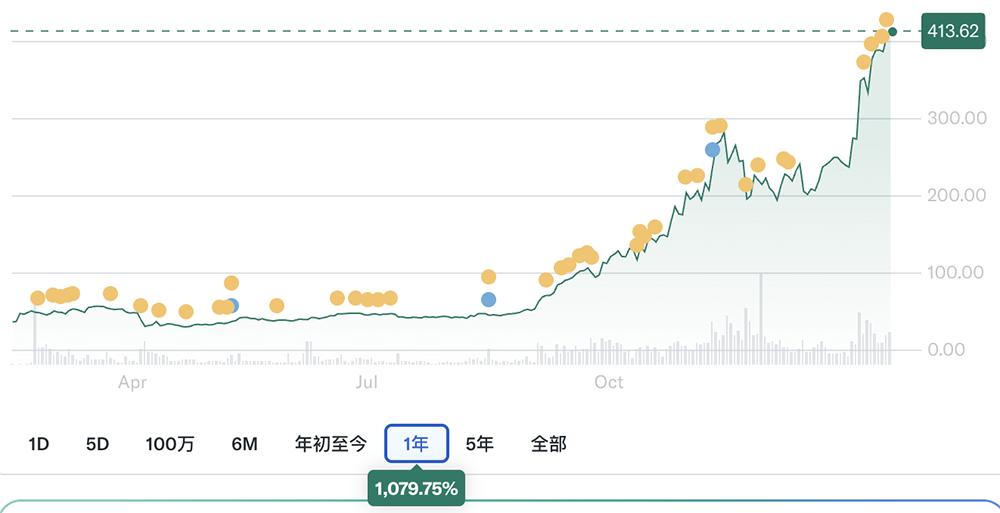
Core Viewpoint - Micron Technology's stock price surged over 7% to a record high of $362.75, with a market capitalization reaching $408 billion, driven by strong demand for AI-related memory products [1][4]. Group 1: Stock Performance - On January 16, Micron's stock closed at $362.75, marking a 7.76% increase from the previous day [2]. - The stock's after-hours price was $363.07, reflecting a slight increase of 0.089% [2]. - Over the past three months, Micron's stock price has risen by 86%, and it has increased by 245% over the past year [4]. Group 2: Financial Performance - For the fiscal year ending August 28, 2025, Micron reported revenues of $37.38 billion, up from $25.11 billion in the previous fiscal year [5]. - The non-GAAP earnings per share for the fiscal year 2025 were $8.29, a significant increase from $1.30 in the prior year [5]. - Micron is projected to achieve a 99% revenue growth rate in fiscal year 2026, ranking tenth among S&P 500 companies [5]. Group 3: Market Dynamics - The demand for high bandwidth memory (HBM) chips has surged due to the growth of AI applications, leading to a "memory shortage" across the industry [4]. - Micron's products are widely used in hardware that drives AI applications, enhancing its pricing power [4]. - The company has sold out its AI memory chips through 2026 and is expanding production capacity by building a new factory in New York and acquiring a wafer fab in Taiwan for $1.8 billion [4][5]. Group 4: Analyst Insights - Analysts from Mizuho and Morgan Stanley have highlighted the positive market sentiment towards Micron and memory stocks, citing limited memory capacity and strong demand for AI as key factors [6]. - Morgan Stanley has ranked Micron among the top ten global DRAM suppliers, emphasizing the long-term visibility of orders due to rising AI demand [6].