NIO(NIO)

Search documents
【联合发布】2026年1月OTA监测月报
乘联分会· 2026-03-03 08:38
Core Insights - The article discusses the significant increase in OTA (Over-the-Air) updates in the automotive industry, highlighting the rapid growth in functionality updates across various brands during January 2026, particularly around the Chinese New Year holiday [5][10][12]. Industry Overview - In January 2026, a total of 1,969 features were updated across the industry, a substantial increase from 1,397 in the previous month, driven by 32 brands focusing on enhancing travel experiences and safety during the holiday season [5]. - New force brands contributed 839 updated features, a significant rise from 216 in the previous month, with notable upgrades in smart driving capabilities and user experience enhancements [7][8]. - Domestic brands updated 1,080 features, slightly down from 1,144, indicating a trend towards a layered technology system, with top-tier brands like BYD and Geely focusing on self-research and high-end brand differentiation [10]. - Joint venture and luxury brands updated 50 features, up from 37, with a focus on central control ecosystems and general settings, exemplified by Nissan's N7 enhancing personalized smart driving features [12]. New Forces - The new force brands, including NIO, Xpeng, and Li Auto, have made significant strides in OTA updates, with NIO adjusting its smart driving strategy and Xpeng enhancing cabin experiences [7][8]. Domestic Brands - Domestic brands are showing a clear division in technology capabilities, with first-tier brands achieving significant advancements in smart driving and cabin services, while second-tier brands are collaborating with partners like Huawei to fill technological gaps [10]. Joint Venture & Luxury Brands - Joint venture and luxury brands are focusing on enhancing user experience through OTA updates, with Nissan's N7 introducing new smart driving features that allow for personalized settings [12]. OTA Operations - The OTA operations for the "Hongmeng Smart Travel" platform emphasize a unified rhythm in information dissemination, with significant engagement from users during promotional activities [19][24]. - The platform has established a mature operational process, leading to high trust and participation rates among car owners [25]. User Feedback - User feedback indicates a significant improvement in smart driving efficiency and decision-making capabilities post-OTA updates, with many users reporting enhanced experiences in complex driving scenarios [35][41]. - Users have expressed satisfaction with the new features, particularly in terms of efficiency and decision-making during driving, although some concerns about safety and comfort remain [36][40]. Future OTA Updates - Upcoming OTA updates are scheduled for various models, with enhancements in smart driving capabilities and user interface improvements expected throughout 2026 [30].





中国汽车行业-能否从上一轮大宗商品上行周期中吸取经验?-China Auto Sector_ Can lessons be learnt from the last commodity upcycle_
2026-03-03 08:28
Summary of the China Auto Sector Conference Call Industry Overview - The conference call focused on the **China Auto Sector**, particularly the electric vehicle (EV) market and the impact of commodity cost inflation on the industry [1][7]. Key Insights and Arguments Commodity Cost Inflation - Commodity cost inflation is a significant challenge for China's EV sector, especially amid weak current demand [1][4]. - Historical analysis from the last commodity upcycle (2021/22) shows that most carmakers faced declines in market share, margins, and valuation multiples, with only CATL maintaining pricing power [1][2]. Company Strategies During Previous Upcycle - **Tesla**: Increased vehicle prices to pass on costs, resulting in initial strong demand but a subsequent loss of market share from 14% in 2021 to 8% in 2024/25 [2][11]. - **BYD**: Focused on DM-i plug-in hybrid technology, leading to significant sales growth (1.5x from 740,000 in 2021 to 1.87 million in 2022) and a 4.5x increase in net profit [13][14]. - **GWM**: Scaled back on low-end BEV models, leading to a drop in sales and market share, with a share price decline of approximately 60% in 2022 [17][18]. - **Nio and XPeng**: Experienced slowed growth and widening losses due to lack of ICE or PHEV options, with significant declines in gross profit margins [21][22]. Current Market Conditions - The current commodity cost spike is less severe than in the previous cycle, with lithium prices not exceeding Rmb200,000/tonne compared to over Rmb500,000/tonne previously [3][35]. - Domestic EV market demand is weak, making it challenging for companies to pass on higher costs to consumers [3][4]. - Companies with established overseas exposure, like CATL, BYD, and GWM, are better positioned to mitigate current challenges compared to mass-market OEMs like XPeng and LeapMotor, which have only about 10% overseas exposure [4][35]. Future Outlook - The sector remains cautious due to ongoing commodity inflation and weak demand, particularly in the economy segment, which is more vulnerable to price sensitivity [4][35]. - The competitive landscape remains fierce, with significant fundamental challenges for carmakers despite some potential positives, such as less demanding valuations compared to the last cycle [3][4]. Additional Important Points - The report highlights the importance of overseas sales for mitigating commodity cost inflation, which was not a factor in the last cycle [35]. - The potential for efficiency gains is diminishing as companies have already optimized many processes [35]. - Risks to the traditional internal combustion engine (ICE) sector include economic slowdown, excessive capacity, and regulatory changes, while risks to the new-energy vehicle (NEV) sector include changes in government policies and potential overcapacity in the battery industry [38][39]. Conclusion - The China Auto Sector is navigating significant challenges due to commodity cost inflation and weak demand, with varying strategies among key players. Companies with strong overseas exposure and innovative technologies are better positioned to weather these challenges.


汽车行业:2月车市表现偏淡,关注新能源“全球化与智能化”机遇
BOCOM International· 2026-03-03 04:35
Investment Rating - The report assigns a "Buy" rating to several companies in the automotive sector, including BYD, NIO, Geely, and XPeng, indicating expected total returns above the industry average over the next 12 months [4]. Core Insights - February saw a decline in new energy vehicle sales, influenced by the Spring Festival holiday and policy rollbacks, with nine companies experiencing a year-on-year and month-on-month sales drop of -24.8% and -19.1% respectively [2][3]. - BYD's passenger car sales in February were 187,782 units, down 41.0% year-on-year and 8.6% month-on-month, but its export sales grew by 41.4% to 100,151 units, marking a significant milestone with overseas sales exceeding 50% [2]. - NIO delivered 20,797 vehicles in February, a year-on-year increase of 57.6%, while XPeng's deliveries fell by 49.9% year-on-year to 15,256 units, highlighting the volatility in delivery numbers [2][3]. - The overall automotive market is expected to stabilize in March due to new consumer promotion policies, with a shift towards competition in AI driving technology and globalization in the new energy vehicle sector [2]. - The report emphasizes two main investment themes: the progress of companies in overseas commercialization and the establishment of competitive advantages in their underlying intelligent systems [2]. Summary by Relevant Sections Sales Performance - February sales data shows a significant decline across major automotive companies, with BYD, XPeng, and NIO experiencing notable fluctuations in their delivery numbers [3]. - The total sales for the automotive market in February were 358,760 units, reflecting a 24.8% decrease year-on-year [3]. Company-Specific Insights - BYD's sales were impacted by domestic policy changes, but its international performance remains strong [2]. - NIO's new model deliveries are gaining traction, while XPeng is focusing on expanding its overseas market presence [2]. - Geely and XPeng are highlighted for their strategic moves in product launches and market expansion [2]. Investment Recommendations - The report suggests focusing on companies like XPeng, Geely, and BYD for their potential growth in overseas markets and product offerings [2].
重点车企2月销量速览
数说新能源· 2026-03-03 03:04
Core Viewpoint - The article highlights the performance of various electric vehicle manufacturers in terms of sales growth and export figures for the first two months of the year, indicating a mixed but generally positive trend in the new energy vehicle market. Group 1: Sales Performance - NIO, Xiaomi, Leap Motor, and SAIC have shown significant year-on-year growth in sales for January and February [2] - BYD reported February sales of 190,000 units, down 41% year-on-year and 9% month-on-month, with cumulative sales of 400,000 units for the first two months, down 36% year-on-year [2] - Geely's February sales reached 206,000 units, up 1% year-on-year but down 24% month-on-month, with cumulative sales of 476,000 units for the first two months, also up 1% year-on-year [2] - Chery's February sales were 161,000 units, down 11% year-on-year and 20% month-on-month, with cumulative sales of 361,000 units for the first two months, down 11% year-on-year [3] - Great Wall Motors reported February sales of 73,000 units, down 7% year-on-year and 20% month-on-month, with cumulative sales of 163,000 units for the first two months, up 3% year-on-year [3] Group 2: Export Performance - BYD's export sales reached 101,000 units in February, up 50% year-on-year and stable month-on-month [2] - Geely's export sales were 61,000 units, up 138% year-on-year and 1% month-on-month [2] - Chery's exports totaled 12,500 units, up 42% year-on-year [3] - Great Wall Motors exported 43,000 units, up 37% year-on-year and 5% month-on-month [3] Group 3: New Product Launches - Li Auto plans to launch new models L9 and L9 Livis in Q2 2026 [5] - Zeekr's sales reached 24,000 units, up 70% year-on-year, with the new model expected to launch in Q2 2026 [2][5]


上亿预算,车企厮杀春节档
汽车商业评论· 2026-03-02 23:06
Core Viewpoint - The article discusses the evolution of automotive marketing strategies during the 2026 Spring Festival, highlighting how brands are integrating cultural elements and emotional connections with consumers to enhance their marketing effectiveness [3][4][10]. Group 1: Brand Localization and Cultural Integration - Luxury brands like Ferrari and BMW are deepening their connection with Chinese culture by incorporating traditional elements into their marketing, moving beyond simple zodiac themes to create a cultural resonance with consumers [5][10]. - Ferrari unveiled a special logo for the Year of the Horse, inspired by traditional Chinese seal carving, which appeals to high-net-worth individuals [6]. - BMW's marketing campaign for the Year of the Horse includes a promotional video that connects the brand with traditional Chinese art, enhancing emotional ties with consumers [8][10]. Group 2: Innovative Marketing Strategies - The Spring Festival Gala remains a key marketing platform, with brands showcasing their technological capabilities and brand philosophies through immersive experiences rather than traditional advertising [12][17]. - Companies like Hongmeng Zhixing and LYNK & CO utilized the Gala to demonstrate their technological prowess, achieving significant exposure and engagement [13][15]. - The integration of automotive brands into popular films, such as "Fast Life 3," allows for deeper narrative connections, with brands becoming central to the storyline rather than mere background elements [19][21]. Group 3: Community Engagement and Emotional Marketing - Brands are leveraging community engagement through cultural events and social media to create emotional connections with consumers, as seen with Changan's cultural festival and Jetta's interactive activities [25][27]. - Buick's response to a viral wedding car incident exemplifies how brands can engage with consumers on a personal level, enhancing brand perception through genuine interactions [33][39]. - The focus on service-oriented marketing, such as Xiaopeng's mobile charging network and NIO's upgraded service centers, addresses consumer pain points during the holiday season, fostering positive brand associations [31][32]. Group 4: Emotional Resonance and Consumer Connection - The article emphasizes the importance of understanding consumer emotions and needs, with brands like BYD and Mercedes-Benz promoting relaxed and personalized holiday experiences [45][47]. - Great Wall Motors' emotional marketing campaign resonates with young consumers by addressing their dilemmas and aspirations, showcasing the brand's understanding of their target audience [58][61]. - The overall trend in automotive marketing is shifting towards a user-centered approach, focusing on emotional resonance and cultural relevance to stand out in a competitive market [64].


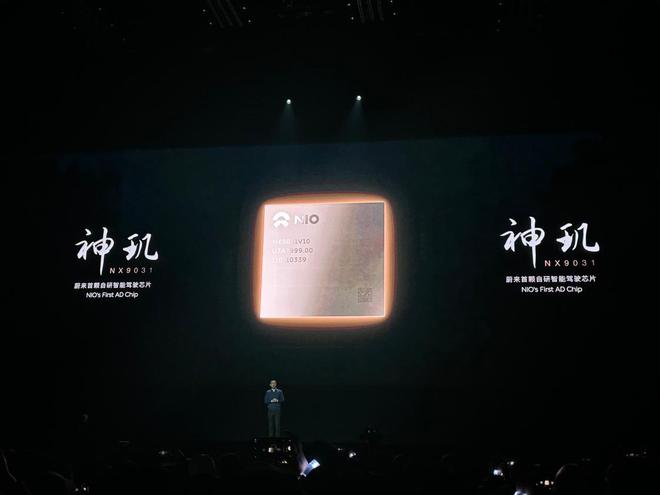
神玑“单挑”英伟达:蔚来要赌AI时代算力话语权
2 1 Shi Ji Jing Ji Bao Dao· 2026-03-02 23:04
Core Insights - The automotive industry's shift towards "intelligentization" is accelerating, particularly in the chip sector, as evidenced by NIO's announcement of a successful financing round for its chip subsidiary, Anhui Shenji Technology Co., Ltd, raising over 2.2 billion RMB with a post-investment valuation nearing 10 billion RMB [1][11] - The financing round attracted a mix of local state-owned enterprises and industry capital, indicating strong confidence in the semiconductor sector and NIO's strategic direction in autonomous driving and embodied intelligence [1][2] - NIO retains a 62.7% stake in Anhui Shenji, while external investors hold 27.3%, with 10% allocated for management incentives, allowing NIO to maintain control over core technologies while alleviating financial pressure [1][3] Company Developments - Anhui Shenji's financing comes at a pivotal moment as the global supply chain is being reshaped and AI technology is rapidly advancing, positioning car-mounted chips as strategic assets for automakers [2][6] - The "Shenji NX9031" chip, the world's first mass-produced 5nm automotive-grade high-performance driving chip, exemplifies NIO's commitment to self-research and development, avoiding reliance on ARM's public licenses [3][4] - The NX9031 chip features over 50 billion transistors, a 32-core CPU architecture, and a self-developed ISP capable of processing 6.5G pixels per second, providing significant cost advantages and performance improvements for NIO vehicles [4][5] Industry Trends - The automotive industry is undergoing a transformation where AI capabilities and chip performance are becoming the core competitive advantages, moving beyond traditional vehicle components [8][9] - Major players in the automotive sector, including Xpeng and Li Auto, are also investing heavily in chip development, indicating a broader industry trend towards self-reliance in AI technology [7][10] - The successful financing of Anhui Shenji reflects a revaluation of technology investments in the automotive sector, highlighting the strong market demand for advanced semiconductor capabilities [11]
How Buying Nio Stock Today Could 10x Your Net Worth
Yahoo Finance· 2026-03-02 17:05
Core Viewpoint - Nio, a leading electric vehicle manufacturer in China, is currently trading below its 2018 IPO price despite significant growth in net sales, which have quadrupled from 2018 to 2024, and it is valued at less than one times its projected 2025 sales [1][2]. Group 1: Company Performance - Nio's stock is undervalued due to competitive and macroeconomic challenges, including trade tensions between the U.S. and China [2]. - The company has introduced new sub-brands, Onvo and Firefly, in 2024, which offer more affordable SUVs and compact cars [4]. - Nio has expanded its battery-swapping infrastructure, operating over 3,500 stations across China and Europe, a significant increase from 777 at the end of 2021 [5]. Group 2: Delivery and Financial Metrics - Nio's delivery growth was robust in 2020 and 2021 but slowed to 34% in 2022 and 31% in 2023, leading to a decrease in vehicle margin from 20.1% in 2021 to 9.5% in 2023 [6]. - Despite challenges, Nio's deliveries increased by 39% in 2024, driven by strong sales of high-end models and expansion in Europe, with vehicle margins improving to 12.3% [7]. - In the first nine months of 2025, deliveries grew by 35%, and the company anticipates reporting its first adjusted profit in Q4 2025 [8]. Group 3: Future Projections - Analysts project that Nio's revenue will more than double from 2024 to 2027, with adjusted EBITDA expected to turn positive in the final year [9]. - If Nio achieves a valuation of 5x forward sales, its stock could potentially rise over 8 times by early 2027, indicating the possibility of being a ten-bagger stock if macro conditions improve [9].
这个2月有点冷,国内车企销量洗牌
凤凰网财经· 2026-03-02 13:18
Core Viewpoint - The automotive market in February 2026 experienced a significant downturn, with all new energy vehicle manufacturers failing to exceed 30,000 units in monthly deliveries, marking a shift in market dynamics and highlighting the challenges faced by both new entrants and established brands [1][2]. Group 1: Sales Performance Overview - In February, BYD's sales reached 190,190 units, a 41% decline year-on-year, with domestic sales dropping to just over 90,000 units, indicating strong pressure from the seasonal downturn [4][5]. - Geely reported total sales of 206,160 units, showing a slight increase of 1% year-on-year, supported by a remarkable performance from its Zeekr brand, which saw a 70% increase in sales [6]. - Great Wall Motors sold 72,600 vehicles in February, down 7% year-on-year and 20% month-on-month, with 12,744 units being new energy vehicles [9]. Group 2: New Energy Vehicle Manufacturers - New energy vehicle manufacturers collectively faced significant challenges, with AITO and XPeng showing notable declines in sales, with AITO delivering approximately 18,000 units in February, a drop of nearly 50% from January [11]. - XPeng delivered 15,256 vehicles in February, reflecting a nearly 50% year-on-year decline and a 24% month-on-month drop, attributed to the aging of older models and product transition pains [12]. - In contrast, Li Auto delivered 26,421 vehicles, showing a slight year-on-year increase, while NIO achieved a substantial 57.6% year-on-year growth with 20,797 units delivered, driven by strong demand for its ES8 model [18][19]. Group 3: Market Dynamics and Future Outlook - The automotive market is experiencing a dual pressure of declining domestic demand and intense price competition, with over 20 brands, including BYD and Tesla, engaging in long-term low-interest promotions [23]. - Despite the challenges, opportunities exist in the form of decreasing battery costs and advancements in smart driving technology, which could enhance the penetration of new energy vehicles in the market [23]. - The export market is becoming increasingly vital for Chinese automotive brands, with BYD's exports exceeding 100,000 units in February, marking a potential shift in focus from domestic to international markets [5].



汽车图谱|2月出海销量高增:比亚迪、奇瑞超10万辆
Xin Jing Bao· 2026-03-02 12:48
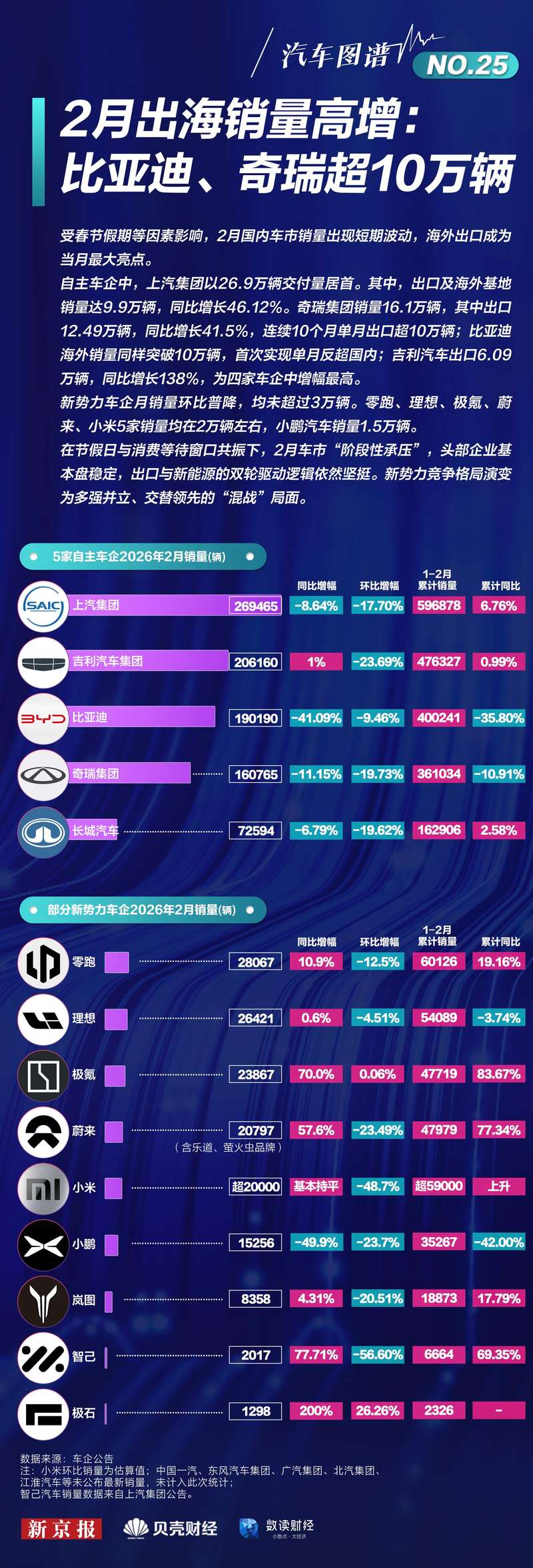
Group 1 - The domestic car market in February experienced short-term fluctuations, but the positive trends of export growth and increasing penetration of new energy vehicles remain unchanged [1] - SAIC Motor led the industry with a delivery volume of 269,465 units, with exports and overseas sales reaching 99,000 units, a year-on-year increase of 46.12%, providing crucial support against domestic market volatility [1] - Chery Group's February sales reached 161,000 units, with exports accounting for 124,900 units, a year-on-year increase of 41.5%, marking ten consecutive months of single-month exports exceeding 100,000 units [1] Group 2 - New energy vehicle companies showed a mixed performance, with sales for Leap Motor, Li Auto, Zeekr, NIO, and Xiaomi around 20,000 units, while XPeng Motors sold 15,000 units [1] - The overall market pressure in February is viewed as a short-term fluctuation rather than a trend decline, with leading companies maintaining their fundamentals and the dual drivers of exports and new energy remaining strong [1] - The competitive landscape among new energy vehicle companies has evolved into a multi-stronghold scenario, characterized by alternating leadership [1] Group 3 - The release of subsequent policy benefits and the arrival of a new round of model cycles are expected to accelerate the recovery of the car market [2] - February sales data for major domestic car companies showed varying performance, with SAIC Motor's sales down 8.64% year-on-year, while BYD's sales dropped significantly by 41.09% [4] - New energy vehicle companies like Ideal and NIO reported year-on-year increases of 0.6% and 57.6%, respectively, while others like Xiaopeng and Lantu faced declines [4]
神玑单挑英伟达:蔚来拆分芯片业务,赌的是AI时代算力话语权
2 1 Shi Ji Jing Ji Bao Dao· 2026-03-02 10:56
Core Viewpoint - The automotive industry's shift towards "intelligentization" is accelerating, with a focus on chip technology as a critical battleground for competitive advantage in autonomous driving and AI applications [1][4]. Group 1: NIO's Strategic Moves - NIO's subsidiary, Anhui Shenqi Technology Co., Ltd., completed its first round of equity financing, raising over 2.2 billion RMB, with a post-investment valuation nearing 10 billion RMB [3]. - The financing will support the continued research and development of high-end, competitive chip products, aiding NIO's long-term strategy in autonomous driving and embodied intelligence [3][5]. - NIO retains a 62.7% stake in Shenqi, while external investors hold 27.3%, and 10% is held by management incentive entities, allowing NIO to maintain control over core technologies [3][6]. Group 2: Technological Advancements - The Shenqi NX9031 chip is the world's first mass-produced 5nm automotive-grade high-performance driving chip, showcasing significant technological advancements [6]. - The NX9031 features over 50 billion transistors, a 32-core CPU architecture, and a self-developed ISP capable of processing 6.5G pixels per second, with a latency of less than 5ms [7]. - NIO's strategy of self-research and development in chip technology aims to reduce costs significantly, with each vehicle potentially saving 10,000 RMB by replacing multiple purchased chips with a single self-developed chip [7]. Group 3: Industry Trends and Competition - The automotive industry is undergoing a transformation where AI technology is becoming essential, shifting from an optional to a mandatory focus for companies aiming to be leaders in the sector [9]. - Major players like Xpeng and Li Auto are restructuring their organizations to enhance their AI capabilities, indicating a broader trend of traditional automakers evolving into AI technology companies [9][10]. - The competition for AI chips is intensifying, as companies recognize that the core competitiveness of vehicles is shifting from traditional components to AI-driven capabilities [10][11]. Group 4: Future Prospects - The successful financing of Shenqi reflects a revaluation of technology investments in the automotive sector, emphasizing the importance of high-barrier, long-cycle technology [12]. - The ability of Shenqi to maintain stable supply to NIO while expanding into new markets, such as embodied robotics, will be crucial for its future success [12]. - The automotive AI competition is set to escalate in 2026, with NIO positioning itself at the forefront of this evolution through its advancements in chip technology [12].