Nestle(NSRGY)

Search documents
雀巢(NSRGY.US)新任CEO:希望公司加快行动并对新想法保持开放态度
Zhi Tong Cai Jing· 2025-09-18 10:39
Group 1 - The new CEO of Nestlé, Philipp Navratil, emphasizes the need for the company to accelerate actions and remain open to new ideas since taking over earlier this month [1] - Navratil aims to achieve Nestlé's 2025 goals, with expectations for organic sales growth to accelerate and profit margins to reach or exceed 16% this year [1] - The recent dismissal of former CEO Laurent Freixe due to an undisclosed office relationship has led to a leadership change, prompting Navratil to focus on improving the company's performance [1] Group 2 - Nestlé's chairman, Paul Bulcke, has stepped down earlier than expected, following the recent dismissal of Freixe, indicating potential significant adjustments within the company [2] - The rapid departure of these key executives is seen as an opportunity for the new leadership to drive growth, address underperforming business segments, and tackle declining sales issues [2]

雀巢董事长提前半年卸任
Jing Ji Guan Cha Wang· 2025-09-18 03:44
经济观察网据智通财经,瑞士食品巨头雀巢董事长提前半年卸任,高管团队近期密集洗牌。9月17日, 雀巢集团董事会宣布,雀巢董事长保罗.薄凯(Paul Bulcke)决定卸任,现任副董事长巴勃罗.伊斯拉(Pablo Isla)将于10月1日接任董事长一职。在声明中,薄凯表示,自己对雀巢的新领导层充满信心,坚信雀巢 已为未来做好了充分准备。此刻是自己卸任、加速推进领导层换届的最佳时机,让伊斯拉和菲利普.纳 夫拉蒂尔(近期新任CEO)推进雀巢的战略,并以全新的视角引领公司发展。" ...
雀巢集团董事会主席保罗·薄凯决定卸任,Pablo Isla将于10月1日接任
Bei Jing Shang Bao· 2025-09-18 02:17
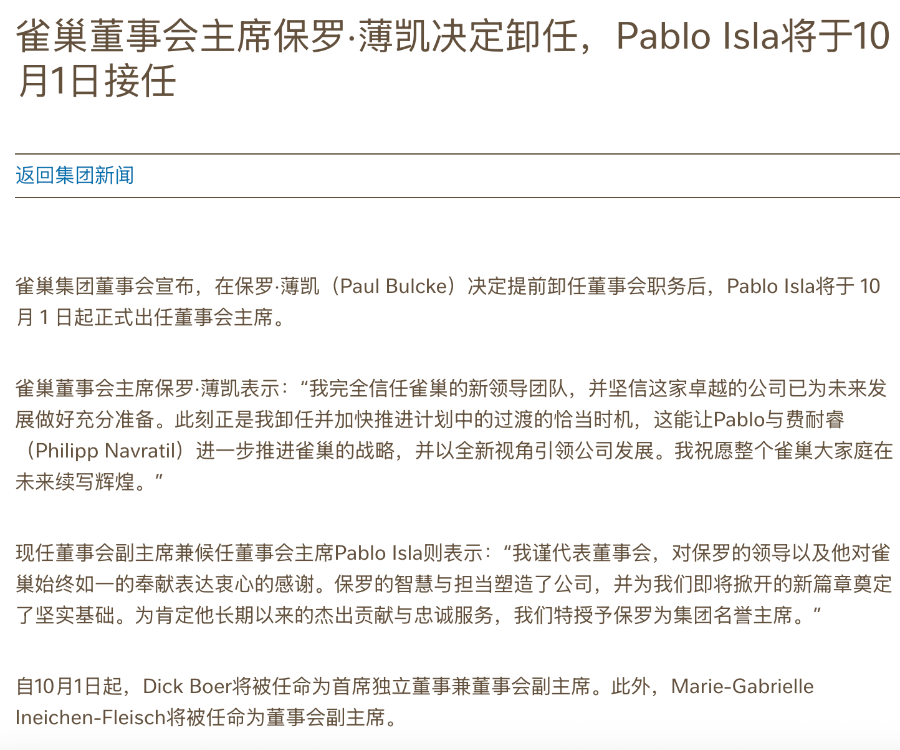
北京商报讯(记者 孔文燮)9月18日,北京商报记者从雀巢中国官网获悉,雀巢集团董事会宣布,在保 罗·薄凯(Paul Bulcke)决定提前卸任董事会职务后,Pablo Isla将于10月1日起正式出任董事会主席。 自10月1日起,Dick Boer将被任命为首席独立董事兼董事会副主席。此外,Marie-Gabrielle Ineichen- Fleisch将被任命为董事会副主席。 雀巢董事会主席保罗·薄凯表示:"我完全信任雀巢的新领导团队,并坚信这家卓越的公司已为未来发展 做好充分准备。此刻正是我卸任并加快推进计划中的过渡的恰当时机,这能让Pablo与费耐睿(Philipp Navratil)进一步推进雀巢的战略,并以全新视角引领公司发展。我祝愿整个雀巢大家庭在未来续写辉 煌。" 现任董事会副主席兼候任董事会主席Pablo Isla则表示:"我谨代表董事会,对保罗的领导以及他对雀巢 始终如一的奉献表达衷心的感谢。保罗的智慧与担当塑造了公司,并为我们即将掀开的新篇章奠定了坚 实基础。为肯定他长期以来的杰出贡献与忠诚服务,我们特授予保罗为集团名誉主席。" ...
雀巢动荡未止!CEO才因办公室恋情被解雇,董事会主席也被迫“闪辞”
Guan Cha Zhe Wang· 2025-09-18 01:42
Core Viewpoint - Nestlé is experiencing a governance crisis marked by the abrupt resignation of Chairman Paul Bulcke, who will be succeeded by Pablo Isla on October 1, 2023, following a series of leadership changes and declining performance [2][4][11]. Group 1: Leadership Changes - Paul Bulcke's resignation was unexpected as he was originally set to retire in April 2026, and it follows the recent dismissal of former CEO Laurent Freixe due to a scandal [4][8]. - Bulcke is the first chairman in nearly 20 years to resign under pressure from investors, reflecting a loss of confidence in the company's governance [5][7]. - The rapid succession of leadership, including two CEO changes within a year, has raised concerns about the company's stability and performance [8][10]. Group 2: Financial Performance - Nestlé's sales have been struggling, with a reported sales figure of 44.23 billion Swiss francs for the first half of 2025, a decline of 1.8% year-on-year, and a net profit of 5.06 billion Swiss francs, down 10.3% [10]. - The company's stock price has dropped over 40% since 2022, indicating significant market challenges and pressure on profit margins [10][12]. Group 3: New Leadership Expectations - Pablo Isla, the new chairman, is the first external appointee in Nestlé's history, previously leading Inditex and known for his strong leadership [11][12]. - Isla's immediate challenge will be to restore investor confidence and address the internal governance issues that have arisen from recent leadership turmoil [12][13]. - Analysts suggest that Isla must focus on strategic repositioning and operational efficiency to navigate the current market challenges and enhance Nestlé's competitive edge [12][13].


雀巢中国研发“一号位”变动;1月至8月全国铁路发送旅客32亿人次
Mei Ri Jing Ji Xin Wen· 2025-09-17 23:24
Group 1: Nestlé's Management Changes - Nestlé is optimizing its R&D model in Greater China to support transformation and accelerate development, with a new appointment effective from October 1, 2025 [1] - The new R&D head, Guglielmo Bonora, has extensive experience across multiple regions and categories, indicating a strategic shift in Nestlé's approach in the competitive Chinese market [1] - This management change aims to enhance innovation speed and product competitiveness, aligning with local consumer demands [1] Group 2: Railway Passenger Growth - From January to August, China's railway system transported 3.2 billion passengers, marking a 6.7% year-on-year increase and setting a historical record for the same period [2] - The average daily operation of passenger trains increased by 7.7%, reflecting sustained growth in capacity [2] - The introduction of tourism trains and cross-border passenger services has stimulated consumption and contributed to the development of the tourism and silver economy [2] Group 3: Subway's Localization Strategy - Subway launched a new sandwich line that incorporates traditional Chinese flavors, marking its first collaboration with a Michelin-starred chef [3] - This initiative reflects Subway's commitment to localization and its strategy to cater to Chinese consumer preferences for fresh and healthy food [3] - The introduction of the "Chinese flavor" sandwiches is expected to enhance Subway's competitiveness in the Chinese market [3] Group 4: Chaohongji's IPO Plans - Chaohongji has submitted an application for an "A+H" listing on the Hong Kong Stock Exchange, indicating an aggressive strategic expansion [4] - The company aims to raise funds for overseas expansion, brand upgrades, and capacity building amid a competitive jewelry market [4] - Chaohongji's strong revenue and profit growth in the first half of 2025, along with its innovative product offerings, position it favorably for investor interest [4] Group 5: Ctrip's Customer Protection Measures - Ctrip announced it will cover losses incurred by customers due to the postponement of the Disney cruise, demonstrating its commitment to consumer rights [5] - This decision may increase short-term costs but is expected to enhance brand image and customer loyalty in the long run [5] - By addressing this issue proactively, Ctrip aims to strengthen user engagement and solidify its position in the online travel market [5]
雀巢中国研发“一号位”变动;1月至8月全国铁路发送旅客32亿人次丨消费早参
Mei Ri Jing Ji Xin Wen· 2025-09-17 23:21
Group 1 - Nestlé is optimizing its R&D model in Greater China to support transformation and accelerate development, with a leadership change in the R&D department [1] - The new R&D head, Guglielmo Bonora, has extensive experience across multiple regions and categories, which aligns with Nestlé's strategic focus on innovation and local market needs [1] - This leadership transition is expected to enhance product competitiveness and help Nestlé regain growth advantages in the competitive Chinese food and beverage market [1] Group 2 - From January to August, China's railway system transported 3.2 billion passengers, marking a historical high with a year-on-year increase of 6.7% [2] - The average daily operation of passenger trains increased by 7.7%, indicating sustained growth in capacity and effective demand management through big data analysis [2] - The rise in cross-border passenger transport and tourism train operations is expected to stimulate consumption and contribute to the development of the tourism and silver economy [2] Group 3 - Subway introduced a new sandwich line that combines traditional Chinese flavors, marking a significant step in its localization strategy [3] - The collaboration with Michelin-starred chefs to create the "Zhi Zi Kao Rou" flavored sandwich reflects Subway's commitment to catering to local tastes and preferences [3] - This product innovation aims to enhance brand competitiveness in the Chinese market by meeting consumer demands for fresh and healthy food options [3] Group 4 - Chao Hong Ji has submitted an IPO application to the Hong Kong Stock Exchange, aiming for a dual listing in A+H shares [4] - The move indicates a proactive strategic approach to expand financing channels for overseas growth, brand upgrades, and capacity building in a competitive jewelry market [4] - The company has shown strong revenue and profit growth in the first half of 2025, alongside notable performance in IP collaborations and product innovation [5] Group 5 - Trip.com announced it will cover losses for customers affected by the postponement of the Disney cruise, demonstrating a commitment to consumer rights [6] - While this may increase short-term costs, it is expected to enhance brand image and customer loyalty in the long run [6] - The crisis management approach aims to strengthen user engagement and attract potential customers, solidifying Trip.com's position in the online travel market [6]
雀巢洗牌:CEO遭解雇后,曾支持他的董事会主席卸任
2 1 Shi Ji Jing Ji Bao Dao· 2025-09-17 12:08
Core Viewpoint - Nestlé is undergoing a significant leadership transition, with Paul Bulcke stepping down and Pablo Isla taking over as Chairman, while Philipp Navratil becomes the new CEO following the dismissal of Laurent Freixe due to a violation of the company's code of conduct [1][3][4]. Leadership Changes - Paul Bulcke announced his resignation to facilitate a smooth transition for the new leadership team [1]. - Pablo Isla will officially assume the role of Chairman on October 1, while Philipp Navratil has already taken over as CEO [1][3]. - Dick Boer will be appointed as the Chief Independent Director and Vice Chairman of the Board, with Marie-Gabrielle Ineichen-Fleisch also becoming a Vice Chairman [1]. Strategic Focus - Under Freixe's leadership, Nestlé initiated a major reform plan focusing on three key areas: operational efficiency, product portfolio enhancement, and strengthening foundational capabilities [5]. - The company aims to save at least 2.5 billion Swiss francs by the end of 2027 and increase advertising and marketing investments to 9% of sales by 2025 [5]. Market Adjustments - The restructuring includes a significant change in the organizational structure of the Greater China region, which will be merged back into the Asia, Oceania, and Africa region starting in 2025 [6]. - The new leadership team is expected to maintain the strategic direction set by Freixe, with a focus on supporting growth in the Chinese market [9]. Performance Metrics - Nestlé's sales in the Greater China region fell to 2.47 billion Swiss francs in the first half of the year, down 6.4% from 2.639 billion Swiss francs in the same period last year [11]. - The overall revenue for Nestlé in the first half of the year was 44.228 billion Swiss francs, a decrease of 1.8%, with net profit declining by 10.3% to 5.065 billion Swiss francs [12].
雀巢洗牌:CEO遭解雇后,曾支持他的董事会主席卸任丨消费一线
2 1 Shi Ji Jing Ji Bao Dao· 2025-09-17 12:07
Core Viewpoint - Nestlé is undergoing a significant leadership transition, with Paul Bulcke stepping down and Pablo Isla taking over as Chairman, while Philipp Navratil has been appointed as the new CEO following the dismissal of Laurent Freixe [2][4][5]. Leadership Changes - Paul Bulcke announced his resignation to facilitate a smooth transition for Pablo Isla and Philipp Navratil to advance Nestlé's strategy [2]. - Dick Boer will become the Chief Independent Director and Vice Chairman of the Board, while Marie-Gabrielle Ineichen-Fleisch will serve as Vice Chairman [2]. Reasons for Leadership Transition - Laurent Freixe's dismissal was due to an investigation revealing an undisclosed romantic relationship with a subordinate, violating Nestlé's Code of Business Conduct [4]. Strategic Focus Areas - Under Freixe's leadership, Nestlé initiated a major reform focusing on three key areas: operational efficiency aiming for cost savings of at least 2.5 billion Swiss francs by 2027, increasing advertising and marketing investments to 9% of sales by 2025, and enhancing capabilities to become a fully connected enterprise [5]. Market Adjustments - The restructuring includes a significant focus on the Chinese market, with the Greater China Region being integrated back into the Asia, Oceania, and Africa region starting in 2025 [6][10]. - New leadership appointments in the Greater China Region are being made to support this transition, with Kais Marzouki taking over as CEO [10][12]. Performance Metrics - Nestlé's sales in the Greater China Region decreased to 2.47 billion Swiss francs in the first half of the year, down 6.4% from 2.639 billion Swiss francs in the same period last year [14]. - The overall revenue for Nestlé in the first half of the year was 44.228 billion Swiss francs, a decline of 1.8%, with net profit falling by 10.3% to 5.065 billion Swiss francs [15]. Future Outlook - The effectiveness of the ongoing reforms and the new leadership's ability to maintain strategic direction amidst these changes remains to be seen [9][16].
雀巢(NSRGY.US)董事长提前卸任!管理层改组之际投资者盼更快速变革
智通财经网· 2025-09-17 10:56
Core Viewpoint - The early resignation of Nestlé's chairman Paul Bulcke is seen as an opportunity for the new leadership to accelerate growth, address underperforming businesses, and tackle declining sales [1][2]. Group 1: Management Changes - The management change was announced on Tuesday evening, with Bulcke stepping down six months earlier than planned, handing over to former Inditex CEO Pablo Isla [1]. - This shift follows the recent dismissal of former CEO Mark Schneider, indicating potential significant adjustments within the company [1][2]. - The leadership overhaul is considered one of the most significant changes in decades, reflecting increasing pressure from investors for a complete leadership reset [2]. Group 2: Investor Sentiment - Investors are calling for faster sales growth, improved efficiency, reduced costs, and increased investment in key brands such as Nescafé and Purina [1]. - Analyst Jean-Philippe Bertschy emphasized the need for Nestlé to regain stability and restore its former status, highlighting issues like growth stagnation and management turmoil [2]. Group 3: Strategic Direction - The new leadership, including Isla and Philipp Navratil, is committed to an organic growth strategy that focuses on leveraging efficiency to support investments in Nestlé's strong product portfolio [2]. - Analyst Jon Cox anticipates a new review of Nestlé's business portfolio, suggesting a focus on cost savings, innovation, and advertising investments to drive growth [3]. - There may be more aggressive measures taken to cut costs and divest underperforming segments, such as the North American frozen food business [3].
Nestle shares indicated slightly higher after chairman's early departure
Reuters· 2025-09-17 06:23
Core Viewpoint - Nestle shares showed a slight increase following the announcement that Chairman Paul Bulcke will step down earlier than anticipated, with former Inditex CEO Pablo Isla set to take over [1] Company Summary - Paul Bulcke, the current Chairman of Nestle, will hand over his position earlier than expected [1] - Pablo Isla, the former CEO of Inditex, has been appointed as the new Chairman [1] Industry Summary - The leadership change at Nestle may influence investor sentiment and market performance in the food industry [1]