Oracle(ORCL)

Search documents
Oracle Corporation (ORCL) a Moderate Buy, Per Wall Street Analysts
Yahoo Finance· 2025-12-20 11:56
Core Viewpoint - Oracle Corporation is recognized as one of the best stocks to buy in the S&P 500, with varying analyst ratings and price targets reflecting mixed financial performance and future expectations [1][2][3]. Financial Performance - Oracle's diluted EPS for Q2 fiscal 2026 was reported at $2.26, surpassing estimates of $1.64 per share, but revenue, adjusted operating income, and Remaining Performance Obligations (RPO) fell short of Wall Street expectations [3]. - The company's revenue growth and earnings forecast for Q3 also did not meet analysts' estimates, leading to a revised capital expenditure projection of $15 billion higher than initially expected for the full year [4]. Analyst Ratings and Price Targets - Barclays maintains an Overweight rating on Oracle with a price target of $310, while RBC Capital has reduced its price target from $310 to $250, maintaining a Sector Perform rating [1][2]. - As of December 17, the consensus among Wall Street analysts is a Moderate Buy rating, with an average one-year price target of $308.87, indicating a potential upside of 67% [6]. Investment Considerations - Analysts highlight that growth in cloud revenue and RPO is being counterbalanced by negative free cash flow and increased capital expenditures, shifting investor focus towards capital efficiency rather than just revenue growth [5]. - Future share price stability is contingent on Oracle demonstrating capital efficiency, credible free cash flow recovery, and sustained margins [5].

今日财经要闻TOP10|2025年12月20日
Xin Lang Cai Jing· 2025-12-20 11:53
Group 1 - ByteDance is reported to potentially achieve a net profit of approximately $50 billion for the year, following a claim of around $40 billion in net profit for the first three quarters of 2025, but insiders have stated that these figures are inaccurate and significantly deviated from reality [1][7] - The world's first commercial supercritical carbon dioxide power generation unit, named "Super Carbon No. 1," has successfully commenced operations in Guizhou, China, with a capacity of 15 megawatts, achieving over 85% efficiency improvement and over 50% increase in net power generation compared to traditional steam generation methods [2][7] Group 2 - The U.S. military is reportedly conducting strong retaliatory actions against ISIS in Syria, following the killing of American personnel, with full support from the Syrian transitional government [4][9] - The National Development and Reform Commission, the State Administration for Market Regulation, and the National Internet Information Office have issued rules prohibiting platform operators from colluding to manipulate market prices using platform rules, data, and algorithms [5][9] Group 3 - Beijing Tongrentang has issued an apology regarding the controversy surrounding its Antarctic krill oil products, announcing a comprehensive brand rectification initiative, including a thorough investigation and immediate product recall [3][10] - The Shanghai Consumer Protection Committee has expressed support for Tongrentang's acknowledgment of the issue and its proposed corrective measures, emphasizing the importance of consumer feedback in assessing the effectiveness of these actions [5][11] Group 4 - Moore Threads has launched a new GPU architecture named "Huagang," which boasts a 50% increase in computing density and a tenfold improvement in energy efficiency, capable of supporting clusters of over 100,000 cards [6][12] - U.S. stock markets saw gains, with the Dow Jones up 0.38%, the Nasdaq up 1.31%, and the S&P 500 up 0.89%, driven by strong performances from major tech stocks [6][13]





Oracle: The Consensus Is Wrong Again And Few Will Take Advantage Of The Opportunity (NYSE:ORCL)
Seeking Alpha· 2025-12-20 10:37
I recommend buying Oracle ( ORCL )( ORAC:CA ) shares after the sharp price drop. This is my initial coverage article about the company. My intention is to discuss why September's euphoria turned intoMore than 5 years of experience in equity analysis in LatAm. We provide our clients with in-depth research and insights to help them make informed investment decisions.Analyst’s Disclosure:I/we have no stock, option or similar derivative position in any of the companies mentioned, and no plans to initiate any su ...

Oracle: The Consensus Is Wrong Again And Few Will Take Advantage Of The Opportunity
Seeking Alpha· 2025-12-20 10:37
Core Viewpoint - The recommendation is to buy Oracle (ORCL) shares following a significant price drop, indicating a potential investment opportunity after a period of market euphoria in September [1]. Company Analysis - Oracle has experienced a sharp decline in share price, which presents a buying opportunity for investors [1]. - The article serves as an initial coverage of Oracle, aiming to provide insights into the company's current market position and future potential [1]. Market Context - The shift from euphoria to a price drop suggests volatility in the market, which may affect investor sentiment and decision-making [1].
甲骨文-若你搭建了平台,客户会买单吗?
2025-12-20 09:54
Summary of Oracle's Earnings Call Company Overview - **Company**: Oracle Corporation - **Industry**: Technology, specifically focusing on cloud computing and AI infrastructure Key Points and Arguments Earnings Report Highlights - Oracle's F2Q results were complex, broadly in line with expectations but lacking investor reassurances, leading to a share price decline of approximately 11% on Thursday and another 5% on Friday [3][8] - Total revenue increased by 13% year-over-year to $16.06 billion, driven by a 33% increase in cloud revenue, which now constitutes half of total sales [8] - Remaining Performance Obligations (RPO) surged by 433% year-over-year to $523 billion, indicating strong backlog momentum [8] - Free Cash Flow (FCF) fell sharply to -$10 billion due to higher-than-expected capital expenditures (capex) of $12 billion related to data center expansion [8] Capital Expenditure and Funding Concerns - Oracle's FY26 capex is now projected at $50 billion, an increase of $15 billion from previous estimates, raising concerns about cash generation timing and durability [8][9] - Management indicated that they expect to require less funding for AI buildout than previously anticipated, despite earlier expectations of needing over $100 billion [4][8] - The company is exploring various debt financing options, but there is frustration among investors regarding the reliance on debt without clear equity risk-sharing strategies [4][9] Market Reactions and Credit Ratings - Following the earnings report, Oracle's credit spreads widened by approximately 30 basis points, with 5-year CDS reaching levels not seen in nearly two decades [3][4] - Credit ratings from Moody's (Baa2, Negative outlook) and S&P (BBB, Negative outlook) reflect concerns about the company's rising commitments and execution risks [2][4] Management's Strategy and Guidance - Oracle's guidance for F3Q includes a projected 39% year-over-year growth in cloud revenue and a total revenue increase of 17% [8] - Management emphasized a rigorous process for accepting customer contracts to ensure acceptable margins, but skepticism remains regarding the sustainability of unit economics as the platform scales [10] - The company plans to utilize customer/supplier structures to manage capex burdens, indicating a focus on synchronizing cash inflows and outflows [10] Balance Sheet and Lease Liabilities - Oracle's total debt reached $108 billion, with cash and equivalents at $20 billion, resulting in a net leverage ratio of approximately 3.32x [10] - A significant increase in off-balance-sheet lease commitments, totaling $248 billion, has raised questions about how these will impact future financial statements and credit ratings [10] Risks and Future Outlook - The primary risks include execution challenges in AI and cloud growth, potential loss of confidence in OpenAI's commitments, and the overall volatility of the AI investment cycle [3][4] - The outlook remains cautious, with the need for Oracle to demonstrate a return on investment from AI capex to alleviate investor concerns [3][4] Additional Important Information - Management's focus on high-quality customers like Meta and NVIDIA, while downplaying reliance on OpenAI, reflects a strategic shift to mitigate risks associated with speculative entities [10] - The overall tone of the earnings call was underwhelming, reinforcing investor fears about rising capital expenditures and demand quality [3][4]
美国科技行业-第三季度业绩摘要:人工智能波动未改变软件投资逻辑-US Technology_ Q3 results summary_ AI volatility doesn‘t change the software playbook
2025-12-20 09:54
Summary of Key Points from the Conference Call Industry Overview - The conference call focuses on the **US Technology Equities** sector, particularly the **software and AI** landscape, highlighting the transition towards AI productization expected by **2026** [1][2]. Core Insights - **AI Productization Timeline**: 2026 is projected as the pivotal year for AI productization within enterprise software, moving from early-stage deployment to widespread enterprise integration [1][2]. - **Current AI Deployment Challenges**: Companies are still in the early stages of AI experimentation, facing challenges in hiring skilled talent and achieving meaningful results from initial projects [1][2]. - **Shift in Investment Focus**: There is a notable shift from hardware to software investments as companies begin embedding AI into their existing workflows, with significant advancements seen in companies like **Oracle, Microsoft, Salesforce, and ServiceNow** [1][2][5]. - **Monetization Visibility**: Vendors controlling structured enterprise processes are expected to have improved monetization visibility as AI becomes a value-added feature in their product suites [2]. Financial Performance Highlights - **Q3 Earnings Performance**: Most companies reported modest revenue beats but significant improvements in non-GAAP operating income and EPS, indicating early economic benefits from AI deployments [7][9]. - **Revenue Growth Constraints**: Despite increased interest in AI, enterprise budget expansions remain modest, limiting revenue growth [9]. - **Profitability Boost from AI**: AI-driven efficiencies are enhancing unit economics, leading to higher non-GAAP operating income and EPS, even without substantial revenue increases [9]. Company-Specific Insights - **Preferred AI Stocks**: The report identifies **Oracle (ORCL), Microsoft (MSFT), ServiceNow (NOW), and Salesforce (CRM)** as preferred stocks likely to benefit from their strategic positioning in the AI landscape by 2026 [2][5]. - **Earnings Revisions**: Companies like **Microsoft** and **Palantir** have seen significant upward revisions in revenue and EPS forecasts, reflecting strong AI-related demand [13][14]. - **CoreWeave's Performance**: CoreWeave reported revenue of **USD 1,365 million** for Q3, exceeding consensus but below estimates, with concerns about asset turnover and future guidance indicating potential revenue decline [18][19]. Market Dynamics - **AI Infrastructure Demand**: The demand for AI infrastructure and data workloads is solid, with companies like **Oracle and CoreWeave** aggressively scaling capacity [15]. - **Investor Sentiment**: There is a growing investor focus on how companies will deploy AI to solve business problems, with many still not fully recognizing the link between AI deployment and enterprise software [2]. Conclusion - The technology sector is on the brink of a significant transformation driven by AI, with 2026 expected to be a critical year for monetization and integration into enterprise workflows. Companies that are well-positioned in the software space are likely to capitalize on this trend, while challenges remain in the broader economic environment and enterprise budget constraints.


Network API Market to Surpass USD 27.01 Billion by 2033, Driven by 5G Expansion and Demand for Real-Time Connectivity | Report by SNS Insider
Globenewswire· 2025-12-20 08:00
Core Insights - The Network API Market is projected to grow from USD 2.15 billion in 2025 to USD 27.01 billion by 2033, with a CAGR of 37.32% from 2026 to 2033 [1][2] Market Drivers - The demand for seamless integration, real-time data exchange, and enhanced connectivity across cloud services, corporate applications, and IoT ecosystems is driving the growth of the Network API market [2] - The adoption of digital transformation projects, 5G networks, and AI-based services is increasing the need for reliable, scalable, and secure APIs [2] Regional Insights - North America holds a dominant share of 42.00% in the Network API Market in 2025, attributed to advanced digital infrastructure and strong enterprise integration of API-driven solutions [10] - The Asia Pacific region is expected to experience the fastest growth with a CAGR of approximately 40.25% from 2026 to 2033, driven by rapid digital transformation and increasing smartphone penetration [10] Market Segmentation By Type - Communication & Messaging APIs lead with a 29.4% market share, essential for real-time interactions and enterprise messaging workflows [5] - Device & IoT Connectivity APIs are the fastest-growing segment, with a CAGR of 28.6%, driven by the rapid expansion of IoT across various industries [5] By Network Type - 3G/4G/LTE Networks account for 41.7% of the market share, serving as the foundation for API-driven telecom services [6] - 5G Networks are the fastest-growing segment, with a CAGR of 30.3%, due to their ultra-low latency and high bandwidth capabilities [6] By Application - IT & Telecom sectors lead with a 33.8% share, relying heavily on APIs for network optimization and operational automation [8] - BFSI is the fastest-growing segment, with a CAGR of 27.4%, driven by the demand for secure financial APIs [8] By End-User - Enterprises hold a 36.2% share, integrating APIs to streamline workflows and enhance connectivity [9] - Developers represent the fastest-growing segment, with a CAGR of 26.1%, due to the increasing availability of open APIs [9] Recent Developments - In 2024, Ericsson launched its Network API Platform, providing enterprises and developers access to real-time 5G network capabilities [14] - In 2025, Nokia introduced Network as Code (NaC), a cloud-native platform offering self-service access to 5G and fixed network APIs [14] Key Players - Major companies in the Network API market include Ericsson, Nokia, Cisco, Microsoft, AT&T, and others [13]





“三巫日”科技股撑美股指两连阳
Hua Er Jie Jian Wen· 2025-12-20 02:44
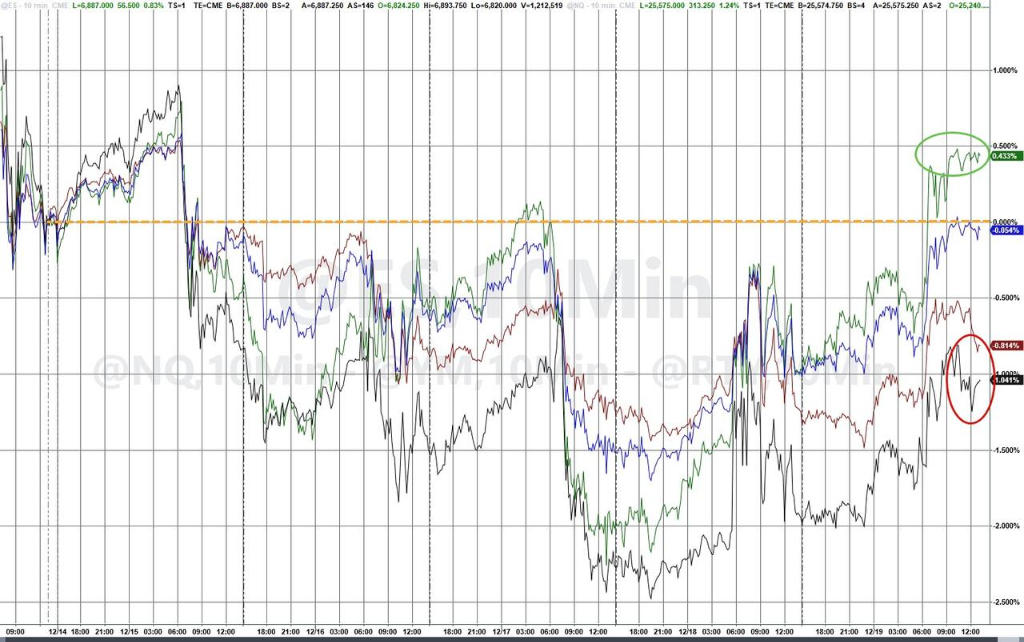
Market Overview - US stock market indices experienced a significant rise, with the S&P 500 up 59.74 points (0.88%) to 6834.50 points, and the Nasdaq gaining 301.26 points (1.31%) to 23307.62 points, marking a weekly increase of 0.48% [9][11] - The trading volume surged to historical highs due to the "triple witching" options expiration and index rebalancing, while volatility indices (VIX and VVIX) declined, indicating a stable market despite high trading activity [4][11] Technology Sector - Major tech stocks, including Nvidia and Oracle, rebounded significantly, contributing to the overall market recovery after earlier concerns regarding AI capital expenditures [1][4] - The Magnificent 7 index of major US tech stocks rose by 1.21%, with Nvidia increasing by 3.93% and Oracle by 6.63% [12] Semiconductor Industry - The semiconductor sector saw a notable increase, with the semiconductor ETF rising by 2.59% and AMD's stock climbing over 6% [9][12] - The Philadelphia Semiconductor Index rose by 2.98%, reflecting strong performance in the chip sector [12] International Markets - European markets also showed positive trends, with the STOXX 600 index up 1.6% for the week, driven by gains in financial services and banking sectors [13] - The UK FTSE 100 index rose by 0.61%, reflecting a weekly increase of 2.57% [14] Inflation and Economic Indicators - Recent US inflation data indicated a moderate trend, with the core CPI for November showing a significant decline, which may provide room for future interest rate cuts [7] - Regional surveys from the Philadelphia and New York Federal Reserves indicated weakening business and consumer confidence, reinforcing the narrative of needing policy support for growth [7][8]


帮主郑重:甲骨文联手TikTok,美股AI板块“回血”!A股科技股能跟上吗?
Sou Hu Cai Jing· 2025-12-20 01:17
Core Insights - The recent surge in the Nasdaq index, which rose over 300 points, signals a recovery in the technology sector, particularly in AI-related stocks, driven by Oracle's acquisition of TikTok's U.S. operations [1][3] Group 1: Market Reaction - Oracle's stock increased nearly 7%, reversing previous declines caused by financing issues in data center projects [3] - The $100 billion deal with TikTok has addressed market concerns regarding high AI capital expenditures by demonstrating viable application scenarios [3] - News about potential easing of chip export restrictions from Nvidia has alleviated fears regarding technology sanctions, contributing to a positive market sentiment [3] Group 2: Implications for A-Share Investors - The rebound in U.S. tech stocks may provide a stabilizing external environment for the A-share technology growth sector [4] - Improved risk appetite for global tech stocks is expected to enhance pricing confidence among A-share investors in sectors like computing power, semiconductors, and application software [4] - A focus on domestic technology sectors with strong policy support and independent industrial logic, such as domestic substitution and AI applications, is recommended [4] Group 3: Strategic Recommendations - Investors are advised to optimize their technology holdings by leveraging the external sentiment recovery while focusing on domestic industrial logic [5] - For existing technology positions, it is suggested to reassess holdings and prioritize companies with real orders and high technical barriers [5] - New investors should monitor U.S. market trends as emotional indicators but base decisions on the fundamentals of domestic companies, paying attention to upcoming policy signals and industry leaders' performance [5]

OpenAI should strike while iron's hot, raise $200 billion at $1 trillion valuation: Jim Cramer
Youtube· 2025-12-20 00:57
分组1 - The market has shown signs of recovery, particularly for AI-related stocks, with the NASDAQ increasing by 1.31% and the Dow gaining 183 points, indicating a positive shift for companies involved in AI data center buildouts [2][3]. - There are significant challenges facing the data center buildout, including labor shortages, material shortages, and increased scrutiny from the stock market on hyperscalers' expansion plans, which have led to a decline in investor confidence [4][7]. - Companies like Oracle are pivotal in the data center space, with Oracle having $300 billion in orders from OpenAI and an additional $223 billion from other clients, positioning it as a key player in the AI infrastructure market [14][15]. 分组2 - Oracle's stock experienced volatility, dropping from $328 to $178 due to concerns over its ability to fulfill its ambitious plans, which has raised doubts about the entire data center sector [19][18]. - OpenAI is reportedly looking to raise up to $100 billion at a valuation potentially exceeding $800 billion, which could provide the necessary funding for Oracle to proceed with its data center projects [20][21]. - The success of the data center theme hinges on OpenAI's ability to secure funding quickly, as failure to do so could lead to a downturn in the entire sector [24][22].