
Oracle(ORCL)

Search documents

阿联酋资本托底美股?不仅注资OpenAI,更把甲骨文从债务悬崖边拉了回来
Hua Er Jie Jian Wen· 2025-12-19 09:03
Core Insights - UAE capital is poised to play a crucial role in reversing market concerns about an AI bubble, with OpenAI planning to raise up to $100 billion, seeking investments from UAE sovereign wealth funds [1] - The involvement of UAE funds reflects a "Too Big To Fail" mentality, indicating that continued capital infusion is necessary to maintain the operational stability of major AI firms [1] - The financing implications extend beyond OpenAI, affecting the financial health of key suppliers like Oracle, which faced a downgrade in debt ratings due to concerns over OpenAI's revenue generation capabilities [1] Funding Impact - The funds raised by OpenAI will primarily be used to cover computing costs, providing a stable revenue stream for data center service providers like Oracle, which saw its stock rise over 5% following the news [2] - OpenAI's financing pressure began in late October, with investor concerns about its ability to manage $1.4 trillion in debt given its revenue of only $13 billion [5] - OpenAI is reportedly seeking government guarantees to attract the necessary investments for AI computing and infrastructure, highlighting the precarious nature of the current AI funding landscape [5] Strategic Investments - The deep involvement of UAE sovereign wealth funds is reshaping the industry landscape, with OpenAI already receiving support from the MGX fund [8] - SoftBank's CEO has committed to investing $30 billion in OpenAI, having sold $5.8 billion in Nvidia stock to fund this investment, although the total financing still falls short of OpenAI's projected $1.4 trillion capital needs [9] - The upcoming $100 billion investment is expected to significantly enhance OpenAI's competitive position in the AI sector and improve the financial outlook for partners like Oracle and CoreWeave [9]

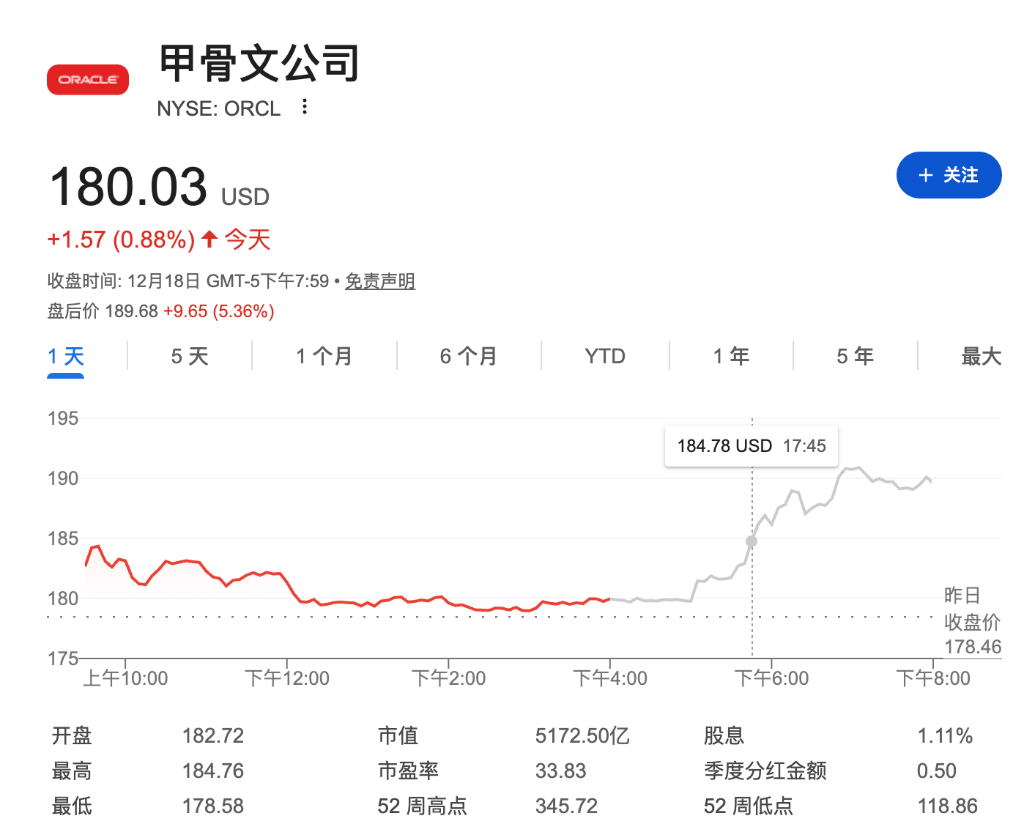
Oracle (ORCL) Stock Gets $275 Target as Evercore Highlights Long-Term OCI Growth
Yahoo Finance· 2025-12-19 08:48
Core Viewpoint - Oracle Corporation is recognized as a significant player in the AI stock market, with Evercore ISI maintaining an "Outperform" rating and a price target of $275, emphasizing the company's long-term growth potential in cloud services [1]. Group 1: Financial Projections - Evercore ISI estimates Oracle's cloud revenue potential to be around $76 billion, based on the assumption that each megawatt can generate $10 million in annual GPU cloud revenue [3]. - The annual cost for leases is projected to be approximately $14.5 billion, or $1.2 billion per month, spread over 15-19 years, assuming an average lease length of 17 years [2]. Group 2: Revenue and Cost Structure - Leases are expected to account for about 18% of the total costs associated with supporting cloud revenue, aligning with Oracle's previous comments during the analyst day [4]. - Oracle has already secured commitments that will support 65% of the projected revenue ramp through FY29, amounting to around $116 billion in total OCI [4]. Group 3: Operational Insights - Despite reports of delays at the Michigan site, Oracle's planning includes delivery buffers, and the most significant revenue ramp from the OpenAI deal is anticipated between FY27 and FY28 [4]. - A potential pushout to FY28 for delivery is not expected to significantly alter the OCI revenue ramp, although it may not be favorable in light of recent stock price movements [5].
“AI泡沫即使存在,也将继续膨胀”
Xin Lang Cai Jing· 2025-12-19 05:35
Core Insights - The current AI boom exhibits characteristics of a historical bubble, but it is not merely a case of "overheated tech stock speculation" as the AI industry is likely to undergo structural differentiation while continuing to grow [1][8] - Despite widespread discussions about the existence of a bubble, investments continue to flow into the sector, with valuations rising and enthusiasm persisting [1][8] - Major tech companies are using their cash flow to fund AI infrastructure, contrasting with the debt-laden startups of the early internet era, leading some investors to believe "this time is different" [8][10] AI Bubble Existence - To assess whether an AI bubble exists, a reliable evaluation tool is needed, such as the four-factor framework proposed by Brent Goldfarb and David A. Kirsch [2] - The four factors include uncertainty, a significant gap between investment scale and actual revenue, the prevalence of pure investment targets, and the influx of inexperienced investors [3][4][5] Investment and Revenue Discrepancy - Large tech companies are projected to invest up to $3 trillion in AI infrastructure by 2028, while current annual AI revenue is approximately $50 billion, indicating a significant gap [4] - Morgan Stanley estimates that to achieve a 10% return on these investments, AI must generate $650 billion annually, which is 13 times the current revenue level [4] Market Dynamics - The narrative surrounding AI is powerful, with claims that AI will solve numerous global issues, which fuels investment despite the lack of clear profitability [6][10] - The current market sentiment is characterized by a fear of missing out (FOMO), leading investors to overlook potential risks associated with AI investments [7][10] Financial Structures and Risks - The financing structure for AI investments is evolving, with private equity and bond markets increasingly involved, which could spread risks beyond traditional equity speculation [11] - Oracle's significant debt and reliance on OpenAI for revenue highlight the risks associated with high leverage in the AI sector [12] Technological Progress vs. Bubble - Technological advancements in AI are real and ongoing, but this does not negate the existence of a bubble characterized by inflated market prices [13][14] - The current valuation of AI companies appears to be the highest since the internet bubble, indicating a potential disconnect between market prices and actual value [14][15] Geopolitical Influences - Geopolitical competition, particularly between the U.S. and China, is driving the narrative that justifies massive investments in AI, further complicating the bubble dynamics [16] Conditions for Bubble Disproof - For the AI bubble to be disproven, core companies must demonstrate robust financial health, productivity gains must be realized quickly, and the competitive landscape must ensure healthy profit distribution [17][18][19] - The financing structure must be de-risked to avoid systemic debt risks, and market sentiment must remain rational to prevent a full-blown bubble [20] Economic Implications of Bubble Burst - If the AI bubble bursts, it could lead to significant economic repercussions, including a potential recession, as AI-related investments have become a substantial part of U.S. GDP growth [21] - The resilience of major tech companies may mitigate systemic financial crises, but asset price corrections could still occur [21][22] Future Outlook - The AI market is expected to continue growing, albeit with structural differentiation, as some overhyped sectors may face challenges while others with clear ROI will thrive [23] - The focus will shift from storytelling to efficiency and physical implementation, with critical issues like power supply and funding gaps needing resolution [23]


安期货晨会纪要-20251219




Xin Yong An Guo Ji Zheng Quan· 2025-12-19 04:01
Core Insights - US core inflation unexpectedly eased to a four-year low, raising questions among economists about the reliability of the data due to a prior government shutdown [8][14] - ByteDance has signed an agreement to establish a joint venture in the US with majority ownership by American investors [8][14] Market Performance - The A-share market opened lower but closed higher, with the Shanghai Composite Index up 0.16% at 3876.37 points, while the Shenzhen Component fell 1.29% and the ChiNext Index dropped 2.17% [1] - The Hong Kong market also saw fluctuations, with the Hang Seng Index closing up 0.12% at 25498.13 points, while the Hang Seng Tech Index fell 0.73% [1][5] Economic Indicators - The US core Consumer Price Index (CPI) rose by 2.6% year-on-year in November, while the overall CPI increased by 2.7% [14] - The report indicated that core CPI only increased by 0.2% over the last two months, with declines in hotel, leisure, and clothing prices limiting the overall increase [14] Corporate Developments - TikTok announced the establishment of a joint venture with US investors, which will operate independently and manage US data protection and algorithm security [8][14] - China has reportedly ordered 7 million tons of US soybeans, achieving over half of the procurement target set during the Trump administration [8][14]
TikTok美国业务重组落定 甲骨文、银湖资本等入局持股
Sou Hu Cai Jing· 2025-12-19 03:47
此次协议的签署,标志着TikTok美国业务重组方案迈出关键一步。据了解,新合资企业负责的数据安全等业务为非营利性质且运营成本 较高,而为保障其正常运转,字节跳动旗下负责商业业务的实体将与合资企业建立商业上合理的收入分享安排。周受资在备忘录中未提 及中国方面对该交易的具体意见,仅明确协议尚待中国批准。 外界分析认为,该方案通过"数据安全独立运营、商业核心留存"的架构设计,既契合了美国对数据安全的监管要求,也保障了字节跳动 在TikTok核心商业领域的控制权,与苹果公司在中国"云上贵州"的运营模式有相似之处,但字节跳动在合资企业中仍保留重要席位。协议 若顺利获批落地,将确保美国1.7亿用户继续正常使用TikTok,广告商也可不受影响地连接全球受众,为TikTok美国业务的稳定发展奠定 基础。 周受资在备忘录中难掩振奋,称"很高兴与大家分享好消息"。根据备忘录披露的股权架构,新成立的美国合资企业50%股份由新投资者持 有,其中甲骨文、银湖资本、MGX将分别持有15%的股份;字节跳动部分现有投资者的关联公司将持有30.1%的股份;字节跳动自身将保 留19.9%的股份,仍为该合资企业的最大单一股东。值得注意的是,合资企 ...

TikTok Says New Joint Venture Will Enable Continued US Operations
PYMNTS.com· 2025-12-19 03:26
Core Insights - TikTok and its parent company ByteDance have established agreements with Oracle, Silver Lake, and MGX to create a new U.S. joint venture, ensuring the app's continued operation in the United States [1] - The transaction is expected to close on January 22, as stated by TikTok CEO Shou Zi Chew [2] Joint Venture Structure - The U.S. joint venture will be majority owned by American investors, governed by a seven-member board of directors, and will include provisions to protect American data and national security [3] - A consortium of new investors will hold 50% of the joint venture, with Oracle, Silver Lake, and MGX each holding 15%, while existing ByteDance affiliates will hold 30.1%, and ByteDance will retain 19.9% [4] Data Protection and Operations - The joint venture will manage data protection, algorithm security, content moderation, and software assurance, with U.S. user data stored in the U.S. by Oracle [5] - TikTok Global's U.S. entities will oversee global product interoperability, eCommerce, advertising, marketing, and other commercial activities [5] User Experience and Legislative Context - The joint venture aims to ensure that over 170 million Americans can continue using the platform without changes to their experience, while advertisers can still reach global audiences [6] - A law signed by former President Joe Biden in April 2024 mandated that TikTok would be banned unless ByteDance divested its stake within a year [6] - The law faced legal challenges and delays, particularly after the election of Trump, as various potential buyers sought to finalize a deal [7] - Trump's executive order in September deemed the joint venture framework a "qualified divestiture" that would address national security concerns [8]

美国众议院通过《Speed Act》 2026年?AI基建有望迈入加速阶段
Zhi Tong Cai Jing· 2025-12-19 03:14
Group 1 - The U.S. House of Representatives has passed the "Speed Act" aimed at simplifying the permitting process for AI infrastructure and energy systems, with a vote of 221 in favor and 196 against [1] - Major U.S. tech companies, including Micron, OpenAI, and Microsoft, have publicly supported the "Speed Act," which is expected to reduce the federal permitting risks associated with energy infrastructure for large data centers [2] - The "Speed Act" is designed to accelerate the construction of AI data centers by addressing external constraints related to obtaining power and energy infrastructure approvals, thereby reducing the "time-to-power" risk [2][3] Group 2 - The legislation will narrow and expedite the National Environmental Policy Act (NEPA) processes, allowing certain projects to bypass redundant reviews and focusing environmental impact analyses on direct effects [3] - The act is seen as a tool to facilitate faster energy supply projects, which are critical for the expansion of AI data centers, especially in regions with tight power loads [3] - However, the "Speed Act" does not address other significant bottlenecks faced by tech giants, such as local zoning issues, community resistance, and utility cost-sharing [4] Group 3 - The "Genesis Project," initiated by the White House, aims to enhance the application of emerging technologies, including AI, in scientific exploration and energy projects, with 24 leading AI companies, including Microsoft and Google, signing agreements to participate [4] - The project is expected to significantly boost the productivity of U.S. researchers by automating experimental design and accelerating simulation processes [4] Group 4 - A report from Bank of America indicates that the global AI arms race is still in its early to mid-stages, with Vanguard noting that the AI investment cycle may have only reached 30%-40% of its peak [5] - Major financial institutions believe that the investment wave in AI infrastructure, particularly in AI chip computing hardware, is just beginning, with potential investments reaching $3 trillion to $4 trillion by 2030 [5]

Down More About 45% From Recent Highs, Is Now the Time to Buy Oracle Stock?
The Motley Fool· 2025-12-19 03:06
Core Insights - Oracle's recent stock sell-off reflects concerns about the sustainability of its AI infrastructure investments despite strong revenue growth [1][2] - The company reported a 14% year-over-year revenue increase to $16.1 billion in fiscal Q2 2026, driven by a 34% rise in total cloud revenue [5][6] - Oracle's remaining performance obligations (RPOs) reached $523 billion, up 438% year-over-year, indicating strong long-term commitments from major clients [7] Financial Performance - Cloud infrastructure revenue surged 68% year-over-year to $4.1 billion, marking an acceleration from a 54% increase in the previous quarter [6] - Operating cash flow for fiscal Q2 was approximately $2.1 billion, but capital expenditures soared to about $12 billion, resulting in negative free cash flow of around $10 billion [9][10] - Total debt reached approximately $111 billion, significantly exceeding cash and cash equivalents of nearly $20 billion [11] Investment Outlook - Management has raised fiscal 2026 capital expenditure guidance from $35 billion to about $50 billion, indicating ongoing investment in AI infrastructure [10] - The stock is trading at a price-to-earnings ratio of about 35, reflecting market confidence in Oracle's ability to convert RPOs into revenue and profits [13] - The current market conditions present a potential buying opportunity for investors who believe in the long-term viability of Oracle's AI-driven cloud strategy [15]

密歇根州通过争议性协议 监管机构批准为甲骨文(ORCL.US)和OpenAI数据中心供电
Zhi Tong Cai Jing· 2025-12-19 03:04
Core Viewpoint - The Michigan regulatory agency has unanimously approved DTE Energy Co.'s request to provide power for a large-scale data center project planned by Oracle and OpenAI, despite public opposition [1][2]. Group 1: Project Details - DTE Energy's plan involves a $1.4 billion facility in Saline Township, which will require significant power supply [1]. - Oracle will cover most of the project's costs, including a minimum monthly fee and termination fees, as part of a financing deal worth approximately $14 billion [2]. - The data center is part of OpenAI's broader plan to build 8 gigawatts of capacity in the U.S., contributing to a total investment of over $450 billion in the next three years [2]. Group 2: Regulatory and Public Response - The Michigan Public Service Commission stated that the agreements protect the grid and the public, ensuring net financial benefits for DTE's other customers [1]. - The approval process has been contentious, with concerns raised about the potential for data centers to consume power at the expense of public services during emergencies [2]. - Public opposition was evident during the hearing, highlighting growing hostility towards data centers in certain regions of the U.S. [3].