
理性泡沫

Search documents
CGS-NDI专题报告:非理性繁荣下的理性AI泡沫将如何演绎?
Yin He Zheng Quan· 2026-02-27 09:38
Group 1: AI Bubble Characteristics - The current AI bubble is characterized as a "rational bubble," differing from historical irrational bubbles like the Dutch tulip mania, due to AI's transformative potential for society[4] - The macroeconomic environment, valuation structures, and investment intensity indicate that the risks associated with the current AI bubble are manageable compared to the 2000 internet bubble[4] - Global major economies are in a rate-cutting window, with actual interest rates significantly declining, which increases market tolerance for long-term capital expenditures and uncertainties in future returns[4] Group 2: Risks and Potential Outcomes - Structural and cyclical issues in the global economy present systemic risks that exceed those during the 2000 internet bubble, driven by demographic aging, debt expansion, and de-globalization[4] - The AI bubble may lead to unexpected liquidity tightening, especially if geopolitical tensions raise commodity prices, potentially resulting in a "secondary inflation" scenario[5] - The difficulty in forming a closed-loop business model within the AI industry could hinder the sustainability of the bubble, as heavy asset expansion increases operational cash flow pressures[5] Group 3: Economic Implications - AI's impact on employment and consumption may lead to economic demand shocks, with the potential for a "smart crisis" that could exacerbate economic downturns[5] - If the bubble bursts, China's adjustment may be more manageable due to its national system and domestic market advantages[5] - The ongoing AI investment is still in the early stages of technology diffusion, with significant room for growth compared to the peak of the internet cycle[7]
如何理解-非理性繁荣-下的-理性泡沫
2026-01-23 15:35
Summary of Key Points from Conference Call Industry Overview - The conference discusses the global AI investment theme, highlighting significant growth from late 2023 to late 2025, with the A-share AI theme index rising approximately 1.2 times, the Hang Seng Tech Index increasing over 46%, and the market capitalization of the seven major US tech companies growing about 174% to reach $21.6 trillion [1][2]. Core Insights and Arguments - **Rational vs. Irrational Bubbles**: - Rational bubbles are driven by investor expectations of future price increases, supported by loose liquidity and technological advancements. In contrast, irrational bubbles are influenced by psychological biases and herd behavior, detaching from fundamental valuations [1][4]. - **Comparison with 2000 Internet Bubble**: - The current AI market shares similarities with the 2000 internet bubble, such as technological benefits and fundamental improvements. However, the macroeconomic environment is more complex, necessitating caution regarding liquidity changes and market sentiment [1][5]. - **Valuation Concerns**: - Current AI-related assets exhibit signs of overvaluation, with the Shiller P/E ratio indicating the Nasdaq is in a dangerous zone. The Tobin Q ratio is high, and the investment in information processing and software as a percentage of GDP is nearing levels seen during the 2000 bubble [16][20]. - **Liquidity and Market Dynamics**: - The decline in long-term risk-free rates in the US has created a favorable environment for tech stock valuation expansion, attracting capital inflows and boosting the dollar index [7][8]. - **Risk Indicators**: - Key risk indicators include the Buffett Indicator exceeding historical highs, equity risk premiums falling into negative territory, and total stock market capitalization compared to financial data being close to 2000 levels [13][16]. Additional Important Content - **Investment Trends**: - By 2025, approximately 50% of global AI industry data investment will come from large enterprises' own funds, contrasting with the 54% from venture capital in 2000 [20]. - **Employment Impact**: - AI technology enhances efficiency but also compresses certain job roles, necessitating attention to changes in employment structure to assess whether the AI bubble could evolve into a detrimental bubble [21][22]. - **Market Sentiment and Future Outlook**: - The AI investment landscape is expected to remain robust, with significant opportunities in 2026 and 2027, particularly in core asset pricing models. The US market, led by companies like Nvidia, shows strong growth potential [23][24]. - **China's Market Dynamics**: - The Chinese mainland market, especially the ChiNext board, mirrors the US market's trends, indicating a dual rise in valuation and profitability, with no immediate downturn expected [24]. - **Technology Cycle Theory**: - The current phase of technology investment may be in the mature stage, with potential for a peak following widespread adoption. Evaluating tech companies should consider their technological barriers and commercialization paths to identify resilient assets [25][26].
“AI泡沫即使存在,也将继续膨胀”
Xin Lang Cai Jing· 2025-12-19 05:35
Core Insights - The current AI boom exhibits characteristics of a historical bubble, but it is not merely a case of "overheated tech stock speculation" as the AI industry is likely to undergo structural differentiation while continuing to grow [1][8] - Despite widespread discussions about the existence of a bubble, investments continue to flow into the sector, with valuations rising and enthusiasm persisting [1][8] - Major tech companies are using their cash flow to fund AI infrastructure, contrasting with the debt-laden startups of the early internet era, leading some investors to believe "this time is different" [8][10] AI Bubble Existence - To assess whether an AI bubble exists, a reliable evaluation tool is needed, such as the four-factor framework proposed by Brent Goldfarb and David A. Kirsch [2] - The four factors include uncertainty, a significant gap between investment scale and actual revenue, the prevalence of pure investment targets, and the influx of inexperienced investors [3][4][5] Investment and Revenue Discrepancy - Large tech companies are projected to invest up to $3 trillion in AI infrastructure by 2028, while current annual AI revenue is approximately $50 billion, indicating a significant gap [4] - Morgan Stanley estimates that to achieve a 10% return on these investments, AI must generate $650 billion annually, which is 13 times the current revenue level [4] Market Dynamics - The narrative surrounding AI is powerful, with claims that AI will solve numerous global issues, which fuels investment despite the lack of clear profitability [6][10] - The current market sentiment is characterized by a fear of missing out (FOMO), leading investors to overlook potential risks associated with AI investments [7][10] Financial Structures and Risks - The financing structure for AI investments is evolving, with private equity and bond markets increasingly involved, which could spread risks beyond traditional equity speculation [11] - Oracle's significant debt and reliance on OpenAI for revenue highlight the risks associated with high leverage in the AI sector [12] Technological Progress vs. Bubble - Technological advancements in AI are real and ongoing, but this does not negate the existence of a bubble characterized by inflated market prices [13][14] - The current valuation of AI companies appears to be the highest since the internet bubble, indicating a potential disconnect between market prices and actual value [14][15] Geopolitical Influences - Geopolitical competition, particularly between the U.S. and China, is driving the narrative that justifies massive investments in AI, further complicating the bubble dynamics [16] Conditions for Bubble Disproof - For the AI bubble to be disproven, core companies must demonstrate robust financial health, productivity gains must be realized quickly, and the competitive landscape must ensure healthy profit distribution [17][18][19] - The financing structure must be de-risked to avoid systemic debt risks, and market sentiment must remain rational to prevent a full-blown bubble [20] Economic Implications of Bubble Burst - If the AI bubble bursts, it could lead to significant economic repercussions, including a potential recession, as AI-related investments have become a substantial part of U.S. GDP growth [21] - The resilience of major tech companies may mitigate systemic financial crises, but asset price corrections could still occur [21][22] Future Outlook - The AI market is expected to continue growing, albeit with structural differentiation, as some overhyped sectors may face challenges while others with clear ROI will thrive [23] - The focus will shift from storytelling to efficiency and physical implementation, with critical issues like power supply and funding gaps needing resolution [23]




钱塘对话 AI热里的冷思考
Zhong Guo Qing Nian Bao· 2025-11-18 06:57
Core Insights - The current AI investment boom is characterized by both revolutionary potential and speculative bubbles, with experts suggesting that the true bubble lies in unrealistic macro narratives rather than the technology itself [1][7]. Group 1: AI Investment Trends - A significant portion of the U.S. economic growth this year is attributed to AI investments, with predictions indicating that over 90% of this growth is linked to AI [1]. - The concentration of market value in the U.S. stock market is notable, with over 30% of the S&P 500 index value held by the top seven tech companies [2]. - The AI investment trend is described as a "rational bubble," where the costs of under-investment are perceived to outweigh the risks of over-investment [2]. Group 2: Historical Context and Future Outlook - Historical patterns show that disruptive technologies often come with significant investment bubbles, which are difficult to avoid [3]. - The development of AI in China is aimed at breaking supply-side growth constraints through productivity improvements, especially in light of an aging population [3][4]. - The "Solow Paradox" is referenced, highlighting the discrepancy between technological advancements and actual productivity gains, emphasizing the need for AI to enhance productivity across various sectors [4]. Group 3: Practical Applications and Market Dynamics - The AI landscape is expected to evolve significantly by 2025, moving beyond basic content generation to deeper industrial applications [5][6]. - The Chinese government has set ambitious goals for AI integration across various sectors, aiming for over 70% application penetration by 2027 [6]. - Startups focusing on vertical applications of AI are seen as more viable than those attempting to develop foundational models without clear market needs [7]. Group 4: Addressing the AI Bubble - The notion of "squeezing" the bubble through genuine market demand and solving real problems is emphasized, with a focus on practical applications of AI technology [7]. - The importance of aligning AI development with actual human needs is highlighted, as seen in projects aimed at creating assistive technologies for individuals with disabilities [7].
突然,猛烈抛售!人工智能,重大利空!
券商中国· 2025-11-15 02:19
Core Viewpoint - The article warns about the potential "AI bubble," highlighting concerns from various financial experts and corporate leaders regarding overvaluation and the risks of significant personal losses for investors in the AI sector [1][3][5]. Group 1: Warnings from Experts - Mohamed El-Erian, Chief Economic Advisor at Allianz, cautions that investors should prepare for substantial personal losses in the AI field and anticipates numerous "credit accidents" [2][3]. - El-Erian describes the current market as experiencing a "rational bubble," where excessive investment driven by high returns may lead to significant losses, similar to past speculative periods like the internet bubble [3][4]. - Concerns about high valuations are echoed by leaders from Goldman Sachs and Morgan Stanley, who warn of potential market corrections as major tech companies reach historical valuation peaks [4]. Group 2: Corporate Concerns - Increasingly, corporate executives express worries about the "AI bubble," with DeepL's CEO noting that valuations appear exaggerated and signs of a bubble are emerging [5]. - Picsart's CEO highlights the issue of AI companies being valued highly despite lacking revenue, indicating a disconnect between valuation and actual financial performance [5]. - A report from Accel predicts that new AI data centers will require approximately $4 trillion in capital expenditure by 2030, necessitating around $3.1 trillion in revenue to offset these costs, raising concerns about sustainability [5]. Group 3: Market Sentiment and Future Outlook - Despite concerns about the AI bubble, the tech industry remains optimistic about AI's long-term potential, with Lyft's CEO acknowledging the revolutionary nature of AI while also recognizing the risks involved [6]. - Executives anticipate strong demand for AI adoption among businesses, indicating a significant interest in integrating AI technologies into operations [6].


深夜,美股大反转,英伟达拉升!金价跳水,加密货币重挫,超27万人爆仓
Mei Ri Jing Ji Xin Wen· 2025-11-14 16:32
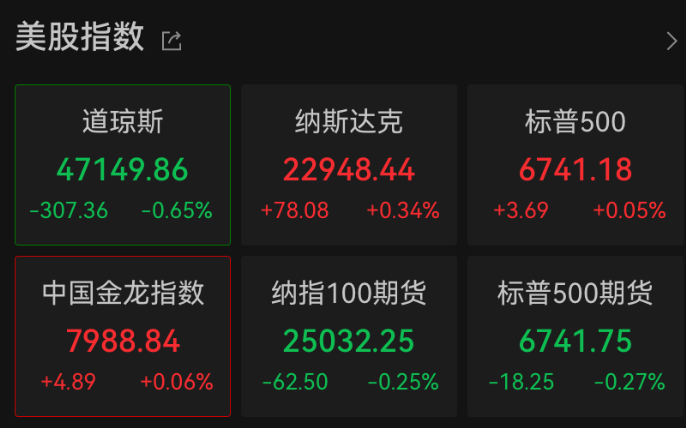
Market Overview - Major U.S. stock indices opened significantly lower, with large tech stocks mostly declining, while gold and silver prices dropped sharply, and Bitcoin fell below $100,000 [1] - The Nasdaq index turned positive later, and the S&P 500 nearly recovered its initial losses, while the Dow Jones remained down by over 300 points, a decline of more than 0.6% [1] Stock Performance - Semiconductor stocks in the U.S. rallied against the trend, contributing to a market sentiment recovery, with SanDisk rising over 7% and Micron Technology increasing more than 6% [2] - Nvidia, a global chip leader, saw its stock price rebound, turning from a decline to a gain of 0.82% [2] Commodity Prices - Spot gold and silver experienced a sharp decline, with gold dropping below $4,100 to a latest price of $4,075.57 per ounce, a decrease of over 2%, after reaching above $4,200 earlier [4] - Spot silver fell to $50.94 per ounce, with a decline exceeding 2.5% [4] Cryptocurrency Market - Major cryptocurrencies faced significant downturns, with Bitcoin plummeting over 6% to $96,501 per coin, and over 270,000 traders liquidated in the past 24 hours [6][7] - Ethereum and Solana also saw declines of 7.48% and 8.89%, respectively [7] Tech Sector Insights - The U.S. tech giants index fell by 3.2% last week and dropped 0.7% in the first four trading days of this week, with Nvidia down nearly 10% from its recent high and Tesla down 12% this month [7] - CoreWeave, once considered a shadow stock of Nvidia, has seen a decline of over 40% this month, raising concerns about its business model and reliance on Nvidia's support [8] Economic Commentary - Mohamed El-Erian from Allianz Group noted that the market is experiencing a "rational bubble," suggesting that while the total value created is significant, it may lead to losses [8] - Mary Callahan Erdoes from JPMorgan emphasized the importance of focusing on future opportunities presented by artificial intelligence rather than fixating on the current bubble concerns [8]
深夜!美股全线大跌!
证券时报· 2025-11-14 15:19
Core Viewpoints - The technology sector continues to experience a downward trend, impacting major U.S. stock indices, with the Dow Jones, Nasdaq, and S&P 500 all declining over 1% [1][2] - Major tech stocks such as Nvidia, Tesla, and Google have seen significant declines, with Nvidia down 2.12%, Tesla down nearly 4%, and Google down 2.49% [2][3] Technology Sector Performance - The U.S. technology giants index fell 3.2% last week and 0.7% in the first four trading days of this week [5] - Nvidia has retreated nearly 10% from its recent highs, while Tesla has dropped 12% this month, and Meta has seen a decline of over 20% since its peak in August [5] - CoreWeave, considered a shadow stock of Nvidia, has plummeted over 40% this month, raising concerns about its business model and reliance on Nvidia [5] Market Sentiment and Institutional Views - Investors are questioning whether the AI bubble is beginning to burst, with differing opinions among financial institutions [6][8] - Citigroup has significantly reduced its holdings in major tech stocks like Nvidia, Microsoft, Apple, and Amazon, while increasing bearish options on small-cap stocks [9] - Conversely, JPMorgan's top holdings still include major tech stocks, with Nvidia being its largest position, having increased its holdings by 5.63% [9] - Wells Fargo has continued to buy tech stocks, with its top purchases including Apple, Google, and Nvidia [9] Earnings Outlook - Nvidia is set to release its quarterly earnings report on November 19, which is expected to significantly influence market sentiment [11] - Citigroup maintains a "buy" rating on Nvidia, raising its target price from $210 to $220 per share, citing supply constraints in AI chip production [11] Federal Reserve and Economic Outlook - The recent U.S. government shutdown has created uncertainty regarding economic data, which may delay or hinder the Federal Reserve's ability to lower interest rates [13][15] - The probability of a rate cut in December has dropped from 90% to about 50%, reflecting a cautious stance from several Federal Reserve officials [14][15]


美股前瞻 | 三大股指期货续跌 美联储鹰派打压降息预期、AI泡沫担忧升温
智通财经网· 2025-11-14 12:49
Market Overview - US stock index futures are all down, with Dow futures down 0.58%, S&P 500 futures down 1.00%, and Nasdaq futures down 1.49% [1] - European indices also show declines, with Germany's DAX down 1.64%, France's CAC40 down 1.52%, and the UK's FTSE 100 down 1.31% [2][3] Commodity Prices - WTI crude oil increased by 1.53% to $59.59 per barrel, while Brent crude oil rose by 1.30% to $63.83 per barrel [3][4] Federal Reserve Insights - The Federal Reserve's hawkish stance is causing internal divisions, with December rate cut expectations dropping below 50% due to inflation concerns and a strong labor market [4] AI Market Concerns - Allianz's chief economic advisor, Mohamed El-Erian, warns of potential losses in the AI sector, indicating a "rational bubble" where over-investment could lead to significant personal losses [5] Cryptocurrency Market - Bitcoin is experiencing a bear market, with nearly $900 million withdrawn from Bitcoin ETFs, marking the second-largest outflow in history [6] Hedge Fund Activity - Hedge funds have been net sellers of stocks, offloading over $67 billion worth of stocks in 2025, while retail investors continue to support the market [7] Semiconductor Industry - Samsung is raising server chip prices by 30% to 60%, which may increase costs for companies building data infrastructure [9] - TSMC is considering increasing its 3nm wafer production capacity, potentially raising its capital expenditure for 2026 from $43 billion to between $48 billion and $50 billion [11] Tesla Developments - Tesla is reportedly developing support for Apple's CarPlay, a highly requested feature among its customers [12] Merger and Acquisition Activity - Merck is acquiring Cidara Therapeutics for approximately $9.2 billion, with Cidara's stock price doubling in pre-market trading [13]

三大股指期货续跌 美联储鹰派打压降息预期、AI泡沫担忧升温
Zhi Tong Cai Jing· 2025-11-14 12:47
Market Overview - US stock index futures are all down, with Dow futures down 0.58%, S&P 500 futures down 1.00%, and Nasdaq futures down 1.49% [1] - European indices also show declines, with Germany's DAX down 1.64%, France's CAC40 down 1.52%, and the UK FTSE 100 down 1.31% [2][3] Commodity Prices - WTI crude oil prices increased by 1.53% to $59.59 per barrel, while Brent crude oil rose by 1.30% to $63.83 per barrel [3][4] Federal Reserve Insights - The Federal Reserve's hawkish stance is causing internal divisions, with December rate cut expectations dropping below 50%. Notable officials are expressing caution regarding further monetary policy easing [5] AI Market Concerns - Allianz's chief economic advisor warns of potential losses in the AI sector, indicating that while the market is experiencing a "rational bubble," significant personal losses may occur [6] Cryptocurrency Market - Bitcoin is experiencing a bear market, with nearly $900 million withdrawn from Bitcoin ETFs, marking the second-largest outflow in history. The overall cryptocurrency market has lost over $1 trillion in value [7] Investment Trends - Hedge funds are net sellers of stocks, having sold over $67 billion worth in 2025, while retail investors continue to support the market. However, retail enthusiasm is showing signs of fatigue [8] Semiconductor Industry - Samsung is raising server chip prices by 30% to 60%, which may increase costs for companies building data infrastructure. This price hike could also affect the costs of smartphones and computers [10] - TSMC is reportedly planning to increase its 3nm wafer production capacity, potentially raising its capital expenditure for 2026 from $43 billion to between $48 billion and $50 billion [12] Automotive Industry - Tesla is developing support for Apple's CarPlay, a highly requested feature among its customers, with internal testing already underway [13] Mergers and Acquisitions - Merck is acquiring Cidara Therapeutics for approximately $9.2 billion, with Cidara's stock price doubling in pre-market trading following the announcement [14]

每日机构分析:11月14日
Xin Hua Cai Jing· 2025-11-14 12:06
Group 1 - Goldman Sachs suggests that the Federal Reserve may soon announce "reserve management purchases," injecting liquidity into the market by buying short-term government bonds, which the market interprets as a signal for a new round of quantitative easing (QE) [1][3] - JPMorgan's CEO emphasizes that the current AI investment wave is not a market bubble but the beginning of a significant transformation in corporate operations, indicating that the market's expectations for AI's value exceed its current realizations, suggesting substantial potential [1] - Citi notes an improvement in credit outlook for peripheral Eurozone countries, with Italy, Spain, Portugal, Greece, and Ireland likely to receive credit rating upgrades by 2026 due to fiscal consolidation and resilient economic growth [1] Group 2 - Guggenheim's Chief Investment Officer indicates that the economic slowdown reflected in the Beige Book, along with pressures on low-income groups and small businesses, suggests a "dual-speed economy," leading the Fed to likely cut rates again in December [2] - Blackhawk Analytics reports that initial jobless claims in the U.S. slightly decreased to 227,500, indicating a stable labor market, which may support the Fed's decision to hold rates steady in December [2] - Morgan Stanley's economists assert that the current level of initial jobless claims is consistent with recent years, showing no signs of an escalating layoff trend, and that the government shutdown may have distorted data reporting [2]


