
Starbucks(SBUX)

Search documents
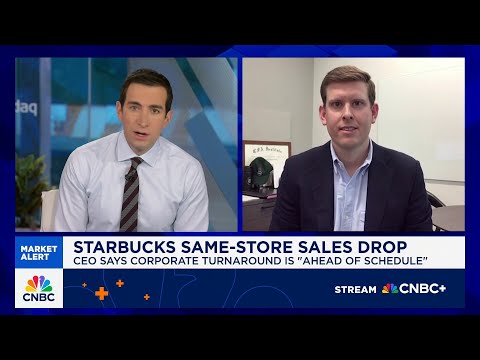
Starbucks CEO is accelerating the rollout of its new operating model: Morgan Stanley's Brian Harbour
CNBC Television· 2025-07-30 12:59
Starbucks's CEO Brian Nichols saying the coffee chain's turnaround is quote ahead of schedule despite the company reporting its sixth straight quarter of declining same store sales. Joining us right now with more on the quarter is Brian Harbor. He's US restaurants analyst at Morgan Stanley.Good morning to you. We're looking at the stock now about 98 bucks. Is this ahead of schedule in your mind.>> Well, look, I think there's no denying that the numbers are still tough here, but what what suggests that it's ...

确认了!星巴克中国业务要卖!CEO倪睿安:20余家收购方关注,希望保留相当比例的股权
Mei Ri Jing Ji Xin Wen· 2025-07-30 12:05
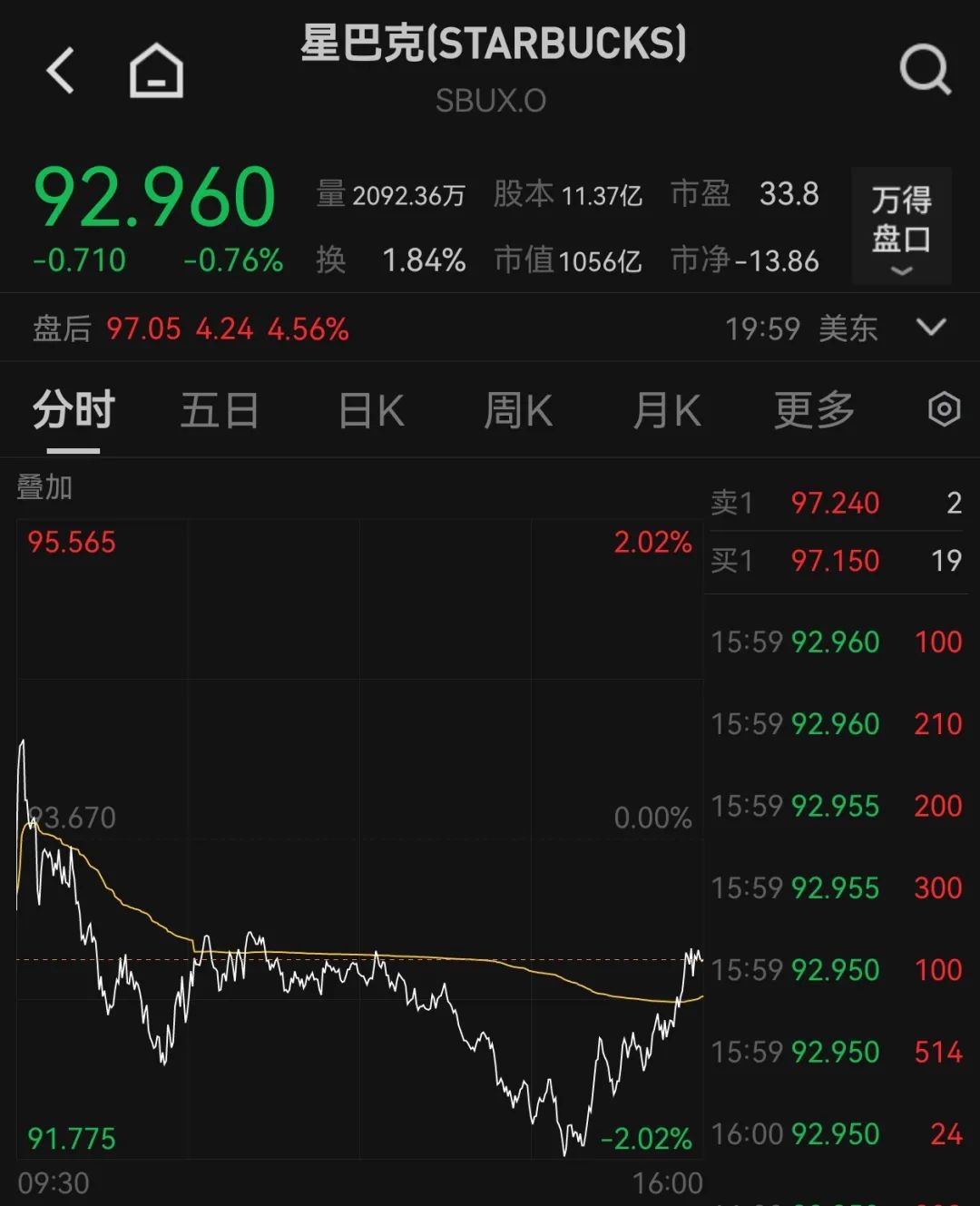
Financial Performance - Starbucks reported Q3 FY2025 net revenue of $9.456 billion, up from $9.11 billion in the same period last year, exceeding analyst expectations of $9.29 billion [1] - Adjusted earnings per share were $0.49, below the forecast of $0.65 [1] - Same-store sales in China grew by 2%, surpassing the expected growth of 1.44% [1] Strategic Initiatives - CEO Howard Schultz stated that recent adjustments in China are yielding results, with three consecutive quarters of revenue growth and year-over-year same-store sales increases [3] - Innovations such as "Sugar-Free True Flavor" beverages and new customization options have increased customer purchase frequency, while price adjustments on non-coffee products have broadened the customer base and enhanced consumption during lunch and evening hours [3] Equity Sale and Market Position - Starbucks is exploring the sale of a portion of its equity in China, seeking strategic partners that share its vision and values, while maintaining a significant stake in the business [4] - The company is evaluating over 20 interested institutional investors, emphasizing its confidence and commitment to the Chinese market [4] - Reports indicate that potential equity sale offers have reached a valuation of $10 billion, with nearly 30 private equity firms, including Centurium Capital and Hillhouse Capital, submitting non-binding bids [5] - As of Q3 FY2025, Starbucks operates 7,828 stores in China, covering over 1,000 cities, with new stores continuing to achieve high profitability [5]
财报解读|星巴克三季度中国同店销售额增长,回应中国股权出售传闻
Di Yi Cai Jing· 2025-07-30 11:56
Core Viewpoint - Starbucks is actively seeking strategic partners that share its vision and values, while evaluating over 20 interested institutions, with the intention of retaining a significant equity stake in its China operations [1][3] Financial Performance - For the third fiscal quarter of 2025, Starbucks reported total revenue of $9.456 billion, representing a year-over-year increase of 3.8%, while net profit attributable to shareholders was $558 million, down 47.1% year-over-year [1] - In the Chinese market, Starbucks' revenue for the quarter grew by 8% to $790 million, with same-store sales increasing by 2%, and both same-store transaction volume and average ticket size showing sequential improvement [1] Market Expansion - As of the end of the third quarter, Starbucks had a total of 7,828 stores, having opened 70 new locations and entered 17 new county-level markets [3] - In response to intense competition in the Chinese market, Starbucks has reduced prices on "non-coffee products" and enhanced consumption during lunch and evening periods [3] Strategic Considerations - Reports from last November indicated that Starbucks was considering selling equity in its China business, with a valuation estimated between $5 billion to $6 billion, and the transaction expected to continue until 2026 [3] - Starbucks remains confident in the significant growth opportunities within the Chinese market and is focused on revitalizing growth in its China operations while maintaining a positive development trend [3]
星巴克在华寻找合作方新进展:正评估超20个有强烈意愿机构
Bei Ke Cai Jing· 2025-07-30 11:13
Core Insights - Starbucks reported a revenue of $9.5 billion for Q3 of fiscal year 2025, marking a 4% year-over-year increase [1] - The company is actively seeking potential equity partners for its China operations, evaluating over 20 interested institutions, while maintaining a strong commitment to the Chinese market [1][2] - In China, Starbucks achieved an 8% year-over-year growth in its business, reaching $790 million, with same-store sales increasing by 2% [1] Financial Performance - Q3 revenue reached $9.5 billion, a 4% increase compared to the previous year [1] - Starbucks' China business grew by 8% to $790 million, continuing a trend of three consecutive quarters of year-over-year growth [1] - The number of Starbucks stores in China reached 7,828, with 70 new stores opened and expansion into 17 new county-level markets [1] Strategic Initiatives - Starbucks is focusing on diversifying its product offerings beyond coffee, with a "morning coffee, afternoon non-coffee" strategy driving growth [2] - Key products like Frappuccino, iced tea, and tea lattes are attracting younger consumers and enhancing afternoon and evening sales [2] - The company is exploring various options for its China business, including potential equity sales to local companies with industry experience [2] Market Positioning - Starbucks' CEO emphasized the search for strategic partners that share the company's vision and values, highlighting the strong interest from various parties in collaborating with Starbucks in China [2] - The ongoing partnerships and brand collaborations are enhancing brand reputation and driving sales growth [2]
Wall Street Breakfast Podcast: Starbucks Perks Up After Turnaround Update
Seeking Alpha· 2025-07-30 11:09
Starbucks Overview - Starbucks outlines the acceleration of the Green Apron Service to all U.S. stores by mid-August, indicating a $0.5 billion labor investment for FY26 [2] - The company reported better-than-expected FQ3 results, with total revenue growing 4% year-over-year to $9.46 billion, surpassing estimates by $150 million [3] - Comparable store sales in China increased by 2%, while North America saw a decline of 2%, which was less than the anticipated 2.49% drop [3] - Adjusted EPS was $0.50, missing the consensus of $0.65 due to a $0.11 discrete tax charge [3] - CEO Brian Niccol stated that the turnaround is "ahead of schedule" and emphasized the impact of the Green Apron Service on transactions, sales, and customer service times [3] Future Plans - Starbucks plans to uplift at least 1,000 stores across North America by the end of 2026 and introduce a new store prototype with a 30% lower build cost [4] - The company will phase out the mobile order and pickup-only concept in fiscal 2026 and has significant menu innovations planned for 2026 [4] - Niccol reaffirmed the company's commitment to its China business, stating that any transaction would need to make sense for Starbucks [5] Market Reactions - Starbucks shares are listed among the biggest movers, with a 5% increase in premarket trading [2]

星巴克中国三季度平均客单价降4%,正评估20个潜在收购者
Nan Fang Du Shi Bao· 2025-07-30 09:51
Core Insights - Starbucks reported Q3 FY2025 revenue of $9.5 billion, a 4% year-over-year increase, and an 8% quarter-over-quarter increase from $8.8 billion [1] - Revenue in the China region grew 8% year-over-year to $790 million (approximately 5.669 billion RMB), marking three consecutive quarters of growth [1] - Global same-store sales declined by 2%, primarily due to a 2% drop in comparable transaction volume, offset by a 1% increase in average ticket price [3] Group 1 - The China market's same-store sales increased by 2% year-over-year, with a 6% rise in comparable transaction volume, although the average ticket price fell by 4% [3] - As of the end of Q3, the total number of stores in China reached 7,828, with 70 new stores opened, entering 17 new county-level markets [3] - Global new store openings totaled 308 in Q3, bringing the total store count to 41,097 [3] Group 2 - The average ticket price in the China market saw a significant year-over-year decline, prompting Starbucks to lower prices and expand its product range [4] - In June, Starbucks China announced a focus on non-coffee beverages, launching a summer pricing strategy with an average price reduction of around 5 RMB for large drinks [4] - The company has been actively innovating products and enhancing consumer experiences to address performance pressures in the Chinese market [4] Group 3 - The new CEO, Brian Niccol, expressed interest in selling a portion of the China business to alleviate performance pressures while seeking strategic partners with shared visions [5] - Niccol emphasized confidence in the Chinese market's potential and the company's commitment to retaining a significant equity stake in the region [5] - The strong interest from over 20 institutions in partnering with Starbucks reflects the brand's strong market position and growth opportunities in China [5]

巴克莱将星巴克目标价从106美元上调至115美元;将西思科目标价从77美元上调至82美元;将Universal Health Services目标价从257美元上调至259美元;将Spotify目标价从800美元下调至750美元。
news flash· 2025-07-30 09:26
Group 1 - Barclays raised the target price for Starbucks from $106 to $115 [1] - Barclays increased the target price for Cisco from $77 to $82 [1] - Barclays adjusted the target price for Universal Health Services from $257 to $259 [1] - Barclays lowered the target price for Spotify from $800 to $750 [1]


星巴克中国股权出售获20余家收购方关注
Sou Hu Cai Jing· 2025-07-30 08:35
Core Insights - Starbucks reported an 8% year-on-year increase in revenue for Q3 FY2025, reaching $790 million, with growth in both overall revenue and same-store sales in China [1][2] - The company is evaluating over 20 interested institutions for the potential sale of its China business, which could be valued at up to $10 billion [3] Financial Performance - Same-store sales in China grew by 2% year-on-year, with operating profit margins continuing to increase quarter-on-quarter, maintaining a healthy double-digit level [2][3] - The total number of Starbucks stores in China reached 7,828 by the end of Q3 FY2025, with 70 new stores opened during the quarter, entering 17 new county-level markets [2] Strategic Initiatives - The recent adjustments made by Starbucks in China have led to three consecutive quarters of revenue growth and year-on-year same-store sales growth [3] - Innovations such as "sugar-free" beverages and new customization options have increased customer purchase frequency, while price adjustments on non-coffee products have broadened the customer base and enhanced consumption during lunch and evening hours [3] Market Outlook - The company remains committed to the long-term development of the Chinese market and aims to retain a significant equity stake in its China operations while seeking strategic partners that share its vision and values [3][4]
同店销售额6个季度来首次增长,星巴克中国收到逾20个潜在收购意向
Zhong Guo Ji Jin Bao· 2025-07-30 08:32
Core Insights - Starbucks China reported a revenue of $790 million for Q3 of FY2025, marking an 8% year-over-year increase and achieving positive same-store sales growth for the first time in six quarters [2] - The company is actively seeking potential buyers for its China operations, having received interest from over 20 parties, while maintaining a commitment to retain a significant equity stake in the business [2][5] Financial Performance - Same-store sales increased by 2% year-over-year, indicating a recovery after a period of decline due to competition from local brands [3] - Average transaction value decreased by 4% year-over-year, suggesting a consumer shift towards lower-priced products [3] Strategic Initiatives - Recent adjustments in product offerings, including the introduction of a "sugar-free" innovation system, have contributed to improved performance by providing healthier and customizable options [4] - The company has expanded its product range beyond coffee, targeting different consumption scenarios, which has attracted younger consumers and increased sales during afternoon and evening hours [4] - Collaborative marketing efforts, such as partnerships with popular music bands, have enhanced brand visibility and customer engagement, further driving same-store sales growth [4] Market Interest - Reports indicate ongoing interest from various investment firms, including KKR and Hillhouse Capital, in acquiring a stake in Starbucks China, with estimated valuations ranging from $5 billion to $6 billion [5] - The potential sale has attracted attention from other major players, including China Resources Group and Meituan, indicating a competitive landscape for the acquisition [5]
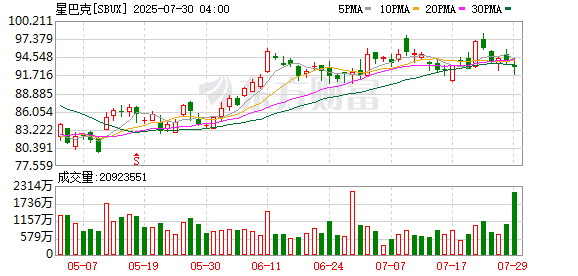
7月30日电,美股绩优股盘前走强,星巴克、MARA Holdings涨超4%,FuboTV涨近10%。



news flash· 2025-07-30 08:30
智通财经7月30日电,美股绩优股盘前走强,星巴克、MARA Holdings涨超4%,FuboTV涨近10%。 ...