
XIAOMI(XIACY)

Search documents
小米集团-W(01810):汽车篇:新消费定义高端豪华,方法论支撑车攀巅峰
Changjiang Securities· 2025-04-29 11:15
Investment Rating - The report maintains a "Buy" rating for Xiaomi Group [11][13]. Core Insights - The "Self-Pleasing" new consumption concept supports the successful launch of the SU7, with the YU7 expected to replicate this success. Xiaomi is accelerating its layout of extended-range models, entering a strong product cycle, and is expected to achieve rapid sales of one million vehicles. Based on Xiaomi's steady growth trend in high-end penetration in its smartphone and IoT businesses, as well as the rapid ramp-up of its automotive segment, the projected net profit attributable to shareholders for 2025, 2026, and 2027 is estimated to be 35.404 billion, 51.653 billion, and 65.531 billion yuan respectively [4][11]. Summary by Sections SU7 Initial Success and YU7 Potential - The 200,000 to 300,000 yuan price segment for cars is continuously expanding, with the SU7 positioned accurately and establishing a mid-to-high-end brand tone, achieving an average monthly sales of 23,000 units since its launch. The YU7 is expected to target a larger market and leverage its comprehensive strengths to potentially become another bestseller [7][34]. Xiaomi's Methodology and Automotive Success - Xiaomi's success in the smartphone and IoT sectors has led to the development of a unique "User + Product + Technology + Efficiency" methodology. This includes a large fan base, self-developed motor and control technology, supply chain management to reduce production costs, and a focus on creating blockbuster products [8][9]. Strong Model Cycle and Sales Projections - The high-end market is expanding, with significant opportunities for domestic alternatives in the electric and intelligent vehicle sectors. The projected sales for the high-end passenger car market (priced above 200,000 yuan) in 2024 is 9.443 million units, a year-on-year increase of 4.8%. The CAGR for high-end market sales from 2020 to 2024 is 14.6%, with domestic brands expected to capture a growing market share [9][10]. Brand Synergy and Ecosystem Integration - The launch of the SU7 not only marks the realization of Xiaomi's car manufacturing plans but also extends its "Smartphone + AIoT" ecosystem strategy into the automotive sector. The interconnected ecosystem enhances user stickiness and drives revenue growth across other product lines, with the lifetime value of automotive users exceeding 230,000 yuan [10][11]. Investment Recommendations - The report emphasizes the potential for Xiaomi to replicate Tesla's profitability rhythm, with expectations for the automotive segment to turn profitable by 2025, and a projected net profit per vehicle exceeding 10,000 yuan [9][10].
Canalys:一季度中国智能手机市场同比增长5% 小米(01810)重回第一
智通财经网· 2025-04-27 06:53
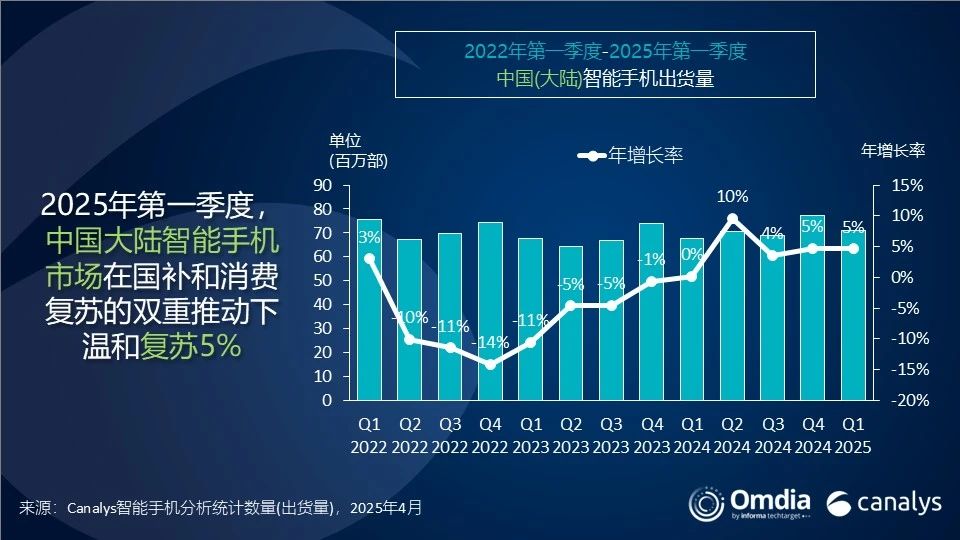
Core Insights - The Chinese smartphone market experienced a mild growth of 5% year-on-year in Q1 2025, with shipments reaching 70.9 million units, driven by national subsidy policies and consumer recovery [1][3] Group 1: Market Performance - Xiaomi led the market with shipments of 13.3 million units, a 40% increase year-on-year, capturing a market share of 19% [1][5] - Huawei followed closely with 13 million units shipped, maintaining double-digit growth [1][5] - OPPO and vivo ranked third and fourth with shipments of 10.6 million and 10.4 million units, respectively [1] - Apple saw a decline in shipments to 9.2 million units, an 8% drop year-on-year, placing it fifth in the market [1][5] Group 2: Impact of National Subsidy Policy - The national subsidy policy implemented in January has positively influenced market performance, prompting some consumers to upgrade their devices earlier, reflecting a shift in demand rather than organic growth [3] - The policy has also reinforced the dominance of major retail channels and e-commerce platforms like Tmall and JD.com [3] Group 3: Company Strategies and Innovations - Xiaomi's growth is attributed to its product and channel synergy, with a unified pricing strategy that reduces consumer decision costs [5] - Huawei is focusing on effective channel management and expanding its product offerings, including advancements in foldable devices and the development of the HarmonyOS ecosystem [5] - The penetration rate of AI smartphones in China reached 22% in 2024 and is expected to exceed 40% in 2025, highlighting the importance of innovation in areas like foldable screens and operating systems [5]

小米集团20250424
2025-04-25 02:44
Summary of Xiaomi Group Conference Call Company Overview - **Company**: Xiaomi Group - **Date**: April 24, 2025 Key Points Industry and Market Position - Xiaomi's stock price has adjusted to levels seen in mid-February, currently fluctuating around 44 HKD, which is considered a comfortable buying position, presenting good investment opportunities [2][4] - The company has a comprehensive layout in the smart home and automotive ecosystem, with the automotive business showing strong performance and expected to deliver well in 2025, with profits anticipated in 2026-2027 [2][5] Financial Projections - Revenue projections for Xiaomi from 2025 to 2027 are 481.8 billion, 636.5 billion, and 716.5 billion HKD respectively; adjusted net profits are expected to be 41.6 billion, 61.3 billion, and 65.6 billion HKD, all exceeding market expectations [3][13] - The automotive business is projected to contribute over 10 billion HKD in profit by 2025, with stable annual sales of the YU7 model expected to reach 360,000 units [10][13] Valuation Insights - A sum-of-the-parts (SOTP) valuation method indicates a target price of approximately 56 HKD per share, based on a 20x PE for traditional business and a 3x PS for the automotive segment [2][6][14] - The conservative DCF estimate suggests a bottom valuation of around 48 HKD, reinforcing the current stock price as a favorable entry point [6][14] Automotive Business Highlights - The YU7 model is anticipated to exceed market sales expectations, with projected sales of 848,000 units in 2026, significantly higher than the market consensus of 574,000 units [7][10] - The YU7 is positioned in the 200,000 to 300,000 HKD SUV market, which has a larger capacity than the sedan market, potentially replicating the success of the previous model, the SU7 [7] Catalysts for Stock Price - Key catalysts for Xiaomi's stock price include exceeding order expectations for the YU7 model, progress in opening Xiaomi Home stores, and advancements in AI-enabled products [8][10] Ecosystem and Channel Development - The automotive business enhances Xiaomi's ecosystem, allowing cross-selling opportunities in Xiaomi Home stores, which now exceed 15,000 locations and are expected to surpass 20,000 by 2025 [11][12] - The integration of Hyper OS across over 200 hardware categories enhances product experience and drives demand for Xiaomi's offerings [12] Risks and Challenges - Major risks include potential negative public sentiment and order loss due to automotive safety incidents, changes in government policies affecting the electric vehicle sector, and the possibility of new model sales falling short of expectations [15]
小米集团(01810) - 2024 - 年度财报
2025-04-24 09:00
Financial Performance - Xiaomi Group reported a revenue of HKD 365.91 billion for the fiscal year 2024, an increase of 35.1% compared to HKD 270.97 billion in 2023[11]. - The net profit for 2024 was HKD 76.56 billion, up 33.3% from HKD 57.48 billion in the previous year[11]. - The company achieved a gross profit of HKD 24.50 billion, representing a 22.5% increase from HKD 20.01 billion in 2023[11]. - Xiaomi's operating profit for 2024 was HKD 28.13 billion, a rise of 27.5% compared to HKD 22.01 billion in 2023[11]. - The company reported a total operating income of $38.57 billion, down from $44.40 billion in 2023, indicating a decrease of 13.0%[12]. - The company reported a revenue of 702.3 million, representing a 9.5% increase year-over-year as of December 31, 2024[18]. - The company reported a revenue of 365,906.4 million for the year ending December 31, 2024, compared to 270,970.1 million in 2023, representing a year-over-year growth of approximately 35.1%[34]. - The company reported a revenue of 63,464.0 million for the fiscal year ending December 31, 2024, reflecting a growth of 55% compared to the previous year[62]. - The company reported a total revenue of $2,115,629 million for the latest fiscal year, a decrease of 760,299 million compared to the previous year[80]. - The company reported a revenue of $4,517,510,134 for the fiscal year ending December 31, 2024, representing a year-over-year growth of 21.9%[134]. Market Expansion and Strategy - The company plans to expand its market presence in Europe and Southeast Asia, focusing on increasing its smartphone market share[11]. - The company plans to expand its market presence in the AIoT sector, focusing on innovative product development and strategic partnerships[14]. - The company is exploring potential mergers and acquisitions to strengthen its position in the technology sector[11]. - The company is focusing on expanding its market presence in the smart device sector, with a projected revenue of K 58 million from new product lines by December 2024[28]. - The company aims to launch new products and technologies in the upcoming quarters to drive further growth and market share[30]. - The company plans to enhance its ESG (Environmental, Social, and Governance) initiatives, aiming for a MSCI ESG rating improvement to BB by the end of 2024[30]. - The company is focusing on market expansion strategies to enhance revenue growth in the upcoming years[54]. - The company is exploring potential acquisitions to enhance its market position and product offerings[56]. - The company is focusing on market expansion strategies, particularly in Asia and Europe[70]. - The company plans to expand its market presence in Asia, targeting a 15% increase in market share by 2025[72]. Research and Development - Xiaomi is investing in new product development, particularly in AI and smart home technologies, to enhance its ecosystem[11]. - The company reported a significant increase in R&D expenditure to HKD 24.34 billion, reflecting a commitment to innovation and technology advancement[11]. - The company is investing in R&D for new technologies, including advancements in AI and IoT solutions[20]. - The company is investing in new technologies to enhance its product offerings, particularly in the AIoT space[15]. - The company plans to invest in new technologies, aiming for a 6.8% increase in R&D spending to drive innovation[133]. - The company has allocated $200 million for research and development in the upcoming year to innovate and improve existing products[126]. - The company is investing $50 million in R&D for new technologies aimed at enhancing user experience[87]. - Research and development expenses increased by 10%, totaling $30 million, focusing on innovative technologies[71]. - The company is investing in new technology development, aiming to enhance user experience and increase market share[79]. - The company is focusing on new product development and technology advancements to enhance user engagement and retention[139]. User Engagement and Data - The company reported a significant increase in user data, with active users reaching 17 million, a growth of 20% year-over-year[11]. - User data showed a significant growth in AIoT segment, with revenue of $3.66 billion, reflecting a 35.0% year-over-year increase[13]. - User data for AIoT products reached 904.6 million, marking a 22.3% growth year-over-year by December 31, 2024[18]. - User data indicates a total of 3,719,482 active users, with a significant increase in engagement metrics[51]. - User data showed a total of 6,829,800 active users as of January 6, 2025, indicating a growth trend in user engagement[64]. - User data showed a growth of 12 million active users, bringing the total to 150 million[87]. - User data indicated a total of 2,358,377,326 active users, with a growth of 124,851,426 users compared to the previous year[85]. - User data showed a total of 609,370,425 active users, with a decline of 181,420,563 users year-over-year[80]. - User data indicates a total of 40 million active users as of December 31, 2024, which is an increase of 36% year-over-year[62]. - User data showed a growth of 25% in active users, totaling 5 million by the end of the quarter[143]. Future Outlook and Guidance - Xiaomi's future outlook includes a revenue growth target of 15-20% for the next fiscal year, driven by new product launches and market expansion[11]. - Future guidance suggests a continued upward trend in revenue, with expectations of reaching $450 billion by the end of 2025[16]. - The company anticipates a revenue guidance of 4,000 to 5,000 million for the upcoming year, with a projected growth rate of 23.3%[20]. - Future guidance indicates a strong growth trajectory, with total revenue expected to reach $272 million by the end of 2024, up from $193 million in 2023[48]. - The company provided a future outlook with a revenue guidance of $27,234,531 for the upcoming fiscal year, indicating a growth trajectory[51]. - The company provided guidance for 2024, expecting revenue growth of approximately 10%[68]. - Future guidance remains positive, with management expressing confidence in achieving set targets and enhancing shareholder value[113]. - The company is projecting a revenue growth of 20% for the next fiscal year, driven by new product launches and market expansion strategies[126]. - The company has provided guidance for Q4 2023, expecting revenue to reach approximately $3.10 million[147]. - The company provided a forward guidance of 10% revenue growth for the next quarter, projecting revenues of approximately $1.32 billion[144].
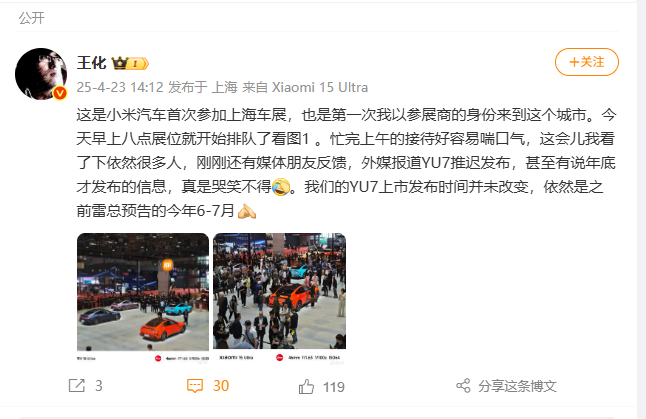
小米集团公关部总经理王化:YU7上市发布时间并未改变
news flash· 2025-04-23 06:29
Group 1 - The core message of the article is that Xiaomi Group's public relations manager Wang Hua has refuted rumors regarding the delay of the YU7 product launch, confirming that the release timeline remains unchanged, scheduled for June to July of this year [1]
港股收盘(04.22) | 恒指收涨0.78% 医药、黄金股表现强势 小米集团-W(01810)收涨近6%
智通财经网· 2025-04-22 08:54
热门板块方面 智通财经APP获悉,港股今日低开高走,三大指数午后集体转涨,恒指盘中一度涨近1%。截止收盘, 恒生指数涨0.78%或167.18点,报21562.32点,全日成交额2513.82亿港元;恒生国企指数涨0.68%,报 7950.79点;恒生科技指数涨0.24%,报4899.21点。 华泰证券指出,往前看,对等关税扰动发生后,该行坚定看好港股相对收益表现,原因是:产业上,市 场中业绩与关税敏感性较高的出口链及中游制造企业市值占比较低;科技企业盈利表现或将持续支持港 股行情演绎;外部扰动下,市场或对内需政策存在较大预期。 蓝筹股表现 小米集团-W(01810)表现亮眼。截至收盘,涨5.84%,报44.4港元,成交额122.9亿港元,贡献恒指71.47 点。富瑞研报指出,小米仍是该行中国科技股中的首选股,原因包括:公司具强劲增长,得益于其独特 的生态系统;美国关税料对其业务影响较小;小米并无美国存托凭证(ADR)退市风险。高盛预计YU7仍 能按计划在6月至7月正式发布,维持今明两年YU7销量预测为约8.5万辆及36万辆不变。 其他蓝筹股方面,石药集团(01093)涨8.81%,报6.05港元,贡献恒指6 ...
高盛:小米集团-电动汽车工厂二期已准备好投产,小米的生产进度按计划推进;中国市YU7场强劲的销售势头将部分抵消海外市场的不确定性;给予 “买入” 评级。
Goldman Sachs· 2025-04-17 15:42
Investment Rating - The report assigns a "Buy" rating to Xiaomi Corp. with a 12-month target price of HK$59, representing a 43% upside potential from the current price of HK$41.25 [1][17][49]. Core Insights - Xiaomi's EV factory Phase II is ready for production, with trial production expected to commence soon, indicating strong execution in EV manufacturing capacity [1]. - The company has shown robust sales momentum in China, particularly in smartphones, with a 40% year-over-year growth in Q1 2025, leading to a market share increase to 18.6% [2][50]. - Despite macroeconomic uncertainties, Xiaomi's revenue from China is expected to offset some overseas revenue challenges, particularly from US tariff impacts [16][50]. Summary by Sections EV Manufacturing - Phase II of the Xiaomi EV factory in Beijing has received approval and is expected to start trial production soon, aligning with management's timeline for the YU7 launch in June-July 2025 [1][19]. - The SU7 order volume has normalized post the SU7 Ultra release, and the additional capacity from Phase II is anticipated to meet rising consumer demand [1][29]. Smartphone Performance - Global smartphone shipments grew by 1% year-over-year in Q1 2025, with Xiaomi maintaining a stable market share of 14% and achieving 41.8 million shipments [2][40]. - In China, Xiaomi's smartphone shipments surged by 40% year-over-year, significantly outperforming the industry average of 3% growth [2][41]. Financial Projections - Revenue forecasts for Xiaomi have been adjusted, with expected revenues of RMB 365.9 billion for 2024 and projected growth to RMB 714.8 billion by 2027 [4][14]. - The report anticipates a 17% year-over-year growth in smartphone revenue for Q1 2025, driven by higher average selling prices [2][12]. Market Position and Strategy - Xiaomi is positioned as the world's third-largest smartphone brand and is expanding its ecosystem through a "Human x Car x Home" strategy, which is expected to drive significant revenue and EPS growth in the coming years [50]. - The company is leveraging its strong balance sheet and operational capabilities to enhance competitiveness in the EV market [50].
小米集团财报前瞻
2025-04-15 14:30
Summary of Conference Call Notes Company and Industry - The conference call primarily discusses **Xiaomi**, focusing on its **smartphone** and **automobile** businesses, as well as its overall market strategy and performance. Key Points and Arguments Smartphone Business - The **gross profit** from the smartphone segment is crucial for the company's profitability, with a significant increase in sales following the launch of the **Xiaomi 15** model, which boosted overall sales volume and average selling price (ASP) [1][2] - The **gross margin** for smartphones is expected to improve due to cost optimization and a shift towards higher-end models, indicating a trend of decreasing volatility in gross margins as Xiaomi enhances its supply chain management [2][3] - Xiaomi's strategy emphasizes balancing **scale and profit**, focusing on operational efficiency alongside growth, which has shown positive results in cost control [3][4] Automotive Business - The company is making strides in its **automotive segment**, with significant R&D in core components like motors, batteries, and vehicle design, indicating a commitment to innovation [5][6] - The **Xiaomi YU7 SUV** is anticipated to be a strong performer, with expectations of reaching profitability by Q3 2023 as production ramps up [11][14] - The automotive supply chain in China is noted to be highly competitive, allowing Xiaomi to produce high-quality electric vehicles at lower costs compared to traditional fuel vehicles [8][9] Research and Development - Xiaomi's R&D investment has increased tenfold, from **3 billion** to **30 billion** annually, supporting its product development and innovation capabilities [7][10] - The company is positioned well in the AI space, with potential applications in smartphones, automobiles, and IoT products, which could enhance user engagement and sales across its product lines [12][17] Market Expansion and Global Strategy - Xiaomi is accelerating its **overseas expansion**, aiming to establish a significant retail presence, including **20,000** physical stores globally, to replicate its domestic success [13][14] - The company is also focusing on high-end smartphone markets, with the **Xiaomi 15 Ultra** positioned to compete directly with premium brands like Apple [9][10] Financial Outlook - Analysts predict a potential market capitalization of **1.5 trillion** based on sustained growth in traditional and automotive sectors, with expectations of continued profitability and revenue growth [16][18] - The overall market sentiment is cautiously optimistic, with Xiaomi's valuation supported by low domestic interest rates and a favorable investment environment [19][20] Risks and Considerations - Potential risks include fluctuations in the U.S. stock market, which could impact investor sentiment towards technology stocks, including Xiaomi [25][26] - The company must navigate competitive pressures while maintaining its growth trajectory and profitability across its diverse product lines [24][25] Other Important Content - The call highlighted the importance of **consumer behavior**, noting that many customers purchase Xiaomi products without prior testing, indicating strong brand loyalty and market confidence [22] - The discussion also touched on the broader implications of Xiaomi's strategies for the technology sector in China, emphasizing the shift towards high-end and global market positioning as a key trend [14][23]
小米集团20250331
2025-04-15 14:30
Summary of Xiaomi's Conference Call Company Overview - The conference call primarily discusses **Xiaomi Corporation** and its strategic move into the automotive industry, particularly focusing on the development of its electric vehicle (EV) segment. Key Points and Arguments Automotive Industry Insights - Xiaomi's entry into the automotive sector is seen as a significant opportunity, leveraging its strengths in brand building and user engagement, which are inherent advantages of a technology company, especially in consumer electronics [1][2] - The company aims to achieve a long-term goal of becoming one of the top five automotive manufacturers globally, despite facing challenges and fluctuations in expectations [2] - The Xiaomi Su7 model was launched in March 2023, with projected sales of **218,000 units** in 2024, but actual deliveries were only **135,000 units**, indicating a supply-demand imbalance [3] Competitive Advantages - Xiaomi's unique selling proposition includes a comprehensive ecosystem that integrates home, car, and personal devices, allowing seamless control of vehicle functions from home and vice versa [4] - The company operates its own delivery centers, which is a significant differentiator compared to competitors who rely on third-party dealerships [5] - Xiaomi's cautious expansion strategy in sales channels is attributed to high demand for the Su7 and limited production capacity [6] Financial Projections and Investments - The automotive business is a critical focus for Xiaomi, with an expected expenditure of **13.2 billion RMB** in 2024 dedicated to this segment [7] - Xiaomi's gross margin in the automotive sector is considered high due to effective supply chain management and strong supplier confidence, which allows for lower costs [8] - To reach its goal of becoming a top automotive manufacturer, Xiaomi's vehicle business revenue needs to exceed **$170 billion**, which is over three times its projected revenue for 2024 [9] Market Position and Future Plans - Xiaomi plans to focus on the high-end market segment initially, with a potential domestic sales volume of **4 million units** in the medium term [10] - The company is expected to expand internationally by 2027, leveraging its strong global brand recognition from its smartphone business [11] - Xiaomi's sales and service network is designed to facilitate a smooth entry into international markets, providing a competitive edge over domestic rivals [12] Valuation and Growth Potential - The automotive business is still in the investment phase, with no stable profitability yet, while other segments are generating stable profits [14] - Future revenue projections for the automotive segment are estimated at **102.8 billion RMB** in 2025, **205.3 billion RMB** in 2026, and **331.1 billion RMB** in 2027 [13] - Xiaomi's long-term valuation potential could reach **1.2 trillion RMB** if it achieves sales of over **600,000 units** annually [15] Broader Business Context - Xiaomi's smartphone segment has shown significant growth, with a global market share of **13.8%**, ranking third behind Apple and Samsung [16] - The company has also seen substantial growth in its IoT and smart home devices, with revenues exceeding **100 billion RMB** and a gross margin above **20%** [20] - Xiaomi's overall valuation is projected to be between **700 billion to 800 billion RMB**, with potential to exceed **1 trillion RMB** as it continues to grow in smartphones, IoT, and AI [22] Additional Important Insights - Xiaomi's strategy includes a dual-brand approach in the smartphone market, which has contributed to its growth [16] - The company is focusing on enhancing its AI capabilities across its product lines, which is expected to drive future growth [21] This summary encapsulates the key insights from Xiaomi's conference call, highlighting its strategic direction in the automotive industry, competitive advantages, financial projections, and broader business context.
Bernstein给予小米集团跑赢大盘的初始评级,目标价55港元。
news flash· 2025-04-15 10:29
Group 1 - Bernstein has initiated a rating of "outperform" for Xiaomi Group with a target price of HKD 55 [1]