
Kimi

Search documents
传媒行业周报系列2026年第8周:2月152款游戏版号落地,Anthropic指控国产模型“蒸馏”-20260301
HUAXI Securities· 2026-03-01 12:28
证券研究报告|行业研究周报 [Table_Date] 2026 年 3 月 1 日 [Table_Author] 分析师:赵琳 邮箱:zhaolin@hx168.com.cn SAC NO:S1120520040003 请仔细阅读在本报告尾部的重要法律声明 [Table_Title] 2 月 152 款游戏版号落地,Anthropic 指控国 产模型"蒸馏" [Table_Title2] 传媒行业周报系列 2026 年第 8 周 [Table_Summary] ►市场行情回顾 2026 年第8周(实际交易日为 2026.2.23-2026.2.27)上证 指数上涨 1.98%,沪深 300 指数上涨 1.08%,创业板指数上 涨 1.05%。恒生指数上涨 0.82%,恒生互联网指数下跌 2.49%,行业落后恒生指数 3.31pct。SW 传媒指数下跌 5.1%,跑输创业板指数 6.15pct,在申万一级 31 个行业涨 跌幅排名中位列第 31 位。子行业中影视、游戏和广告营销 位 列 前 三位,分别为上涨 4.26%、上涨 0.37%和下跌 0.17%。 ►核心观点&投资建议 2 月 152 款游戏版号落地, ...

从Kimi不急于上市说起
3 6 Ke· 2026-02-27 13:05
没上市的Kimi刷屏了。 Anthropic在2月24日发文称遭到来自中国的"蒸馏攻击",点了三家公司的名,Kimi赫然在列;OpenRouter春节期间token调用量周榜,Kimi 2.5排第二; 而 在各路大谈特谈 O pen C law风口的帖子下面, Kimi C law更以"性价比"优势被大批网友追帖提及; 此前,Kimi还在不到2个月时间内完成了12亿美元的融 资,估值超百亿美元。 这个融资规模相当于刚刚完成港股IPO的Minimax和智谱的融资金额之和。 但人家两个上市40多天涨了5倍,杨植麟和他背后的资本能不着急? "不以上市为目的"前面应该有个"短期"的限定。 杨植麟 在2025 年 末内部信,虽然又谈到到"不着急上市",但是, 三大战略 又 无一不含着对上市的部署。 要"追平世界前沿模型",是因为现在K2.5没有比Minimax M2.5和GLM-5有明显优势。所以, 一切都指望K3了,要求具备"其他模型没有定义过的能力",帮 助"营收规模实现数量级增长"。 2026 Kimi-K2.5技术报告 Kimi C law 不上市可以闷声大发财,要上市则不得不造势。 不得不承认,Minimax ...

50亿红包AI战之后:谁在退场,谁能留下
3 6 Ke· 2026-02-27 11:20
Core Insights - The AI competition during the recent Spring Festival has significantly transformed social interactions, with major companies investing heavily to capture market share and educate users about AI [1][2][3] - The total investment from major players like Tencent, Alibaba, ByteDance, and Baidu exceeded 5 billion yuan, surpassing previous years' spending on similar promotional activities [1][2] Group 1: User Engagement and Market Dynamics - The engagement on social media platforms surged, with over 371 trending topics related to AI models on Weibo, accumulating 12.7 billion views and nearly 26.9 million interactions during the festival [1] - The rapid adoption of AI applications was evident, with significant increases in app downloads and user activity, such as the "Yuanbao" app reaching a peak of 1.2 billion in WeChat index within hours of its launch [3][5] - The competition among major players led to a dramatic increase in daily active users (DAU), with "Doubao" achieving 145 million, "Qianwen" at 73.5 million, and "Yuanbao" at 40.5 million during the festival [11] Group 2: Competitive Strategies and Outcomes - Companies aimed to replicate the success of past mobile payment wars by heavily subsidizing user acquisition, but the challenge remains whether these users will continue to engage post-subsidy [2][21] - "Qianwen" emerged as a dark horse, experiencing a 940% increase in user participation after launching its "Spring Festival Treat Plan," which significantly boosted its DAU [15][16] - "Doubao" maintained its lead due to effective marketing strategies, leveraging its parent company ByteDance's ecosystem for user acquisition and retention [15][16] Group 3: Industry Trends and Future Outlook - The AI industry is witnessing a clear bifurcation, with large companies focusing on user engagement and ecosystem integration, while smaller firms concentrate on technological advancements and B2B services [22][23] - The competition is expected to shift from casual interactions to solving real user needs, as companies like "Qianwen" and "Antifor" integrate AI into practical applications like e-commerce and health services [23][25] - The high operational costs associated with AI applications pose a challenge for sustainability, as the industry grapples with the balance between user growth and profitability [25]


谷歌封杀OpenClaw?封号、薅羊毛与巨头焦虑
3 6 Ke· 2026-02-26 00:01
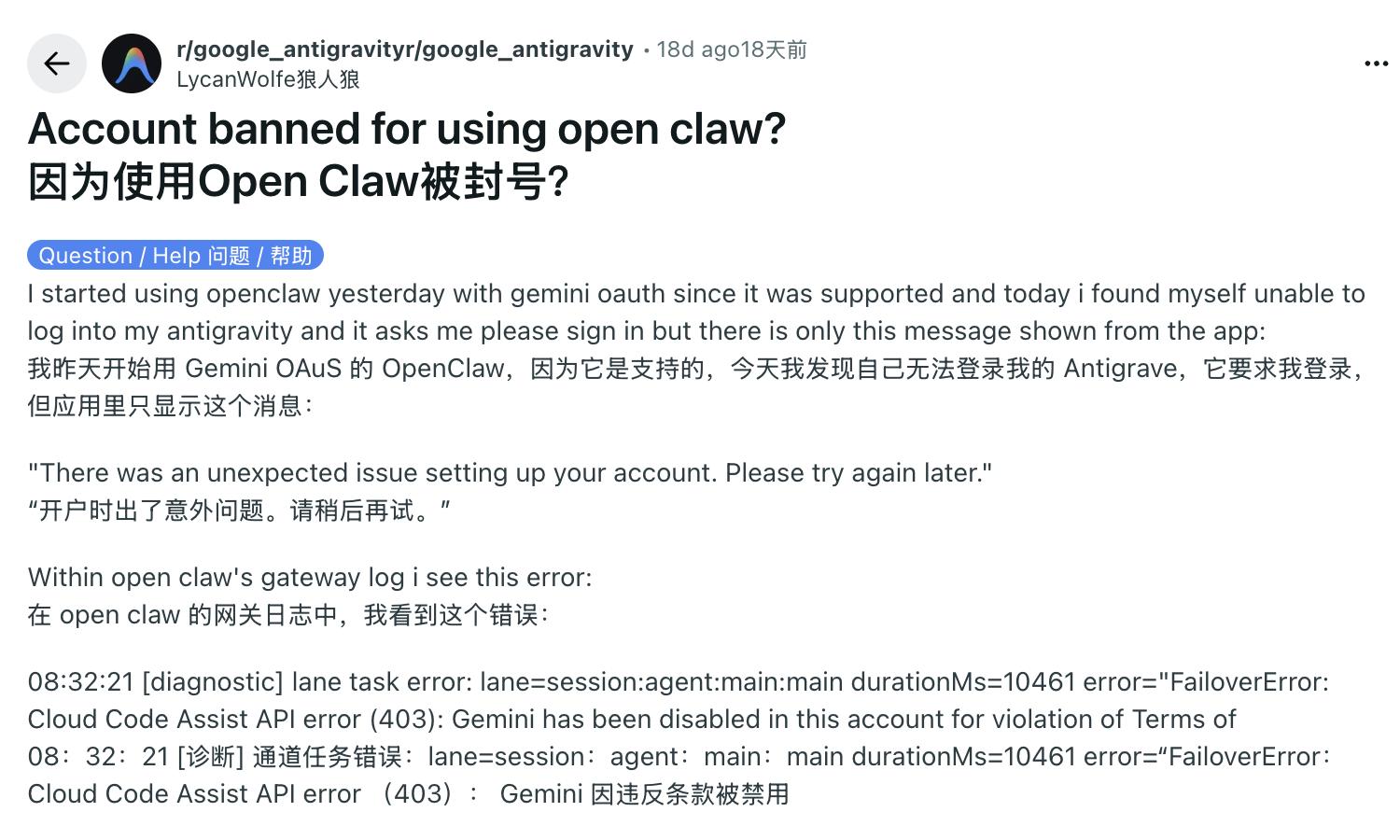
Core Viewpoint - The recent actions by Google to ban accounts using OpenClaw to access its AI services have sparked significant backlash from users, raising questions about the company's decision-making and user communication strategies [1][4][5]. Group 1: Google’s Actions and User Reactions - Google has implemented widespread account bans for users accessing its AI services through OpenClaw, leading to user frustration and criticism on platforms like Reddit and X [1][2][4]. - Many users reported being unable to log into their accounts after using OpenClaw, with some receiving vague error messages without prior warning about potential violations [2][4][5]. - The founder of OpenClaw, Peter Steinberger, criticized Google's harsh measures and noted that other companies, like Anthropic, have been more cooperative in addressing similar issues [4][6]. Group 2: OAuth Authorization Abuse - The primary trigger for Google's account bans is identified as "OAuth authorization abuse," where users exploit the authorization mechanism to access services without proper payment [5][7]. - OAuth allows users to grant third-party applications access to their accounts without sharing passwords, but its misuse has led to significant service quality issues for Google [7][11]. - The combination of OpenClaw and OAuth has enabled users to utilize Google’s AI services in a cost-effective manner, undermining the traditional subscription and API payment models [11][12]. Group 3: Competitive Landscape and Industry Response - In contrast to Google’s restrictive approach, Chinese AI companies are embracing OpenClaw, integrating it into their products and enhancing user experience [17][25]. - The recent release of domestic AI models, such as Kimi K2.5, has positioned them as strong competitors in the AI landscape, focusing on capabilities that align with the needs of intelligent agents [24][25]. - The differing strategies between Google and Chinese firms highlight a fundamental divergence in how AI services are structured, with Google favoring tight integration and control, while Chinese companies adopt a more open and service-oriented approach [25].
AI主线开年布局-春节期间海内外大模型产业动态
2026-02-24 14:15
Summary of Key Points from the Conference Call Industry Overview - The conference call discusses the developments in the AI industry, particularly focusing on domestic models like Zhipu and Minimax, which have shown strong performance in Agent AI and cost optimization, leading in usage on third-party platforms like Open Router [1][2]. Core Insights and Arguments - **Domestic Model Performance**: Zhipu and Minimax have released new versions (GM5 and M2.5) that excel in coding and agent capabilities, with Zhipu performing well in benchmark tests and Minimax leading in agent capabilities and cost optimization [2]. - **Token Demand Growth**: The rise of Agent AI has significantly increased token demand, making global developers more price-sensitive. Domestic models are capturing substantial demand due to their high cost-performance ratio [1][2]. - **Revenue Growth**: Kimi's K2.5 version generated revenue equivalent to its entire previous year's income within 20 days post-launch, with a higher proportion of revenue coming from overseas [4]. - **ByteDance's C-DOS 2.0**: ByteDance's C-DOS 2.0 is recognized as a leader in video generation, outperforming competitors in effectiveness, cost-performance, and usability, especially during the Spring Festival [5]. - **Alibaba's Progress**: Alibaba's Qianwen 3.5 has improved in multi-modal understanding and reasoning capabilities, maintaining a strong open-source approach despite a slower C-end deployment compared to ByteDance [6]. - **OpenAI's Revenue Goals**: OpenAI aims for $280 billion in revenue by 2030, planning to invest $665 billion in computing power, indicating strong commercial expectations [7]. - **Google's Gemini 3.1**: Google released Gemini 3.1, which is considered to have the leading comprehensive capabilities globally, competing closely with OpenAI's GPT-5.2 [7]. Additional Important Insights - **Future Trends**: The AI industry is expected to see significant advancements in reasoning technology by 2026, with unified models being a key trend that integrates content understanding and generation across various media [3][9]. - **SaaS Model Challenges**: The SaaS model faces challenges, particularly with user-based pricing, but underlying demand for AI infrastructure remains strong, benefiting companies in cloud computing and related fields [11]. - **Investment Opportunities**: Despite short-term pressures, companies with strong industry knowledge and customer barriers are expected to prove their value in the long term, with high-margin companies like TaxFriend and Glodon maintaining significant advantages in the AI era [12]. - **Multi-Agent Collaboration**: The Multi-Agent Scaling Law suggests that collaborative agents can significantly enhance overall efficiency, as demonstrated by Kimi K2.5, which utilizes multiple agents for improved task performance [17]. Conclusion - The AI industry is rapidly evolving, with domestic companies gaining ground through innovative models and competitive pricing. Key players like ByteDance and Alibaba are making strides in multi-modal capabilities, while global giants like OpenAI and Google set ambitious revenue targets. Investors should focus on the ongoing demand for AI solutions and the potential for significant advancements in technology and infrastructure.
Kimi春节档挣超一年钱!这口“龙虾肉”大厂开始抢吃了
Xin Lang Cai Jing· 2026-02-24 11:07
Core Insights - Kimi's recent launch of Kimi Claw has rapidly gained popularity, reaching the top of the OpenClaw model usage rankings within a week, leading to a significant increase in revenue and valuation to approximately 70 billion RMB [1][2][26] - The competitive landscape is intensifying as major internet companies like NetEase and Alibaba are also launching their own versions of AI models, indicating a shift towards widespread adoption of AI agents [6][19][39] Company Performance - Kimi's revenue in the last 20 days has surpassed its total revenue for the previous year, with a valuation now exceeding 100 billion RMB, making it the fastest AI company to reach unicorn status in China [15][35] - The company has recently completed a financing round of 700 million USD, bringing its total funding to over 1.2 billion USD [15][35] Product Features - Kimi Claw allows users to deploy applications easily without needing additional APIs, utilizing a cloud-based persistent agent that can be accessed through various platforms [8][28] - The product integrates over 5000 community plugins, enabling a wide range of functionalities including development, coding, and office tasks, enhancing user experience significantly [8][29] Market Dynamics - The launch of Kimi Claw has prompted other tech giants to enter the AI agent space, with NetEase introducing Lobster AI and Alibaba launching CoPaw, both offering similar functionalities [19][39][41] - The competitive environment is characterized by rapid product development and deployment, with Kimi also expanding its offerings to mobile platforms shortly after the initial launch [41]
未知机构:一海外AI的C端与B端流量数据及趋势-20260224
未知机构· 2026-02-24 04:40
Summary of Conference Call Records Industry Overview - The conference call discusses trends in the AI industry, focusing on both C-end (consumer) and B-end (business) traffic data and trends, highlighting the performance of various AI models and companies in the market [1][2]. Key Points on C-end Traffic - **User Engagement**: ChatGPT's daily active users (DAU) rebounded from 460 million in December 2025 to current levels, indicating strong user engagement driven by model improvements like GPT-5.2 and 5.3 [1]. - **Growth of Competitors**: Google's Gemini saw its DAU increase from 23 million in 2025 to 130 million, although growth has slowed recently. Anthropic's Claude Pro doubled its DAU from 5 million to 10 million, driven by its coding capabilities and increased user subscription willingness [1]. Key Points on B-end Traffic - **Demand Surge**: The OpenRouter platform's token consumption surged from 8 trillion tokens per week at the end of January 2026 to 13 trillion tokens per week in February, primarily driven by domestic model vendors like Minimax and Kimi [2]. - **Cost Optimization**: The proliferation of agent products has led to a significant increase in token consumption, with Kimi's package reportedly consuming millions of tokens daily, showcasing the competitive edge of domestic models in the B-end market [2]. Trends in Model Vendors - **Platform Transition**: OpenAI launched Frontier, an enterprise-level middleware product, enhancing B-end capabilities with features like virtual employee functions and independent digital identity tracing [3]. - **Multi-Model Distribution**: Google is developing a multi-model distribution platform to reduce reliance on single model sales, integrating models from various vendors like Gemini and Anthropic into a cloud and software service model [3]. Commercialization Acceleration - **Revenue Goals**: OpenAI has significantly raised its revenue targets for 2026, with plans to further increase them in 2027, focusing on C-end subscriptions and advertising as core revenue sources [4]. - **Advertising Market Impact**: The advertising sector is experiencing a split, with companies like Google and Meta benefiting from AI-driven ad precision, while mid-tier firms like Pinterest and Snapchat face declining growth and user loss [4]. Challenges to Traditional Industries - **Security Software Threats**: The introduction of Claude Code Security by Anthropic poses a challenge to traditional security software companies by automating code vulnerability detection and patching [4]. Model Capability Enhancement - **Large-Scale Clusters**: Meta's Avocado model, set to launch in Q1 2026, is under observation as it utilizes a GB200 cluster for training, which could validate the "big push" strategy if it reaches top-tier model performance [5][6]. - **Multi-Agent Interaction**: The rise of multi-agent collaboration is seen as a new technical direction, with various companies implementing features that allow multiple models to work together, necessitating hardware upgrades to support this interaction [6]. Hardware Demand Growth - **Optimized Hardware**: Google is enhancing its TPUV8 architecture to improve storage efficiency and accelerate communication between agents, which is expected to drive demand for high-bandwidth memory (HBM) and optical modules [6].

8点1氪丨三亚飞北上广深机票逼近万元;史上最贵iPhone要来了,苹果首发折叠屏定价或冲2万;2026中国电影票房暂列全球第一
3 6 Ke· 2026-02-24 00:08
今日热点导览 TOP 3 大新闻 三亚飞北上广深机票逼近万元,官方出手 2月23日,春节假期进入尾声。海南三大机场将迎来整个春运期间客流峰值日,预计运送旅客将突破 23.2万人次。记者查询 多家在线旅游平台发现,2月22日至23日期间,从三亚飞往北京、上海等核心城 市的直飞航班经济舱几乎全部售罄,仅剩的公务舱票价普遍逼近万元大关。 与此同时,三亚至广州的直飞航班在23日已显示"售罄";旅客只能选择耗时更久、价格仍高达近万元的 中转方案。深圳航线也不例外,2月22日、23日三亚飞往深圳的直飞机票全部售罄,一直到24号才有直 飞深圳的航班,售价仍超8000元。 面对"天价机票",航司方面也给出了回应。根据"海口发布"消息,海南航空工作人员表示,春运期间机 票价格受市场供需关系影响出现波动,属于正常现象。所有国内航班经济舱票价均严格按备案价格体系 执行。"我们通过内部系统实时监控票价波动,确保春运期间票价处于合理区间。"另据新华社消息,中 国民航局已批复多个批次航班增加计划,在海口增加超110架次航班,精准执飞上海、北京、成都等热 门目的地。(智通财经、新华社) 史上最贵iPhone要来了,苹果首发折叠屏定价或冲2 ...



Kimi估值突破100亿美元,阿里腾讯等领投超7亿美元融资
Cai Jing Wang· 2026-02-17 08:40
Group 1 - Kimi is set to complete a new financing round of over $700 million, following a previous $500 million round just over a month ago [1] - The latest financing round is led by existing shareholders including Alibaba, Tencent, Wuyuan, and Jiua [1] - Kimi's valuation has doubled to exceed $10 billion, with the total amount raised in the last two rounds reaching over $1.2 billion, marking the highest financing amount in the large model industry in the past year [1]
从写代码到做工程,北京AI用硬核技术改写全球AI竞赛规则
Bei Ke Cai Jing· 2026-02-17 00:50
2026年,全球人工智能领域迎来新一轮技术爆发潮。在这场激烈的技术竞赛中,北京企业展现出强劲实 力,在全球掀起"惊涛骇浪"。 1月8日,智谱AI在香港交易所挂牌上市,成为"全球大模型第一股",此后发布的智谱GLM-5在全球权威 榜单中位居全球第四、开源模型第一。2月7日,字节推出的视频生成模型Seedance 2.0全球"出圈",令 好莱坞导演惊叹,让海外网友在社交平台"催上线"。Kimi、生数科技、面壁智能、银河通用等企业也相 继推出新一代大模型产品,在通用大语言模型、多模态视频生成、代码编程、具身智能等核心赛道实现 全面突破。 北京,这座千年古都,正在以惊人的速度蜕变为全球AI创新的策源地。 从"会写代码"到"能完成工程" 过去两年,大模型在代码生成能力方面的进展业界有目共睹。但写代码和完成工程系统之间,始终横亘 着一道鸿沟。这道鸿沟,正在被北京的企业们用实实在在的技术突破填平。GLM-5的发布,标志着国 产大模型完成了从"初级程序员"到"总架构师"的进化。 GLM-5采用了744B总参数、40B激活参数的MoE架构,引入DeepSeek稀疏注意力机制(DSA),部署成 本降低30%以上。在Vending ...