Mistral AI

Search documents
ASML预计明年中国市场净销售额回落
Di Yi Cai Jing· 2025-10-15 05:36
Core Insights - ASML reported a net sales of €7.5 billion in Q3 2025, with a gross margin of 51.6% and a net profit of €2.1 billion [1] - The company expects a year-on-year net sales growth of approximately 15% for the full year 2025, with a gross margin around 52% [1] - ASML's CEO indicated that Q4 2025 net sales are projected to be between €9.2 billion and €9.8 billion, with a gross margin between 51% and 53% [1] Financial Performance - Q3 2025 net sales: €7.5 billion [1] - Q3 2025 gross margin: 51.6% [1] - Q3 2025 net profit: €2.1 billion [1] - Expected full-year 2025 net sales growth: approximately 15% [1] - Expected full-year 2025 gross margin: around 52% [1] - Q4 2025 net sales forecast: between €9.2 billion and €9.8 billion [1] - Q4 2025 gross margin forecast: between 51% and 53% [1] Market Outlook - ASML anticipates a strong performance in Q4 2025 and expects that net sales for 2026 will not be lower than those in 2025 [1] - However, the outlook for the Chinese market is less optimistic, with a projected decline in net sales for 2026 compared to the high base levels of 2024 and 2025 [1] Technological Developments - ASML is integrating artificial intelligence into its lithography solutions through collaboration with Mistral AI to enhance system performance and production efficiency [2] - The company noted a positive trend in AI-related investments, expanding to more clients in advanced logic chips and DRAM sectors [2] - The introduction of the TWINSCAN XT:260, an i-line lithography machine, is expected to improve production efficiency by up to four times compared to existing solutions [2]

手握万亿现金,英伟达如何“撒钱”构建AI生态?
Sou Hu Cai Jing· 2025-10-14 02:55
Core Insights - The AI revolution has provided NVIDIA with unprecedented opportunities, leading to explosive growth in revenue, profit, and cash reserves since the emergence of ChatGPT over two years ago, with a current market capitalization of $4.5 trillion [2] - NVIDIA is actively investing in startups, particularly in the AI sector, to expand its strategic footprint, having participated in 50 venture capital deals in 2025 alone, surpassing its total of 48 deals in 2024 [2] - NVIDIA's corporate venture fund, NVentures, has accelerated its investment pace, completing 21 deals in 2025 compared to just 1 in 2022 [2] Investment Activities - NVIDIA's investments in startups with over $100 million in funding since 2023 showcase its expanding influence in the tech industry, moving beyond its traditional role as a hardware supplier [3] - Notable investments include: - OpenAI: NVIDIA invested $100 million in OpenAI's record $6.6 billion funding round, valuing the company at $157 billion, and plans to invest up to $100 billion in future strategic collaborations [4] - xAI: NVIDIA participated in a $6 billion funding round for xAI, with plans to invest up to $2 billion in equity [4] - Mistral AI: NVIDIA made a third investment in Mistral AI during its €1.7 billion ($2 billion) Series C funding round, valuing the company at €11.7 billion ($13.5 billion) [4] Recent Funding Rounds - Reflection AI: NVIDIA led a $2 billion funding round for Reflection AI, valuing it at $8 billion, which offers a cheaper alternative to closed-source models from competitors [5] - Thinking Machines Lab: NVIDIA participated in a $2 billion seed round for Thinking Machines Lab, valuing it at $12 billion [7] - Inflection: NVIDIA co-led a $1.3 billion funding round for Inflection, which faced challenges after Microsoft acquired non-exclusive technology rights [7] Additional Investments - Wayve: NVIDIA participated in a $1.05 billion funding round for Wayve, which is developing self-learning systems for autonomous driving [8] - Figure AI: NVIDIA invested in Figure AI's over $1 billion Series C funding round, raising its valuation to $39 billion [8] - Scale AI: NVIDIA, along with other tech giants, invested $1 billion in Scale AI, bringing its valuation close to $14 billion [8] Other Noteworthy Investments - Commonwealth Fusion: NVIDIA participated in an $863 million funding round for Commonwealth Fusion, valuing the company at $3 billion [9] - Cohere: NVIDIA has invested in multiple funding rounds for Cohere, including a $500 million Series D round, valuing it at $6.8 billion [10] - Lambda: NVIDIA participated in a $480 million Series D round for Lambda, which provides model training services [11]


前英国首相“跳槽”美国硅谷,欧洲AI可能真没救了
3 6 Ke· 2025-10-14 00:59
Core Insights - Former UK Prime Minister Rishi Sunak has accepted a part-time senior advisor position with Microsoft and AI startup Anthropic, raising concerns about the implications for Europe's AI industry [3][4] - The appointment symbolizes a troubling trend where political assets are being absorbed by American tech giants, rather than benefiting local European innovation [4] - Europe's AI industry faces significant challenges, including a lack of competitive capital and regulatory burdens that hinder innovation [5][7][10] Group 1: Economic Context - The EU's GDP in Q1 2025 is projected to be approximately $4.85 trillion, significantly lower than the US's $7.32 trillion, highlighting a growing economic gap [4] - The EU's share of global generative AI patent applications is only 6.7%, compared to 74.96% for the US and China, indicating a structural lag in innovation [5] - Europe's AI chip market is dominated by Nvidia, which holds 80% of the global market, while Europe accounts for only 4.8% of AI computing power [5] Group 2: Regulatory Challenges - The EU's AI Act, while establishing ethical standards, has created a "Brussels Paradox" where regulatory compliance becomes a costly burden for local startups [7] - European startups must prioritize compliance over innovation, leading to a competitive disadvantage against more agile US counterparts [7][10] - The fragmented nature of European markets complicates capital flow and investment, further stifling innovation [11] Group 3: Talent and Capital Issues - The European venture capital landscape is characterized by conservatism and fragmentation, making it difficult for startups to secure necessary funding [11] - The lack of a unified exit mechanism for tech stocks in Europe hampers the growth of a robust investment ecosystem [11] - The talent drain from Europe to the US is exacerbated by the disparity in compensation and resources available to AI professionals [11] Group 4: Ethical Concerns in AI Development - Mistral AI, a promising European startup, faces allegations of unethical practices, which could undermine trust in the European AI sector [12][16] - The controversy surrounding Mistral highlights the potential risks of knowledge transfer and ethical breaches within the industry [12][16] Group 5: Comparative Analysis with China - The contrasting paths of Europe and China in AI development reveal Europe's regulatory strengths but market fragmentation, while China benefits from a unified digital market [16][17] - China's rapid advancement in AI applications contrasts with Europe's struggle to translate academic prowess into commercial success [16][17] - The need for China to engage actively in global AI governance is emphasized, as it seeks to balance its technological advancements with ethical considerations [17]
英伟达的疯狂投资版图:71笔交易,数百亿美元,押注整个AI时代
3 6 Ke· 2025-10-13 12:54
Core Insights - Nvidia has emerged as a dominant player in the AI industry, with a market capitalization exceeding $4.5 trillion, driven by the rise of AI technologies like ChatGPT [1][3] - The company is rapidly expanding its investment portfolio, participating in 50 venture capital deals in 2025 alone, surpassing its total of 48 deals in 2024 [3][39] Investment Strategy - Nvidia's investment strategy involves a multi-faceted approach, focusing on various AI sectors, including large model development, computational infrastructure, autonomous driving, medical AI, nuclear fusion energy, and optical chips [3][11] - The company has committed a staggering $100 billion to OpenAI for strategic collaboration, highlighting its intent to secure a significant role in AI infrastructure [6][12] Major Investments - Nvidia's investments include a $1 billion stake in OpenAI during a $6.6 billion funding round in 2024, followed by a massive $100 billion commitment for AI infrastructure development [4][6] - The company has also invested in xAI, founded by Elon Musk, despite OpenAI's opposition, indicating Nvidia's strategy to diversify its technological bets [7][11] - Nvidia has made multiple investments in Mistral AI, a European AI company, to support the continent's push for AI independence [8][11] Computational Infrastructure - Nvidia is heavily investing in computational infrastructure, with significant stakes in companies like Nscale, which is building data centers for OpenAI's Stargate project [12][14] - The company has also invested in Cruso, which builds data centers for major tech firms, creating a closed-loop system where Nvidia's GPUs are essential for both users and service providers [16][18] Energy Solutions - Nvidia is addressing the energy consumption challenges of AI by investing in Commonwealth Fusion, which is developing nuclear fusion technology for clean energy [20][22] - The company is also backing Firmus Technologies, which is transitioning from cryptocurrency mining to AI infrastructure, further solidifying its position in the energy sector [20][22] AI Applications - Nvidia's investment portfolio spans various AI applications, including autonomous driving, robotics, healthcare, and content creation, ensuring its chips are integral to these technologies [23][31] - The company has invested in Wayve, a self-learning autonomous driving system, and Figure AI, a humanoid robotics company, reflecting its commitment to long-term value in these sectors [24][29][31] Strategic Framework - Nvidia's investment strategy can be summarized in three layers: dependency on computational power, ecosystem binding across the AI value chain, and coverage of multiple application sectors [37][38] - The company's goal is to become the foundational infrastructure for the AI ecosystem, akin to how Microsoft and Google established their operating systems [38][39]
速递|英伟达的AI帝国:揭秘其顶尖初创企业投资版图
Z Potentials· 2025-10-13 04:55
没有哪家公司比英伟达更能戏剧性地抓住人工智能革命的机遇。自两年多前 ChatGPT 及随后众多竞 争性生成式 AI 服务问世以来,其营收、盈利能力和现金储备均呈飙升态势。股价的飞涨使其成为市 值达 4.5 万亿美元的企业巨头。 全球领先的高性能 GPU 制造商利用其不断膨胀的财力大幅增加了对初创企业的投资,尤其是在人工 智能领域。 Mistral AI : 当这家法国大语言模型开发商于 9 月以 117 亿欧元(约合 135 亿美元)投后估值完成 17 亿欧元(约 20 亿美元) C 轮融资时,英伟达第三次投资了 Mistral 。 Reflection AI : 2023 年 10 月,英伟达领投了成立仅一年的 Reflection AI20 亿美元融资轮 ,该公司 估值达 80 亿美元。 Reflection AI 正将自己定位为中国深度求索 (DeepSeek) 的美国竞争对手,其开 源大语言模型为 OpenAI 和 Anthropic 等公司的闭源模型提供了更低成本替代方案。 根据 PitchBook 数据,英伟达在 2025 年迄今已参与了 50 笔风险投资交易,超过了该公司 2024 年全 年完成 ...

英国前首相“跳槽”美国硅谷,欧洲AI可能真没救了
Tai Mei Ti A P P· 2025-10-11 10:23
Core Insights - The appointment of former UK Prime Minister Rishi Sunak as a senior advisor to Microsoft and AI startup Anthropic highlights the challenges faced by the European AI industry, symbolizing a shift of political assets from Europe to American tech giants [1][2][3] - The economic gap between the EU and the US has widened, with the EU's GDP in Q1 2025 estimated at approximately $4.85 trillion, compared to the US's $7.32 trillion, exacerbated by low growth in core economies like Germany and France [2] - Europe's AI industry struggles with a "Brussels Paradox," where stringent regulations intended to ensure ethical AI development have hindered commercial growth, leading to a significant lag in innovation compared to the US and China [4][5] Economic Context - The EU's GDP briefly surpassed that of the US in 2007 but has since fallen behind, with the current economic landscape reflecting a significant decline in competitiveness [2] - The EU's share of global generative AI patents is only 6.7%, while the US and China hold 74.96%, indicating a structural lag in innovation [3] Regulatory Challenges - The EU's comprehensive AI regulation, the AI Act, aims to set global standards but has become a "compliance tax" for local startups, diverting resources from innovation to regulatory adherence [5][6] - The regulatory environment in Europe is seen as a barrier to rapid innovation, contrasting sharply with the agile development models employed by US firms [5] Capital and Investment Landscape - The US has a robust capital ecosystem that supports AI startups through aggressive venture capital and strategic investments, while Europe’s investment landscape is characterized by conservatism and fragmentation [6][7] - The lack of a unified investment framework in Europe leads to difficulties in capital flow and integration, further stifling innovation [7] Talent Drain - European AI startups face a talent drain as top scientists are attracted to better opportunities in the US, where salaries and resources are significantly more appealing [7][8] - This cycle of "capital shortage—talent loss—innovation stagnation" creates a vicious cycle that undermines the competitiveness of the European AI sector [8] Ethical and Competitive Concerns - The controversy surrounding Mistral AI, which faced allegations of unethical practices, underscores the fragility of trust in the European AI landscape, potentially damaging its competitive position [10][11] - The incident raises questions about the integrity of European AI firms and their ability to maintain ethical standards while competing globally [11] Comparative Analysis with China - The challenges faced by Europe in AI development serve as a cautionary tale for China, which has its own set of advantages and disadvantages in the AI landscape [12] - While Europe struggles with fragmented markets and regulatory burdens, China benefits from a unified digital market and abundant data, highlighting the need for Europe to adapt its strategies to remain competitive [12] Conclusion - Sunak's transition to the tech industry serves as a stark reminder of the structural weaknesses in European AI, emphasizing the need for a cohesive strategy that aligns political will with technological and capital resources to foster innovation [13]
AI造富风暴中的“数据卖铲人”传奇:37岁华裔,登顶全球最年轻富豪
Sou Hu Cai Jing· 2025-10-11 01:35
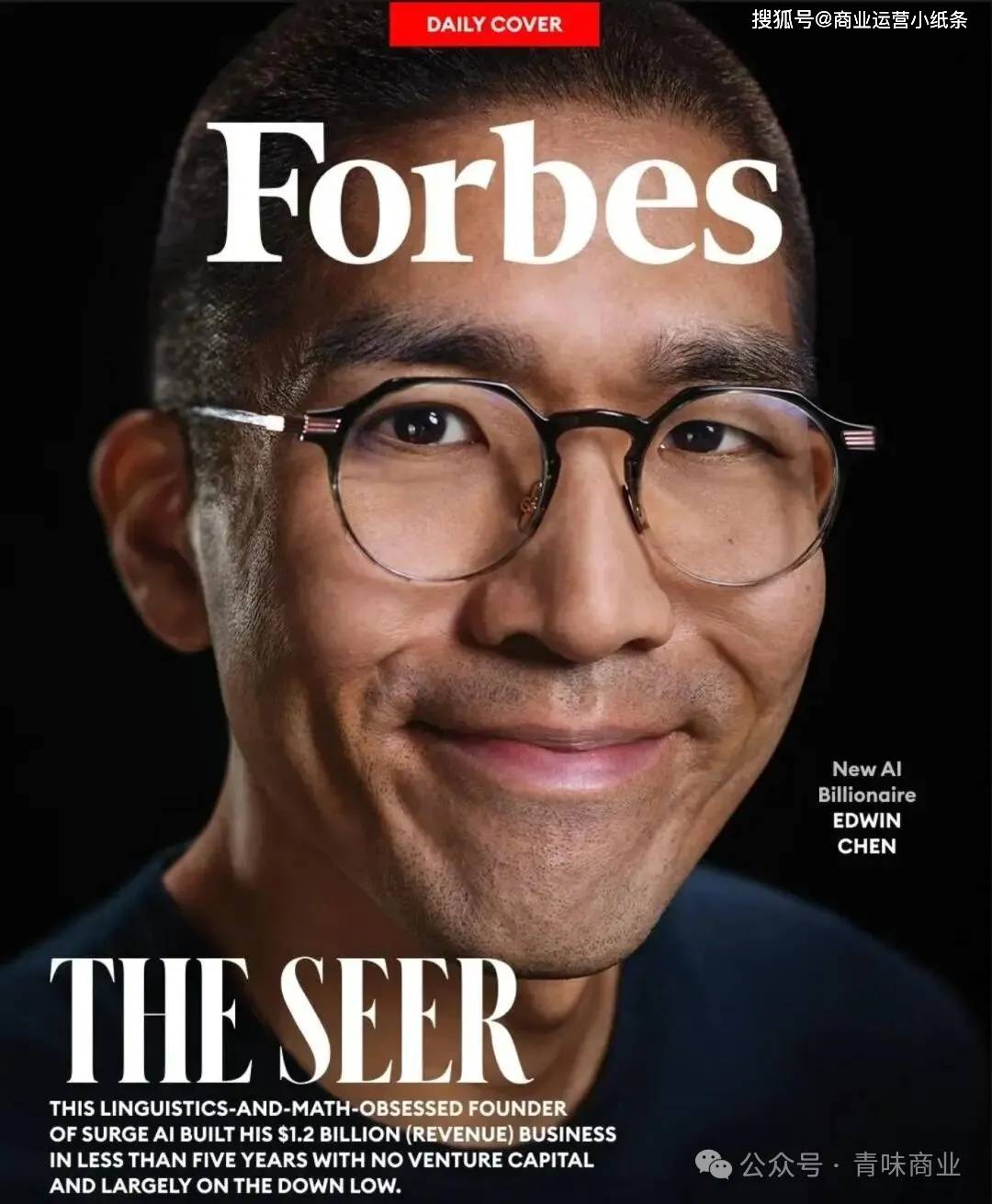
Core Insights - Edwin Chen, a 37-year-old MIT graduate, has made headlines by debuting on the Forbes American Billionaires list with a net worth of $18 billion, thanks to his company Surge AI, which has reached a valuation of $24 billion in the AI data annotation sector [1][4][7] - Surge AI and Scale AI are positioned as key players in the AI industry, providing essential "data fuel" for algorithms, which is crucial for the development of advanced AI models like ChatGPT and Claude3 [4][6] Company Overview - Surge AI was founded by Edwin Chen in 2020 after he identified a significant gap in the data annotation market, particularly after a failed outsourcing attempt at Facebook [5][6] - The company has achieved remarkable growth, generating eight-digit revenue within 12 months of launching its first product, and has since secured contracts with major tech firms like OpenAI, Google, and Microsoft [6][10] Market Dynamics - The AI industry is experiencing a wealth creation surge, with data annotation companies like Surge AI benefiting from their unique positioning as "pick-and-shovel" providers in the AI gold rush [4][9] - The valuation of Surge AI has led to significant wealth accumulation for its founder, who holds 75% of the company's shares, highlighting the lucrative nature of the AI sector [7] Technological Advancements - Surge AI is developing advanced intelligent annotation systems capable of recognizing cultural nuances in over 200 languages and achieving extremely low error rates in medical image annotation [10] - The company is also working on cognitive annotation to enhance data with philosophical and ethical dimensions, setting it apart from competitors focused on basic classification tasks [10][11] Future Outlook - Despite warnings of a potential AI bubble, Edwin Chen remains focused on building a pathway to Artificial General Intelligence (AGI) through innovative data annotation solutions [11] - Surge AI's contracts emphasize the commercial value of data usage rights, indicating a shift towards viewing data as a critical asset in the evolving digital landscape [11]
AI venture funding continued to surge in third quarter, data shows
Yahoo Finance· 2025-10-06 11:01
Core Insights - The AI sector has seen a significant influx of venture funding, with notable companies like Anthropic receiving billions in the third quarter [1][2][3] Group 1: Venture Funding Overview - Global venture funding in Q3 increased by 38% year-over-year to $97 billion, up from $92 billion in Q2 [2] - Approximately 46% of global venture funding in Q3 was directed towards AI companies, with 29% specifically invested in Anthropic [2] - The three largest venture rounds in Q3 were led by foundation model companies: Anthropic raised $13 billion, xAI raised $5.3 billion, and Mistral AI raised $2 billion [2] Group 2: Importance of AI Sector - The surge in AI-related companies has significantly influenced Wall Street, contributing to record highs in major stock indexes [3] - OpenAI, the parent company of ChatGPT, has reportedly become the most valuable private company globally, with a valuation of $500 billion [3] - Other private players in the AI chatbot space have also led funding efforts in the last quarter [3] Group 3: Sector-Specific Funding - U.S.-based companies received the majority of venture capital in Q3, totaling $60 billion [4] - The hardware sector was the second-largest recipient of funding, with $16.2 billion raised by companies in robotics, semiconductors, quantum, and data infrastructure [5] - Healthcare and biotech sectors raised $15.8 billion, making them the third-largest sector for venture funding in the quarter [5]
Bruno Le Maire no longer advising ASML, company says
Yahoo Finance· 2025-10-06 08:33
By Nathan Vifflin (Reuters) -France's former finance minister Bruno Le Maire is no longer an advisor at ASML, a spokesperson for the Dutch chip equipment maker told Reuters on Monday. Le Maire, who was poised to become defence minister in the latest French government that collapsed just hours after being appointed on Sunday, had been named as a special advisor to ASML's executive board in 2024. During his time with the company, Le Maire had advised its executives on investments to reinforce Europe's chi ...
37岁,他登顶今年最年轻富豪
首席商业评论· 2025-10-02 04:01
Core Viewpoint - The article highlights the rise of Edwin Chen and his company Surge AI as a significant player in the AI industry, achieving a valuation of approximately $24 billion and annual revenues exceeding $1 billion without external funding [4][6][7]. Company Overview - Surge AI, founded by Edwin Chen in 2020, specializes in providing data annotation services essential for AI model training [6][9]. - The company has grown rapidly, achieving over $1 billion in revenue within five years and has not sought external financing during this period [4][6]. - Edwin Chen holds 75% of Surge AI's shares, leading to a personal net worth of $18 billion, making him the youngest billionaire on the Forbes list this year [4][7]. Competitive Landscape - Surge AI competes with other data annotation companies like Scale AI, which recently received a $15 billion investment from Meta, raising its valuation to over $29 billion [6][7]. - The article emphasizes the critical role of data annotation companies in the AI ecosystem, as they provide the necessary "clean" data for model training, which is indispensable regardless of technological advancements [6][7]. Industry Trends - The AI sector is experiencing a wealth creation wave, with numerous startups achieving billion-dollar valuations, such as Perplexity and Mistral AI, which have recently raised significant funding [12][13]. - The stock market reflects this trend, with companies like Nvidia and domestic AI chip firms seeing substantial increases in their market valuations [12][13]. Future Outlook - Edwin Chen expresses optimism about the future of AI, suggesting that advancements could lead to groundbreaking achievements, including solving complex mathematical problems and enhancing human creativity [10]. - The article concludes with a cautionary note about the potential for a market correction in the AI sector, highlighting the historical patterns of technology booms and busts [14].