大成基金

Search documents
发行大战持续!机构抢滩“新”基金
券商中国· 2025-06-12 01:56
Core Viewpoint - The new floating fee rate funds are experiencing a competitive issuance phase, with significant marketing efforts from fund companies as the market recovers [2][20]. Fund Issuance and Performance - As of June 11, 2023, 24 new floating fee rate funds have been launched, collectively raising over 8 billion yuan, with nearly 20 funds surpassing the 200 million yuan threshold for establishment [2][8]. - The first batch of 16 new floating fee rate funds began sales on May 27, 2023, with some companies like Dongfanghong Asset Management achieving early success by reaching their fundraising limits quickly [3][6]. - Fund companies are employing differentiated marketing strategies, leading to varied fundraising timelines, with some companies experiencing slower sales than expected [6][8]. Fund Manager Engagement - The first batch of 26 companies receiving approval for new floating fee rate funds includes both large and smaller fund managers, showcasing a mix of experienced and emerging talent [11]. - Fund companies are demonstrating commitment by deploying seasoned fund managers and investing their own capital into the funds, with Dongfanghong Asset Management announcing a self-investment of 10 million yuan [15][18]. Innovations in Fee Structure - The new floating fee rate funds are designed to align the interests of fund managers and investors, promoting a "win-win" scenario through asymmetric fee structures that enhance investor protection [20][21]. - These funds encourage long-term holding and rational investment, aiming to smooth out short-term volatility while enhancing transparency and trust [20][21]. - The fee structure is linked to fund performance and the duration of investment, incentivizing both fund managers to seek long-term excess returns and investors to commit for longer periods [21].


新型浮动费率基金密集发行 24只产品已募集超80亿元
Zheng Quan Shi Bao· 2025-06-11 17:24
Core Viewpoint - The issuance of new floating rate funds is intensifying as market conditions improve, with over 80 billion yuan raised across 24 funds, indicating strong demand and competition among fund companies [1][2][3] Fund Issuance and Performance - As of June 11, 2023, 24 new floating rate funds have been launched, with a total fundraising exceeding 80 billion yuan, and nearly 20 funds surpassing the 200 million yuan threshold for establishment [2][3] - The Oriental Red Core Value Fund was the first to reach its fundraising cap of 1.991 billion yuan and ended its fundraising early, showcasing effective marketing strategies [2][3] - Various fund companies are employing differentiated marketing strategies, leading to varied fundraising timelines and outcomes [2][3] Fund Management and Investment Strategies - The first batch of 26 companies includes both large and small fund managers, with experienced professionals leading the funds, indicating a focus on strong management [4] - Fund companies are actively investing their own capital into these new funds, with total self-purchases reaching 110 million yuan as of June 11, 2023, reflecting confidence in their products [5] Advantages of New Floating Rate Funds - New floating rate funds are designed to align the interests of fund managers and investors, promoting a "win-win" scenario through innovative fee structures that link management fees to fund performance [6][7] - These funds encourage long-term holding and rational investment, aiming to smooth out short-term volatility and enhance investor experience [6][7]
北交所主题基金年内最高已上涨超70%;自由现金流基金年内募资151亿元丨天赐良基早参
Mei Ri Jing Ji Xin Wen· 2025-06-11 00:46
Group 1 - A new floating rate fund, the交银施罗德瑞安混合, is being launched with a proprietary investment of 20 million yuan by交银施罗德, reflecting confidence in the long-term stability of China's capital markets [1] - Since the launch of the first batch of floating rate products on May 27, multiple public funds have announced self-purchases, with total subscriptions exceeding 100 million yuan as of June 9 [1] Group 2 - 15 fund companies have terminated their sales cooperation with民商基金销售公司 as of June 9, with 中欧基金 and 华泰保兴基金 being among the latest to announce this decision [2][3] - Additionally, 上银基金 has also announced the termination of its sales cooperation with海银基金销售有限公司 [4] Group 3 - As of June 9, the total scale of ETFs has reached 4.16 trillion yuan, with an increase of nearly 440 billion yuan this year, and the number of shares has risen to 2.74 trillion [5] - 14 ETFs have seen an increase in scale of over 10 billion yuan this year, with the highest individual increase exceeding 30 billion yuan [5] Group 4 - 26 new free cash flow strategy funds have been established this year, raising a total of 15.143 billion yuan, with several funds exceeding 1 billion yuan in issuance [6] - New products in this category are actively being reported, indicating ongoing interest and expansion in the free cash flow strategy fund segment [6] Group 5 - The 北证50成份指数 has shown strong performance, with all 20 available北交所主题基金 achieving positive returns this year, the highest increase being 72.29% [7][8] - Several北证50成份指数基金 have implemented purchase limits to protect the interests of fund holders [7] Group 6 - 兴证全球基金's manager, 陈聪, emphasizes four key investment directions: internet leading companies, innovative pharmaceuticals, new consumer trends, and technology hardware, particularly in the context of AI applications [9] - The innovative pharmaceutical sector is expected to continue its momentum into the second half of the year, with A-shares showing potential in niche markets like pet products and beauty [9] Group 7 - On June 10, the market experienced a decline, with the Shanghai Composite Index falling by 0.44% and the Shenzhen Component Index by 0.86% [10] - The trading volume reached 1.42 trillion yuan, indicating increased market activity compared to the previous trading day [10]
纳斯达克100指数ETF今日合计成交额46.02亿元,环比增加115.24%
Zheng Quan Shi Bao Wang· 2025-06-10 09:43
Core Insights - The total trading volume of Nasdaq 100 index ETFs reached 4.602 billion yuan today, an increase of 2.464 billion yuan from the previous trading day, representing a growth rate of 115.24% [1] Trading Volume Summary - The trading volume of GF Nasdaq 100 ETF (159941) was 1.509 billion yuan, up 959 million yuan from the previous day, with a growth rate of 174.39% [1] - The trading volume of Guotai Nasdaq 100 (QDII-ETF) (513100) was 1.119 billion yuan, an increase of 772 million yuan, with a growth rate of 222.85% [1] - The trading volume of Huaxia Nasdaq 100 ETF (QDII) (513300) was 488 million yuan, up 219 million yuan, with a growth rate of 81.22% [1] Market Performance Summary - As of market close, the average increase of ETFs tracking the Nasdaq 100 index was 0.22%, with notable performers including Harvest Nasdaq 100 ETF (QDII) (159501) and Huaxia Nasdaq 100 ETF (QDII) (513300), which rose by 0.34% and 0.31% respectively [1]
稳定战胜基准的主动基金有何特征
HTSC· 2025-06-10 06:40
Quantitative Models and Construction Methods 1. Model Name: Brinson Attribution Model - **Model Construction Idea**: The model is used to decompose the excess returns of active equity funds into stock selection and sector allocation contributions, providing insights into the sources of fund performance [16][19][22] - **Model Construction Process**: The Brinson model calculates excess returns as follows: $ R_{excess} = \sum_{i=1}^{n} (W_{i,f} - W_{i,b}) \cdot R_{i,b} + \sum_{i=1}^{n} W_{i,f} \cdot (R_{i,f} - R_{i,b}) $ - $ W_{i,f} $: Fund weight in sector $ i $ - $ W_{i,b} $: Benchmark weight in sector $ i $ - $ R_{i,f} $: Fund return in sector $ i $ - $ R_{i,b} $: Benchmark return in sector $ i $ The first term represents the allocation effect, and the second term represents the selection effect [16][19] - **Model Evaluation**: The model highlights that stock selection contributes more significantly to excess returns than sector allocation, with stock selection accounting for 83.17% of the total contribution on average [16][22] --- Model Backtesting Results 1. Brinson Attribution Model - Average stock selection contribution: 5.38% per half-year [22] - Probability of positive stock selection returns: 69.12% [23] - Probability of positive sector allocation returns: 53.66% [23] --- Quantitative Factors and Construction Methods 1. Factor Name: Fund Stability Factor - **Factor Construction Idea**: This factor measures the stability of a fund's sector allocation and its impact on outperforming benchmarks [10][12] - **Factor Construction Process**: Funds are categorized into 16 groups based on static and dynamic sector allocation characteristics: - Static categories: Highly diversified, diversified, concentrated, highly concentrated - Dynamic categories: Highly stable, stable, rotational, highly rotational The average probability of outperforming benchmarks is calculated for each group [10][12] - **Factor Evaluation**: Funds with highly stable and diversified sector allocations have the highest probability of outperforming benchmarks, exceeding 73% on average [12][14] 2. Factor Name: Style Consistency Factor - **Factor Construction Idea**: This factor evaluates the consistency of a fund's style (e.g., large-cap value) and its correlation with performance [27][30] - **Factor Construction Process**: Funds are classified based on their style consistency over time: - Long-term stable allocation - Majority-time allocation - Partial-time allocation - Rare-time allocation The probability of outperforming benchmarks is calculated for each group [27][28] - **Factor Evaluation**: Funds with long-term stable large-cap value styles have the highest probability of outperforming benchmarks, reaching 79.77% [28][30] --- Factor Backtesting Results 1. Fund Stability Factor - Highly diversified-highly stable funds: - Probability of outperforming benchmark: 73.12% - Probability of outperforming benchmark +10%: 57.29% [12] 2. Style Consistency Factor - Long-term stable large-cap value funds: - Probability of outperforming benchmark: 79.77% - Probability of outperforming benchmark +10%: 69.05% [28]
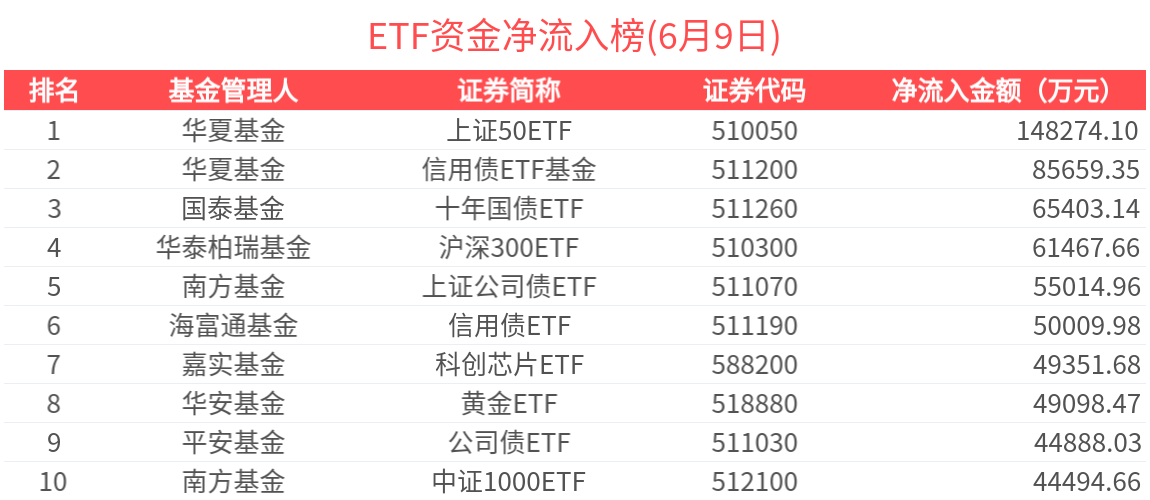
ETF资金榜 | 豆粕ETF(159985)资金加速流入,上证50ETF(510050)单日“吸金”近15亿元-20250609
Sou Hu Cai Jing· 2025-06-10 01:59
Core Insights - On June 9, 2025, a total of 212 ETF funds experienced net inflows, while 390 funds saw net outflows, indicating a significant disparity in investor sentiment towards different ETFs [1] - The top five ETFs with net inflows exceeding 100 million yuan included the SSE 50 ETF, Credit Bond ETF, Ten-Year Treasury ETF, CSI 300 ETF, and SSE Corporate Bond ETF, with inflows of 1.48 billion yuan, 856.5 million yuan, 654 million yuan, 615 million yuan, and 550 million yuan respectively [1][3] - Conversely, 17 ETFs had net outflows exceeding 100 million yuan, with the ChiNext ETF, Hang Seng Internet ETF, Short-term Bond ETF, Military Industry ETF, and Pharmaceutical ETF leading the outflows, totaling 359 million yuan, 331 million yuan, 287 million yuan, 285 million yuan, and 214 million yuan respectively [1][5] Inflow and Outflow Analysis - A total of 110 ETFs have seen consecutive net inflows, with the top performers being the Hong Kong Stock Connect Dividend ETF (29 days), Soybean Meal ETF (27 days), High Dividend ETF (26 days), SSE 180 Index Fund (23 days), and Credit Bond ETF Dachen (23 days), accumulating inflows of 445 million yuan, 61.69 million yuan, 171.34 million yuan, 140 million yuan, and 3.16 billion yuan respectively [1][7] - In contrast, 202 ETFs have experienced consecutive net outflows, with the leading ones being the Biopharmaceutical ETF (32 days), Innovative Drug ETF (27 days), Dividend Value ETF (26 days), Hang Seng Consumer ETF (24 days), and Traditional Chinese Medicine ETF (23 days), resulting in outflows of 556 million yuan, 3.29 billion yuan, 213 million yuan, 303 million yuan, and 262 million yuan respectively [1][8] Recent Trends - Over the past five days, 66 ETFs have recorded cumulative net inflows exceeding 100 million yuan, with the Short-term Bond ETF, Ten-Year Treasury ETF, Credit Bond ETF, Corporate Bond ETF, and SSE Corporate Bond ETF leading with inflows of 3.42 billion yuan, 3.37 billion yuan, 2.48 billion yuan, 2.29 billion yuan, and 2.19 billion yuan respectively [1][8] - Conversely, 86 ETFs have seen cumulative net outflows exceeding 100 million yuan, with the ChiNext ETF, Hang Seng Internet ETF, Hang Seng Medical ETF, Hong Kong Innovative Drug ETF, and East Financial Treasury ETF leading the outflows, totaling 1.82 billion yuan, 971 million yuan, 825 million yuan, 763 million yuan, and 583 million yuan respectively [1][8]
多家公募调整停牌股估值方式;超百只ETF流动性告急?丨天赐良基早参
Mei Ri Jing Ji Xin Wen· 2025-06-10 00:42
Group 1 - Wang Chongkun has been appointed as the new Chief Inspector of Vanguard Fund, succeeding Huang Jinsong who has retired [1] - Yuan Qingwei has been appointed as the new General Manager of China Merchants Sheldon's Fund, with a background in various senior roles at China Communications Bank [2][3] - The establishment of a wholly-owned subsidiary, E Fund Wealth, has been approved by the CSRC, marking E Fund's entry into the wealth management sector [4] Group 2 - Over a hundred ETFs are facing liquidity issues, with some funds warning of potential liquidation due to low asset values [5][6] - As of June 5, 147 out of 1179 ETFs had assets below 50 million yuan, indicating significant liquidity challenges [7] - More than twenty public fund companies have announced a change in the valuation method for suspended stocks, adopting the "index income method" for valuation [8][9] Group 3 - Fund manager Zhou Sicong predicts that 2025 will be a pivotal year for China's innovative drug industry, marking a year of revenue growth, profitability, and valuation increases [10] - The innovative drug sector in China has evolved through three significant phases, and companies are now entering new treatment areas while achieving profitability [10] Group 4 - The previous trading day saw the market rise, with the Shanghai Composite Index increasing by 0.43% and the Shenzhen Component Index by 0.65%, indicating positive market sentiment [11] - The Hong Kong innovative drug ETF performed strongly, with a peak increase of 4.72% [11]
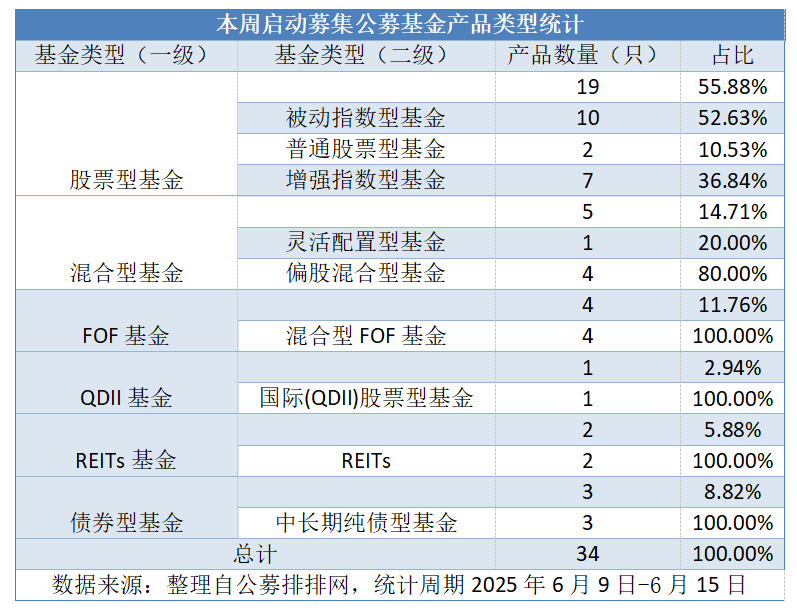
基金发行热度不减,新发数量连续3周超30只
Guo Ji Jin Rong Bao· 2025-06-09 14:03
Group 1 - The public fund issuance market remains robust, with 34 new funds launched in the week from June 9 to June 15, averaging a subscription period of 24.85 days [1] - This marks the third consecutive week where the number of newly issued funds exceeds 30, indicating strong momentum in the public fund issuance market [1] - Equity funds dominate the product structure, with 23 equity funds accounting for 67.65% of the total issuance, including 19 stock funds (82.61%) and 4 equity-mixed funds (17.39%) [1][2] Group 2 - Index fund issuance continues to show strong performance, with 17 out of 19 stock funds being index products, representing 89.47% of the stock fund category [1] - FOF (Fund of Funds) issuance shows signs of recovery, with 4 FOF funds launched, making up 11.76% of the total, a significant increase from the previous week [1][2] Group 3 - 26 public fund institutions launched new funds this week, with 7 institutions having at least 2 funds in the market [2] - Yongying Fund was the most active, launching 3 new funds, all of which are index stock funds [3] - The trend towards equity funds and index investment is driven by policy support for industrial upgrades and technology innovation, which are seen as key market themes [3][4] Group 4 - Despite rising global recession expectations, domestic policies continue to mitigate external risks, providing a solid foundation for market allocation [4] - The return of funds to A-shares is facilitated by domestic equity funds, which serve as a crucial channel for overseas capital transitioning to the local market [4]
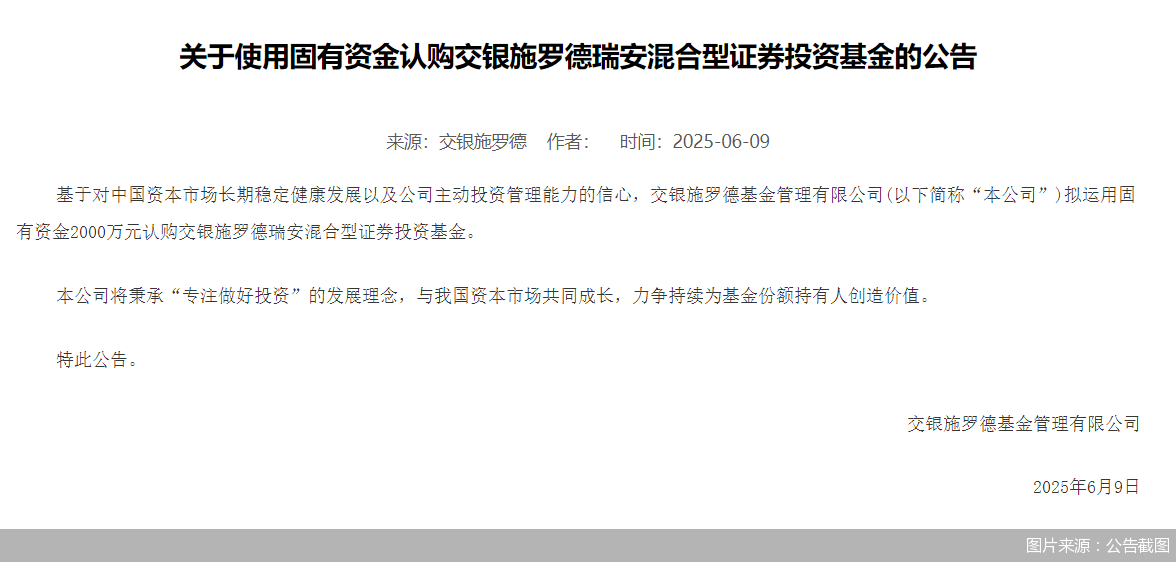
组团认购超1亿元!公募“真金白银”支持新型浮动费率基金发行
Bei Jing Shang Bao· 2025-06-09 13:21
Core Viewpoint - The public fund industry shows strong confidence in the new floating rate funds, with total subscriptions exceeding 100 million yuan, indicating a positive market outlook and potential for these products [1][4][7] Group 1: Fund Subscription Activity - On June 9, China Jianyin Schroder Fund announced a subscription of 20 million yuan for its new floating rate fund, Jianyin Schroder Rui'an Mixed Fund [3] - Multiple public funds have collectively subscribed over 100 million yuan, with several companies announcing their self-purchases, reflecting their belief in the market potential of these products [3][4] - The first batch of 26 floating rate funds began issuing on May 27, with several companies, including Dongfanghong Asset Management, also announcing significant self-purchases [3][5] Group 2: Market Confidence and Expectations - Industry insiders believe that the substantial self-purchase amounts indicate a strong confidence in the market prospects of floating rate funds, which can provide initial capital for better investment operations [4][6] - The first batch of products is expected to achieve considerable fundraising success, with some funds already announcing significant subscription amounts, such as Dongfanghong's 1.991 billion yuan [6][7] - Analysts predict that the overall issuance scale of the first batch of floating rate funds will be substantial, contributing to market stabilization and attracting more incremental capital [6][7] Group 3: Product Features and Investor Interest - The floating rate funds have a fee structure linked to performance and holding periods, which is expected to better incentivize fund managers to enhance investment capabilities [7] - Investors are anticipated to focus more on the long-term investment value of these funds rather than short-term market performance, indicating a shift in investment strategy [7]
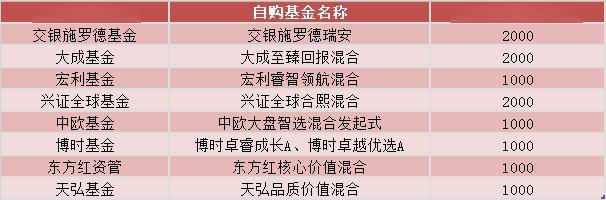
8家基金公司自购浮费基金总额突破1亿元 这类产品对投资者来说有哪些好处?需要注意哪些事项?
Sou Hu Cai Jing· 2025-06-09 13:18
Core Viewpoint - The self-purchase of floating rate funds by fund companies is a significant way to express confidence in the market, with a total self-purchase amount reaching 100 million yuan as of June 9, 2023 [1][2][3]. Group 1: Fund Companies' Self-Purchase Activities - On June 9, 2023,交银施罗德基金 self-purchased 20 million yuan, increasing the number of fund companies participating in self-purchase to eight, with a total self-purchase amount of 100 million yuan [1]. - Fund companies such as 东方红资管, 天弘基金, 博时基金, and 中欧基金 each self-purchased 10 million yuan, while 兴证全球基金 and 大成基金 self-purchased 20 million yuan [2][3]. - The self-purchase activities reflect a commitment to aligning the interests of fund companies with those of investors, enhancing the quality of public fund development [4]. Group 2: Benefits of Floating Rate Funds - Floating rate funds optimize fee structures, reducing holding costs for investors, as management fees can decrease significantly when fund performance is poor [5][6]. - The floating fee mechanism incentivizes fund managers to enhance performance, as management fees are linked to fund performance, promoting a shift from a scale-oriented to a performance-oriented industry [6][10]. - The design of floating rate funds encourages long-term holding by reducing the impact of short-term market fluctuations on investor behavior [7][9]. Group 3: Trust and Confidence in Fund Management - The floating fee mechanism strengthens the binding of interests between investors and fund managers, fostering trust as higher fees are only earned when fund performance is strong [8][12]. - Fund companies' self-purchases, such as that of 宏利基金, demonstrate confidence in their management capabilities, further enhancing investor trust [11]. - The floating fee structure improves the overall investor experience by lowering costs during poor performance and focusing on long-term returns [9][10].