
三环集团

Search documents
科技赋能千年瓷韵 北流陶瓷以新质生产力绘转型新篇
Zhong Guo Xin Wen Wang· 2025-12-31 10:31
Core Viewpoint - The ceramic industry in Beiliu, Guangxi, is undergoing a significant transformation through technological innovation and green development, enhancing productivity and expanding market reach while maintaining traditional craftsmanship [1][2][4]. Group 1: Industry Transformation - Beiliu is recognized as one of China's four major daily-use ceramic production areas, facing challenges such as low product added value and insufficient innovation investment [2]. - The city has implemented the "Beiliu Ceramic Industry Transformation and Upgrading Development Plan," integrating advanced technologies like 3D printing and digital design into traditional manufacturing [2]. - A specific company, Xiongcheng Ceramics, reported a 40% reduction in labor costs, a 20% decrease in overall production costs, a 15% increase in capacity, and a product quality rate of 99% after upgrading its production lines [2][3]. Group 2: Financial Support and Policy Implementation - Over the past five years, Beiliu has utilized funding and policy tools to support 51 ceramic enterprises, securing 229 funding projects totaling 37.28 million yuan, with 29.83 million yuan already disbursed [3]. - Six large-scale ceramic enterprises have applied for regional technical transformation funds, resulting in the establishment of 39 intelligent production lines [3]. Group 3: Green Innovation and Diversification - During the 14th Five-Year Plan period, Beiliu's ceramic enterprises invested 54.58 million yuan in research and development, fostering innovation [4]. - The city promotes collaboration between leading enterprises and academic institutions to develop key technologies, such as micro-nano fiber Sic ceramics, and has introduced three national-level ceramic master studios [4]. - Environmentally friendly glaze developed by a representative of intangible cultural heritage can reduce firing temperatures by 100°C and save over 30% in energy consumption, addressing high energy costs in traditional ceramic production [4]. Group 4: Market Expansion and Economic Impact - Beiliu is expanding its industry boundaries by integrating ceramics with culture and tourism, creating a ceramic cultural ecosystem that attracts visitors [5]. - The city is diversifying its product offerings beyond daily-use ceramics to include architectural ceramics, sanitary ware, and microcrystalline ceramics, contributing to high-end development [5]. - Current data indicates that Beiliu has over 50 ceramic enterprises with an annual output exceeding 600 million pieces, accounting for 80% of Guangxi's total ceramic exports. The total output value of large-scale ceramic enterprises is projected to grow from 1.58 billion yuan in 2020 to approximately 1.9 billion yuan by 2025, with an average annual growth rate of about 3.8% [5].
内资券商港股竞速,银河国际成最大“破局者”
2 1 Shi Ji Jing Ji Bao Dao· 2025-12-31 00:18
Core Insights - The Hong Kong stock market is expected to lead globally in IPO financing in 2025, surpassing 200 billion HKD, marking the second-highest record in five years [1] - Four of the top ten global IPOs in 2025 are from the Hong Kong market, including major companies like CATL and Sany Heavy Industry [1] - Domestic securities firms are leveraging the growth of the Hong Kong market to build competitive advantages through diverse strategies [2] Group 1: Market Dynamics - The Hong Kong market's unique advantages and regulatory support are driving mainland companies to list, with notable firms like CATL and Sany Heavy Industry participating [2] - The surge in the Hong Kong market presents historic opportunities for domestic securities firms, with leading firms enhancing competitiveness through capital increases and business license improvements [2] - The establishment of benchmark projects is crucial for firms to break into the market, exemplified by the successful IPO of Seres, which is the largest IPO for a car company globally in 2025 [2][3] Group 2: Competitive Strategies - Domestic firms are exploring differentiated paths in the Hong Kong market, such as focusing on specific regions or industries, leveraging prior A-share IPO experience [4][5] - China Galaxy Securities has established a significant international presence, enhancing its competitive edge in the Hong Kong market through acquisitions and a broad network across Southeast Asia [5][6] - The firm has successfully completed over 20 IPO projects in 2025, covering various sectors including technology and renewable energy [6] Group 3: Talent and Mechanism Integration - The integration of domestic and international operations is emphasized, with firms recruiting top talent to enhance their capabilities in the Hong Kong market [8] - China Galaxy Securities has developed a well-trained team to provide high-quality investment banking services, promoting cross-border collaboration [8] - The firm is also innovating in cross-border capital market services, addressing challenges in foreign currency allocation for domestic investors [9]


襄阳轴承:长江产业投资集团间接控制公司的股份比例达到45.03%
Mei Ri Jing Ji Xin Wen· 2025-12-30 12:32
Core Viewpoint - Xiangyang Bearing (000678) announced that Changjiang Industrial Investment Group Co., Ltd. has released a summary of its acquisition report, which involves obtaining control of Sanhuan Group (300408) through a non-compensatory transfer of state-owned equity, resulting in an increase of 27.94% in the indirect control of Xiangyang Bearing's shares, reaching 45.03% [1] Group 1 - The acquisition aligns with the provisions of Article 63 of the "Measures for the Administration of the Acquisition of Listed Companies," which exempts the requirement to issue a tender offer [1] - The acquisition is pending approval from the State Administration for Market Regulation regarding the concentration of operators [1]


襄阳轴承:长江产业集团控制公司的股份比例达到45.03%
Zheng Quan Shi Bao Wang· 2025-12-30 12:28
Core Viewpoint - The announcement indicates a strategic move by the Hubei Provincial State-owned Assets Supervision and Administration Commission to transfer 64.599% of its stake in Sanhuan Group to Changjiang Industrial Group, aiming to consolidate automotive resources in Hubei and enhance the competitive edge of Sanhuan Group and Xiangyang Bearing [1] Group 1 - The transfer of shares will allow Changjiang Industrial Group to control a combined 45.03% stake in the company through both Sanhuan Group and Xiangyang Bearing [1]
襄阳轴承:长江产业集团间接控制公司股份比例达45.03%
Xin Lang Cai Jing· 2025-12-30 12:19
襄阳轴承公告,收购人长江产业投资集团有限公司通过国有股权无偿划转方式取得三环集团的控制权, 导致间接控制上市公司股份比例增加27.94%,达到45.03%。本次收购尚待履行的程序包括:本次收购 涉及的经营者集中获得国家市场监督管理总局经营者集中审批。本次收购是否能通过相关部门审批及通 过审批的时间存在一定的不确定性。 ...
三环集团(300408) - 关于非独立董事辞任暨选举职工代表董事的公告
2025-12-30 09:50
证券代码:300408 证券简称:三环集团 公告编号:2025-55 潮州三环(集团)股份有限公司 公司于 2025 年 12 月 29 日召开职工代表大会,会议选举公司副总经理邱基 华先生(简历详见附件)为公司第十一届董事会职工代表董事,任期自本次职工 代表大会决议通过之日起至本届董事会任期届满之日止。邱基华先生符合《公司 法》《公司章程》规定的有关职工代表董事的任职资格和条件。邱基华先生当选 公司职工代表董事后,公司第十一届董事会中兼任公司高级管理人员以及由职工 代表担任的董事人数未超过公司董事总数的二分之一,符合相关法律法规的要 求。 三、备查文件 1、书面辞任报告; 2、职工代表大会会议决议。 特此公告。 潮州三环(集团)股份有限公司 关于非独立董事辞任暨选举职工代表董事的公告 本公司及董事会全体成员保证信息披露的内容真实、准确、完整,没有 虚假记载、误导性陈述或重大遗漏。 一、关于非独立董事辞任的情况 潮州三环(集团)股份有限公司(以下简称"公司")董事会于近日收到公 司非独立董事邱基华先生的书面辞任报告。因公司治理结构调整,邱基华先生申 请辞去公司第十一届董事会非独立董事职务,辞任后继续担任公司副 ...
元件板块12月30日跌1.05%,高华科技领跌,主力资金净流出31.69亿元
Zheng Xing Xing Ye Ri Bao· 2025-12-30 08:56
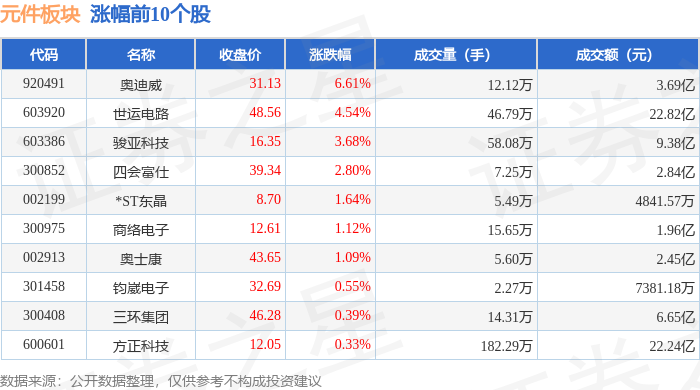
证券之星消息,12月30日元件板块较上一交易日下跌1.05%,高华科技领跌。当日上证指数报收于 3965.12,下跌0.0%。深证成指报收于13604.07,上涨0.49%。元件板块个股涨跌见下表: 从资金流向上来看,当日元件板块主力资金净流出31.69亿元,游资资金净流入8.24亿元,散户资金净流 入23.45亿元。元件板块个股资金流向见下表: | 代码 | 名称 | 主力净流入(元) | 主力净占比 游资净流入 (元) | | 游资净占比 散户净流入(元) | | 散户净占比 | | --- | --- | --- | --- | --- | --- | --- | --- | | 002384 | 东山精密 | 7866.56万 | 2.03% | -728.66万 | -0.19% | -7137.90万 | -1.84% | | 920491 | 圆迪威 | 5968.17万 | 16.19% | 291.62万 | 0.79% | -211.06万 | -0.57% | | 603920 | 世运电路 | 5067.86万 | 2.22% | -1.19亿 | -5.23% | 6875.01万 ...

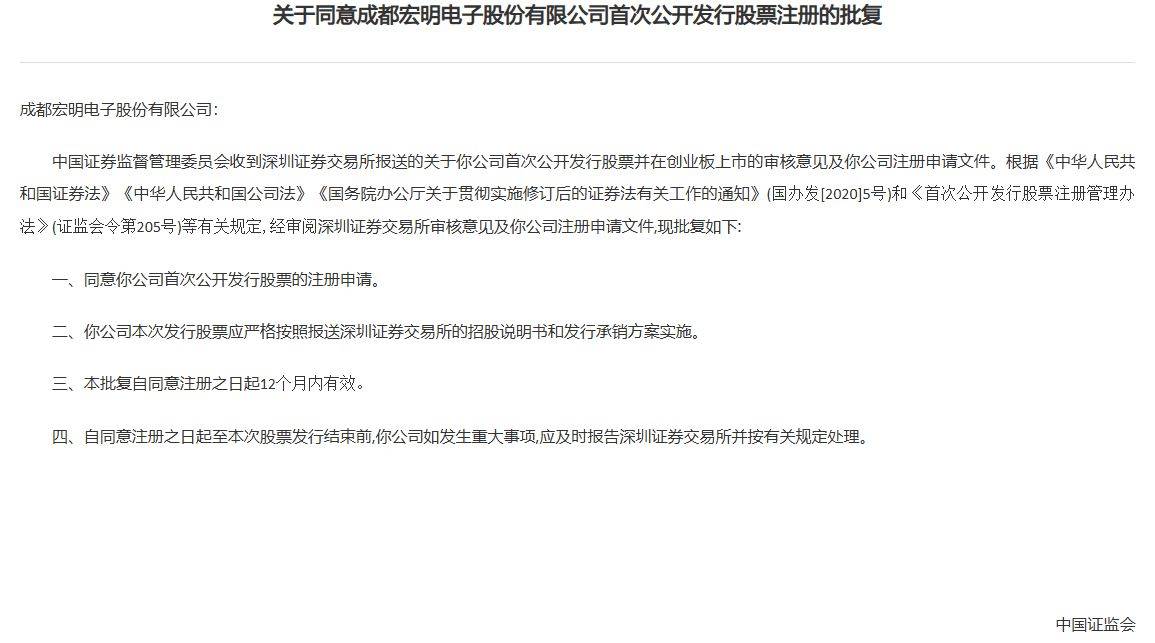
宏明电子创业板IPO获注册
Sou Hu Cai Jing· 2025-12-30 08:51
Core Viewpoint - The China Securities Regulatory Commission has approved the initial public offering registration of Chengdu Hongming Electronics Co., Ltd., indicating a significant step for the company in the capital market [1] Company Overview - Chengdu Hongming Electronics Co., Ltd. specializes in the research, production, and sales of new electronic components, primarily focusing on passive components such as capacitors and resistors, with applications in consumer electronics and automotive electronics [4] - The company has over 60 years of experience in electronic component manufacturing and possesses multiple proprietary core technologies, including multilayer ceramic capacitors (MLCC) and various types of capacitors and sensors [4][5] - Hongming Electronics is recognized for its full industry chain capabilities, from high-quality electronic materials to electronic components, and has achieved several domestic firsts in military-standard production lines [5] Market Position - The passive component industry in China holds approximately 44% of the global market share, with a high domestic market penetration in mid-to-low-end products, such as resistors with a domestic production rate of 85% [6] - However, the high-end market, particularly in automotive and aerospace sectors, remains dominated by Japanese manufacturers, with significant challenges in achieving competitive quality and technology [6][7] Industry Challenges - The industry faces high technical and certification barriers, particularly for high-end products that require rigorous reliability and lifespan standards [7] - Intense internal competition and profit pressures exist due to a concentration of domestic firms in the mid-to-low-end market, leading to a risk of structural oversupply [7] - Supply chain security and external uncertainties, such as fluctuations in raw material prices and international trade conditions, pose additional challenges [7] Future Directions - The industry is expected to focus on material innovation, technological upgrades, and supply chain restructuring, with an emphasis on self-sufficiency in materials and advancements in miniaturization and integration technologies [9] - The transition from "domestic substitution" to "domestic leadership" in the passive component sector is critical, requiring ongoing investment in foundational material research and high-end customer certification [9]

趋势研判!2026年中国电子陶瓷材料行业发展历程、行业政策、市场现状、竞争格局及发展趋势分析:随着下游新兴领域的快速发展,市场需求日益增长[图]
Chan Ye Xin Xi Wang· 2025-12-29 01:40
Core Viewpoint - The electronic ceramic materials industry is a vital and rapidly developing segment of specialty ceramics, characterized by its electrical, magnetic, optical, thermal, and mechanical properties, with significant applications in high-tech fields such as electronics, aerospace, and biotechnology. The market demand for high-performance electronic ceramic components is growing, driven by advancements in new energy vehicles, 5G/6G technologies, and aerospace applications. The global market for advanced electronic ceramic materials is projected to grow from 16.8 billion yuan in 2020 to 24.1 billion yuan by 2025, and further to approximately 27.4 billion yuan by 2026. The development of environmentally friendly electronic ceramic materials is becoming a research focus in developed countries, with China making notable advancements in this area, evidenced by over 200 patents filed from 2016 to 2024 [1][4][6]. Industry Definition and Classification - Electronic ceramic materials refer to a category of functional ceramics with electromagnetic capabilities, characterized by a wide bandgap that allows for adjustable dielectric and conductive properties. They can be classified into five categories based on their applications: insulating ceramics, capacitor ceramics, ferroelectric ceramics, semiconductor ceramics, and ionic ceramics [2][4]. Industry Development History - The electronic ceramic materials industry in China started relatively late with a weak technological foundation. However, it has experienced rapid growth in recent years, supported by national policies. The industry has transitioned from technology catch-up and scale expansion to a focus on high-quality development, with an emphasis on high-end material breakthroughs and the expansion of emerging application fields [2][3]. Current Industry Status - The electronic ceramic materials industry is experiencing fast growth, with its output accounting for approximately 70% of the total output value of specialty ceramics. The demand for high-performance electronic ceramic components is increasing due to the proliferation of applications in communications, computing, and digital technologies, particularly in new energy vehicles and high-end equipment [4][6]. Industry Chain - The electronic ceramic materials industry chain consists of four main segments: raw material supply, material preparation, device processing, and end-user applications. The upstream includes raw materials like alumina (Al₂O₃), aluminum nitride (AlN), and barium titanate (BaTiO₃), while the downstream focuses on the manufacturing of electronic components and applications in various sectors such as consumer electronics, automotive electronics, and aerospace [5][6]. Industry Development Environment - Relevant Policies - The electronic ceramic materials sector is supported by various national policies aimed at promoting its development, including the "2023-2024 Action Plan for Steady Growth in the Electronic Information Manufacturing Industry" and guidelines for accelerating the green transformation of manufacturing [6][7]. Major Companies - Key players in the electronic ceramic materials industry include domestic companies such as Zhongci Electronics, Sanhuan Group, Fenghua Hi-Tech, and Guoci Materials. These companies are enhancing their technological capabilities and gradually capturing market share in both mid-to-low-end and high-end segments [8][9].



电子行业周报:AI需求旺盛+上游原材料成本上升,覆铜板涨价有望持续-20251228
SINOLINK SECURITIES· 2025-12-28 11:19
Investment Rating - The industry is rated positively, with a focus on AI-PCB, core computing hardware, and the Apple supply chain, indicating a bullish outlook for the upcoming quarters [4][27]. Core Insights - The demand for AI is robust, leading to price increases in copper-clad laminates (CCL), with a projected continuous rise due to escalating copper prices and material shortages [1][4]. - The semiconductor industry, particularly DRAM and NAND Flash, is expected to see significant price increases and revenue growth, with DRAM average selling prices projected to rise by approximately 58% year-on-year by 2026 [1][27]. - Companies like Google, Amazon, Meta, OpenAI, and Microsoft are anticipated to experience explosive growth in ASIC demand from 2026 to 2027, driven by strong AI requirements [1][4]. Summary by Sections 1. AI Demand and CCL Pricing - The report highlights a strong demand for AI, which is driving up the technical requirements for CCL, with price increases already implemented by major manufacturers like 建滔积层板 [1]. - The report anticipates that the price increases will lead to performance improvements starting in Q4, with a sustained upward trend expected [4]. 2. Semiconductor Market Outlook - The semiconductor market is projected to grow significantly, with DRAM revenues expected to exceed $300 billion by 2026, and NAND Flash revenues reaching $110.5 billion [1]. - The report notes that the average price of NAND Flash is expected to increase by 32% year-on-year [1]. 3. AI Hardware and ASIC Growth - The report emphasizes the strong demand for AI hardware, particularly in the context of ASIC production, with major tech companies ramping up orders [1][4]. - The anticipated growth in ASIC demand is expected to benefit the entire AI hardware supply chain, with companies currently operating at full capacity [4]. 4. Industry Segmentation and Performance - The report categorizes various segments within the electronics industry, indicating a stable upward trend in consumer electronics, PCB, and semiconductor chips [4]. - Specific segments such as passive components and advanced packaging are also noted for their robust performance, driven by AI and other technological advancements [4][20]. 5. Company Performance and Projections - Companies like 思泉新材 and 三环集团 are highlighted for their strong revenue growth and profitability, driven by AI-related demand and product innovations [29][31]. - The report suggests that companies involved in the AI-PCB and semiconductor equipment sectors are well-positioned to benefit from the ongoing trends in AI and semiconductor demand [27][32].