
华为云

Search documents
长鑫存储完成首期上市辅导,罕见34人豪华团队护航
是说芯语· 2025-10-10 03:36
Core Viewpoint - Changxin Storage, as the only IDM enterprise in China to achieve mass production of general-purpose DRAM, is undergoing a highly anticipated capital process with significant backing from major financial institutions [3][4]. Group 1: Company Overview - Changxin Technology Group Co., Ltd. is preparing for its initial public offering (IPO) in China, with China International Capital Corporation (CICC) and CITIC Securities acting as advisory institutions [4]. - The company has achieved a breakthrough in DRAM chip production, with a yield rate exceeding 90% for its 19nm DRAM products, and has entered the supply chains of major clients like Huawei Cloud and Inspur [10]. Group 2: Advisory Team and Structure - The advisory team for the IPO consists of a rare 34-member group, with CICC contributing 18 members and CITIC Securities providing 16 members, including newly added core members to strengthen the team [3][5]. - The advisory process includes on-site investigations, video and phone meetings, and online consultations, focusing on regulatory compliance and corporate governance [5]. Group 3: Market Context and Future Prospects - The global storage chip market is entering a favorable cycle, with major players like Samsung and SK Hynix raising prices by 15%-30% this year, and the global market size expected to reach $189 billion in 2025, a 13% year-on-year increase [12]. - Changxin Storage's valuation reached approximately 139.98 billion yuan before investment, with a projected 50% increase in shipment volume by 2025, potentially raising its global market share from 6% to 8% [10][12]. - The company is expected to submit its IPO application by the end of 2025 or early 2026, which could position it as a significant player in the A-share semiconductor sector, akin to "China's Micron" [12].


2025年中国城市可信数据空间行业研究报告
艾瑞咨询· 2025-10-10 00:06
Core Viewpoint - The urban trusted data space is a key infrastructure led by the government to promote the development and utilization of urban data resources, serving as a bridge between data supply and application [1][2]. Development Drivers Policy - Since the introduction of the data element market reform in 2019, China has implemented a series of top-level designs and strategic plans to encourage the creation of urban trusted data spaces, with the first batch of 13 pilot cities announced [4][5]. Technology - Privacy computing and blockchain technology are crucial for solving data sharing issues, enabling data owners to share data confidently and willingly [5][6]. Demand - With China's data production expected to exceed 40ZB by 2024, the urban trusted data space is essential for enhancing urban governance efficiency by integrating and utilizing public data resources [8]. Value of Urban Trusted Data Space - The urban trusted data space aims to address issues such as the lack of trust mechanisms and inefficient data circulation, thereby enhancing urban governance and promoting the modernization of city management [11]. Overall Framework - The urban trusted data space is built around a foundational infrastructure, two major platforms, and capabilities for secure data circulation, enabling diverse applications such as government services and inclusive finance [13]. Core Capabilities - The core capabilities of the urban trusted data space include trusted control, resource interaction, and value co-creation, which are essential for establishing a reliable data circulation infrastructure [16]. Industry Chain and Players - The urban trusted data space involves five main entities: operators, data providers, data users, data service providers, and regulatory bodies, each playing a critical role in data circulation and compliance [21]. Competitive Analysis - In the technology service sector, comprehensive solution providers with ICT backgrounds, such as Inspur Cloud and Huawei Cloud, are leading the market, while specialized firms focus on specific verticals [24]. Application Scenarios Government Services - The urban trusted data space facilitates inter-departmental data sharing, enhancing government efficiency through initiatives like "one network for all services" [27]. Inclusive Finance - By integrating government public data with financial data, the urban trusted data space supports the development of dynamic risk assessment models, promoting inclusive finance [30]. Case Studies Zhangjiakou Trusted Data Space - The Zhangjiakou trusted data space employs a "one space, four platforms, one system" architecture to support secure data circulation and enhance public data utilization [33][35]. Shanghai Trusted Data Space - Shanghai's trusted data space, leveraging blockchain technology, aims to meet the complex data needs of a mega city, facilitating secure and efficient data flow [37][39]. Technical Trends - AI technology is becoming a key driver in enhancing data governance efficiency, transitioning from manual governance to automated and intelligent strategies [42]. Future Trends - The urban trusted data space is expected to evolve from pilot projects to a collaborative ecosystem, attracting industry and enterprise participation to explore vertical applications [44][45].

艾瑞咨询:2025年中国城市可信数据空间行业研究报告
Sou Hu Cai Jing· 2025-10-09 12:33
Core Viewpoint - The report emphasizes the significance of the urban trusted data space as a key infrastructure for data governance, driven by urbanization and digital transformation, facilitating secure and compliant data circulation for urban management and industrial empowerment [1][8]. Group 1: Development Background - The urban trusted data space is defined as a city-level infrastructure led by the government, primarily utilizing public data to break data circulation barriers and enhance urban governance [11][12]. - The development is supported by a series of national and local policies encouraging the establishment and pilot projects of trusted data spaces, aiming for large-scale implementation [13][20]. Group 2: Current Development Status - The urban trusted data space is built on a government cloud foundation, incorporating data circulation support systems and two main platforms for data management and utilization [28][30]. - The core capabilities include trusted control, resource interaction, and value co-creation, ensuring secure data flow and promoting interconnectivity and value transformation [35][36]. Group 3: Application Scenarios and Case Studies - In government services, the urban trusted data space facilitates cross-departmental data sharing, enabling integrated governance and service delivery [30][31]. - In inclusive finance, it merges government and financial data to create dynamic risk control models, addressing financing challenges for small and micro enterprises [30][31]. Group 4: Development Trends - Technological advancements, particularly AI, are expected to drive data governance towards automation, intelligence, and dynamism, enhancing governance efficiency [8][20]. - The development will follow a "pilot - demonstration - promotion" pathway, evolving from city-level trials to a nationwide integrated ecosystem, attracting industry and enterprise participation [8][20].

信创ETF(159537)涨近6%,DeepSeek-V3.2-Ex发布,国产云厂商day0适配
Mei Ri Jing Ji Xin Wen· 2025-10-09 03:28
Group 1 - DeepSeek officially released the DeepSeek-V3.2-Exp model on September 29, which is an experimental version aimed at optimizing training and inference efficiency for long texts [1] - The new model introduces DeepSeek Sparse Attention, a sparse attention mechanism, building on the previous V3.1-Terminus version [1] - The development of the new model utilized TileLang, an open-source AI operator programming language developed by a team led by Associate Professor Yang Zhi from Peking University [1] Group 2 - The 信创 ETF (159537) tracks the 国证信创指数 (CN5075), which selects listed companies in the semiconductor, software development, and computer equipment sectors from the Shanghai and Shenzhen markets [2] - The index focuses on reflecting the overall performance of the information technology innovation theme, with a significant emphasis on semiconductor and software development industries [2] - The average market capitalization of the index constituents is large, showcasing a diversified development pattern within the 信创 industry [2]


国投证券-计算机行业周报:海内外科技共振,看好AI产业趋势-251008
Xin Lang Cai Jing· 2025-10-08 15:58
Group 1: Chip Collaboration - OpenAI and AMD have signed a multi-billion dollar chip deal to co-develop AI data centers based on AMD processors [1] - OpenAI commits to purchasing AI chips worth 6 gigawatts based on multiple generations of AMD Instinct GPUs [1] - The partnership aims to deepen collaboration on hardware and software since the MI300X and MI350X series, starting with the MI450 series [1] Group 2: Model Development - DeepSeek has released the experimental model DeepSeek-V3.2-Exp, which introduces Sparse Attention for improved training and inference efficiency on long texts [2] - The model development utilized TileLang, an open-source AI operator programming language developed by a team from Peking University [2] - Huawei Cloud and Cambricon announced Day0 adaptation for DeepSeek-V3.2-Exp, supporting a maximum context length of 160K [2] Group 3: Application Advancements - OpenAI launched the next-generation video generation model Sora2, enhancing realistic video effects and adding audio generation capabilities [3] - The Dev Day event introduced several platform-level tools, including Apps SDK, Agent Kit, and Codex, aimed at creating a closed loop for development, distribution, and monetization [3] - Apps SDK allows developers to build interactive applications within ChatGPT, while Agent Kit focuses on backend development efficiency [3] Group 4: Investment Opportunities - Investment opportunities are suggested in areas such as AI computing power, applications, physical AI, AIGC, and anti-generative AI [4]

海内外科技共振,看好AI产业趋势算力侧:openAI与AMD签署数百亿美元芯片交易
Guotou Securities· 2025-10-08 15:15
Investment Rating - The report maintains an investment rating of "Outperform the Market - A" [6] Core Insights - The report highlights significant developments in the AI industry, including a multi-billion dollar chip deal between OpenAI and AMD, which aims to enhance AI data center capabilities [11][22] - The introduction of the DeepSeek-V3.2-Exp model marks a step towards next-generation architecture, optimizing long text training and inference efficiency [12][22] - OpenAI's release of the Sora2 video generation model and various platform-level tools further strengthens its ecosystem, allowing developers to create interactive applications within ChatGPT [13][22] Summary by Sections 1. Industry Insights - OpenAI and AMD have signed a chip deal worth hundreds of billions, with OpenAI committing to purchase AI chips valued at 6 gigawatts based on AMD's technology [11] - The partnership aims to deepen collaboration on multiple generations of hardware and software, starting with the AMD Instinct MI450 series [11] 2. Model Developments - The DeepSeek-V3.2-Exp model introduces a sparse attention mechanism, enhancing training and inference for long texts [12] - The model's development utilized TileLang, an open-source AI programming language, to optimize code generation [12] 3. Application Advancements - OpenAI's Sora2 model improves video realism and adds audio generation capabilities, allowing users to create personalized video content [13] - The launch of the Apps SDK and Agent Kit during OpenAI's Dev Day enhances the development of interactive applications and AI agents [13] 4. Investment Opportunities - The report suggests focusing on investment opportunities in AI computing, applications, physical AI, AIGC, and anti-generative AI sectors [14] - Specific areas of interest include chips, servers, data centers, and various B-end applications [14]
AI云市场“暗战”机场广告牌
Bei Ke Cai Jing· 2025-10-05 13:29
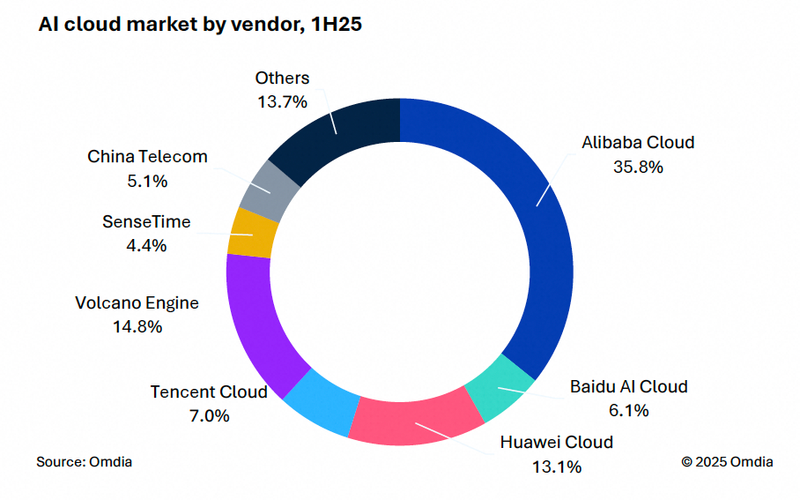
Core Insights - The AI cloud market in China is experiencing rapid growth, with significant increases in advertising from major cloud service providers at airports in major cities [1][2] - Reports from Omdia and IDC predict substantial growth in the AI cloud market, with Omdia forecasting a 148% increase by 2025 and IDC reporting a nearly 400% growth in model usage [1][8] Market Overview - The AI cloud market in China is projected to reach 22.3 billion yuan by the first half of 2025, with Alibaba Cloud holding a 35.8% market share, followed by Volcano Engine at 14.8% and Huawei Cloud at 13.1% [5][6] - IDC's report indicates that the market size for AI cloud services will reach 536.7 trillion tokens in the first half of 2025, with Volcano Engine leading at 49.2% market share [8] Competitive Landscape - Alibaba Cloud is recognized as the largest cloud service provider in China, leveraging its extensive customer base and continuous investment in AI [9] - Volcano Engine, a newer entrant, has rapidly gained market share, driven by its popular platforms and the success of its models [9][10] Growth Drivers - The introduction of DeepSeek's models has triggered a price war among major cloud providers, significantly reducing costs and increasing market accessibility [10][11] - The rapid growth of the MaaS (Model as a Service) segment is attributed to the competitive pricing and enhanced capabilities of AI models [10][11] Future Projections - IDC predicts that the market for generative AI software in China will reach 48.24 billion yuan by 2028, indicating substantial growth potential [13] - Omdia forecasts a compound annual growth rate (CAGR) of 26.8% for the AI cloud market from 2025 to 2030, with the MaaS segment expected to grow at a CAGR exceeding 72% [13]
2025年中国基础云服务行业数据报告
艾瑞咨询· 2025-10-04 00:06
Core Insights - The overall cloud service market in China is projected to reach 544.54 billion yuan in 2024, with a growth rate of 15%. The rapid development of artificial intelligence is driving upgrades in cloud infrastructure and capability platforms, which are key factors for market growth [1][8]. Market Overview - The IaaS market in China is expected to grow to 371.86 billion yuan in 2024, with a growth rate of 19.1%. The PaaS market is projected to reach 101.86 billion yuan, growing at 35.8% [11]. - The public cloud service market is anticipated to reach 387.87 billion yuan in 2024, with an 18% growth rate. The non-public cloud service market is expected to be 163.58 billion yuan, growing at 11.2% [13][16]. Market Characteristics - AI has become a focal point for cloud service industry construction and business layout. Participants are expanding investments in intelligent computing infrastructure and improving AI development tools [8]. - The public cloud service market is experiencing new opportunities due to the rapid development of AI, with comprehensive cloud vendors focusing on "intelligence" to build intelligent computing infrastructure [13]. Competitive Landscape - In the public cloud IaaS market, Alibaba Cloud, Huawei Cloud, and Tianyi Cloud rank as the top three, with Tencent Cloud and Mobile Cloud tied for fourth place, and Amazon Web Services in fifth [19]. - Operator-backed cloud vendors are enhancing their competitiveness by improving infrastructure and investing in AI, while internet-based cloud vendors are focusing on business streamlining and capability concentration to alleviate competitive pressure [19]. Development Trends - The cloud computing sector is expected to continue providing foundational resources and platform tools to support AI industry development, while also deepening the integration of cloud and intelligence [8]. - The PaaS market is entering a critical technological transition period, with AI reshaping technical architecture and development processes [11]. Industry Implications - The integration of AI into traditional industries is creating potential opportunities in the non-public cloud market, as businesses seek cost-effective and adaptable deployment methods [16]. - The current AI applications are primarily concentrated in the internet sector, but there is potential for traditional enterprise clients to upgrade their cloud capabilities through AI [21].

海南西部国际数据一站通服务中心揭牌成立
Zhong Guo Xin Wen Wang· 2025-09-29 13:55
Group 1 - The Hainan Western International Data One-Stop Service Center was inaugurated to provide comprehensive services for enterprises, marking a significant step in building a "data economy ecosystem" in Danzhou [1] - Danzhou has a solid foundation for digital economy development, with the Yangpu Digital Free Trade Zone being the first of its kind in the country, and the leading enterprise Aiheng Shuchan playing a crucial role in the construction of the data factor market system [1] - By April 2025, Danzhou has signed 24 projects with a total investment of 314.33 billion yuan, of which 7 digital economy projects account for 74.85% of the total investment [1] Group 2 - The Runze Free Trade Port International Information Port project in Danzhou is set to be completed by 2026, providing high-performance computing resources for complex model training [2] - Danzhou's industrial foundation supports the development of cross-border data flow and green computing industries, with clean energy projects providing stable power for computing infrastructure [2] - The establishment of an international internet data dedicated channel in Yangpu enhances cross-border data transmission efficiency [2] Group 3 - Danzhou has signed strategic cooperation agreements with multiple enterprises to promote digital economy development and infrastructure upgrades, with total investments exceeding 5 billion yuan [3] - The "Hainan Digital Nomad Hub" and "Yangpu Bay Digital Nomad Community Demonstration Point" were officially launched to provide one-stop solutions for global digital nomads [3]
2025年中国智算云服务行业:人工智能时代下IaaS/PaaS/SaaS的产业机遇
Tou Bao Yan Jiu Yuan· 2025-09-29 12:44
Investment Rating - The report does not explicitly state an investment rating for the industry Core Insights - The rapid development of large model technology is fundamentally transforming the global computing paradigm, with a shift from traditional CPU cloud computing to GPU-centric intelligent computing [3] - The cloud service industry's value chain is being reshaped, with profound changes in the business logic, commercial models, and competitive factors across IaaS, PaaS, and SaaS layers [3] - The industry is transitioning from a "compute-first" approach to building model ecosystems and commercializing applications, with a significant application explosion expected around 2025 [16][19] Summary by Sections Industry Overview - The intelligent computing industry has formed a four-layer structure: hardware, cloud, model, and application, currently transitioning from "compute-first" to "model ecosystem building" and "application commercialization" [10][16] - The industry value transfer trend indicates a shift from heavy investment in infrastructure to a focus on model ecosystem construction and the commercialization of industry-specific agents [19] IaaS Layer Opportunities - The core value of the IaaS layer lies in selling GPU computing power, with high-end card retention and vertical industry capability construction being key to capturing high-value clients [30][33] - Major clients include internet giants, government enterprises, and AI-driven emerging industries, all of which have significant demand for GPU computing power [31] - The growth path for IaaS involves selling bundled solutions of IaaS, PaaS, and MaaS to industry clients, enhancing customer stickiness and increasing average transaction value [36] PaaS Layer Opportunities - MaaS is becoming the core revenue entry point for cloud vendors, with those possessing self-research capabilities needing to adopt a dual strategy of open and closed source to lock in customers [41][42] - The success of MaaS hinges on the ability to provide a rich model marketplace and a comprehensive toolchain for clients, driving resource consumption in IaaS and PaaS layers [42][44] SaaS Layer Opportunities - The SaaS market is shifting towards deep vertical integration, where the ability to build industry-specific products is crucial for customer retention [52][55] - Large cloud vendors face challenges from smaller firms that leverage low prices and localized services to capture market segments that larger companies cannot reach [55] - Effective strategies for entering the SaaS market include "soft-hard integration" and building Agent platforms to transform from direct competitors to value integrators and ecosystem enablers [57][59]