
国星宇航

Search documents
中信证券:我国航天产业已进入发展“快车道” 相关产业链迎发展契机
智通财经网· 2025-11-29 11:24
Core Viewpoint - The Chinese aerospace industry is entering a rapid development phase, with significant opportunities arising from the commercialization of space and advancements in space computing power [1][2]. Group 1: Industry Development - China's aerospace sector is experiencing a transformation with the launch of large-scale projects like China Star Network and the G60 Qianfan Constellation [1]. - The establishment of commercial launch sites and rockets is leading to a trend of high capacity and low cost in commercial space endeavors [1]. - A trillion-dollar market is emerging, presenting substantial growth opportunities for the related industrial chain [1]. Group 2: Space Computing Power - Beijing plans to construct a GW-level space computing power system in low Earth orbit, aiming to transfer large-scale AI computing to space [2]. - The construction of the data center will occur in three phases, with the first phase focusing on key technology breakthroughs and the launch of trial satellites by 2025-2027 [2]. - The second phase will aim to reduce construction and operational costs, while the third phase will involve mass production and deployment of satellites by 2031-2035 [2]. Group 3: Energy Efficiency and Cost Reduction - Space data centers can achieve a Power Usage Effectiveness (PUE) close to 1, significantly reducing energy consumption compared to ground data centers, which typically have a PUE around 1.4 [3]. - Space solar power stations can generate electricity for over 8000 hours annually, further lowering energy costs [3]. - The integration of space data centers with solar power stations and high-energy laser transmission is seen as a new trend in AI development [3]. Group 4: Competitive Landscape - The dawn-dusk orbit is a critical resource for space computing, with intense competition among major powers for satellite frequency and orbital resources [4]. - The competition for these resources is expected to accelerate the development of China's space computing capabilities [4]. Group 5: Market Opportunities - Major tech companies, including those in the U.S., are actively investing in space computing technologies, indicating a growing market for solar cells and laser modules [5]. - The successful launch of the "Three-body Computing Constellation" by a domestic lab marks a significant milestone in space computing [5]. - The demand for solar cells and upgraded laser modules is anticipated to rise as the space computing industry expands [5].

马斯克画的上天大饼,中国人已经在做了
3 6 Ke· 2025-11-25 01:45
Core Insights - Elon Musk's ambitious plan to build AI data centers in space is gaining traction, with China already making significant advancements in this area [1][27] - The competition for computational power in AI is intensifying, with major tech companies investing heavily in data center infrastructure [7][14] Group 1: Space Data Centers - Musk's vision includes launching AI satellites to create a space-based data center, which could provide energy and computational power far exceeding Earth's capabilities [11][13] - The proposed space data centers would utilize solar energy, taking advantage of the higher efficiency of solar panels in space compared to Earth [11][17] - The cooling challenges faced by terrestrial data centers could be mitigated in space due to the extreme cold of the environment, allowing for more efficient heat dissipation [12][22] Group 2: Investment and Infrastructure - Major tech companies, including Amazon and Google, are exploring similar concepts for space data centers, indicating a broader industry trend towards off-Earth computational solutions [14][16] - Amazon's Project Kuiper and Google's Project Suncatcher are examples of initiatives aimed at integrating AI capabilities with space infrastructure [14][16] - The estimated capital expenditure for AI infrastructure by major tech firms in the next few years is projected to reach $1.2 trillion [7] Group 3: Challenges and Considerations - The primary challenge for space data centers is the high cost of launching equipment into space, which needs to be reduced significantly for the concept to be economically viable [25][27] - Concerns regarding the maintenance and upgrade of hardware in space, as well as protection against cosmic radiation, are significant hurdles that need to be addressed [22][23] - The timeline for achieving operational space data centers is debated, with some experts suggesting it may take a decade or more to become feasible [23][25] Group 4: China's Advancements - China has already launched its "Star Computing Plan," which includes a constellation of satellites designed for computational tasks, demonstrating a proactive approach in the space computing race [27] - The first satellite constellation launched by China includes 12 satellites capable of processing data in orbit, showcasing the potential for advanced computational capabilities in space [27]



马斯克画的上天大饼 中国人已经在做了
Xin Lang Ke Ji· 2025-11-25 01:23
Core Insights - Elon Musk's ambitious plan to build AI data centers in space reflects a significant shift in the competition for computational power, with China already making strides in this area [1][27] - The demand for AI infrastructure is driving massive investments from tech giants, with projected capital expenditures reaching $1.2 trillion over the next three to five years [6][9] Group 1: Space Data Centers - Musk's proposal includes launching AI satellites to create a space-based data center, which he claims could generate 100 GW of solar energy annually, equivalent to a quarter of the average annual electricity consumption in the U.S. [12][13] - The efficiency of solar energy in space is significantly higher than on Earth, with solar radiation intensity being 1.36 times greater in orbit [10] - The cooling requirements for data centers in space can be met more efficiently due to the extreme cold of space, allowing for effective heat dissipation without traditional cooling systems [11][12] Group 2: Investment and Infrastructure - Major tech companies are investing heavily in AI infrastructure, with a total projected investment of $6.7 trillion in data centers by 2030, driven largely by AI workloads [6][9] - Musk's xAI is collaborating with Saudi Arabia to build a $25 billion data center with a capacity of 500 MW, surpassing the capacity of xAI's existing center in Tennessee [6][7] Group 3: Challenges and Considerations - The primary challenge for space data centers is the cost of launching equipment into space, with current costs around $1,400 per kilogram, although future projections suggest this could drop to between $67 and $100 per kilogram [24][25] - Concerns about cosmic radiation and the harsh environment of space necessitate robust engineering solutions to protect sensitive equipment [21][22] Group 4: Competitive Landscape - Other tech giants, such as Amazon and Google, are also exploring space-based data centers, with Amazon's Blue Origin and Google's Project Suncatcher aiming to leverage solar energy in space for AI processing [14][16] - China's advancements in space computing, including the launch of a satellite constellation for computational tasks, indicate that the race for space-based AI infrastructure is intensifying [27]
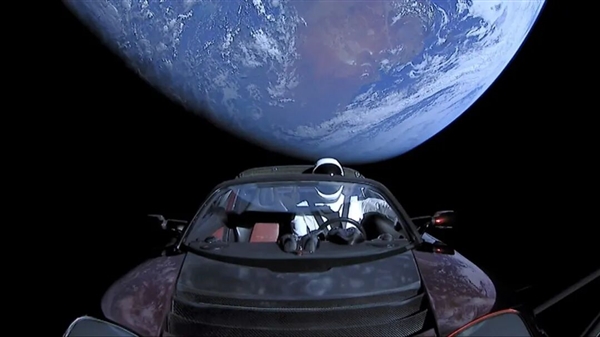
马斯克画的上天大饼,中国人已经在做了|硅谷观察
Xin Lang Ke Ji· 2025-11-24 23:52
Core Viewpoint - Elon Musk's ambitious plans for space-based AI data centers highlight a competitive landscape where companies are racing to establish advanced computing capabilities beyond Earth, with China already making significant strides in this area [2][28]. Group 1: Space-Based AI Data Centers - Musk's vision includes launching AI satellites to create a super AI data center in space, with plans to deploy these satellites within five years [6][14]. - The energy demands of data centers are driving the need for innovative solutions, with Musk's proposed space-based centers potentially offering superior energy efficiency compared to terrestrial options [12][26]. - The operational costs of space data centers could be significantly lower than those on Earth, with estimates suggesting they could be one-tenth of terrestrial data center costs [26]. Group 2: Competitive Landscape - Major tech companies like Amazon and Google are exploring similar concepts, with Amazon's Blue Origin and Google's Project Suncatcher aiming to establish space-based data processing capabilities [15][18]. - The competition is intensifying, as various companies are investing in technologies to reduce launch costs and improve the feasibility of space data centers [26][20]. - China's advancements in space computing, including the launch of a satellite constellation for on-orbit processing, position it as a frontrunner in this emerging field [29][30]. Group 3: Technical Challenges and Innovations - The construction of space data centers faces significant technical challenges, including radiation protection and the need for robust hardware capable of withstanding harsh space conditions [23][24]. - Innovative cooling solutions, such as radiative cooling in the vacuum of space, could address some of the limitations faced by terrestrial data centers [13][12]. - The successful deployment of AI satellites will depend on advancements in chip production and the ability to transport necessary equipment to space efficiently [14][26].
陕西华达(301517.SZ):与国星宇航尚无直接业务往来
Ge Long Hui· 2025-11-20 07:10
Core Viewpoint - Shaanxi Huada (301517.SZ) is providing supporting products for commercial aerospace through direct or indirect means, and there is currently no direct business relationship with Guoxing Aerospace [1] Company Summary - Shaanxi Huada is involved in the commercial aerospace sector by supplying supporting products [1] - The company has clarified that it does not have any direct business dealings with Guoxing Aerospace at this time [1]
陕西华达:与国星宇航尚无直接业务往来
Ge Long Hui· 2025-11-20 07:05
Group 1 - The company, Shaanxi Huada (301517.SZ), provides supporting products for commercial aerospace through direct or indirect means [1] - There is currently no direct business relationship between the company and Guoxing Aerospace [1]
降维打击,把数据中心建在太空,马斯克高调宣布,中国公司悄然亮剑,无需冷却也不缺能源!
Sou Hu Cai Jing· 2025-11-18 13:50
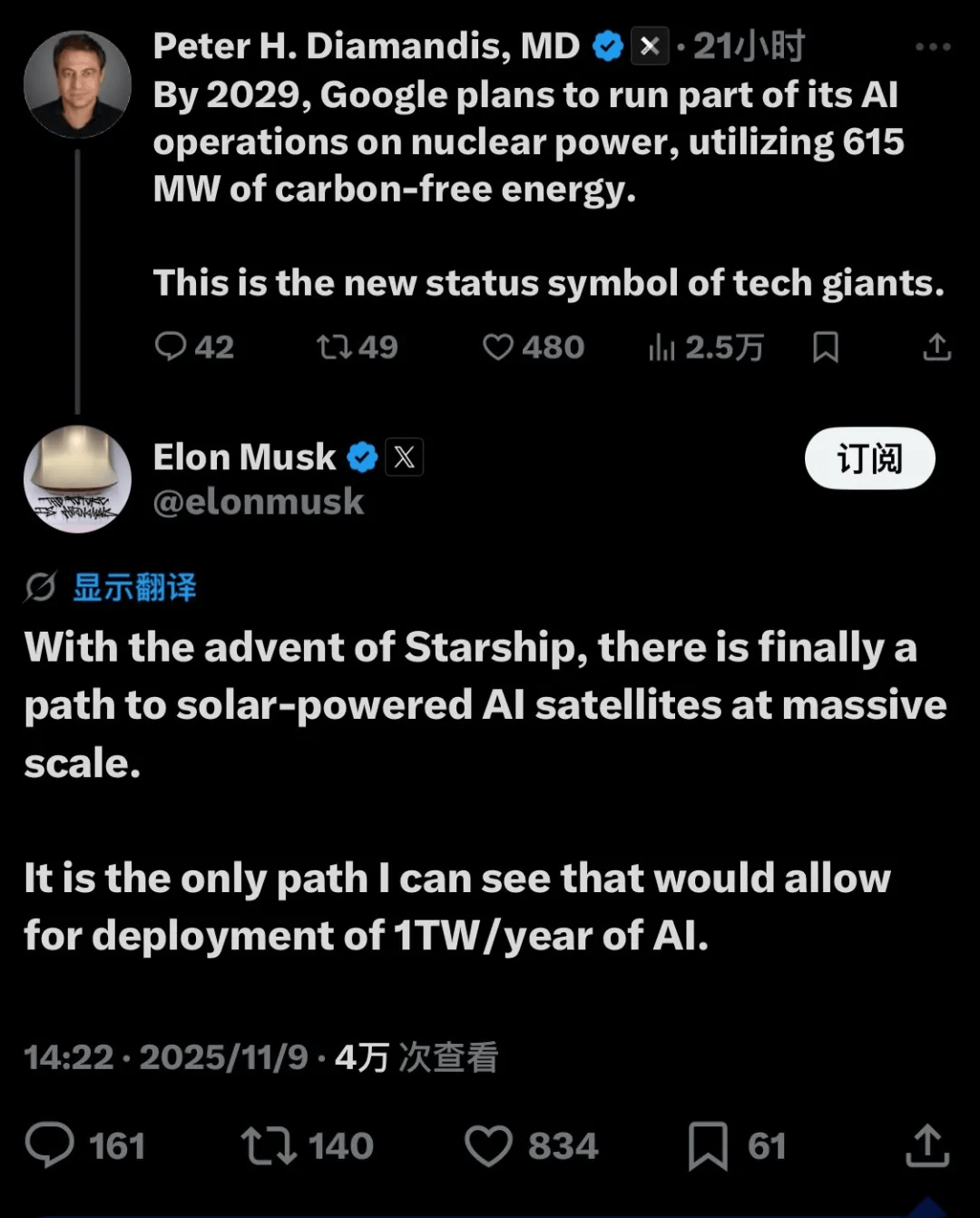
Group 1 - Elon Musk stated that the advent of Starship opens the path for large-scale deployment of solar-powered AI satellites, which he believes is the only way to achieve 1 terawatt (1TW) of AI computing power annually [1] - The energy supply shortage is a critical bottleneck for AI data center construction, with FTI Consulting predicting that energy demand for data centers in the U.S. will nearly double by 2027 [3] - The construction of data centers in space is becoming a viable option for many Silicon Valley tech companies due to power limitations on Earth [4] Group 2 - StarCloud successfully launched a satellite equipped with NVIDIA H100 chips and Google Gemini models, which will provide 100 times the GPU computing power compared to previous space computing facilities [4] - StarCloud plans to build a 5-gigawatt orbital data center powered by large solar and cooling battery panels, which will not require water for cooling or rely on batteries [4] - Google is considering a project named "Project Suncatcher" to establish the first space data center, planning to launch prototype satellites by 2027 in collaboration with Planet [5] Group 3 - The first space computing satellite constellation was successfully launched by Guoxing Aerospace and Zhijiang Laboratory, consisting of 12 satellites capable of processing data in orbit [7] - The U.S. has launched over 10,000 satellites, with significant contributions to the ongoing conflict in Ukraine, and there are expectations for accelerated launch progress in China in the coming years [7]
数据中心加速迈向太空
Ke Ji Ri Bao· 2025-11-17 00:08
Core Insights - The rapid development of artificial intelligence (AI) is driving a surge in global data center demand, which poses significant energy consumption and carbon emission challenges [1] - Companies are exploring the deployment of data centers in space to overcome land use restrictions and utilize solar energy more efficiently [1][2] Group 1: Advantages of Space Data Centers - Space data centers can harness solar energy directly from outside the atmosphere, providing a continuous and clean power source [2] - A feasibility study funded by the European Commission indicates that space data centers could reshape Europe's digital landscape and offer sustainable data solutions, potentially yielding billions of euros in investment returns by 2050 [2] - These facilities do not require water for cooling, avoiding common land acquisition and regulatory challenges faced by terrestrial data centers [2] Group 2: Industry Developments - Various companies are actively developing space data centers, including Lonestar Data Assets, which tested a small data center on the Moon, and SpaceX, which launched a satellite for Starcloud equipped with NVIDIA H100 GPUs [3] - China's Guoxing Aerospace and Zhijiang Laboratory launched a satellite constellation specifically for space computing, aiming to deploy 2,800 satellites for a global integrated computing network [3] - Google is working on satellites equipped with proprietary chips to create a scalable computing network in space, with prototype testing planned for early 2027 [3] Group 3: Challenges Ahead - Key challenges for space data centers include managing heat dissipation in a vacuum and ensuring chip stability in high-radiation environments [4] - Concerns about space debris accumulation and the potential for collisions pose risks to space-based infrastructure [5] - The high cost of launching servers into orbit remains a significant barrier, although advancements in reusable rocket technology, such as SpaceX's Starship, are expected to reduce costs substantially [5]


中国抢滩390亿太空算力市场
21世纪经济报道· 2025-11-13 14:51
Core Viewpoint - The article discusses the emerging trend of space computing driven by the increasing demand for AI computational power, highlighting initiatives by major tech companies to establish data centers in space to address the limitations of terrestrial data centers [1][4][20]. Group 1: Space Computing Initiatives - Nvidia launched its H100 GPU into space on November 2, marking the first instance of a data center-grade GPU being sent to low Earth orbit [2][8]. - Elon Musk announced plans to expand the Starlink V3 satellite network to build space data centers, aiming for a deployment of 100 GW of data centers annually within 4-5 years [2][9]. - Google initiated the "Project Suncatcher," planning to launch two prototype satellites equipped with TPU chips by early 2027 to deploy AI computing directly in space [2][10]. Group 2: Advantages of Space Computing - Space offers unique environmental advantages, such as solar panels receiving eight times more solar energy than those on Earth, which can alleviate the pressure on terrestrial resources [6][4]. - In-orbit computing can process vast amounts of data generated by satellites, significantly reducing the time required to transmit valuable data back to Earth from hours to seconds [6][7]. Group 3: Market Potential - The market for in-orbit data centers is projected to reach $39 billion by 2035, with a compound annual growth rate of 67.4%, indicating a significant opportunity for the space economy [6][14]. - The Chinese commercial space industry is expected to grow from approximately 1 trillion yuan in 2020 to 2.3 trillion yuan by 2024, with a projected value of around 8 trillion yuan by 2029 [15]. Group 4: Technological Challenges - The development of space computing faces challenges such as high radiation levels affecting chip reliability and the need for effective thermal management in the vacuum of space [19][18]. - The economic feasibility of space computing hinges on reducing launch costs to around $200 per kilogram, which could make the annualized launch power costs comparable to current terrestrial data center electricity costs [18][19]. Group 5: Strategic Positioning - Companies like Guoxing Aerospace are positioning themselves as full-chain participants in the space computing industry, focusing on satellite manufacturing and advanced AI-driven data analysis services [11][15]. - The article emphasizes the potential for Chinese companies to leverage the nascent nature of the space computing sector to overcome existing technological limitations in terrestrial data centers [20].
中国太空算力进击
2 1 Shi Ji Jing Ji Bao Dao· 2025-11-13 12:15
Core Viewpoint - The rise of space computing is driven by the increasing demand for AI computing power, with major tech companies like NVIDIA, Google, and Chinese firms investing in space data centers to address the limitations of terrestrial data centers [1][3][5]. Group 1: Space Computing Initiatives - NVIDIA launched its H100 GPU into space, marking the first instance of a data center-grade GPU being sent to low Earth orbit [5]. - Elon Musk announced plans to expand the Starlink V3 satellite network to build space data centers, aiming for a deployment of 100GW of data centers annually within 4-5 years [2]. - Google initiated the "Project Suncatcher," planning to launch two prototype satellites equipped with TPU chips by early 2027 to deploy AI computing directly in space [2][6]. Group 2: Advantages of Space Computing - Space offers unique environmental advantages for solar energy collection, with solar panels in space receiving eight times more energy than those on Earth [3]. - In-orbit computing can process vast amounts of data generated by satellites, significantly reducing the time needed to transmit valuable data back to Earth from hours to seconds [3][8]. - The market for in-orbit data centers is projected to reach $39 billion by 2035, with a compound annual growth rate of 67.4% [4]. Group 3: China's Role in Space Computing - China is actively participating in the space computing race, with the launch of the "zero-carbon space computing center" recognized at the World Internet Conference [2]. - The Chengdu Guoxing Aerospace Technology Co. has developed AI satellites with a total in-orbit computing capability of 5POPS, aiming to create a distributed computing network in space [7][10]. - The Chinese commercial space industry is expected to grow from approximately 1 trillion yuan in 2020 to 2.3 trillion yuan by 2024, with a projected value of around 8 trillion yuan by 2029 [10]. Group 4: Challenges and Future Prospects - Despite the potential, space computing faces significant challenges, including high launch costs and the need for advanced thermal management systems in the vacuum of space [13][14]. - The industry is expected to evolve, with advancements in technology potentially overcoming current limitations, making space computing a vital component of AI infrastructure within 5-10 years [11][15]. - The competitive landscape remains fluid, providing opportunities for Chinese companies to innovate and establish a foothold in this emerging sector [15].