
广汽

Search documents
畅谈Robotaxi和机器人配送小车
2025-05-27 15:28
Summary of Key Points from the Conference Call Company Overview - The document discusses the company Xiaoma Zhixing, which is set to go public in November 2024 with an IPO valuation of approximately $4.2 billion, lower than the pre-IPO valuation of $9 billion. Post-IPO, the stock price rebounded, indicating market interest in the company [1][5]. Industry Insights - Xiaoma Zhixing's revenue is expected to be predominantly from its Robotaxi business, projected to account for 80% of total revenue by 2028. Currently, the main revenue source is technology licensing, including sales of domain controllers and autonomous driving technology to companies like Meituan and Cainiao [1][5]. - The company showcased its seventh-generation Robotaxi, which has reduced operational costs by 70% and is collaborating with local automakers like BAIC and GAC to lower vehicle prices [1][6]. Financial Projections - The average Gross Merchandise Value (GMV) per Robotaxi is currently around several hundred thousand RMB annually, with expectations to exceed 200,000 RMB in the future. The company anticipates achieving group-level breakeven between 2028 and 2029, with single-vehicle breakeven expected by late 2025 to early 2026. By 2030, gross margins are projected to exceed 50%, with net margins reaching over 20% [3][20]. Technological Advancements - Xiaoma Zhixing possesses L4 level autonomous driving technology, which is a significant competitive advantage. The company collaborates with platforms like Gaode, Tencent, and Lichi to secure customer acquisition channels [1][7]. - The document outlines the complexity of autonomous driving applications, categorizing them into four scenarios: closed cargo, closed passenger, open cargo, and open passenger, with the latter being the most challenging [4]. Competitive Landscape - Key competitors include WeRide, Waymo, and various domestic and international automakers such as XPeng, Xiaomi, Huawei, and Tesla. While these competitors have technical capabilities, they are still catching up to L4 level autonomous driving technology [8]. Market Dynamics - The autonomous driving ecosystem is heavily reliant on technology, partnerships with ride-hailing platforms, and collaborations with automakers. Team stability is also crucial for maintaining operational efficiency and technological advancement [9]. Future Outlook - The document highlights the potential for autonomous delivery systems, particularly in low-density areas abroad and high-density areas domestically, indicating a growing market for such technologies [22]. - The differences between Robotaxi and autonomous delivery vehicles are noted, with Robotaxi companies providing both technical and hardware support, while delivery vehicles are easier to commercialize due to simpler operational scenarios [23]. Valuation Methods - Various valuation methods are discussed, including Price-to-Sales (PS), Price-to-Earnings (PE), and Discounted Cash Flow (DCF) approaches, with conservative estimates suggesting significant future valuation potential [21]. Conclusion - Xiaoma Zhixing is positioned to capitalize on the growing demand for autonomous driving solutions, with a strong focus on technology development and strategic partnerships, while navigating a competitive landscape that includes both domestic and international players.

小马智行(PONY.US):Robotaxi收入大增200%, L4级自动驾驶量产破局者浮出水面
智通财经网· 2025-05-21 07:18
Core Viewpoint - Pony.ai is leveraging its core Robotaxi business to drive scalable commercial deployment, as evidenced by its Q1 2025 financial results showing significant growth in revenue and user base [1][2]. Financial Performance - In Q1 2025, Pony.ai reported total revenue of 102 million RMB, a year-on-year increase of 12% [1]. - The Robotaxi business generated revenue of 12.3 million RMB, marking a substantial year-on-year growth of 200%, with passenger fare revenue increasing by 800% [1][2]. Business Expansion - The commercial operation of Robotaxi has expanded to major cities including Beijing, Shanghai, Guangzhou, and Shenzhen, covering over 2,000 square kilometers, which is 20 times the area of San Francisco [1]. - The user base for Robotaxi services grew by over 20% quarter-on-quarter, indicating effective operational strategies [1]. Technological Advancements - Pony.ai's seventh-generation Robotaxi features significant cost reductions, with hardware costs decreasing by 70% and the cost of onboard computing units dropping by 80% [2]. - The new L4 autonomous driving system utilizes automotive-grade components, ensuring reliability and durability with a lifespan of 10 years or 600,000 kilometers [2][3]. Safety and Reliability - The L4 fleet has accumulated 500,000 hours of fully autonomous driving operation, demonstrating a safety level 10 times higher than human drivers [3]. - The system includes over 20 redundancy designs to enhance fault tolerance, ensuring stable operation [3]. Production and Partnerships - Pony.ai aims to expand its Robotaxi fleet to 1,000 vehicles by the end of 2025, supported by collaborations with Toyota, BAIC, and GAC to reduce marginal costs through pre-production models [3][4]. - A joint venture with Toyota and GAC has been established with an investment of 1 billion RMB to develop the first seventh-generation Robotaxi model [4]. International Strategy - Pony.ai is pursuing an international strategy, having formed a global partnership with Uber to launch services in the Middle East, leveraging Uber's 60 million monthly active users [5]. - The company has also established collaborations with various domestic and international ride-hailing services to create a diversified commercial ecosystem [5]. Future Outlook - With the mass production of the seventh-generation Robotaxi and the expansion of the fleet, Pony.ai is positioned to further reduce costs and enhance service quality, solidifying its leadership in the autonomous driving sector [5].
纳思达:极海在人形机器人芯片布局上相对完善 已和宇树等工控领域大客户合作
news flash· 2025-05-09 13:09
Core Insights - Nasda (002180) reported on May 9 that its subsidiary, Jihai, has a well-established layout in humanoid robot chips [1] - Jihai's products in perception and execution components, such as ultrasonic radar chips and the first high-performance real-time control DSP chip based on the Arm Cortex-M52 processor, are applicable in both automotive and robotics sectors [1] - The company has achieved domestic substitution for various chips, including joint control and drive chips, encoder chips, cerebellum computing chips, BMS management MCUs, communication management, and power management MCUs [1] - Jihai has established partnerships with major automotive manufacturers like GAC and FAW, as well as several leading Tier 1 suppliers and key clients in the industrial control sector, such as Huichuan and Yushu [1]

孚能科技2024年营收116.8亿元大幅减亏,毛利率稳步提升
Jing Ji Guan Cha Wang· 2025-05-09 01:05
Core Viewpoint - Company Fudi Technology (孚能科技) has significantly reduced its losses in 2024, achieving a revenue of 11.68 billion yuan and a net loss of 0.332 billion yuan, marking an 82.22% reduction in losses year-on-year. The company is positioned as a leader in the global soft-pack power battery market and is set to benefit from a strategic partnership with Guangzhou Industrial Control Group, enhancing its capital strength and business expansion capabilities [1][2][5]. Financial Performance - In 2024, Fudi Technology's revenue reached 11.68 billion yuan, with a net loss of 0.332 billion yuan, reflecting an 82.22% reduction in losses compared to the previous year. The first quarter of 2025 shows a further narrowing of losses [1][2]. - The company reported a significant improvement in key financial metrics, with basic and diluted earnings per share losses narrowing by 82.35%, and cash flow from operating activities increasing by 36.86% year-on-year [2][3]. Product Development - Fudi Technology launched its SPS large soft-pack product in 2024, which features a high-integration battery system that enhances vehicle space efficiency while ensuring safety [3][7]. - The company has developed a super-fast charging lithium iron phosphate (LFP) battery capable of over 6C charging and more than 5000 cycles, suitable for various applications including PHEV and BEV [3][7]. Market Expansion - Over half of Fudi Technology's revenue comes from international clients, with significant partnerships established with companies like Mercedes-Benz and Mahindra Group. The company ranked third in China for power battery exports in 2024 [4][5]. - The establishment of a 6GWh production line in Turkey by Fudi's joint venture Siro supports its international operations and market expansion efforts [4][5]. Strategic Partnership - The acquisition of a controlling stake by Guangzhou Industrial Control Group is expected to enhance Fudi Technology's capital strength and facilitate collaboration within the local automotive supply chain, particularly with GAC Group [5][6]. - Guangzhou Industrial Control Group aims to leverage its resources to support Fudi Technology's growth in the low-altitude economy and enhance its financing capabilities [6][7]. Future Outlook - Fudi Technology is advancing its semi-solid and solid-state battery technologies, with plans to start mass production of its second-generation semi-solid battery in 2025 and to commercialize solid-state batteries in the coming years [7]. - The company anticipates that new capacity releases and product innovations in the next three years will significantly enhance its market position and growth trajectory [7].

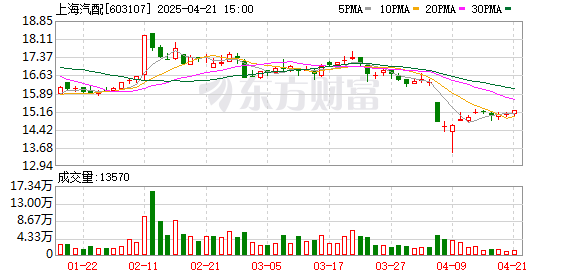
上海汽配2024年归母净利增长17.32% 推进模块化供应及国际化布局
Zheng Quan Shi Bao Wang· 2025-04-21 11:24
Core Viewpoint - Shanghai Automotive Parts achieved significant growth in 2024, with a revenue of 2.15 billion and a net profit of 189 million, reflecting year-on-year increases of 12.66% and 17.32% respectively [2] Group 1: Financial Performance - The company reported a revenue of 2.15 billion, marking a year-on-year growth of 12.66% [2] - The net profit attributable to shareholders was 189 million, representing a year-on-year increase of 17.32% [2] - A cash dividend of 3 yuan per 10 shares (including tax) is proposed for shareholders [2] Group 2: Business Segments - The automotive thermal management system products generated sales of 1.714 billion, up 15.34% year-on-year [2] - The automotive engine system products achieved sales of 387 million, reflecting a year-on-year increase of 7.08% [2] Group 3: Customer Base and International Sales - The company has established a healthy customer structure, supplying major clients such as Volkswagen, General Motors, and Toyota [3] - In 2024, international sales reached 913 million, accounting for 42.47% of total revenue, with a year-on-year growth of 59.83% [3] - The company has secured a global project for fuel distribution pipes with an overseas client, with an expected total sales amount exceeding 500 million over the project lifecycle [3] Group 4: International Expansion - The Mexican subsidiary generated approximately 290 million in sales, enhancing the company's ability to supply North and South American clients [3] - A Moroccan subsidiary is under construction to support European and African markets [3] Group 5: Future Developments - The company plans to actively develop hydrogen fuel distribution pipes for automotive applications [3] - In the thermal management system segment, the company aims to enhance integrated supply capabilities and explore modular supply markets [4] - The company has secured contracts for valve assembly products with clients like FAW-Volkswagen and plans to increase R&D efforts in system integration and modular supply [4]


欣旺达:深度报告:“欣”火燎原,旺达九州-20250416
Minsheng Securities· 2025-04-16 02:23
Investment Rating - The report maintains a "Recommended" rating for the company [5]. Core Viewpoints - The company has been deeply engaged in the lithium battery sector for 28 years, focusing on the research, production, and sales of lithium battery cells and modules, with a strong performance in electric vehicle batteries and energy storage solutions [1][9]. - The consumer battery industry is expanding, driven by AI technology, which is expected to boost demand for new devices and replacement cycles [2][29]. - The company adopts a "focus + differentiation" strategy in its power battery business, covering various application markets, which is anticipated to drive growth as new customer projects are launched [3][21]. Summary by Sections 1. Company Overview - The company specializes in lithium-ion battery cells and modules, achieving a stable foundation in consumer batteries while expanding into power and energy storage sectors [9][10]. - The company has established long-term partnerships with major clients, including Apple and Huawei, ensuring a robust customer base [56]. 2. Financial Performance - In the first three quarters of 2024, the company reported revenue of 38.28 billion yuan, a year-on-year increase of 11.5%, and a net profit of 1.21 billion yuan, up 50.8% [1][21]. - The company forecasts revenues of 56.53 billion yuan, 67.66 billion yuan, and 79.43 billion yuan for 2024, 2025, and 2026, respectively, with corresponding net profits of 1.49 billion yuan, 2.45 billion yuan, and 3.17 billion yuan [4][21]. 3. Market Trends - The AI technology boom is expected to significantly increase the demand for consumer electronics, with predictions of 590 million AI smartphones shipped by 2027 [2][40]. - The company is well-positioned to benefit from the anticipated growth in the AI PC market, with a projected shipment of over 200 million units by 2028 [2][40]. 4. Business Strategy - The company is expanding its production capacity and self-supply ratio in consumer battery cells, which is expected to enhance profitability [50][52]. - The company is actively investing in R&D to innovate battery technologies, including fast-charging and high-capacity solutions, which will strengthen its competitive edge [64].

欣旺达(300207):深度报告:“欣”火燎原,旺达九州
Minsheng Securities· 2025-04-16 02:19
Investment Rating - The report maintains a "Recommended" rating for the company [5]. Core Views - The company has been deeply engaged in the lithium battery sector for 28 years, focusing on the research, production, and sales of lithium battery cells and modules. It has expanded into electric vehicle batteries and energy storage solutions, achieving strong revenue growth [1][9]. - The consumer battery industry is experiencing significant growth driven by AI technology, with expectations for increased demand for high-energy-density batteries in smart devices [2][29]. - The company adopts a "focus + differentiation" strategy in its power battery segment, catering to various application scenarios, which is expected to drive future growth [3][21]. Summary by Sections 1. Company Overview - The company specializes in lithium-ion battery cells and modules, achieving a stable foundation in consumer batteries while expanding into power and energy storage markets [9][10]. - The company has established long-term partnerships with major clients, including Apple and Huawei, ensuring a robust customer base [56]. 2. Financial Performance - The company's revenue for the first three quarters of 2024 reached 38.279 billion yuan, a year-on-year increase of 11.5%, while net profit attributable to shareholders was 1.212 billion yuan, up 50.8% [1][21]. - The report forecasts revenues of 56.529 billion, 67.663 billion, and 79.426 billion yuan for 2024, 2025, and 2026, respectively, with corresponding net profits of 1.486 billion, 2.449 billion, and 3.170 billion yuan [4][5]. 3. Market Dynamics - The AI technology boom is expected to significantly boost the demand for consumer electronics, with predictions of 590 million AI smartphones shipped by 2027 [2][40]. - The company is well-positioned to benefit from the increasing demand for high-capacity batteries, as the market for AI-enabled devices expands [41][45]. 4. Product Development - The company is investing heavily in R&D to innovate battery technologies, including fast-charging and high-power battery solutions, which enhance product performance and customer loyalty [64]. - The introduction of silicon-carbon anode materials is anticipated to significantly increase battery capacity, meeting the growing demand for high-performance batteries in consumer electronics [45][46].
万向钱潮:布局人形机器人用和工业机器人用轴承 逐步切入农业无人机供应链
Zheng Quan Shi Bao Wang· 2025-04-14 10:53
Core Viewpoint - Wanxiang Qianchao is actively engaging in the automotive parts industry, focusing on R&D and manufacturing, with significant developments in robotics and a strategic acquisition plan to enhance its market position [1][2][3] Group 1: Company Overview - Wanxiang Qianchao specializes in the R&D and manufacturing of automotive components, including universal joints, drive shafts, wheel hub units, bearings, brakes, automotive electronics, shock absorbers, fuel tanks, and after-treatment systems [1] - The company primarily serves international OEMs such as Mercedes-Benz, BMW, General Motors, and Volkswagen, as well as leading domestic joint and independent brand manufacturers like BYD, FAW, SAIC, Dongfeng, Chery, and GAC [1] Group 2: Business Development and Projects - In Q1 2025, Wanxiang Qianchao plans to launch several new projects, including wheel hub bearing units for SAIC and BYD, universal joint projects for FAW Liberation and Handan Axle, and various bearing projects for other major manufacturers [1] - The company is also focusing on the robotics sector, developing bearings for humanoid and industrial robots, with an emphasis on low friction, high rigidity, and long lifespan products [2] Group 3: Strategic Initiatives - Wanxiang Qianchao is in the process of acquiring 100% of WAC, a company specializing in high-end automotive transmission and steering systems, with the transaction details still under negotiation [3] - The company has initiated collaborations with well-known enterprises for the development of Electric Brake Systems (EMB), aiming for a response time of under 100ms, although these products are still in the R&D phase [2]

信测标准(300938):汽车检测经营稳健 关注机器人业务增长点
Xin Lang Cai Jing· 2025-04-01 00:37
Core Viewpoint - The company reported a revenue of 725 million yuan for 2024, reflecting a year-on-year increase of 6.7%, and a net profit attributable to shareholders of 176 million yuan, up 7.7% year-on-year [1] Group 1: Financial Performance - The company's revenue for Q4 2024 was 174 million yuan, showing a year-on-year growth of 3.0%, while the net profit for the same period was 33 million yuan, an increase of 8.7% year-on-year [1] - The non-recurring net profit attributable to shareholders for 2024 was 165 million yuan, representing a year-on-year increase of 10.8% [1] - The gross profit margin for 2024 was 58.0%, a decrease of 1.11 percentage points year-on-year, with specific margins for automotive testing, electronic products testing, and testing equipment at 67.71%, 60.98%, and 39.10% respectively [3] Group 2: Business Segments - Automotive testing revenue reached 306 million yuan, growing 12.4% year-on-year, although the growth rate has slowed compared to previous years [2] - Revenue from electronic and electrical product testing was 171 million yuan, reflecting a steady growth of 9.1% year-on-year [2] - Revenue from testing equipment declined by 5.9% year-on-year to 154 million yuan, attributed to price competition in the manufacturing sector [2] - Daily consumer goods testing revenue increased by 22.2% year-on-year to 50 million yuan, while health and environmental testing revenue grew by 7.0% year-on-year to 45 million yuan [2] Group 3: Future Outlook - The company established a joint venture for robotics technology, aiming to create new growth avenues, with a focus on the development and sales of various types of robots [4] - Revenue projections for 2025-2027 are estimated at 849 million yuan, 971 million yuan, and 1.103 billion yuan, with corresponding year-on-year growth rates of 17.1%, 14.4%, and 13.6% [4] - The forecasted net profit attributable to shareholders for the same period is 208 million yuan, 248 million yuan, and 287 million yuan, with growth rates of 17.9%, 19.4%, and 15.9% respectively [4]
中创新航20250328
2025-03-28 03:14
Summary of Zhongxin Innovation's Conference Call Company Overview - Zhongxin Innovation's current market capitalization is approximately 30 billion RMB, which is lower compared to its peers such as Yiwei Lithium Energy (40 billion RMB) and Funeng Technology (close to 20 billion RMB) [3] - The expected shipment volume for Zhongxin Innovation in 2025 is 110 GWh, surpassing competitors like Guoxuan High-Tech and Funeng Technology, indicating that its market cap may be undervalued [3] Strategic Development and Product Diversification - The company's recent development strategy focuses on strategic transformation and product diversification, initially concentrating on ternary battery technology and later enhancing research on lithium iron phosphate batteries [4] - Zhongxin Innovation has expanded its product offerings to include power batteries for passenger vehicles, commercial vehicles, electric tricycles, and energy storage, aiming to become one of the top three players in the domestic market [4] - The company is also exploring emerging markets such as low-altitude economy and electrified transportation [4] Fast Charging Technology and Customer Structure - Zhongxin Innovation has launched a 5C lithium iron phosphate fast-charging product, currently applied in Xiaopeng models, and has secured orders from major clients including GAC, Leapmotor, Geely, and Volvo [6] - The customer structure has evolved from early reliance on GAC to a more balanced portfolio, indicating significant improvements in product capabilities and breakthroughs in vehicle manufacturing [6] Developments in Large Cylindrical Batteries - In 2024, Zhongxin Innovation introduced large cylindrical batteries and received project orders, such as the Xiaopeng Huitian Vmoto project, with plans to apply this technology to hybrid models to enhance fast-charging performance [7] - The company is also developing next-generation solid-state batteries with energy densities expected to reach 300-400 Wh/kg, which will attract high-margin customers and increase market share [7] Profitability Outlook from 2023 to 2025 - In 2023, the profit per watt was less than one cent, expected to rise to one cent in 2024 with profits around 700 million RMB [8] - For 2025, the production capacity utilization rate is projected to exceed 80%, which will further enhance net profit margins, supported by an increase in the share of energy storage modules and expansion into overseas high-margin customers [8] Long-term Growth Potential - Zhongxin Innovation's long-term growth potential includes improved capacity utilization, optimized product structure with a higher proportion of premium products, and significant room for unit profit improvement [9] - If unit profit reaches two cents, total profits could exceed 2 billion RMB in 2025, with a current valuation of around 15 times earnings, indicating potential for valuation recovery and a chance to catch up with industry leaders [9]