良品铺子

Search documents
良品铺子:预计2025年净利润亏损1.2亿元~1.6亿元
Mei Ri Jing Ji Xin Wen· 2026-01-19 10:33
Core Viewpoint - The company, Liangpinpuzi, forecasts a net loss of between 160 million to 120 million yuan for the fiscal year 2025, indicating an increase in losses compared to the previous year's net profit of 46.1 million yuan [1] Financial Performance - The anticipated net profit for 2025 is projected to be between -160 million yuan and -120 million yuan, compared to a net profit of 46.1 million yuan in the same period last year, reflecting a significant deterioration in financial performance [1] - The decline in sales revenue is attributed to the company's proactive optimization of store structure and the closure of inefficient stores [1] Operational Challenges - The company has experienced a decrease in gross margin due to price reductions on certain products and adjustments in product mix [1] - Despite efforts in lean management to reduce operational costs, the combined effect of declining revenue and gross profit, along with reduced investment income and government subsidies, has led to a year-on-year decline in net profit [1]

良品铺子:预计2025年净亏损1.2亿元-1.6亿元
Di Yi Cai Jing· 2026-01-19 10:29
良品铺子公告,预计2025年年度实现归属于上市公司股东的净利润为-16000万元到-12000万元;归属于 上市公司股东的扣除非经常性损益的净利润为-19000万元到-15000万元。报告期内,公司因主动优化门 店结构、关闭低效门店导致销售收入下降,部分产品售价下调及产品结构调整影响毛利率。虽通过精益 管理降低运营成本,但收入与毛利下滑叠加投资收益及政府补助同比减少,致使净利润同比下降。 ...
2025年1-11月农副食品加工业企业有26875个,同比增长1.38%
Chan Ye Xin Xi Wang· 2026-01-17 04:00
2025年1-11月,农副食品加工业企业数(以下数据涉及的企业,均为规模以上工业企业,从2011年起, 规模以上工业企业起点标准由原来的年主营业务收入500万元提高到年主营业务收入2000万元)为26875 个,和上年同期相比,增加了367个,同比增长1.38%,占工业总企业的比重为5.11%。 上市公司:黑芝麻(000716),双汇发展(000895),千味央厨(001215),青岛食品(001219),三 全食品(002216),得利斯(002330),金字火腿(002515),洽洽食品(002557),五芳斋 (603237),安井食品(603345),绝味食品(603517),惠发食品(603536),有友食品 (603697),良品铺子(603719),来伊份(603777),桃李面包(603866) 相关报告:智研咨询发布的《2026-2032年中国营养食品加工行业市场经营管理及发展前景展望报告》 数据来源:国家统计局,智研咨询整理 知前沿,问智研。智研咨询是中国一流产业咨询机构,十数年持续深耕产业研究领域,提供深度产业研 究报告、商业计划书、可行性研究报告及定制服务等一站式产业咨询服务。专业的角 ...


2025年上海市罐头制品商品包装物减量(过度包装)监督抽查结果公布
Zhong Guo Zhi Liang Xin Wen Wang· 2026-01-15 08:57
Core Insights - In 2025, the Shanghai Municipal Market Supervision Administration conducted a supervision and sampling inspection of canned products, revealing that 10 out of 30 batches were non-compliant with packaging standards [2]. Group 1: Compliance Results - The inspection was based on GB 23350-2021 standards, focusing on packaging void ratio and number of packaging layers [2]. - A list of compliant canned products was provided, including brands such as SPAM, 娃哈哈, and others, with various specifications and production dates [2]. Group 2: Non-compliance Results - The inspection identified several non-compliant products, including 整颗炖梨罐头 and 缤纷果捞, primarily due to excessive packaging void ratios [4]. - Specific details of non-compliant products included their brands, specifications, production dates, and the retailers involved, highlighting issues with packaging standards [4].
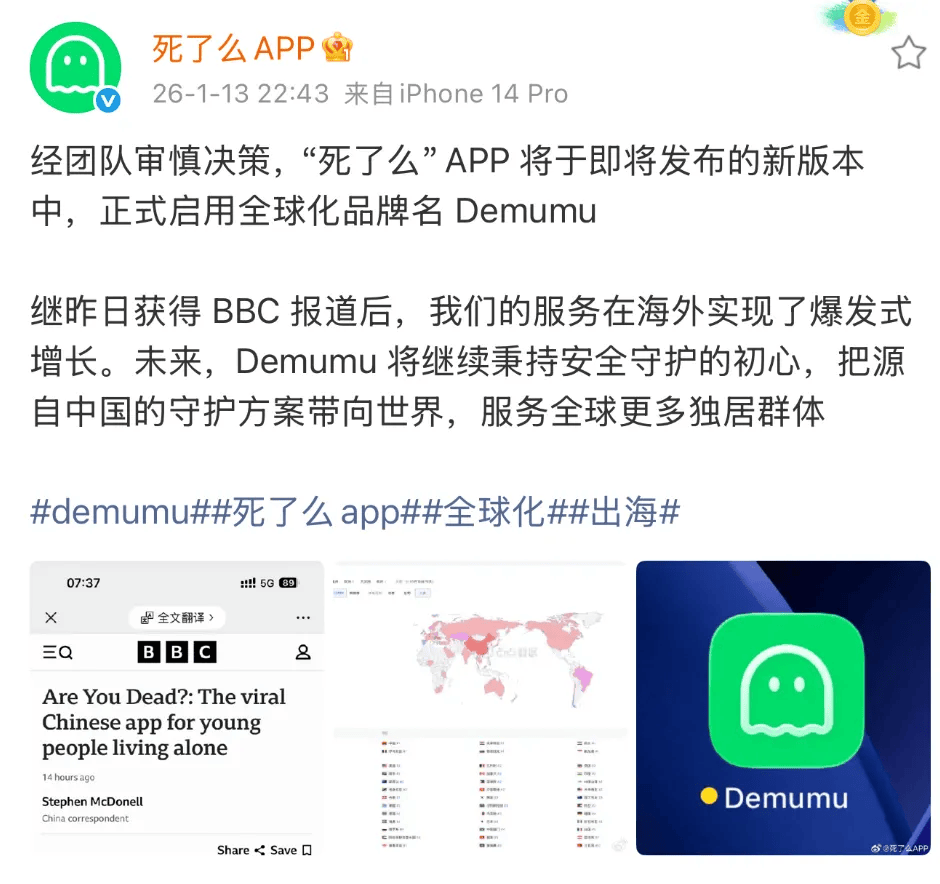
“死了么”App估值上亿,照见“孤独经济”万亿新蓝海
Sou Hu Cai Jing· 2026-01-14 14:50
Group 1: App and Company Overview - The "Are You Dead?" app has gained significant popularity, with a rapid increase in downloads by 100 times since its launch, which had an initial investment of just over 1,000 yuan and was developed in less than a month [1] - The app's daily new user count has surged by 500-800 times compared to its initial phase, leading to a company valuation increase to approximately 100 million yuan from 10 million yuan within two days [1] - The app's founder plans to sell 10% of the company's equity for a financing amount in the tens of millions, despite the name "Are You Dead?" being criticized for its negative connotation, prompting a rebranding to "Demumu" for the upcoming version [1] Group 2: Societal Trends and Market Potential - The emergence of the "Are You Dead?" app reflects a growing trend in the "loneliness economy," which is a response to the increasing number of individuals living alone, particularly among urban youth [2][3] - By 2030, it is projected that the number of people living alone in China could reach 150-200 million, with the solo living rate exceeding 30%, driven by factors such as urban migration and changing marriage views [3] - The "loneliness economy" is expected to grow rapidly, with a focus on products that provide emotional value and cater to the needs of individuals living alone, indicating a significant market opportunity [3][5] Group 3: Emotional and Material Needs - The loneliness economy encompasses both emotional and material needs, with young individuals seeking emotional release and social interaction while feeling fatigued by interpersonal relationships [5][7] - The market for companionship services is expanding, with offerings ranging from online companionship to in-person activities, reflecting a growing demand for emotional fulfillment [7] - The rise of AI products and pets as alternatives for companionship is notable, with AI companionship market revenues projected to soar from $30 million to between $70 billion and $150 billion by 2030 [12][16] Group 4: Industry Developments and Consumer Behavior - Major companies are entering the AI companionship and pet markets, with significant investments and product launches aimed at meeting the emotional needs of consumers [15][16] - The pet industry is also experiencing rapid growth, with a projected market size of 312.6 billion yuan by 2025, driven by younger generations who view pets as family members [16][19] - The food and beverage industry is adapting to the needs of solo diners, with businesses like Haidilao innovating their offerings to cater to individual consumption patterns [20][22]
2025年海味零食电商消费趋势
知行战略咨询· 2026-01-14 14:20
Investment Rating - The report does not explicitly provide an investment rating for the seafood snack industry Core Insights - The seafood snack industry is experiencing mixed performance across different e-commerce platforms, with significant growth in certain product categories while others are declining - Jinzai Foods, a leading brand in the seafood snack sector, reported a remarkable revenue growth of 16.79% year-on-year and a net profit increase of 39.91% for 2024, driven by the success of its flagship product, small dried fish, which sold over 1.5 billion units [6] - The overall sales of seafood snacks on e-commerce platforms are showing a downward trend, particularly on Taobao, where sales dropped by over 200 million [8][10] Summary by Relevant Sections E-commerce Sales Performance - Taobao's seafood snack sales declined by 18.6% year-on-year, with all subcategories experiencing a decrease, including instant fish (-19.8%) and seaweed (-16.2%) [10] - JD.com saw a slight overall growth of 1.6%, with instant fish showing a significant increase of 123.3%, while seaweed and instant squid faced declines [13] - Douyin's seafood snack sales decreased by 2.2%, with instant squid experiencing a growth of 17% [16] Category Performance - The top-performing categories in 2024 include: - Instant fish: 3.81 billion with a decline of 19.8% - Seaweed: 3.20 billion with a decline of 16.2% - Instant squid: 1.19 billion with a decline of 15.6% [11] - Notable growth categories on JD.com include: - Instant fish: 0.82 billion with a growth of 123.3% - Instant shrimp: 0.03 billion with a growth of 132.9% [14] Brand Rankings and Growth - Jinzai Foods ranked first in the seafood snack category with a sales figure of 0.31 billion and a growth rate of 48.4% [20] - Other notable brands include: - Good Time: 0.79 billion with a growth of 65.4% - Three Squirrels: 0.25 billion with a growth of 10.7% [20] - On Taobao, Jinzai Foods also led in the instant fish category with a sales figure of 74.56 million, despite a decline of 4.9% [21] Market Share Trends - Douyin's market share in the seafood snack category reached 52.5% in 2024, indicating a strong position compared to other platforms [8] - The overall market dynamics suggest a shift in consumer preferences, with some brands and categories outperforming others significantly [19]


为什么所有的消费品牌,都会在2026被GEO重做一遍?
新消费智库· 2026-01-14 14:19
Core Viewpoint - The article emphasizes the need for brands to adapt to a new era of consumer engagement driven by AI and GEO (Generative Engine Optimization), moving away from traditional short video and live-streaming strategies to focus on building trust and knowledge through AI-driven content [3][11][30]. Group 1: Challenges in Current Business Environment - The current business landscape is increasingly challenging, with high costs of traffic and fleeting consumer attention, leading to thin profit margins for brands relying solely on short video and live-streaming [2][4]. - Brands must shift their strategies to avoid hitting an "invisible wall" by embracing new methods of consumer engagement that leverage AI [3][6]. Group 2: Importance of GEO - GEO represents a significant new opportunity for brands, focusing on how to be recognized and recommended by AI systems, which are becoming the primary source of consumer information [3][14]. - Brands that fail to establish a strong presence in AI knowledge bases risk being overlooked in consumer decision-making processes [16][19]. Group 3: Balancing Brand and Performance - There is a need for brands to balance performance-driven marketing with brand-building efforts, as overemphasis on short-term results can lead to hollow brand identities [4][6]. - AI provides a unique opportunity to enhance brand perception and consumer trust through in-depth, informative content rather than superficial marketing tactics [7][10]. Group 4: Content Strategy Shift - Future marketing budgets should be reallocated to focus on creating knowledge-based content that builds trust, rather than solely on conversion-driven short videos [17][19]. - Brands must produce detailed, evidence-based content that addresses consumer questions and concerns, establishing themselves as authorities in their fields [21][22]. Group 5: Competitive Landscape - The competitive landscape is shifting, with brands needing to understand GEO as a new optimization strategy distinct from traditional SEO [23][24]. - Companies must adapt to this new environment by developing a deep understanding of their products and creating high-quality, informative content that can be recognized by AI [25][26]. Group 6: Trust and Authority in AI - Trust signals such as awards, academic papers, and media endorsements will become increasingly important in the AI-driven marketplace, as AI relies on these signals to determine credibility [57][58]. - Brands that can provide robust evidence of their claims will be favored by AI systems, enhancing their visibility and consumer trust [60][61]. Group 7: Opportunities for Smaller Brands - Smaller and newer brands have a unique opportunity in the GEO era, as the focus shifts from budget-driven marketing to expertise and knowledge [46][47]. - By concentrating on niche markets and providing in-depth, credible information, smaller brands can compete effectively against larger, established players [48][49]. Group 8: The Role of AI in Brand Positioning - GEO forces brands to articulate clear, factual value propositions, moving away from vague marketing language to concrete evidence of product benefits [50][52]. - This shift necessitates a return to foundational marketing principles, emphasizing the importance of clarity and substantiation in brand messaging [53][54]. Group 9: The Future of Content and Communication - The evolution of content formats will continue, but the core need for deep, trustworthy communication will remain essential [55][56]. - Brands should focus on creating compelling narratives supported by evidence, which will serve as a foundation for building trust in an AI-driven marketplace [66].

2025年饼干膨化零食电商消费趋势
知行战略咨询· 2026-01-14 14:03
Investment Rating - The report indicates a positive investment outlook for the snack food industry, particularly in the e-commerce segment, with a projected growth rate of 10.9% for 2024 [8]. Core Insights - The e-commerce platform Douyin has shown significant growth, increasing its market share from 22.2% in 2022 to 42.8% in 2024, while traditional platforms like Taobao and JD.com have seen a decline in their market shares [8]. - The overall sales of puffed snacks in e-commerce reached 78.26 billion in 2022, with a steady increase projected for the following years [9]. - The report highlights specific categories within the puffed snack segment that are experiencing varied growth rates, with some categories like digestive biscuits and compressed biscuits showing substantial increases [11][12]. E-commerce Trends - Douyin's sales growth for puffed snacks is at 29.9%, with key categories such as potato chips and cookies leading the growth [16]. - Taobao has seen a decline of 5.3% in the puffed snack category, with notable growth in specific subcategories like soda biscuits and digestive biscuits [10]. - JD.com has experienced a 20.1% decline overall, but certain categories like wafer biscuits have shown remarkable growth of 158.8% [13][14]. Category Performance - The report details the sales and growth rates for various subcategories of puffed snacks for 2024, indicating that: - Compressed biscuits have a growth rate of 74.3% with sales of 0.90 billion - Digestive biscuits are growing at 45.0% with sales of 1.57 billion - Other categories like wafer biscuits and soda biscuits also show significant growth [12][14]. Brand Rankings - The leading brands in the puffed snack category for 2024 include Lay's with sales of 3.60 billion, despite a decline of 13.9%, and other brands like Wantwant and Oreo showing varied performance [19][21]. - The report lists specific brand performances across different platforms, highlighting brands like 脆升升 with a growth rate of 295.4% and 江中食疗 with 88.0% growth [19][22].



2025年坚果零食电商消费趋势
知行战略咨询· 2026-01-14 13:57
Investment Rating - The report indicates a positive investment outlook for the nut snack industry, highlighting significant growth opportunities in e-commerce channels, particularly on platforms like Douyin [8][15]. Core Insights - The nut snack market has shown a recovery with a 16.2% growth in online sales in 2024, reversing the decline seen in 2023 [8]. - Douyin has emerged as a dominant player, increasing its market share from 26.3% in 2022 to 49.3% in 2024, while traditional platforms like Taobao and JD have stagnated [8][9]. - Mixed nuts remain the largest category but have experienced a decline of 6.1% in sales, while other categories like sunflower seeds and peanuts have shown positive growth [10][12]. E-commerce Performance - Douyin's overall growth in the nut category reached 38.9%, with mixed nuts growing by 63.1% and nut gift boxes skyrocketing by 304.5% [15][17]. - Taobao saw a slight decline of 0.6% in the nut category, but specific segments like sunflower seeds and paper-shelled walnuts experienced growth rates of 9.6% and 19.3%, respectively [10][12]. - JD reported a modest growth of 1.5%, with mixed nuts achieving a notable increase of 12.7% [13][14]. Sales Data - The total e-commerce sales for nuts in 2024 are projected at approximately 92.87 billion, with significant contributions from Douyin [9]. - Key sales figures for 2024 include: - Mixed nuts: 21.19 billion with a -6.1% growth - Sunflower seeds: 7.02 billion with a 9.6% growth - Peanuts: 4.30 billion with a 14.2% growth [12]. Brand Rankings - The leading brands in the nut snack market for 2024 include: - Three Squirrels: 11.12 billion with a 23.3% growth - Be&cheery: 5.07 billion with a -18.9% growth - Wolong: 2.75 billion with a 4.0% growth [19][21]. - On Douyin, Three Squirrels also leads with 25.28 billion in sales, reflecting a 63.1% growth [17]. Market Trends - The nut snack industry is witnessing a shift towards online purchasing, with consumers increasingly favoring platforms that offer convenience and variety [6][8]. - The growth of specific categories, such as nut gift boxes and certain types of nuts, indicates changing consumer preferences towards premium and gift-oriented products [15][16].

从规模突围到上市聆讯:鸣鸣很忙道阻且长
Sou Hu Cai Jing· 2026-01-13 02:52
Core Viewpoint - The company "Ming Ming Hen Mang" is set to become the first stock in the snack retail sector in Hong Kong, having achieved significant growth in retail sales and store numbers, but faces challenges related to low profit margins and sustainability concerns [1][3]. Group 1: Company Performance - As of September 2025, the company achieved a retail sales volume (GMV) of 66.1 billion yuan, a year-on-year increase of 74.5%, surpassing the total for 2024 [1]. - The number of operational stores is approaching 20,000, covering 28 provinces across China [1]. - Revenue skyrocketed from 4.286 billion yuan in 2022 to 39.344 billion yuan in 2024, with a compound annual growth rate of 203% over three years [1]. Group 2: Business Model - The company operates primarily as a "super wholesale" entity, with 99% of its revenue coming from sales to its franchise stores rather than franchise fees [3]. - The business model relies on extreme efficiency and scale, necessitating rapid expansion to maintain profitability [3][10]. - The company has positioned itself in the underserved lower-tier markets, with nearly 70% of its stores located in third-tier cities and below [8]. Group 3: Market Strategy - The company has developed a digital retail platform that utilizes AI algorithms to optimize inventory management, achieving an impressive inventory turnover of 11 days [7]. - By minimizing supply chain costs and maintaining low price points, the company offers significant savings to consumers compared to traditional retail models [5][8]. Group 4: Challenges and Risks - The company has maintained a low gross margin of around 8%, which is significantly below the industry average of 15%-20%, indicating a fragile business model [10]. - Complaints regarding product quality have emerged, with over 2,400 complaints filed, raising concerns about product safety and quality control [11]. - Franchisees are experiencing longer return periods, with some reporting losses, as competition intensifies and market saturation increases [13]. Group 5: Future Outlook - The upcoming IPO presents both opportunities and challenges, as the company must demonstrate sustainable profitability and address governance issues highlighted by market observers [16][17]. - The company is attempting to pivot towards a broader retail model by transforming its brand into a "hard discount supermarket," which may require significant operational adjustments and investment [17].