邮储银行

Search documents
黄金跌价,金条降价,2026年02月19日,国内黄金最新价格,各大银行黄金金条最新价格
Sou Hu Cai Jing· 2026-02-21 06:02
Core Viewpoint - The domestic gold market experienced slight fluctuations on February 19, 2026, with gold prices showing a minor decline, impacting the prices of gold bars and various gold products [1] Group 1: Gold Purity Standards and Prices - Gold products with a gold content greater than 990‰ are classified as "foot gold," with various purity levels available in the market, including ≥990‰, ≥999‰, ≥99.99%, and ≥99.999% [1] - High-purity gold, such as 99.99% and 99.999%, is ideal for high-end jewelry due to its excellent color and malleability, while 9999 gold is favored by investors for its higher value retention [1] - The latest prices for various gold products are as follows: - Domestic gold 9995: 1103.80 CNY/gram - Domestic gold 9999: 1103.80 CNY/gram - Domestic 9999 foot gold: 1110.40 CNY/gram - Domestic foot gold: 1124.00 CNY/gram - Domestic gold: 1108.50 CNY/gram - Domestic investment gold bars: 1122.00 CNY/gram [1] Group 2: Bank Gold Bar Quotes - The latest gold bar prices from various banks are as follows: - Industrial and Commercial Bank of China: 1105.14 CNY/gram for Ru Yi gold bars [2] - China Construction Bank: 1109.80 CNY/gram for Long Ding gold bars [3] - Minsheng Bank: 1127.50 CNY/gram for gold bars [4] - Bank of Communications: 1129.20 CNY/gram for gold bars [5] - Ping An Bank: 1129.50 CNY/gram for He Xie Ping An gold bars [6] - The gold bar prices from banks are subject to real-time fluctuations, and it is recommended to consult the respective banks for the most accurate pricing [7][8]



数字人民币点亮2026年春节消费新图景:政策引领下的创新实践
Sou Hu Cai Jing· 2026-02-20 11:12
导 语 数字人民币点亮2026年春节消费新图景。 文 | 亦可 出品 | Tao财经 2026年春节前夕,一场以数字人民币为核心引擎的"乐购新春"促消费行动,在全国范围内掀起热潮。在 国务院《关于促进消费市场高质量发展的指导意见》(2025年12月发布)的顶层设计下,中国人民银行 联合商务部、财政部等多部门,将数字人民币深度嵌入春节消费的各个环节,构建起"政府引导、金融 赋能、商户协同、百姓受益"的全新消费生态。 01 国家战略驱动数字人民币深度融入消费生态 2026年春节掀起的数字人民币热潮,绝非偶然的市场现象,而是国家顶层设计精准落地、政策合力集中 发力的结果。2025年12月,国务院办公厅印发《关于促进数字人民币在春节消费场景应用的指导意 见》,首次将数字人民币明确定位为"促消费、扩内需"的核心政策工具。该文件创新性地提出"三同 步"原则——政策同步支持、资金同步保障、场景同步覆盖,为春节消费市场注入了强劲的制度性动 能。 在年货消费场景中,邮储银行联合"原汁原味原产地"农产品电商平台,推出"数字人民币支付满30元立 减7.5元"的专项活动。消费者在京东、美团、拼多多等平台购买年货时,系统自动触发智能合 ...

雄安探索金融科技和社保业务深度融合
Xin Lang Cai Jing· 2026-02-19 23:02
转自:河北日报 雄安探索金融科技和社保业务深度融合 (来源:河北日报) 本报讯(见习记者郝金钰)2月6日,雄安新区公共服务局与金融系统战略合作银行共同举行社银合作签 约仪式,积极探索金融科技和社保业务的深度融合,构建"15分钟社保服务圈",推动社保服务数字化、 智能化升级,助力打造智慧社保新模式。 雄安新区公共服务局与中国工商银行雄安分行、中国农业银行雄安分行、中国建设银行雄安分行、中国 银行雄安分行、交通银行雄安分行、中国邮政储蓄银行雄安分行共同签署社银合作协议,并进行授牌。 根据协议,雄安新区公共服务局与这6家国有银行将共同推动城乡居民基本养老保险参保登记、城乡居 民基本养老保险待遇申领、失业保险金申领等13项社银服务事项延伸至基层网点,构建政策统一、标准 规范、服务高效、监督到位的合作体系。此举将雄安新区社保经办服务触角延伸至"最后一米",标志着 打造覆盖城乡、便捷高效的社保服务体系迈出关键一步。 在网点服务方面,各银行将依托其遍布雄安的营业网点和自助服务终端,打造雄安社银合作示范网点, 设置社保服务专区,配备专职导办人员,将灵活就业人员养老保险参保登记、领取养老金人员待遇资格 认证、参保人员信息查询等 ...
邮储银行高管变动与行业政策影响股价波动
Jing Ji Guan Cha Wang· 2026-02-19 02:34
Recent Events - On February 13, 2026, Postal Savings Bank announced that Lu Wei officially took office as the bank's president and executive director, with qualifications approved by the National Financial Supervision and Administration Bureau, effective immediately [1] - Concurrently, banking regulatory data revealed that in 2025, commercial banks' net profit grew by 2% year-on-year, with large banks also seeing a 2% increase, and the net interest margin remained stable at 1.42%, indicating overall stable asset quality in the industry [1] - A new personal consumption loan policy was implemented in January 2026, with Postal Savings Bank's "Postal Enjoy Loan" annual interest rate ranging from 3.1% to 12.4%, aligning with the regulatory lower limit set for state-owned banks [1] Stock Performance - In the past week, Postal Savings Bank's A-share price exhibited significant volatility, closing at 5.07 yuan on February 13, 2026, with a single-day decline of 0.78% and a trading volume of 564 million yuan; the closing price on February 12 was 5.11 yuan, down by 1.54% [2] - The cumulative decline over the period was 2.31%, with a price fluctuation of 2.70%; fund flow data indicated a net outflow of 38.14 million yuan from major investors on February 13, while retail investors showed a net inflow [2] - In the Hong Kong stock market, as of February 16, the closing price was 5.11 HKD, reflecting a slight increase of 0.39% [2] Institutional Perspectives - Institutions maintain a neutral outlook on Postal Savings Bank, with a comprehensive target price of 6.63 yuan as of February 19, 2026, indicating a potential upside of 31.03% from the latest price [3] - Profit forecasts from 39 institutions predict a 15.26% year-on-year increase in net profit for 2025, with growth expected to slow to 4.82% in 2026 [3] - Early research reports highlighted the resilience of non-interest income in the company's Q3 2025 report, although net interest margin is under pressure [3]

中国手机银行用户规模见顶,行业逻辑转向存量提升
Xin Lang Cai Jing· 2026-02-18 05:56
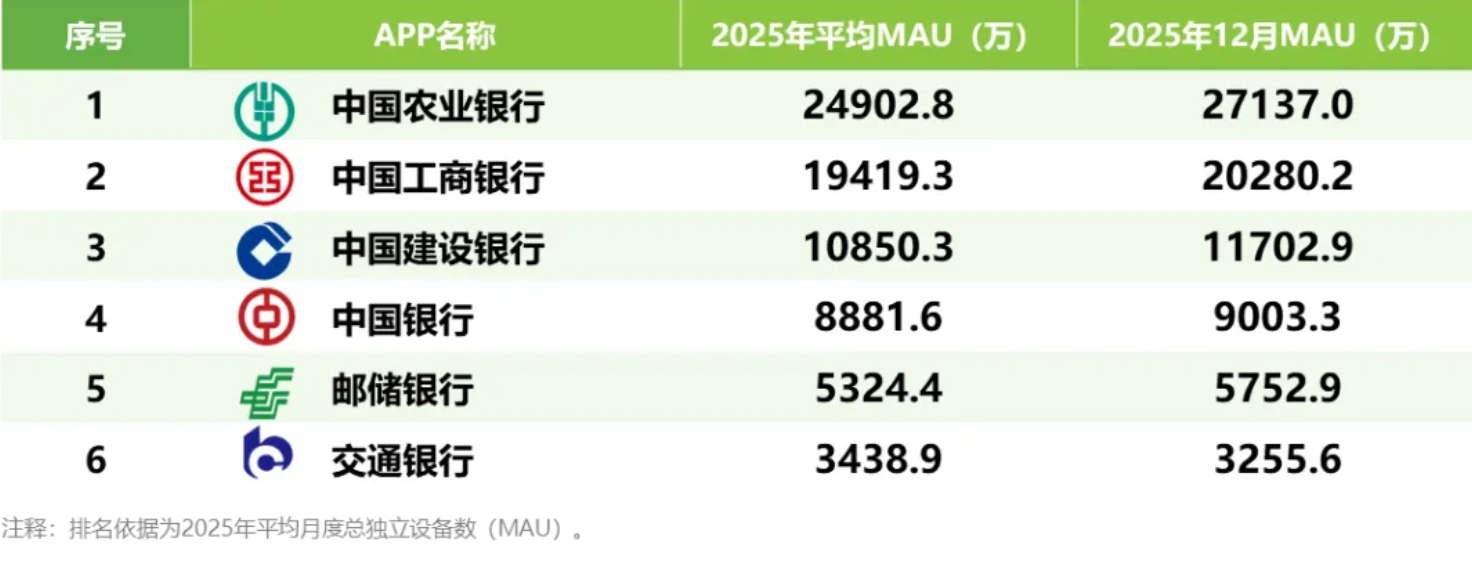
Core Insights - The report indicates that the average monthly active users (MAU) for major Chinese mobile banking apps in 2025 shows a significant user base, with the Agricultural Bank of China leading at approximately 24.9 million users [1]. Group 1: User Metrics - The average MAU for the top five mobile banking apps in 2025 are as follows: Agricultural Bank of China (24.9 million), Industrial and Commercial Bank of China (19.4 million), China Construction Bank (10.9 million), Bank of China (8.9 million), and Postal Savings Bank (5.3 million) [1]. - The total number of independent devices for mobile banking in China is projected to stabilize between 648 million and 739 million, indicating a plateau in user growth [1]. Group 2: Industry Trends - The report highlights a shift in industry dynamics from acquiring new users to enhancing existing user engagement, as the flow of new users has reached a ceiling [1]. - User behavior is changing structurally, with the effective daily usage time per device decreasing from 4.9 minutes in 2023 to around 2.7 minutes by mid-2025, stabilizing at approximately 3 minutes [1]. - The trend towards high-frequency, short-duration, and function-oriented usage is prompting financial institutions to streamline processes and focus on core transaction scenarios [1].



国有大行主导手机银行市场,生态嵌入构筑护城河
Jing Ji Guan Cha Wang· 2026-02-18 05:47
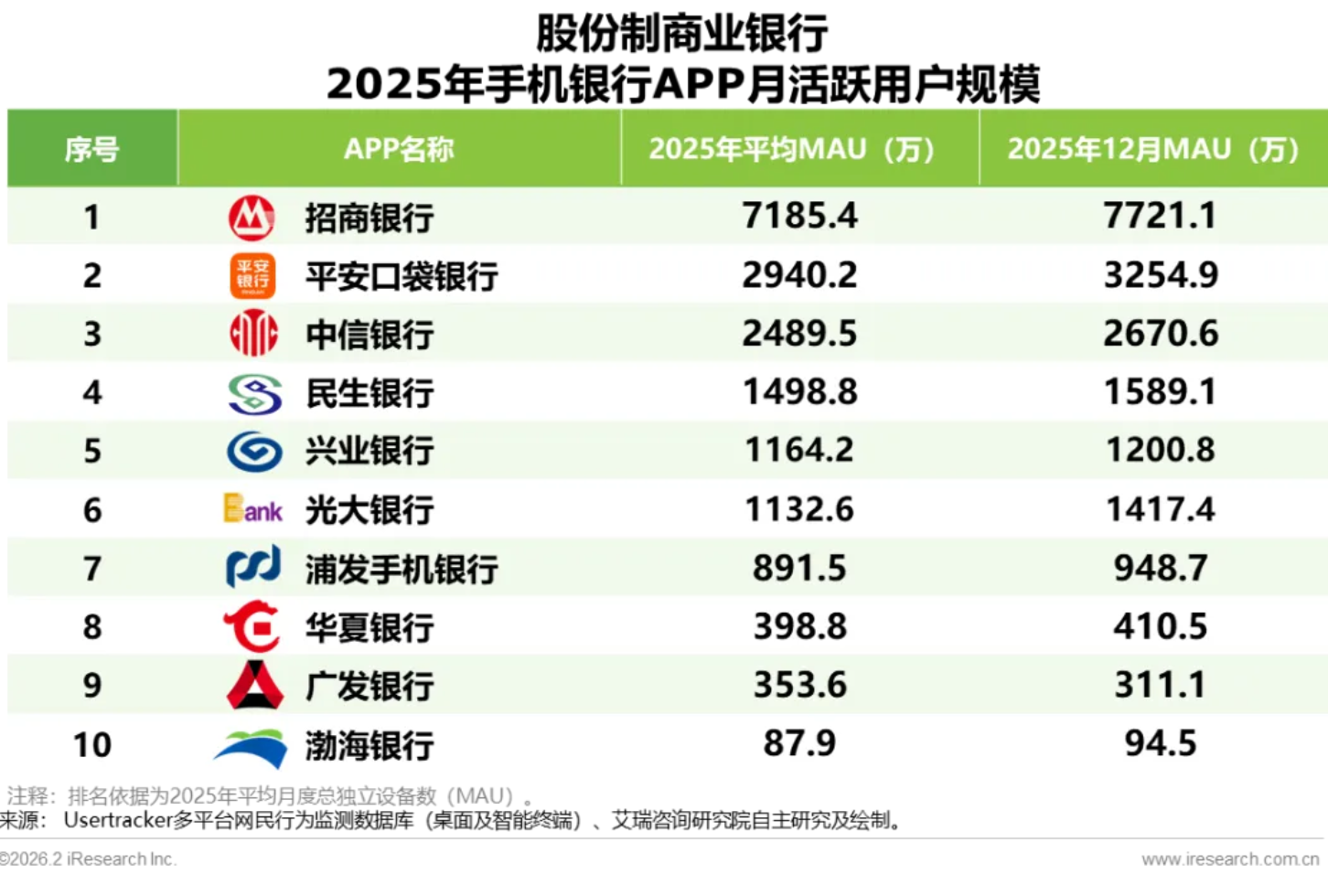
Core Insights - The Chinese mobile banking market is entering a stage of stock competition in 2025, with monthly active users (MAU) stabilizing between 648 million and 739 million [2] - State-owned commercial banks dominate the market due to their ecological embedding advantages, with Agricultural Bank of China leading at 249 million MAU, followed by Industrial and Commercial Bank of China (194 million) and China Construction Bank (109 million) [2] - Private banks are expected to collectively exit the top 50 MAU rankings in 2025 due to a lack of offline branch support and local living ecosystems [2] Group 1: Major Players - Agricultural Bank of China has the highest MAU at 249 million, followed by Industrial and Commercial Bank of China with 194 million and China Construction Bank with 109 million, forming the first tier of banks [2] - China Bank and Postal Savings Bank have MAUs exceeding 50 million, constituting the second tier [2] - China Merchants Bank leads the joint-stock banks with 71.85 million MAU, while Ping An Bank and CITIC Bank form the second tier, with other joint-stock banks generally below 20 million MAU [2] Group 2: Market Dynamics - The core advantage of state-owned banks lies in their "full-scenario integration" capabilities, embedding services deeply into high-frequency life scenarios such as government affairs, social security, healthcare, and education [2] - Agricultural Bank of China extends its services to rural areas through intelligent service matching and customer customization, while Industrial and Commercial Bank of China utilizes its "Gong Xiao Zhi" model for interactive service [2] - Regional banks like Jiangsu Bank, Beijing Bank, and Ningbo Bank show stable performance by focusing on local markets, with some rural commercial banks like Fujian Rural Credit exceeding 4.5 million MAU, indicating the sustainability of localized operations in the stock market [2]

手机银行TOP50再无民营 生态壁垒高筑草根绝迹
Jing Ji Guan Cha Wang· 2026-02-18 05:47
Core Insights - The monthly active users (MAU) of mobile banking apps in China have stabilized between 648 million and 739 million, indicating that user growth has reached a ceiling, marking the end of a decade-long traffic dividend period [2] - User behavior has shifted significantly, with average session duration decreasing from 4.9 minutes in 2023 to approximately 2.7 minutes by mid-2025, reflecting a preference for high-frequency, short-duration, and function-oriented usage [2] - Major state-owned banks have solidified their market dominance, with all six major state-owned banks ranking in the top ten for MAU, led by Agricultural Bank of China with 249 million MAU [2] Industry Dynamics - The core competitive advantage of state-owned banks lies in their "full-scenario integration" capabilities, providing financial services deeply embedded in public services such as government, social security, healthcare, and education [3] - Joint-stock banks are adopting specialized development strategies, with China Merchants Bank leading its peers with 71.85 million MAU, while Ping An Bank and Citic Bank are leveraging AI technology to enhance service processes and maintain user engagement [3] - Local banks are experiencing polarization, with some city commercial banks maintaining MAU above 3 million due to their deep understanding of local markets, while private banks like WeBank and MYbank have fallen out of the top 50 due to challenges in customer acquisition and retention [3] Future Trends - As the industry standard for single-session usage time becomes 3 minutes, banks must rethink their value creation strategies [4] - AI-driven service process optimization, real-time risk control systems, and multi-device collaboration within ecosystems are reshaping the competitive landscape [4] - Key factors for institutional success in the future will include precise user insights, prudent risk management, and robust ecosystem integration capabilities [4]

黄金跌了价,2026年2月17日,国内黄金新价格、人民币黄金新价格
Sou Hu Cai Jing· 2026-02-18 02:32
Core Viewpoint - The international precious metals market is experiencing significant volatility, with gold prices under pressure due to high interest rate expectations and liquidity tightening, while silver has seen dramatic fluctuations, indicating a deep adjustment period in the market [1] Group 1: International Precious Metals Market Dynamics - On February 17, 2026, spot gold was reported at $5038.5 per ounce, having dipped to $4910 during trading, with bearish sentiment dominating as indicated by technical indicators [1] - Spot silver increased by 2.55% to $77.11 per ounce after a sharp decline, having previously reached a historical high of $121.65 at the end of January, followed by a single-day drop exceeding 36% [1] - The gold-silver ratio compressed to 47-49, significantly below the normal range of 50-80, indicating a potential for corrective pressure on silver prices [1] Group 2: Domestic Retail Gold Prices - Domestic retail prices for gold jewelry show significant differentiation, with wholesale prices in Shenzhen's Shui Bei at 1300 RMB per gram, the lowest in the country, while brand stores price gold between 1529 and 1548 RMB per gram [3] - The highest quoted brand is Lao Feng Xiang at 1548 RMB per gram, while other brands like Chow Tai Fook and Luk Fook Jewelry are priced at 1529 RMB per gram [3] - A comparison of consumer purchases shows a 37.5-gram gold piece priced at approximately 57375 RMB at China Gold, while the same weight at Shui Bei costs about 48750 RMB, highlighting the impact of brand premiums and processing costs on retail prices [3] Group 3: RMB Denominated Gold Market - Data from the Shanghai Gold Exchange indicates a general decline in RMB gold prices, with AuT D at 1108.50 RMB per gram, down 16.55 RMB, a decrease of 1.47% [4] - Au9999 fell to 1109.00 RMB per gram, while Au9995 dropped to 1080.05 RMB per gram, reflecting tightening liquidity and potential pricing anomalies [4] - The price of silver T D plummeted to 19270 RMB per kilogram, marking a 3.26% decline, indicating its high volatility [4] Group 4: Market Adjustments by Financial Institutions - In response to price volatility, several banks and gold stores are tightening their precious metals business, with announcements from China Gold and Cai Bai regarding the suspension of gold buybacks and implementation of daily limits [11] - Notably, banks like Industrial Bank and Postal Savings Bank have ceased personal gold trading services, reflecting a broader trend among at least 11 banks to restrict new positions and purchases [11] - These actions indicate heightened vigilance from regulators and financial institutions regarding market risks, particularly following significant drops in silver LOF funds [13] Group 5: Market Outlook - The current volatility in the precious metals market is primarily driven by speculative funds and the bursting of a price bubble, particularly in silver, which has seen inventory depletion leading to extreme market conditions [14] - Future price movements will depend on inflation data, Federal Reserve policy directions, and the recovery of market liquidity, with consumers advised to focus on wholesale market prices for practical insights [14]



寄大件重物哪个快递公司划算
Sou Hu Cai Jing· 2026-02-17 11:41
碰到要搬家,遇上需退货,还有得发货,在碰到有大件重物得去寄送的时候,好多人的第一反应便是感到头疼。几十公斤重的货物,动不动就有上百元的运 费,不同快递公司给出的报价更是差别极大。有德邦,有顺丰,有京东,还有邮政……究竟选哪一家才不会白花那冤枉钱呢? 寄大件的时候,不能仅仅只去看单价,计费方式得算进去,首重续重也得考虑进去,偏远地区附加费同样要算进去。以下是2026年主流快递的大致收费特 点: 强力加粗重点突出的德邦快递,是大件物流领域里资历深厚的老牌,对于31千克超越之上的物件会走精准卡航或者汽运通道,其价格处于适度范围,网点覆 盖面积广泛,适宜用于省外路途遥远的运输场景。 "顺丰快运",20千克往上能够走顺丰大件,速度挺快,服务优良,但价钱偏高,适宜对时效有着较高要求的贵重物品。 京东物流,凭借仓储方面的优势而存在、发展,在同城或者周边城市具备价格方面的优势,并且常常会有优惠券能够领取。 低价格的邮政普通包裹,相对速度却较慢,这种情况须亲自前往进行提取,比较契合那些并不着急且要寄往偏远地方的较重物品。 中通、韵达等那些被称作通达系的快递,在部分地区对于大件物品有着特别的折扣情况,不过这是需要向当地的网点去进 ...
邮储银行迎首位股份行出身行长,芦苇履新带来新契机
Sou Hu Cai Jing· 2026-02-17 02:29
Core Viewpoint - The appointment of Lu Wei as the new president of Postal Savings Bank marks a significant shift in the leadership dynamics of state-owned banks in China, as he is the first leader to transition directly from a joint-stock bank, breaking the traditional internal promotion or external appointment model [2] Group 1: Appointment Significance - Lu Wei's appointment is a groundbreaking attempt to bridge the talent flow between state-owned banks and joint-stock banks, which has historically faced "invisible barriers" [2] - His career trajectory reflects a strong background in the "CITIC system," having risen through the ranks of CITIC Bank and later serving as chairman of CITIC Trust, showcasing his management capabilities and adaptability [2][3] Group 2: Qualifications and Challenges - Lu Wei's international background and professional qualifications, including a master's degree in accounting from Deakin University and CPA certifications from China, Hong Kong, and Australia, are seen as key factors in his selection, especially as Postal Savings Bank pushes for retail transformation and international expansion [3] - The bank faces challenges such as narrowing interest margins and asset quality pressures, with a non-performing loan ratio of 0.94% as of September 2025, while net profit growth has slowed to 0.98% [3] Group 3: Transformation and Strategy - Postal Savings Bank, known for its "inclusive finance" label, has a vast network of nearly 40,000 outlets, which presents both an advantage and higher operational costs; its asset scale reached 18.61 trillion yuan with an 8.9% year-on-year growth, but revenue growth was only 1.82% [4] - Lu Wei's management team will need to align with his strategic direction, particularly in technology and customer management, raising questions about the potential introduction of market-oriented incentive mechanisms [4] Group 4: Industry Implications - This personnel adjustment signals a diminishing "gatekeeping" mentality in the selection of senior executives at state-owned banks, emphasizing professional competence and cross-institutional experience [5] - Lu Wei's appointment presents both opportunities and challenges for Postal Savings Bank, as he must balance the bank's policy-driven mission with market demands, potentially setting a new paradigm for executive selection in other state-owned banks [5]