大成基金

Search documents
浮动管理费率基金蝶变产品设计更加精细化
Zhong Guo Zheng Quan Bao· 2025-05-18 21:27
Core Viewpoint - The recent submission of a new batch of floating management fee rate funds by 26 fund companies marks a significant development in the public fund industry, emphasizing investor interest protection and long-term investment guidance [1][8]. Group 1: New Fund Submission - On May 16, the first batch of new model floating management fee products was accepted by the CSRC, involving 26 fund managers, including 21 leading firms and 4 smaller firms [1]. - The submitted products are primarily market selection equity funds, benchmarked against major indices such as the CSI 300 and CSI 500 [1]. Group 2: Fund Design and Fee Structure - The new fund designs focus on enhancing investor interests, aligning with the "Action Plan" that establishes a performance-based floating management fee mechanism [2]. - The fee structure allows for different management fee rates based on the fund's performance relative to a benchmark, with lower fees applied when performance is below the benchmark and higher fees when performance exceeds it [2][8]. - The design emphasizes asymmetric adjustments to fees, with more significant reductions when performance lags behind the benchmark compared to increases when performance exceeds it [2]. Group 3: Historical Context and Evolution - The floating management fee rate mechanism has evolved since its inception in 1999, with various models emerging over the years, including performance-linked fees and tiered fee structures [3][4][6]. - Recent innovations include a model where 50% of the basic management fee is performance-based, and another where fees vary based on the investor's holding period [6][7]. Group 4: Industry Impact and Future Outlook - Industry experts believe the new floating management fee funds will enhance the alignment of fund managers' income with investors' actual returns, promoting long-term investment and reducing irrational trading [8]. - The introduction of these funds is seen as a deep optimization of product supply in the industry, potentially leading to clearer strategies and defined risk-return characteristics [8].
新规下首批浮动管理费产品申报【国信金工】
量化藏经阁· 2025-05-18 16:28
Market Review - The A-share market showed a mixed performance last week, with the ChiNext Index, CSI 300, and Shanghai Composite Index yielding returns of 1.38%, 1.12%, and 0.76% respectively, while the STAR 50, CSI 1000, and CSI 500 indices had negative returns of -1.10%, -0.23%, and -0.10% respectively [6][10] - The automotive, non-bank financial, and retail sectors performed well, with returns of 2.71%, 2.67%, and 2.23% respectively, while the defense, computer, and comprehensive finance sectors lagged with returns of -1.61%, -1.40%, and -0.79% respectively [16][17] Fund Performance - Last week, the median returns for active equity, flexible allocation, and balanced mixed funds were 0.34%, 0.17%, and 0.16% respectively. Year-to-date, alternative funds have performed the best with a median return of 4.85% [28][30] - The median excess return for index-enhanced funds was 0.14%, while quantitative hedging funds also had a median return of 0.14%. Year-to-date, the excess median return for index-enhanced funds was 1.50% [31][32] Fund Issuance - A total of 15 new funds were established last week, with a total issuance scale of 6.345 billion yuan, which is a decrease from the previous week. Additionally, 27 funds entered the issuance phase, and 31 funds are set to begin issuance this week [3][40] - The first batch of 26 new floating management fee products was submitted for approval, which will link management fees to fund performance for eligible investors [5] Bond Market - As of last Friday, the central bank's reverse repos netted a withdrawal of 350.1 billion yuan, with a total of 836.1 billion yuan maturing and a net open market injection of 486 billion yuan. The pledge-style repo rates increased, with the 1-day rate rising by 12.92 basis points [18][19] ETF Index Series - On May 14, the China Securities Index officially launched several new ETF index series, including the CSI A500 and CSI cash flow indices, providing diversified benchmarks and investment targets for fund companies [9]


数量稀缺,长期跑赢大盘的基金出炉
Sou Hu Cai Jing· 2025-05-18 11:14
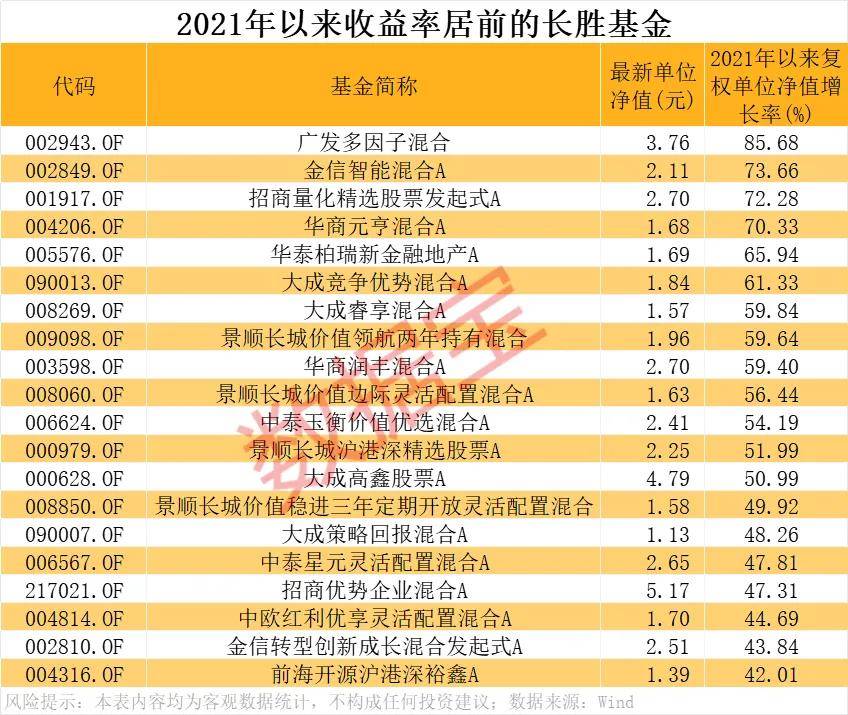
Group 1 - The public fund industry in China is undergoing significant reform, shifting focus from "scale" to "return" as emphasized in the "Action Plan for Promoting High-Quality Development of Public Funds" released by the China Securities Regulatory Commission [1] - The plan aims to ensure that industry institutions prioritize the best interests of investors, integrating this principle into governance, product issuance, investment operations, and assessment mechanisms [1] - Data from Xinda Securities indicates that a majority of funds have underperformed against benchmarks, with approximately 30% of active equity funds showing excess returns below -20% over the past three years [1] Group 2 - A total of 82 actively managed equity funds established before 2021 have consistently outperformed the CSI 300 index from 2021 to 2024, with an average net value growth rate of 25.93% since 2021 [2] - The top-performing fund, Guangfa Multi-Factor Mixed Fund, achieved a net value growth rate of 85.68% since 2021, with a stock allocation of 83.09% as of the first quarter of 2025 [2] - The second-best performing fund, Jinxin Intelligent Mixed A, recorded a net value growth rate of 73.66%, heavily invested in the banking sector [3] Group 3 - As of May 16, 2025, 25 funds from the 82 long-term outperformers have seen their share increase by over 20% this year, with four funds doubling their shares [6] - The fund with the highest share growth is Huazhang Event-Driven Quantitative Mixed A, which increased by 386.19% since the beginning of 2025 [6] - Other notable funds with significant share growth include Jinxin Intelligent Mixed A and Huashang Runfeng Mixed A, both of which have also seen their total shares double [6]
跑赢基准100个百分点?基金公司密集“纠偏”!什么情况?
券商中国· 2025-05-18 10:38
Core Viewpoint - The China Securities Regulatory Commission (CSRC) has released an action plan to promote the high-quality development of public funds, emphasizing the importance of performance benchmarks for funds [1][7]. Group 1: Changes in Performance Benchmarks - A significant increase in the number of funds changing their performance benchmarks has been observed this year, with 82 funds making changes compared to only 37 in the same period last year [3]. - Several North Exchange theme funds have updated their performance benchmarks to align with relevant indices, although five companies have yet to make these necessary adjustments [3][6]. - The Tianhong Qingxiang Fund and Zheshang Huijin Quantitative Fund have both adjusted their performance benchmarks to better reflect their investment strategies, moving away from indices that do not accurately represent their risk-return profiles [4][5]. Group 2: Importance of Performance Benchmarks - Performance benchmarks are crucial for evaluating fund performance, yet many funds have benchmarks that do not serve their intended purpose, leading to a lack of accountability for fund managers [6][9]. - The CSRC's action plan aims to enforce stricter guidelines for setting and modifying performance benchmarks, linking them to fund company performance assessments and manager compensation [7][10]. - The current benchmarks often reflect a simplistic approach, with a high concentration of funds using major indices like the CSI 300, which may not accurately represent the diverse market landscape [9][11]. Group 3: Future Implications - The action plan is expected to lead to more refined management of performance benchmarks, encouraging fund companies to reassess their benchmarks and align them more closely with their investment strategies [8][10]. - As the industry evolves, there is a push for more sophisticated benchmark selection, including the potential use of composite indices instead of relying solely on broad indices [11].

年内超额收益最高超11%!这类产品火了
Zhong Guo Ji Jin Bao· 2025-05-18 10:32
Core Viewpoint - Small-cap index enhancement strategy products have shown significant excess returns in 2023, with nearly 80% of products achieving excess returns, particularly in small-cap categories [1][2]. Performance Summary - As of May 16, 2023, the highest unit net value growth rate for off-market index enhancement funds exceeded 30%, with small-cap index enhancement products outperforming benchmarks by over 8% [2]. - On the on-market side, enhancement strategy ETFs also performed well, with the highest net value growth rate exceeding 20%, and specific ETFs like the招商中证2000 enhancement strategy ETF achieving an excess return of 11.32% [2]. Market Environment - The active performance of small-cap stocks this year, particularly in indices like 中证2000 and 中证1000, has provided more opportunities for excess returns due to their higher growth potential and volatility [3]. - Increased market attention on small-cap stocks has led to a continuous inflow of funds into related index components, driving stock price increases and creating a favorable investment environment for enhancement strategy products [3]. Quantitative Models - This year, factors such as reversal, dividend, and growth have performed well, contributing to excess returns for traditional multi-factor combinations [3]. - Many institutions have adopted machine learning models to capture high-frequency, non-linear stock volatility characteristics, enhancing the stability of returns [3]. Strategy Outlook - For the second half of the year, it is crucial to closely follow index styles and minimize significant deviations, optimizing quantitative models to improve sensitivity to market changes [5][6]. - Risk management remains essential, with a focus on monitoring macroeconomic data, policy changes, and industry dynamics to reduce portfolio risk exposure [6]. - The emphasis will be on enhancing the predictive capability of Alpha models while maintaining a stable style constraint in index enhancement product management [6].
ETF兵器谱、金融产品每周见:债券ETF全景图:实物申赎、质押融资、T+0交易三位一体-20250518
Shenwan Hongyuan Securities· 2025-05-18 09:41
Report Industry Investment Rating No relevant content provided. Core Viewpoints of the Report - In 2025, the bond ETF market expanded with 29 products across credit bonds, interest - rate bonds, and convertible bond index funds, reaching a total scale of 256.546 billion yuan. Credit bond index ETFs grew rapidly after adding 8 market - making bond ETFs at the beginning of the year [2][7][10]. - The 8 market - making credit bond/company bond ETFs have differences in index characteristics and fund investment. Both indexes are better than the medium - and long - term pure bond fund index and may be a better choice for investors to allocate credit bond funds [2]. - Bond ETFs have advantages in trading mechanisms over over - the - counter products, with higher trading efficiency and "T + 0" trading, and some support physical redemption [2]. - In 2025, eligible credit bond ETFs can be included in the pledge - style repurchase pool, marking a new stage in China's bond market liquidity management tools [2]. - Bond ETFs generally use sampling replication and active management strategies, but it is difficult to obtain excess returns, with most products underperforming the benchmark index [2]. - China's bond ETF market mostly shows discount trading, and the discount/premium level is positively correlated with the liquidity of the underlying bond market, while other factors can also affect it [2]. Summary According to the Directory 1. 2025 Bond ETF Market Expansion - There are 29 bond ETF products in total, covering credit bonds, interest - rate bonds, and convertible bond index funds, with a total scale of 256.546 billion yuan. Credit bond index ETFs have 11 funds with a scale of 112.192 billion yuan, interest - rate bond index ETFs have 16 funds with a scale of 102.964 billion yuan, and there are 2 convertible bond index ETFs with a scale of 41.389 billion yuan [7][10]. 2. Differences Among 8 Market - Making Credit Bond/Company Bond ETFs - Divided into two types based on tracking indexes, with a total scale of 4.2403 billion yuan. Both indexes perform better than the medium - and long - term pure bond fund index [13]. - Index characteristic differences are reflected in industry distribution, enterprise nature, and duration. For example, the Shenzhen market - making credit bond index and the Shanghai market - making company bond index have different selection methods, component bond quantities, and weighted methods [15][22]. - Fund investment differences are shown in investment concentration, leverage level, and duration. Different products have different characteristics in these aspects [25]. 3. Differences in Bond ETF Trading Mechanisms Compared to Over - the - Counter Products - Bond ETFs have significant advantages in trading convenience, allowing trading in both the primary and secondary markets with "T + 0" trading, suitable for trading - oriented investors [30]. - There are two redemption methods: cash redemption and single - market physical redemption. Only a few products support only cash redemption, while others support single - market physical redemption [31]. 4. Bond ETFs Eligible for Pledge - Style Repurchase - Currently, 13 products including treasury bond ETFs, local government bond ETFs, or policy - financial bond ETFs can participate in pledge - style repurchase. In 2025, eligible credit bond ETFs can also be included in the pledge - style repurchase pool, with specific requirements for eligible credit bond funds [33][34]. 5. Sampling Replication + Active Management Strategy of Bond ETFs - Bond ETFs generally use sampling replication due to the large number of component bonds, fast portfolio adjustment, and weak liquidity of bond indexes. They also use strategies such as increasing duration, adding leverage, investing in treasury futures, and band trading to enhance returns, but it is difficult to obtain excess returns, with most products underperforming the benchmark index [36][37][50]. 6. Regularity of Bond ETF's Discount/Premium Rate - China's bond ETF market mostly shows discount trading, with over 60% of trading days of most products in a discount state. - The discount/premium level is positively correlated with the liquidity of the underlying bond market. For example, local government bond ETFs often trade at a discount with larger standard deviations of discount rates, and credit bond ETFs have more significant changes in discount/premium rates than interest - rate bond ETFs, except for the stable performance of newly - listed market - making credit bond ETFs in 2025 [53][56][59]. - Market sentiment, supply - demand relationship, policy environment, etc., can also affect the discount/premium of bond ETFs. For example, the discount/premium rate of urban investment bond ETFs has narrowed rapidly since Q3 2023 [61].
量化基金周度跟踪(20250512-20250516):A股表现分化,量化基金整体收涨、超额回升-20250517
CMS· 2025-05-17 14:43
Report Industry Investment Rating No relevant content provided. Core View of the Report From May 12th to May 16th, 2025, the A-share market showed divergence, while quantitative funds as a whole recorded gains and their excess returns rebounded. The main stock indices also showed divergence, with the one-week returns of CSI 300, CSI 500, and CSI 1000 being 1.12%, -0.10%, and -0.23% respectively. All types of quantitative funds had positive average returns this week, with active quantitative funds rising 0.60% and market-neutral funds rising 0.11%. The excess returns of index-enhanced funds rebounded, and the average excess returns of CSI 500 index-enhanced and CSI 1000 index-enhanced funds were relatively high, at 0.40% and 0.26% respectively [2][6][8]. Summary by Relevant Catalog 1. Performance of Major Indices and Quantitative Funds in the Past Week - The A-share market showed divergence, and quantitative funds as a whole recorded gains and their excess returns rebounded. The one-week returns of CSI 300, CSI 500, and CSI 1000 were 1.12%, -0.10%, and -0.23% respectively [6]. - All types of quantitative funds had positive average returns this week, with active quantitative funds rising 0.60% and market-neutral funds rising 0.11%. The excess returns of index-enhanced funds rebounded, and the average excess returns of CSI 500 index-enhanced and CSI 1000 index-enhanced funds were relatively high, at 0.40% and 0.26% respectively [8]. 2. Performance of Different Types of Public Quantitative Funds - **CSI 300 Index-Enhanced Funds**: The one-week return was 1.16%, the excess return was 0.04%, the maximum drawdown was -1.20%, the excess maximum drawdown was -0.24%, and the excess return dispersion was 0.26% [12]. - **CSI 500 Index-Enhanced Funds**: The one-week return was 0.30%, the excess return was 0.40%, the maximum drawdown was -1.17%, the excess maximum drawdown was -0.14%, and the excess return dispersion was 0.23% [12]. - **CSI 1000 Index-Enhanced Funds**: The one-week return was 0.04%, the excess return was 0.26%, the maximum drawdown was -1.47%, the excess maximum drawdown was -0.26%, and the excess return dispersion was 0.24% [13]. - **Other Index-Enhanced Funds**: The one-week return was 0.53%, the excess return was -0.02%, the maximum drawdown was -1.47%, the excess maximum drawdown was -0.32%, and the excess return dispersion was 0.41% [13]. - **Active Quantitative Funds**: The one-week return was 0.60%, the maximum drawdown was -1.10%, and the return dispersion was 0.63% [14]. - **Market-Neutral Funds**: The one-week return was 0.11%, the maximum drawdown was -0.21%, and the return dispersion was 0.22% [14]. 3. Performance Distribution of Different Types of Public Quantitative Funds - The report shows the six-month performance trends and the one-week and one-year performance distribution of different types of public quantitative funds, with index-enhanced funds showing excess return performance [15]. 4. High-Performing Public Quantitative Funds - **CSI 300 Index-Enhanced High-Performing Funds**: Include funds such as FURONG CSI 300 Index Enhancement and HUAXIA CSI 300 Index Enhancement Strategy ETF [29]. - **CSI 500 Index-Enhanced High-Performing Funds**: Include funds such as PINGAN CSI 500 Index Enhancement and CHANGXIN CSI 500 Index Enhancement [30]. - **CSI 1000 Index-Enhanced High-Performing Funds**: Include funds such as GUOLIANAN CSI 1000 Index Enhancement and TIANHONG CSI 1000 Enhancement Strategy ETF [31]. - **Other Index-Enhanced High-Performing Funds**: Include funds such as ZHAOSHANG CSI 2000 Enhancement Strategy ETF and YONGYING SSE STAR MARKET 100 Index Enhancement [32]. - **Active Quantitative High-Performing Funds**: Include funds such as PINGAN HK STOCK CONNECT DIVIDEND PREFERRED and NUODE NEW ENERGY VEHICLE [33]. - **Market-Neutral High-Performing Funds**: Include funds such as DACHENG ABSOLUTE RETURN and DEBANG QUANTITATIVE HEDGING STRATEGY [34].
红利风格投资价值跟踪(2025W20):中证红利成交较4月缩量,本周ETF净流出28.24亿元
Xinda Securities· 2025-05-17 13:50
Macro Perspective - Recent US Treasury yields are influenced by expectations of interest rate cuts by the Federal Reserve, with a 36.8% probability of a cut in July 2025[3] - Domestic M2 growth in April 2025 was 8.0%, up from 7.0% in the previous month, while the M1-M2 differential decreased to -6.5% from -5.4%[10] Valuation Metrics - The absolute PETTM for the CSI Dividend Index is at the 99.60th percentile over the past three years, indicating a high valuation level[17] - The relative PETTM is at the 77.30th percentile, suggesting a decrease from the previous month's 88.38th percentile[21] Price and Volume Analysis - 64.68% of the CSI Dividend Index component stocks are above the six-month moving average, an increase from 52.14% a month ago, indicating improved price momentum[23] - The absolute trading volume is at the 57.41st percentile over the past three years, down from 72.90% a month ago, suggesting reduced trading activity[30] Fund Flows - The CSI Dividend ETF experienced a net outflow of 28.24 billion yuan this week, with a total net outflow of 53.09 billion yuan over the past month[36] - The exposure of equity mutual funds to dividend strategies has decreased from 0.45 in Q4 2024 to 0.37 in Q1 2025, indicating a reduction in allocation to dividend stocks[36] Summary Insights - The macro model suggests that the dividend style may underperform compared to growth style in the near future due to high valuation levels and reduced trading volume[44] - Long-term outlook remains positive for growth style as liquidity conditions improve with potential monetary and fiscal policy measures[44]
来了!首批新模式浮动管理费基金上报,持有满一年或分三档浮动
Mei Ri Jing Ji Xin Wen· 2025-05-16 11:17
Core Viewpoint - The introduction of a new floating management fee structure for public funds aims to align the interests of fund managers and investors, enhancing the long-term value coexistence between them [1][4]. Group 1: New Floating Management Fee Products - Over 20 fund companies have reported new floating management fee products, which link management fees to investors' holding periods and investment results [1][2]. - The new fee structure consists of fixed management fees, contingent management fees, and excess management fees, determined by the holding duration and annualized return of each fund share [2][3]. - The first batch of these products will primarily target broad market indices such as the CSI 300 and CSI 500 [3]. Group 2: Fee Structure Details - The management fee will be charged at 1.20% for holdings of less than one year, while for holdings of one year or more, it will vary based on performance [2][3]. - Three tiers of management fees are established: - 1.50% if annualized excess return exceeds 6% and holding return is positive - 0.60% if annualized excess return is -3% or below - 1.20% for all other cases [3]. Group 3: Industry Implications - The new fee structure is seen as a significant breakthrough in the fee mechanism for actively managed equity funds, promoting a performance-based approach [4][5]. - This reform is expected to enhance fund managers' focus on improving active management capabilities and optimizing investment strategies for long-term excess returns [4][5]. - The floating fee mechanism is anticipated to provide investors with more differentiated product choices while maintaining the dominance of fixed fee products [4][5]. Group 4: Market Considerations - There are concerns regarding the potential for fund companies to issue new products during market downturns, which may face significant sales resistance [5]. - The complexity of the new fee structure necessitates investor education to improve understanding and acceptance of the products [5]. - The ongoing issuance of these new floating management fee funds will serve as a critical observation point for the deepening of public fund fee reform [5].
重磅!“新基金”正式开闸!
证券时报· 2025-05-16 10:56
Core Viewpoint - The first batch of innovative floating fee rate products based on performance benchmarks has been reported, with 26 fund managers participating, indicating strong representation and capability in equity management [1][3][11]. Group 1: Product Overview - 26 fund management companies have quickly responded to the public fund reform policy by reporting the first batch of new model floating management fee products within ten days of the reform's implementation [3]. - The reported products are managed by well-performing fund managers, focusing on creating returns for investors [2][11]. Group 2: Fee Structure - Unlike traditional floating fee rate funds, the new model will have a more detailed fee structure based on each investor's holding time and annualized return during the holding period [7]. - If the holding period is less than 365 days, only the basic management fee can be charged; if it is 365 days or more, the management fee will be linked to the annualized return compared to the performance benchmark [7]. Group 3: Investment Strategy - The first batch of products will primarily invest in a broad market selection, benchmarking against mainstream indices such as CSI 300, CSI A500, and CSI 500 [8]. - The aim is to encourage long-term investment from investors, enhancing their overall investment experience [8][11]. Group 4: Future Developments - More fund managers are expected to follow suit in reporting similar products as they prepare adequately [9][11]. - The "Action Plan" stipulates that leading institutions should issue at least 60% of such funds compared to their actively managed equity funds within a year [10].