
中国平安

Search documents
A股,两融降温!结束10连增
Zheng Quan Shi Bao Wang· 2026-01-20 03:21
Core Insights - The implementation of new margin requirements has led to a decline in the margin trading market, with a notable drop in both margin balance and trading volume on the first day of the new regulations [2][3][4]. Group 1: Market Overview - On January 19, 2026, the margin trading balance in the A-share market was approximately 27,232 billion yuan, a decrease of about 84 billion yuan from the previous trading day, ending a streak of 10 consecutive increases [3]. - The financing balance on the same day was around 27,059 billion yuan, down by approximately 85 billion yuan, also marking the end of a 10-day growth trend [3]. - The total margin trading volume on January 19 was about 2,684 billion yuan, the first time it fell below 3,000 billion yuan since January 6, 2026, and the lowest single-day figure for the year [3]. Group 2: Regulatory Changes - The new regulation, which increased the minimum margin requirement for investors from 80% to 100%, took effect on January 19, 2026, and applies only to new financing contracts [4]. - Existing financing contracts and their extensions are still governed by the previous margin requirements [4]. Group 3: Stock Performance - Despite the overall decline in margin trading balance, many stocks still maintain high margin balances, with 17 stocks having margin balances exceeding 10 billion yuan as of January 19 [5]. - Notably, stocks such as China Ping An, Dongfang Wealth, and Ningde Times have margin balances exceeding 20 billion yuan [5].
A股保险股拉升,中国人寿涨2.5%
Jin Rong Jie· 2026-01-20 03:20
Group 1 - The A-share market saw a rise in insurance stocks, with China Life increasing by 2.5% [1] - China Ping An and China Pacific Insurance both experienced gains of over 1% [1]

中国保险:2026 展望:寿险迎来历史性机遇;产险受益于持续监管红利-China Insurance-2026E Outlook Life Embarking on a Historic Opportunity; P&C Riding on Continued Regulatory Tailwinds
2026-01-20 03:19
Summary of Conference Call Notes Industry Overview - **Industry**: Life and Property & Casualty (P&C) Insurance in China - **Key Trends**: The life insurance sector is expected to experience significant growth opportunities due to a large volume of bank deposits maturing, estimated at over Rmb70 trillion, and a low-interest rate environment for reinvestment [22][2]. The P&C sector is projected to see a steady premium growth of 4% in 2026E, driven by auto insurance and personal P&C lines [3]. Core Insights Life Insurance Sector - **Growth Potential**: The life insurance industry is entering a "golden era" as retail investors seek higher returns from insurance products due to maturing bank deposits [2]. - **Margin Stability**: Margins are expected to remain stable, with pricing rate adjustments in September 2025 potentially offsetting margin erosion from a shift towards participating products [2][1]. - **Preferred Companies**: Industry leaders such as China Life and Ping An are favored due to anticipated K-shaped growth divergence between larger and smaller insurers amid regulatory tightening [2][1]. Property & Casualty (P&C) Insurance Sector - **Premium Growth**: The P&C industry is expected to achieve a 4% growth in premiums in 2026E, supported by regulatory tailwinds and expense rationalization [3]. - **Cost of Risk (CoR) Enhancement**: There is significant room for CoR improvement, driven by regulatory measures including expense management and adjustments in NEV insurance pricing [3]. - **Top Performers**: PICC P&C is expected to benefit the most from these trends, potentially delivering best-in-class results [3][1]. Financial Projections - **China Life Insurance**: Target price raised to HK$38 from HK$27.70, with EPS estimates for FY25E/FY26E/FY27E increased by 105%/48%/46% respectively, reflecting improved investment performance [7]. - **China Pacific Insurance**: Target price increased to HK$44.40 from HK$40.50, with FY25E/FY26E EPS estimates raised by 27%/14% [9]. - **Ping An Insurance**: Target price lifted to HK$79 from HK$68, with slight adjustments to EPS estimates [20]. Regulatory Environment - **Regulatory Changes**: New regulations are being implemented to strengthen supervision over insurers' asset liability management and expense management, focusing on quality-oriented metrics rather than volume [27][28]. - **Impact on Life Insurance**: Regulations will require life insurers to maintain specific liquidity and coverage ratios, which could affect their operational strategies [27]. - **P&C Insurance Regulations**: The P&C sector is seeing a shift towards more stringent expense management and compliance with quality metrics [27]. Additional Insights - **Market Dynamics**: The life insurance market is witnessing a shift towards bancassurance channels as consumers reallocate their wealth [44]. - **Product Mix Changes**: Insurers are increasingly shifting their product mix towards participating products, which may lower the cost of in-force books [41]. - **Investment Opportunities**: The anticipated interest rate hikes in China are expected to enhance investment returns for insurers, further supporting their growth [11][12]. This summary encapsulates the key points from the conference call, highlighting the growth potential and regulatory landscape of the life and P&C insurance sectors in China.



A股,两融降温!结束10连增
证券时报· 2026-01-20 03:13
Core Viewpoint - The implementation of new margin requirements has led to a decline in the margin trading balance and trading volume in the A-share market, indicating a cooling off in the margin trading environment [2][4][5]. Group 1: Margin Trading Regulations - On January 19, 2026, the minimum margin requirement for investors financing the purchase of securities was raised from 80% to 100% [5]. - This adjustment applies only to new financing contracts, while existing contracts will continue under previous regulations [5]. Group 2: Market Impact - On the first day of the new regulations, the margin trading balance decreased to approximately 27,232 billion yuan, a reduction of about 84 billion yuan from the previous trading day, ending a streak of 10 consecutive increases [4]. - The financing balance on January 19 was about 27,059 billion yuan, down by approximately 85 billion yuan, also marking the end of a 10-day growth trend [4]. - The total margin trading volume on January 19 was around 2,684 billion yuan, the first time it fell below 3,000 billion yuan since January 6, and the lowest single-day figure for 2026 [4]. - The proportion of margin trading volume to total A-share trading volume decreased to 9.82%, the first time it has been below 10% since December 16, 2025, down from 11.01% on January 16 [4]. Group 3: High Margin Balances in Selected Stocks - Despite the overall decline in margin trading balances, many stocks still maintain high margin balances, with 17 stocks having balances exceeding 10 billion yuan as of January 19 [7]. - Notably, stocks such as China Ping An, Dongfang Wealth, and Ningde Times have margin balances exceeding 20 billion yuan [7].


资金风向标 | 两融余额较上一日减少83.62亿元 汽车行业获融资净买入额居首
Sou Hu Cai Jing· 2026-01-20 01:52
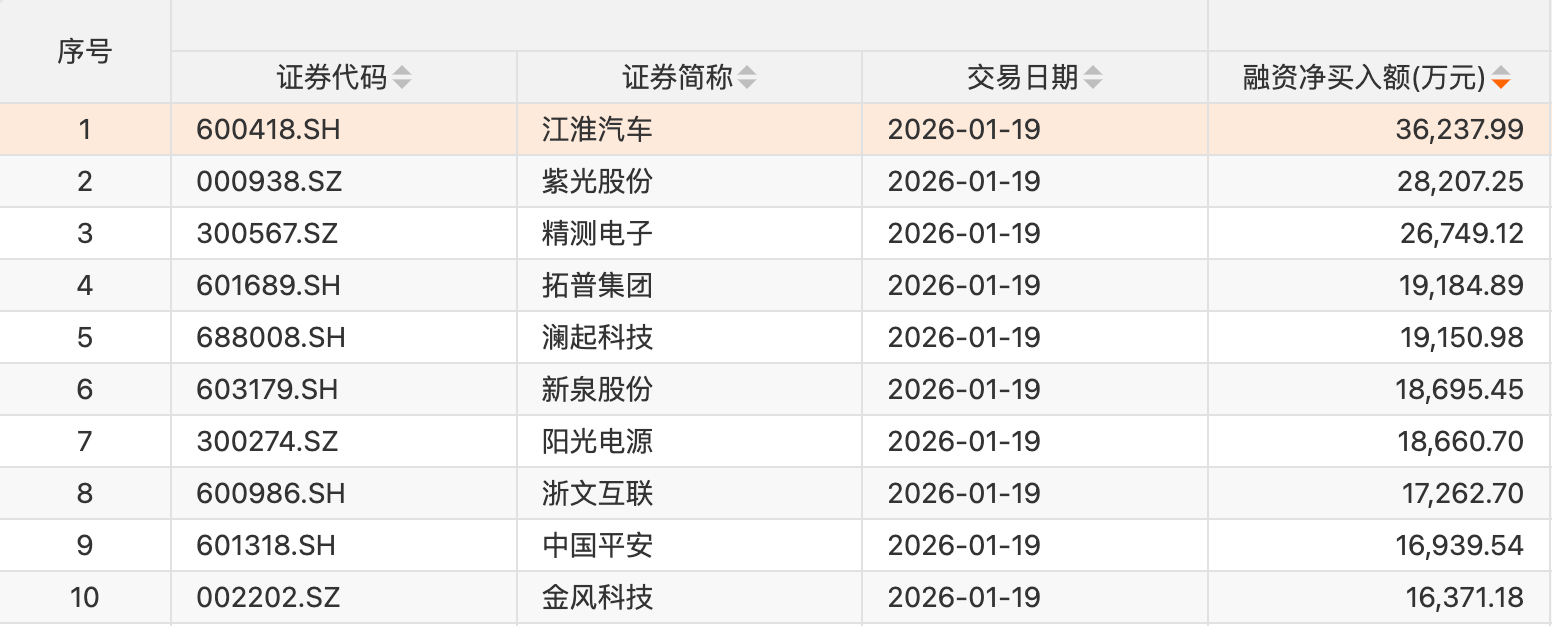
Group 1 - As of January 19, the margin trading balance of A-shares is 27,231.75 billion yuan, a decrease of 83.62 billion yuan from the previous trading day, accounting for 2.63% of the A-share circulating market value [1] - The margin trading turnover on the same day is 2,683.76 billion yuan, down by 681.14 billion yuan from the previous trading day, representing 9.82% of the A-share transaction volume [1] - Among the 31 primary industries, 10 industries received net financing inflows, with the automotive industry leading at a net inflow of 758 million yuan [1] Group 2 - A total of 33 stocks received net financing inflows exceeding 100 million yuan, with Jianghuai Automobile leading at a net inflow of 362 million yuan [1] - Other notable stocks with significant net financing inflows include Unisplendour, Jingce Electronics, Top Group, Lanke Technology, New Spring Shares, Sungrow Power Supply, Zhejiang Wenhu Interconnect, China Ping An, and Goldwind Technology [1] - According to a report from Industrial Securities, in 2026, the automotive sector is expected to undergo a value reassessment due to advancements in high-level assisted driving and breakthroughs in robotics technology [2] - The robotics sector is gradually entering a large-scale production phase, with investment opportunities shifting from divergence to convergence [2] - The report suggests focusing on two main lines: technological changes in autonomous driving and robotics, and the industrial chain opportunities arising from large-scale implementation [2]




33股获融资净买入额超1亿元 江淮汽车居首
Zheng Quan Shi Bao Wang· 2026-01-20 01:25
Industry Summary - On January 19, among the 31 primary industries tracked by Shenwan, 10 industries experienced net financing inflows, with the automotive industry leading at a net inflow of 758 million yuan [1] - Other industries with significant net financing inflows included banking, power equipment, non-bank financials, retail, and non-ferrous metals [1] Company Summary - A total of 1,619 stocks received net financing inflows on January 19, with 100 stocks having inflows exceeding 50 million yuan [1] - Notably, 33 stocks had net financing inflows exceeding 100 million yuan, with Jianghuai Automobile leading at a net inflow of 362 million yuan [1] - Other companies with significant net financing inflows included Unisoc, Jingce Electronics, Top Group, Lanke Technology, New Spring Shares, Sunshine Power, Zhejiang Wenhu Interconnection, and China Ping An [1]
老年群体健康险市场迎变,“照护服务纳入赔付权益”求解结构性矛盾
Xin Lang Cai Jing· 2026-01-20 01:04
Group 1 - The health insurance purchasing difficulties faced by the elderly population are gradually being addressed, with policies encouraging the introduction of dedicated health insurance products for this demographic [1][2] - Shanghai's recent measures highlight the need for specialized health insurance for the elderly, acknowledging the unique health risks they face and advocating for differentiated product designs rather than generic offerings [1][2][4] Group 2 - The current health insurance market for the elderly is characterized by structural contradictions, with limited product availability and high restrictions, leading to a mismatch between existing offerings and the actual needs of older adults [2][5] - Existing products like "惠民保" provide broad coverage but primarily address immediate medical expenses rather than the ongoing care and management needs of the elderly, indicating a gap in the market [4][5] Group 3 - The introduction of care services as a compensation right in health insurance represents a significant innovation, allowing for earlier intervention in chronic disease management and rehabilitation, which aligns more closely with the needs of the elderly [6][7] - Major insurance companies are increasingly focusing on health management and care services, expanding their offerings to better serve the elderly population [7][8] Group 4 - The insurance industry faces challenges in product innovation for the elderly, with a tendency to replicate Western models without adequately addressing local needs [8][9] - Companies are encouraged to balance profitability with policy compliance by adopting a layered approach to product design, integrating health management as a risk control tool, and collaborating with public services to mitigate risks [9][10]
杠杆资金净买入前十:中国平安(13.32亿元)、特变电工(11.20亿元)




Jin Rong Jie· 2026-01-20 00:19
Group 1 - The top ten stocks with net financing purchases on January 16 include China Ping An (1.33 billion), TBEA (1.12 billion), and Kweichow Moutai (1.03 billion) [1] - Other notable stocks in the top ten include Baiwei Storage (655 million), Shannon Microelectronics (604 million), and Xinquan Co. (593 million) [1] - Additional stocks in the list are Zhongwei Company (566 million), Zhaoyi Innovation (490 million), Tongfu Microelectronics (483 million), and Changdian Technology (461 million) [1]
2025年度保险理赔报告密集出炉:“直付”服务打通壁垒,重疾出险年轻化、仍存较大保障缺口
Xin Lang Cai Jing· 2026-01-20 00:13
Core Insights - The insurance industry is witnessing a significant shift in claims and service models, with a focus on digitalization and direct payment services, enhancing the efficiency of claims processing [1][8] - Total claims paid by life insurance companies reached 1.18 trillion yuan, while property insurance companies paid 1.03 trillion yuan in 2025, both showing an increase compared to the previous year [1] - Medical insurance remains the dominant category in terms of claim numbers, while critical illness insurance accounts for a significant portion of claim amounts, highlighting a growing awareness of health risks among residents [5][6] Group 1: Claims Data Overview - Major insurance companies reported substantial increases in claims for 2025, with China Life processing over 62.24 million claims, a 7% increase year-on-year, and total claims amounting to over 100.4 billion yuan, a 10% increase [2] - China Pacific Life reported 4.24 million claims with a total payout of 20.1 billion yuan, while Ping An Life processed 4.96 million claims totaling 41.51 billion yuan [3] - China Property & Casualty Insurance processed over 200 million claims, with a total payout exceeding 380 billion yuan, marking a growth of over 10% [2] Group 2: Critical Illness and Medical Insurance Trends - Medical insurance claims accounted for over 90% of total claims in many companies, while critical illness insurance represented over 50% of the total payout amounts [5][6] - The trend of younger individuals being diagnosed with critical illnesses is rising, with significant claims from the 40-60 age group, and the 18-40 age group showing a high incidence rate [6][7] - Despite the increase in awareness and claims, the average payout for critical illness insurance remains insufficient to cover the high costs of treatment, with many claims below 100,000 yuan [7] Group 3: Digitalization and Service Improvements - The introduction of direct payment services has streamlined the claims process, allowing patients to avoid upfront costs, with China Life reporting 8.17 million direct payment claims totaling over 4.3 billion yuan [8][9] - The digital transformation in the insurance sector has led to over 90% of claims being processed online for several companies, significantly improving efficiency [8][9] - Companies are leveraging technology, including IoT and automated claims processing, to enhance service delivery and customer experience [9]
多家险企发布2025年度理赔报告 信息技术助力服务效率提升
Zhong Guo Zheng Quan Bao· 2026-01-19 23:17
Core Insights - The insurance industry has shown a stable claims scale for 2025, with major insurers enhancing their protection capabilities and many small to medium-sized insurers experiencing significant business growth [2][3] Claims Scale Stability - The total number of claims for China Life exceeded 62.24 million, a year-on-year increase of 7%, with total claims amounting to over 100.4 billion yuan, up 10% [2] - Ping An Life reported 4.958 million claims with a total payout of 41.51 billion yuan, while Xinhua Insurance had 5.01 million claims totaling 14.7 billion yuan [2] - Smaller insurers like Zhongyou Insurance saw customer service numbers exceed 2.49 million, a growth of over 370%, with claims amounting to 3.2 billion yuan, up over 90% [2] - The claims acceptance rates for several insurers remained high, with China Life, CITIC Prudential, and Ping An Life at 99.8%, 99.7%, and 99.2% respectively [2] High Payouts in Critical Illness Insurance - Critical illness claims accounted for a significant portion of total payouts, with Ping An Life reporting 261,000 claims totaling over 20.86 billion yuan, representing over 50% of total claims [3] - The average payout for critical illness and death claims was notably high, with Zhonghong Insurance reporting average payouts of 181,500 yuan and 184,500 yuan respectively [3] - There exists a substantial coverage gap between critical illness payouts and treatment costs, with Zhongyou Insurance indicating an average payout of 100,000 yuan against an average treatment cost of 400,000 yuan for malignant tumors [3] Growth Potential in Critical Illness Insurance - Analysts predict that the aging population and increasing demand for better medical resources will expand the potential customer base for critical illness insurance, leading to a sales growth period [4] - Medical claims accounted for the highest proportion of total claims for China Life at 60.6%, and over 65% for Cigna Life [4] Technological Empowerment in Claims Services - The integration of information technology has significantly accelerated claims processing times, with Xinhua Insurance reporting an average processing time of 0.5 days for small medical claims under 5,000 yuan [5] - Ping An Life's "111 Fast Claims" service has improved efficiency, with 93% of automated claims being processed within 60 seconds [5] - China Life has implemented a "one-day claim" service for critical illness claims, allowing for same-day processing for eligible cases [6] - The focus on IT in the insurance sector has shifted towards intelligent underwriting and claims systems, with major insurers adopting digital solutions to replace manual processes [6]