
OPPO

Search documents
财信证券晨会纪要-20251112
Caixin Securities· 2025-11-11 23:31
Market Strategy - The market is experiencing a volume contraction and continued weakness in the technology sector [5][7] - The overall A-share index fell by 0.51%, with the Shanghai Composite Index down 0.39% and the ChiNext Index down 1.40% [7][8] - Small-cap stocks outperformed, while mid-cap stocks lagged behind [8] Industry Dynamics - The Jiangsu Provincial Development and Reform Commission announced a bidding notice for mechanism electricity prices for new energy projects from June 1, 2025, to December 31, 2026, with a total scale of 13 billion kWh [24][25] - The Chinese foldable smartphone market saw a significant recovery in Q3 2025, with shipments reaching 2.63 million units, a year-on-year increase of 17.8% [26][27] - Huawei leads the foldable smartphone market with nearly 70% market share, followed by Honor and vivo [28] Company Updates - Zoomlion (000157.SZ) has led the publication of two national standards in the concrete machinery industry, filling a gap in technical parameter testing [29][30] - Chengde Lululemon (000848.SZ) completed a share buyback of 2.98% of its shares, which will be canceled, enhancing investor confidence [32][33] - Fangsheng Pharmaceutical (603998.SH) received a drug registration certificate for Indobufen tablets, expanding its cardiovascular drug portfolio [34]
段永平再捐2.2亿元!近期罕见接受访谈,多次提及茅台
Di Yi Cai Jing· 2025-11-11 22:40
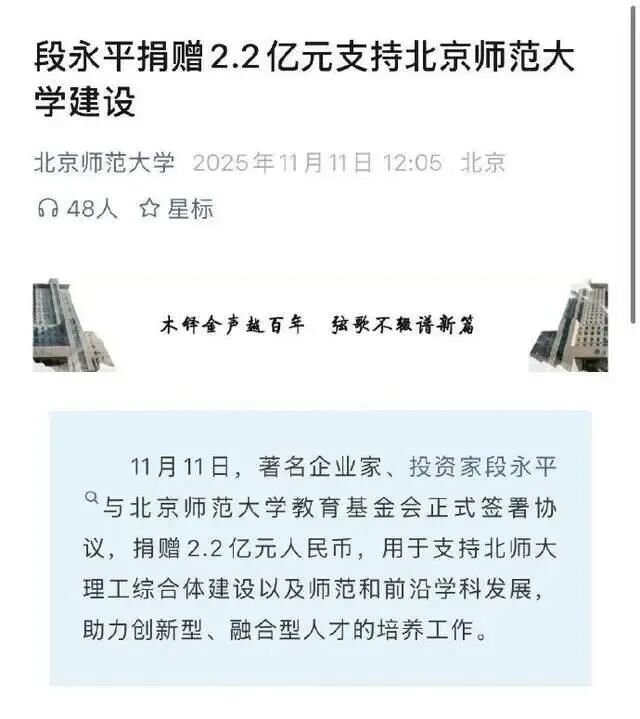
Group 1 - Renowned investor Duan Yongping signed an agreement to donate 220 million RMB to Beijing Normal University, aimed at supporting the construction of the Science and Engineering Complex and the development of teacher training and cutting-edge disciplines [2][4] - This donation follows Duan's previous contribution of 10,000 shares of Kweichow Moutai stock to Jiangxi Water Conservancy and Electric Power University in October [4] - In recognition of Duan Yongping and his mother Peng Jianhua's contributions, Beijing Normal University will name the core academic hub of the Zhuhai campus "Duan Yongping Academic Cloud Ring" and the library of the Science and Engineering Complex "Peng Jianhua Library" [4] Group 2 - Duan Yongping has frequently mentioned Kweichow Moutai in recent discussions, indicating a strong investment interest in the company [5][7] - He has expressed a conservative investment approach, primarily focusing on Kweichow Moutai in the A-share market, emphasizing the importance of understanding the companies one invests in [5][7] - Duan Yongping is recognized as a prominent figure in the investment community, often referred to as "China's Warren Buffett," with a successful track record including investments in companies like NetEase, Apple, and Tencent [7]



打造消费新供给、新场景 激发消费市场潜能 今年“双11” 融合有新意(中国消费向新而行)
Ren Min Ri Bao· 2025-11-11 22:31
Core Insights - The "14th Five-Year Plan" emphasizes expanding domestic demand as a strategic foundation, integrating consumer welfare and investment to stimulate new supply and demand dynamics [1] - The "Double 11" shopping festival showcases a deep integration of online and offline retail, enhancing consumer experience and driving sales growth [2] Group 1: Online and Offline Integration - The "Double 11" event saw a 30% year-on-year increase in foot traffic at JD MALL, with home goods sales surging by 191% [3] - The integration of online platforms and physical stores allows consumers to experience products in-store while ordering online for home delivery, enhancing retail efficiency [2][3] - Meituan reported that nearly one million offline stores participated in its "Double 11" campaign, with significant sales increases in various categories [3] Group 2: Consumption Patterns and Market Trends - The automotive aftermarket is rapidly growing, with online orders for car services and products seeing substantial increases during "Double 11" [4] - Industrial products are also participating in the "Double 11" promotions, with significant growth in service clients and transaction values [4] - The global reach of "Double 11" expanded, with sales and order volumes in international markets growing over 100% [4] Group 3: Financial and Consumer Integration - Financial services are increasingly integrated with consumer experiences, providing discounts and incentives that enhance shopping during "Double 11" [5] - The collaboration between financial institutions and retail platforms is driving consumer spending by offering direct benefits [5] Group 4: Supply and Demand Alignment - The C2M (Customer-to-Manufacturer) model is effectively aligning supply with consumer demand, leading to successful product launches during "Double 11" [6] - The introduction of customized products, such as gaming laptops and insulated bottles, demonstrates the effectiveness of reverse customization in meeting market needs [6] Group 5: Automotive Sector Developments - The launch of new electric vehicles through collaborations between automotive manufacturers and e-commerce platforms highlights the evolving consumer preferences in the automotive sector [7]

股市面面观丨“非洲手机之王”近期股价暴跌超30% 端侧AI方向潜力仍被看好
Xin Hua Cai Jing· 2025-11-11 15:53
Core Viewpoint - Transsion Holdings, known as the "King of African Mobile Phones," has experienced a significant decline in stock price, dropping nearly 35% over 27 trading days since September 25, making it the worst performer among the STAR Market 50 index stocks, which only fell about 6% during the same period [1][3]. Financial Performance - For the first three quarters of 2023, Transsion Holdings reported revenue of 49.54 billion yuan, a year-on-year decrease of 3.33%, and a net profit of 2.148 billion yuan, down 44.97% year-on-year, marking the lowest level for the same period since 2021 [3]. - The company's gross profit margin has fallen to 19.47%, dipping below 20% for the first time in recent years, attributed to market competition and rising supply chain costs [3][4]. - In Q3 2023, Transsion achieved revenue of 20.466 billion yuan, a year-on-year increase of 22.60% and a quarter-on-quarter increase of 27.33%, but the net profit decreased by 11.06% year-on-year to 0.935 billion yuan [3]. Market Competition - Transsion is facing intensified competition in its traditional African market, with domestic brands like Xiaomi, OPPO, and Honor increasing their presence. Xiaomi's market share in Africa has risen to approximately 14%, while Honor holds about 4% [4]. - Despite the competition, Transsion maintains over 50% market share in Africa, indicating its dominant position [4]. Supply Chain Challenges - The recent surge in storage prices has added pressure to Transsion's operations. The company plans to respond to these cost increases through price adjustments and product structure changes [4]. AI Potential - Transsion's potential in edge AI is viewed positively by institutions, with its TECNO AI and Infinix AI being applied in various functions such as image enhancement and voice assistance [5]. - The company is focusing on localized AI solutions to cater to low-resource languages in emerging markets, which could enhance user experience [5]. Strategic Partnerships - Transsion is actively collaborating with major internet companies like NetEase and Tencent to develop mobile internet products, aiming to enhance user experience and market share in key regions [6]. Investment Ratings - In the past month, nine brokerage firms have issued investment ratings for Transsion, with six firms recommending "buy" and two recommending "hold" [7].


段永平,再捐2.2亿元!近期罕见接受访谈,多次提及茅台
第一财经· 2025-11-11 14:59
Core Viewpoint - The article highlights the philanthropic efforts of investor Duan Yongping, who has made significant donations to educational institutions, including a recent donation of 220 million RMB to Beijing Normal University to support the development of innovative and interdisciplinary talent [3][5]. Group 1: Donations and Contributions - Duan Yongping signed an agreement with Beijing Normal University to donate 220 million RMB, aimed at supporting the construction of a comprehensive science and engineering complex and the development of teacher training and cutting-edge disciplines [3][5]. - This donation follows his earlier contribution of 10,000 shares of Kweichow Moutai stock to Jiangxi Water Conservancy and Electric Power University in October [5]. - In recognition of his contributions, Beijing Normal University has named the core academic hub of its Zhuhai campus "Duan Yongping Academic Cloud Ring" and the library of the science and engineering complex "Peng Jianhua Library" [5]. Group 2: Investment Philosophy - Duan Yongping has expressed his investment philosophy in recent interviews, emphasizing the importance of understanding companies before investing, stating that it is difficult to replicate successful investment strategies without a deep understanding of the underlying businesses [6][8]. - He has been vocal about his investments in Kweichow Moutai, indicating a strong belief in the company's potential, and has made several purchases of its stock throughout the year [8]. - Duan Yongping is recognized for his successful investments in major companies like Apple, Tencent, and Kweichow Moutai, earning him the nickname "China's Warren Buffett" [8].

捐出1万股茅台后,投资大佬再捐2.2亿元,支持母亲母校建设
Mei Ri Jing Ji Xin Wen· 2025-11-11 12:09
Group 1 - Entrepreneur and investor Duan Yongping signed an agreement to donate 220 million RMB to Beijing Normal University for the construction of a science and engineering complex and the development of teacher training and cutting-edge disciplines [1] - The donation is in honor of Duan Yongping's mother, Peng Jianhua, who graduated from Beijing Normal University, leading to the naming of the academic cloud hub as "Duan Yongping Academic Cloud Ring" and the library as "Peng Jianhua Library" [2] - Duan Yongping, born in 1961, is known for founding well-known companies such as Subor and BBK, and has made significant investments, including a major stake in NetEase during the 2000 internet bubble [4] Group 2 - Duan Yongping has a history of philanthropy, having donated 40 million USD to Zhejiang University in 2006 and 30 million USD to his alma mater, Renmin University of China, in 2010 [5] - In October of this year, he donated 10,000 shares of Kweichow Moutai stock to establish an educational fund in the name of his parents, who both worked at Jiangxi Water Conservancy and Electric Power University [8]
三季度中国折叠屏手机市场回暖 上市公司持续加码
Zheng Quan Shi Bao Wang· 2025-11-11 10:52
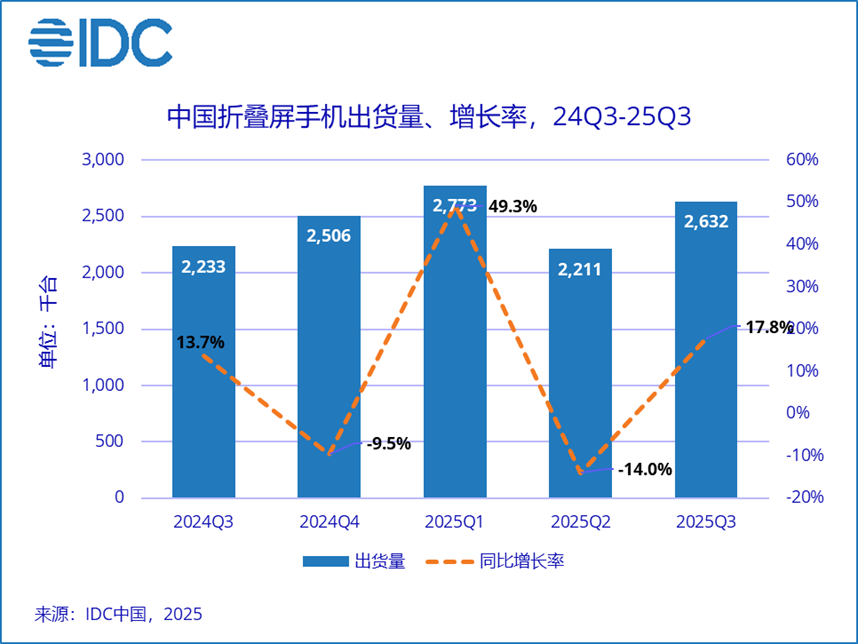
Market Overview - The Chinese foldable smartphone market showed a significant recovery in Q3 2025, with shipments reaching 2.63 million units, a year-on-year increase of 17.8% [1] - Cumulative shipments for the first three quarters of 2025 reached 7.62 million units, reflecting a year-on-year growth of 14.3%, with Huawei holding nearly 70% market share [1] - The market had previously experienced a decline in growth rates starting from Q3 2024, but rebounded in Q1 2025 with a 49.3% year-on-year increase [1] Industry Trends - The foldable smartphone market is expected to approach 10 million units in shipments by 2025, driven by technological advancements that have resolved previous limitations such as weight and structural reliability [2] - The differentiation of foldable smartphones through innovative designs and customized display ratios is helping to overcome market homogenization, creating a dual-driven model of "technology iteration + form innovation" [2] - The industry is transitioning from stock competition to innovation-driven growth, with foldable smartphones becoming a key segment in the high-end smartphone market [2] Product Development Focus - Future competition will focus on enhancing overall product experience, including achieving a lightweight design while improving reliability and functionality [3] - The importance of software and hardware collaboration, as well as ecosystem development, is increasing, with a focus on AI capabilities to enhance user interaction and practical value [3] Company Activities - Companies like LianDe Equipment are actively investing in the foldable screen sector, collaborating with Huawei on screen manufacturing and assembly equipment [4] - Changxin Technology is leveraging its strong technology reserves in the UTG field to provide products to major clients like Honor and OPPO, focusing on joint R&D in cutting-edge technology [4] - BOE Technology has been promoting its flexible AMOLED solutions for three-fold products for several years, continuing to push new technologies into product applications [5]
机构:三季度中国折叠屏手机市场同比增长17.8%
Bei Jing Shang Bao· 2025-11-11 09:47
Core Insights - The Chinese foldable smartphone market is experiencing a significant recovery, with Q3 2025 shipments reaching 2.63 million units, representing a year-on-year growth of 17.8% [1] - Cumulatively, the foldable smartphone market in China saw shipments of 7.62 million units in the first three quarters of 2025, marking a year-on-year increase of 14.3% [1] - IDC forecasts that the foldable smartphone market in China will approach 10 million units in 2025, continuing its growth trend [1] Brand Performance - Huawei maintains a dominant position in the market with nearly 70% market share, showcasing its absolute leadership [1] - Honor ranks second in the industry with an 11.2% market share, driven by the performance of its new products, Magic V5 and Magic V Flip series [1] - The third to fifth positions in the market are held by vivo, OPPO, and Samsung, respectively [1]
IDC:三季度中国折叠屏手机市场回暖 出货量达263万台 同比增长17.8%
智通财经网· 2025-11-11 06:04
Core Insights - The Chinese foldable smartphone market is experiencing a significant recovery, with Q3 2025 shipments reaching 2.63 million units, a year-on-year increase of 17.8% [1] - The total shipments for the first three quarters of 2025 reached 7.62 million units, reflecting a 14.3% year-on-year growth, with expectations to approach 10 million units by the end of the year [1] - Key advancements in technology have addressed traditional pain points such as weight and thickness, leading to improved product experiences and a shift towards mainstream adoption [1][5] Company Performance - Huawei continues to dominate the foldable smartphone market with nearly 70% market share, having surpassed 15 million cumulative shipments [3] - Honor ranks second with an 11.2% market share, driven by the success of its Magic V5 and Magic V Flip series [3] - Vivo holds a 5.0% market share, focusing on competitive pricing and enhancing interoperability with the iOS ecosystem [3] - OPPO, with its Find N5 series, and Samsung, through its Galaxy Z Fold7 series, are also making strides in the market, with Samsung returning to the top five [3] Industry Trends - The foldable smartphone market is transitioning from niche to mainstream, driven by technological advancements and improved user experiences [5] - Innovations in design and functionality, such as three-fold and wide-fold models, are helping to differentiate products in a previously homogeneous market [5] - The industry is expected to shift from competition based on existing products to innovation-driven competition, with foldable smartphones becoming a key segment in the high-end market [5]
IDC:2025年Q3中国折叠屏手机出货量同比增17.8%,华为、荣耀、vivo前三
Feng Huang Wang· 2025-11-11 05:43
Core Insights - The Chinese foldable smartphone market is experiencing a significant recovery, with a projected shipment volume of 2.63 million units in Q3 2025, representing a year-on-year growth of 17.8% [1] - Cumulatively, the shipment volume for the first three quarters of 2023 reached 7.62 million units, showing a year-on-year increase of 14.3% [1] - IDC forecasts that the total shipment volume for the Chinese foldable smartphone market will approach 10 million units in 2025, continuing its growth trend [1] Market Competition Landscape - Huawei maintains a leading position with nearly 70% market share, having shipped over 15 million foldable devices [1] - Honor ranks second with an 11.2% market share, driven by the performance of its Magic V5 and Magic V Flip series [1] - Vivo holds the third position with a 5.0% market share, focusing on price competitiveness and expanding interoperability with the iOS ecosystem through its X Fold5 series [1] - OPPO, with its Find N5 series leveraging flagship chip advantages, ranks fourth by a narrow margin [1] - Samsung re-enters the top five with its Galaxy Z Fold7 series, emphasizing advancements in lightweight design [1]