石药集团

Search documents
资金动向 | 北水加仓美团、中芯国际,连续3日净买入中海油
Ge Long Hui· 2025-10-24 12:36
Group 1 - Southbound funds net bought HK stocks worth HKD 34.14 billion on October 24, with notable net purchases in Meituan (HKD 6.54 billion), SMIC (HKD 6.01 billion), CNOOC (HKD 5.7 billion), Tencent (HKD 3.75 billion), Xiaomi (HKD 2.98 billion), and Alibaba (HKD 1.7 billion) [1] - Southbound funds have continuously net bought SMIC for four days, totaling HKD 17.9796 billion, and Tencent for three days, totaling HKD 9.4926 billion, as well as CNOOC for three days, totaling HKD 29.7542 billion [3] Group 2 - CNOOC's largest offshore oil and gas platform in the Beibu Gulf, the Weizhou 11-4CEPD platform, completed land engineering on October 24 and has entered the offshore installation phase, with a total weight exceeding 14,000 tons and an annual processing capacity exceeding one million tons, which will enhance the region's oil and gas self-sufficiency [4] - Alibaba launched its first self-developed Quark AI glasses on October 24, featuring dual flagship chips from Qualcomm and Hengxuan, while Apple plans to release a competing AI glasses product by the end of 2026 [4] - The Chinese government emphasized the importance of technological modernization in its 14th Five-Year Plan, aiming to enhance independent innovation capabilities and seize opportunities in the new round of technological revolution and industrial transformation [4] Group 3 - A fire incident involving a Li Auto Mega vehicle occurred on October 23 in Shanghai, with the vehicle catching fire during normal operation without prior collision or impact [5][6]





2025年维生素补充剂品牌推荐:个性化营养趋势下的品牌创新
Tou Bao Yan Jiu Yuan· 2025-10-24 12:35
Investment Rating - The report does not explicitly state an investment rating for the vitamin supplement industry Core Insights - The vitamin supplement market is expected to maintain a moderate growth trend due to increasing health awareness among consumers and supportive policies in the health food industry [4][7] - The market structure is characterized by a "pyramid" model, with a few international giants dominating the high-end market, while numerous specialized brands focus on differentiated positioning [9][10] - The industry is evolving towards precision and personalization, with a shift from generic products to customized solutions for specific demographics and health needs [28] Market Background - Vitamin supplements are essential nutrients that support normal bodily functions and are categorized into single vitamin supplements and vitamin-mineral complex supplements [5] - The market has evolved through various stages, from an unregulated early phase to a high-quality growth phase marked by standardized management and increased consumer trust [6] Market Status - The market size for vitamin supplements in China grew from 95.03 billion yuan in 2019 to 103.9 billion yuan in 2023, with a CAGR of 2.3%. It is projected to reach 119.94 billion yuan by 2028, with a CAGR of 3.1% [7] - The average price of vitamin supplements in China was 161.0 yuan in 2023, expected to rise to 177.8 yuan by 2028 [8] Market Competition - The competitive landscape includes three tiers: top-tier companies backed by large pharmaceutical groups, mid-tier specialized health food companies, and a large number of budget brands [15] - The top ten recommended brands include Baihe Co., Huaren Sanjiu, and others, each with unique competitive advantages such as strong brand reputation, extensive distribution networks, and innovative product offerings [16][18][22] Development Trends - The industry is moving towards more complex and functional products, with a focus on combining multiple vitamins and minerals to meet consumer demands for effective health solutions [29] - Sustainable production methods, such as microbial fermentation, are becoming increasingly important, representing a shift towards greener manufacturing processes in the vitamin supplement industry [30]
石药集团近一个月首次上榜港股通成交活跃榜





Zheng Quan Shi Bao Wang· 2025-10-24 12:09
Core Insights - On October 24, 2023, CSPC Pharmaceutical Group made its debut on the Hong Kong Stock Connect active trading list for the first time in a month [2][3] - The total trading volume of active stocks on the Hong Kong Stock Connect reached HKD 457.51 billion, accounting for 40.61% of the day's total trading amount, with a net buying amount of HKD 14.12 billion [2] - Among the active stocks, SMIC had the highest trading volume at HKD 103.55 billion, followed by Alibaba-W and Hua Hong Semiconductor with HKD 89.33 billion and HKD 54.03 billion respectively [2] Trading Activity Summary - CSPC Pharmaceutical Group recorded a trading volume of HKD 5.39 billion on the day, with a net sell amount of HKD 2.47 billion, and its stock price closed down by 3.90% [2][3] - The most frequently listed stocks in the past month include Alibaba-W and Hua Hong Semiconductor, each appearing 16 times, indicating strong interest from Hong Kong Stock Connect investors [2] - Other notable stocks on the active trading list include Tencent Holdings with a trading volume of HKD 35.65 billion and a net buying amount of HKD 3.75 billion, and Xiaomi Group-W with HKD 45.85 billion and a net buying amount of HKD 2.99 billion [2]
港股通(沪)净买入7.04亿港元
Zheng Quan Shi Bao· 2025-10-24 11:38
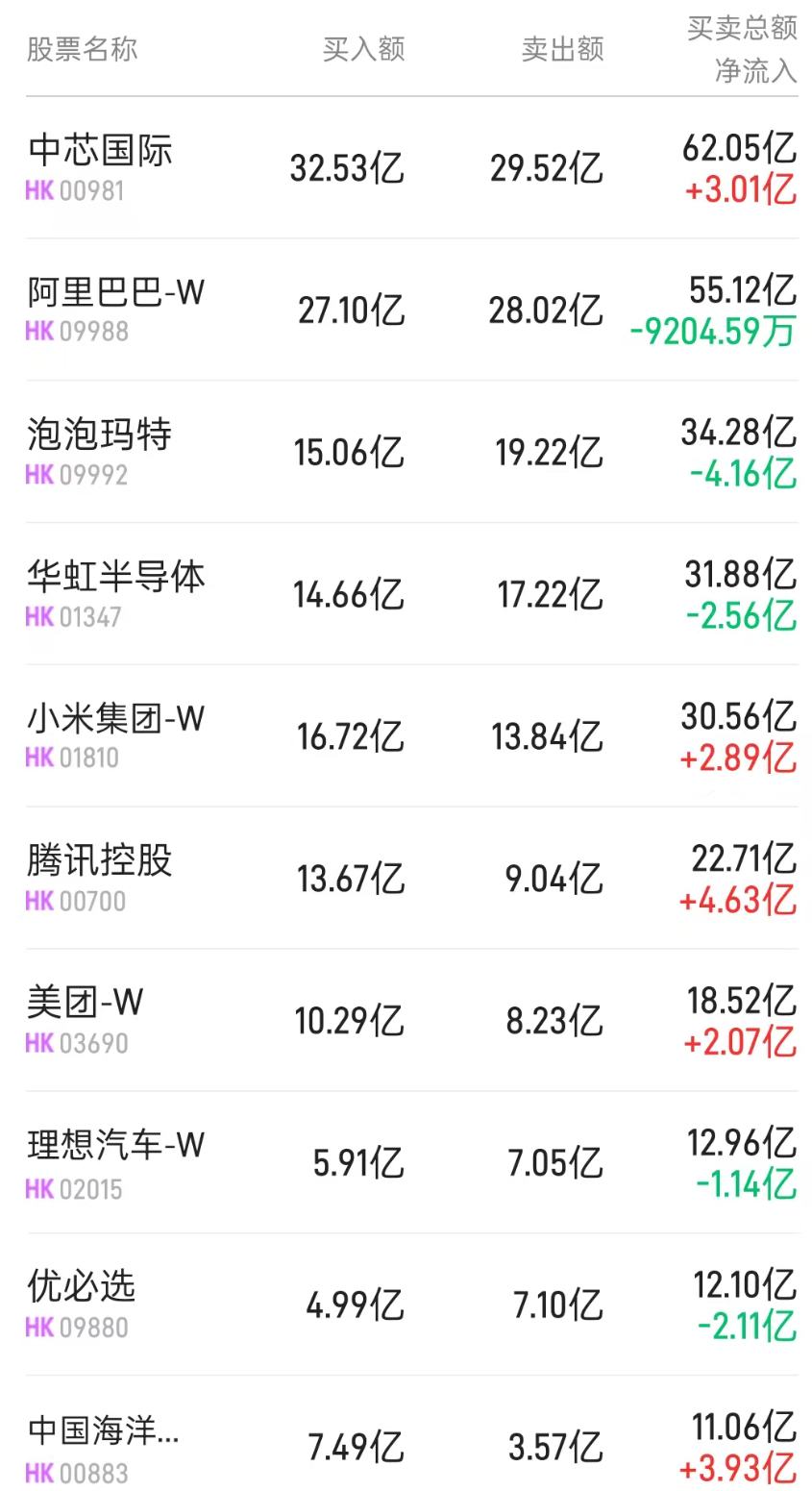
Market Overview - On October 24, the Hang Seng Index rose by 0.74%, closing at 26,160.15 points, with a net inflow of HKD 34.14 billion through the southbound trading channel [1] - The total trading volume for the southbound trading was HKD 1,126.62 billion, with a net buy of HKD 34.14 billion [1] Southbound Trading Details - The Shanghai Stock Exchange's southbound trading had a total transaction amount of HKD 726.19 billion, with a net buy of HKD 7.04 billion [1] - The Shenzhen Stock Exchange's southbound trading had a total transaction amount of HKD 400.44 billion, with a net buy of HKD 27.10 billion [1] Active Stocks - In the Shanghai Stock Exchange's southbound trading, the most actively traded stock was SMIC, with a transaction amount of HKD 62.05 billion, followed by Alibaba-W and Pop Mart, with transaction amounts of HKD 55.12 billion and HKD 34.28 billion, respectively [1] - In terms of net buying, Tencent Holdings had the highest net buy amount of HKD 4.63 billion, with its stock price increasing by 0.71% [1] - Pop Mart had the highest net sell amount of HKD 4.16 billion, with its stock price decreasing by 0.86% [1] Shenzhen Stock Exchange Active Stocks - In the Shenzhen Stock Exchange's southbound trading, SMIC led with a transaction amount of HKD 41.50 billion, followed by Alibaba-W and Huahong Semiconductor, with transaction amounts of HKD 34.21 billion and HKD 22.16 billion, respectively [2] - The stock with the highest net buy was Meituan-W, with a net buy of HKD 4.48 billion, and its stock price rose by 0.60% [2] - The stock with the highest net sell was CSPC Pharmaceutical Group, with a net sell of HKD 2.47 billion, and its stock price fell by 3.90% [2]

港股创新药ETF(159567)跌0.12%,成交额7.97亿元
Xin Lang Cai Jing· 2025-10-24 11:38
Core Points - The Hong Kong Innovative Drug ETF (159567) closed down 0.12% with a trading volume of 797 million yuan on October 24, 2024 [1] - The fund was established on January 3, 2024, with a management fee of 0.50% and a custody fee of 0.10% [1] - As of October 23, 2024, the fund's latest share count was 8.225 billion shares, with a total size of 6.801 billion yuan, reflecting a year-to-date increase of 1980.29% in shares and 1700.12% in size [1] Fund Performance - The current fund manager is Ma Jun, who has managed the fund since its inception, achieving a return of 65.38% during the tenure [2] - The fund's performance benchmark is the National Index for Hong Kong Innovative Drugs, adjusted for valuation exchange rates [1] Liquidity and Trading Activity - Over the last 20 trading days, the ETF has accumulated a trading amount of 22.849 billion yuan, with an average daily trading amount of 1.142 billion yuan [1] - Since the beginning of the year, the ETF has recorded a total trading amount of 227.996 billion yuan over 195 trading days, averaging 1.169 billion yuan per day [1] Top Holdings - The ETF's top holdings include: - Innovent Biologics (9.52% holding, 26 million yuan market value) - WuXi Biologics (9.47% holding, 25.8 million yuan market value) - BeiGene (8.73% holding, 23.8 million yuan market value) - CanSino Biologics (7.62% holding, 20.8 million yuan market value) - China National Pharmaceutical Group (7.17% holding, 19.6 million yuan market value) [2]


董事会“掀桌”,诺和诺德的转折点
3 6 Ke· 2025-10-24 11:12
Core Viewpoint - Novo Nordisk is undergoing significant management upheaval, with two CEO changes and a mass board resignation within six months, raising concerns about the company's stability and future direction [1][2][3]. Management Changes - Lars Fruergaard Jørgensen was replaced as CEO in May 2025, followed by Maziar Mike Doustdar's appointment in August, which initially boosted stock prices by 39% [1]. - On October 21, 2025, Novo Nordisk announced the resignation of seven board members, including the chairman, due to disagreements with the majority shareholder, the Novo Nordisk Foundation, regarding board composition [1][2]. Board Restructuring - The Novo Nordisk Foundation proposed a more extensive board restructuring, aiming to appoint Lars Rebien Sørensen as chairman, who previously served as CEO from 2000 to 2016 [2]. - The new board is seen as a transitional government, with a mandate to support the new management in executing transformation plans and identifying a long-term chairman [2]. Market Challenges - Novo Nordisk faces challenges in the obesity treatment market, losing its competitive edge to Eli Lilly, which has gained market share with its GLP-1 drug, tirzepatide [3][6]. - The company is implementing a global restructuring plan, including a workforce reduction of approximately 9,000 employees by the end of 2026, to focus on growth opportunities in diabetes and obesity [3][5]. Financial Implications - The restructuring is expected to yield annual savings of around 8 billion Danish kroner (approximately 8.85 billion RMB) by the end of 2026 [5]. - The company's stock price has significantly declined, from $143 in July 2024 to a low of $45 in August 2025, resulting in a market capitalization loss of over $480 billion [6]. Production and Supply Issues - Novo Nordisk's GLP-1 drug, semaglutide, faced supply shortages, leading to its inclusion on the FDA's drug shortage list, which allowed for the rapid rise of generic alternatives [7][9]. - The company has been criticized for its slow response to expand production capacity, which has allowed competitors to capture market share [9][10]. Strategic Shifts - Novo Nordisk is recognizing the need to adapt to the consumer-driven nature of the obesity treatment market, which requires a shift from traditional hospital-based sales to more dynamic consumer marketing strategies [10][12]. - The company has begun collaborating with e-commerce platforms in China to enhance its market presence, reflecting a shift towards a more consumer-oriented approach [13][14].
半导体板块,暴涨!
Zhong Guo Ji Jin Bao· 2025-10-24 10:56
Market Performance - The Hong Kong stock indices all rose on October 24, with the Hang Seng Index increasing by 0.74% to 26,160.15 points, marking a weekly gain of 3.62% [1][2] - The Hang Seng Tech Index rose by 1.82% to 6,059.89 points, with a weekly increase of 5.2% [1][2] - The Hang Seng China Enterprises Index increased by 0.68% to 9,363.94 points, achieving a weekly gain of 3.91% [1][2] - Southbound funds recorded a net inflow of HKD 3.214 billion [1] Stock Performance - Among the Hang Seng Index constituents, 61 stocks rose while 22 fell [2] - Notable gainers included SMIC, which rose by 8.04%, China Hongqiao by 4.29%, and WuXi AppTec by 3.95% [2][3] - The semiconductor sector showed strong performance, with the semiconductor industry index rising by 8.33% [6][12] Sector Analysis - The semiconductor industry is experiencing a robust uptrend, driven by domestic substitution and industry recovery [6] - The Wind concept sector saw most indices rise, with the financial IC index up by 13.63%, integrated circuit industry fund index up by 9.03%, and integrated circuit index up by 8.59% [4] - The Hang Seng Tech Index constituents had 26 stocks rising and 4 falling, with Huahong Semiconductor leading with a gain of 13.73% [4][12] Economic Outlook - Deutsche Bank raised its GDP growth forecast for China to 5.0% for the year, citing industrial and export growth as key drivers [15] - The report highlighted the need for policy stimulus to address weak consumption and investment, while also noting the potential impact of external factors like US-China trade relations on exports [15]
最新出炉!10月24日港股通净流入34.14亿港元,其中6.548亿港元都买了它
Mei Ri Jing Ji Xin Wen· 2025-10-24 10:45
Summary of Key Points Core Viewpoint - The southbound capital market shows active trading with notable net buying and selling activities among specific stocks, indicating investor sentiment and market trends in Hong Kong [2]. Group 1: Net Buying Stocks - Meituan-W (3690.HK) had the highest net buying amount of 654.8 million HKD, closing at 100.6 HKD with a price increase of 0.60% [4]. - SMIC (0981.HK) recorded a net buying of 602 million HKD, closing at 80.0 HKD with an increase of 8.04% [4]. - CNOOC (0883.HK) saw a net buying of 571 million HKD, closing at 20.02 HKD with a slight increase of 0.50% [4]. - Tencent Holdings (0700.HK) had a net buying of 375 million HKD, closing at 637.5 HKD with a rise of 0.71% [4]. - Xiaomi Group-W (1810.HK) experienced a net buying of 299 million HKD, closing at 45.92 HKD with a decrease of 1.75% [4]. - Alibaba-W (9988.HK) had a net buying of 171 million HKD, closing at 168.3 HKD with an increase of 2.25% [4]. - Hua Hong Semiconductor (1347.HK) recorded a net buying of 70 million HKD, closing at 82.4 HKD with a significant increase of 13.73% [4]. Group 2: Net Selling Stocks - Pop Mart (9992.HK) had the highest net selling amount of 628.6 million HKD, closing at 230.4 HKD with a decrease of 0.86% [2][4]. - Li Auto-W (2015.HK) experienced a net selling of 114 million HKD, closing at 85.1 HKD with a decrease of 2.07% [4]. - ZTE Corporation (0763.HK) saw a net selling of 130 million HKD, closing at 40.38 HKD with an increase of 5.32% [4]. - UBTECH (9880.HK) had a net selling of 211 million HKD, closing at 142.7 HKD with an increase of 6.81% [4]. - CSPC Pharmaceutical Group (1093.HK) recorded a net selling of 247 million HKD, closing at 7.89 HKD with a decrease of 3.90% [4].
南向资金连续买入港股 四季度可能发生重大风格切换
Xin Lang Cai Jing· 2025-10-24 10:32
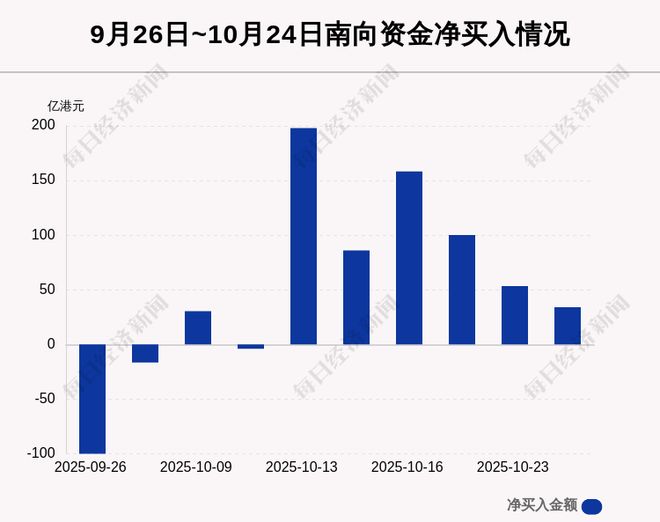
Market Performance - The Hong Kong stock market saw all three major indices rise, with the Hang Seng Index up 0.74% to close at 26,160.15 points, the Hang Seng Tech Index rising 1.82% to 6,059.89 points, and the National Enterprises Index increasing by 0.68% [1] - The total trading volume for the day reached 226.614 billion HKD [1] Sector Highlights - The semiconductor sector performed exceptionally well, with Hua Hong Semiconductor soaring nearly 14% to 82.4 HKD per share, and SMIC rising by 8% [1] - Research indicates that strong AI demand is expected to drive continued growth in the storage market, with price increases for storage products likely to persist until Q4 2025 due to limited capacity from major overseas suppliers [1] Capital Flows - Southbound funds continued to show a net inflow, with a net purchase of 3.414 billion HKD for the day [1] - The top three net purchases were Meituan-W (655 million HKD), SMIC (602 million HKD), and CNOOC (571 million HKD), while Pop Mart, CSPC Pharmaceutical, and UBTECH faced net sell-offs of 629 million HKD, 247 million HKD, and 211 million HKD respectively [1][2] Future Outlook - Institutions remain optimistic about the Hong Kong stock market, with expectations of a significant style shift in Q4, favoring low-position growth sectors like Hang Seng Tech [3] - CITIC Securities believes that the potential restart of the Federal Reserve's rate cut cycle will benefit the Hong Kong market, particularly the tech sector within the AI industry chain [3] - Huatai Securities notes that the market's central tendency remains unchanged, supported by ample liquidity, stable domestic policies, and positive trends in AI, new consumption, and pharmaceuticals [3]
北水动向|北水成交净买入34.14亿 内资重新加仓芯片股 全天买入中芯国际(00981)超6亿港元
智通财经网· 2025-10-24 10:00
Core Insights - The Hong Kong stock market saw a net inflow of 34.14 billion HKD from northbound trading on October 24, with the Shanghai-Hong Kong Stock Connect contributing 7.04 billion HKD and the Shenzhen-Hong Kong Stock Connect contributing 27.1 billion HKD [1] Group 1: Stock Performance - Meituan-W (03690) received a net inflow of 6.54 billion HKD, driven by strategic leadership changes and the upcoming launch of its Keeta brand in Brazil [4] - Semiconductor stocks, particularly SMIC (00981) and Huahong Semiconductor (01347), saw net inflows of 6.01 billion HKD and 696.5 million HKD respectively, supported by domestic self-sufficiency trends and strong AI chip demand [5] - CNOOC (00883) attracted a net inflow of 5.7 billion HKD, with positive sentiment stemming from geopolitical factors affecting oil supply [5] Group 2: Notable Stock Movements - Alibaba-W (09988) experienced a net inflow of 1.7 billion HKD, with Goldman Sachs projecting significant capital expenditures driven by AI demand [6] - Li Auto-W (02015) faced a net outflow of 1.13 billion HKD following a vehicle fire incident, although the company has assured safety measures were in place [7] - Tencent (00700) and Xiaomi Group-W (01810) saw net inflows of 3.75 billion HKD and 2.98 billion HKD respectively, while CSPC Pharmaceutical Group (01093) and ZTE Corporation (00763) faced net outflows of 2.46 billion HKD and 1.29 billion HKD [7]