
招商银行

Search documents
多家银行卫星,近期集中上天
财联社· 2026-01-20 11:47
Core Viewpoint - The recent surge in commercial aerospace has prompted banks to actively participate in satellite launches to enhance their risk control capabilities, utilizing satellite remote sensing technology for real-time monitoring of loan projects and collateral status [1][2]. Group 1: Satellite Launches by Banks - Multiple leading banks, including China Merchants Bank and Shanghai Pudong Development Bank, have successfully launched satellites as part of the "Tianqi Constellation," China's first global low-orbit satellite IoT network [2]. - The satellites are aimed at improving smart risk control and comprehensive service systems, particularly in extreme scenarios like natural disasters, enabling rapid recovery and provision of essential financial services [2][3]. - China Merchants Bank's "Zhaoyin Jinkui" satellite is designed for post-loan monitoring, achieving over 95% accuracy in construction progress monitoring through high-resolution satellite imagery [2][3]. Group 2: Industry Trends and Applications - The use of satellite remote sensing technology is becoming increasingly common among banks, with several major banks already implementing it to optimize their business and risk management [3][4]. - The integration of satellite data is seen as a significant upgrade in risk control methods, particularly beneficial in areas like rural revitalization, green finance, and supply chain finance, addressing information asymmetry and reducing credit risks [4]. - Major banks, such as ICBC and Bank of China, have reported plans to enhance their credit risk management through satellite technology in their 2025 semi-annual reports [4]. Group 3: Future Prospects and Challenges - Smaller regional banks are also beginning to engage in satellite technology, with institutions like Shanghai Rural Commercial Bank enhancing their smart supply chain platforms through the integration of satellite remote sensing and other technologies [5]. - Analysts suggest that while the costs associated with satellite launches and data integration are currently high, larger banks are better positioned to adopt these technologies, whereas smaller banks may need to collaborate or procure data services [5]. - As the deployment of low-orbit satellite networks accelerates and data costs decrease, the penetration of satellite remote sensing technology in the banking sector is expected to increase [5].




金价创新高,有银行这种存款售罄,最高年化8%能冲吗?
3 6 Ke· 2026-01-20 11:01
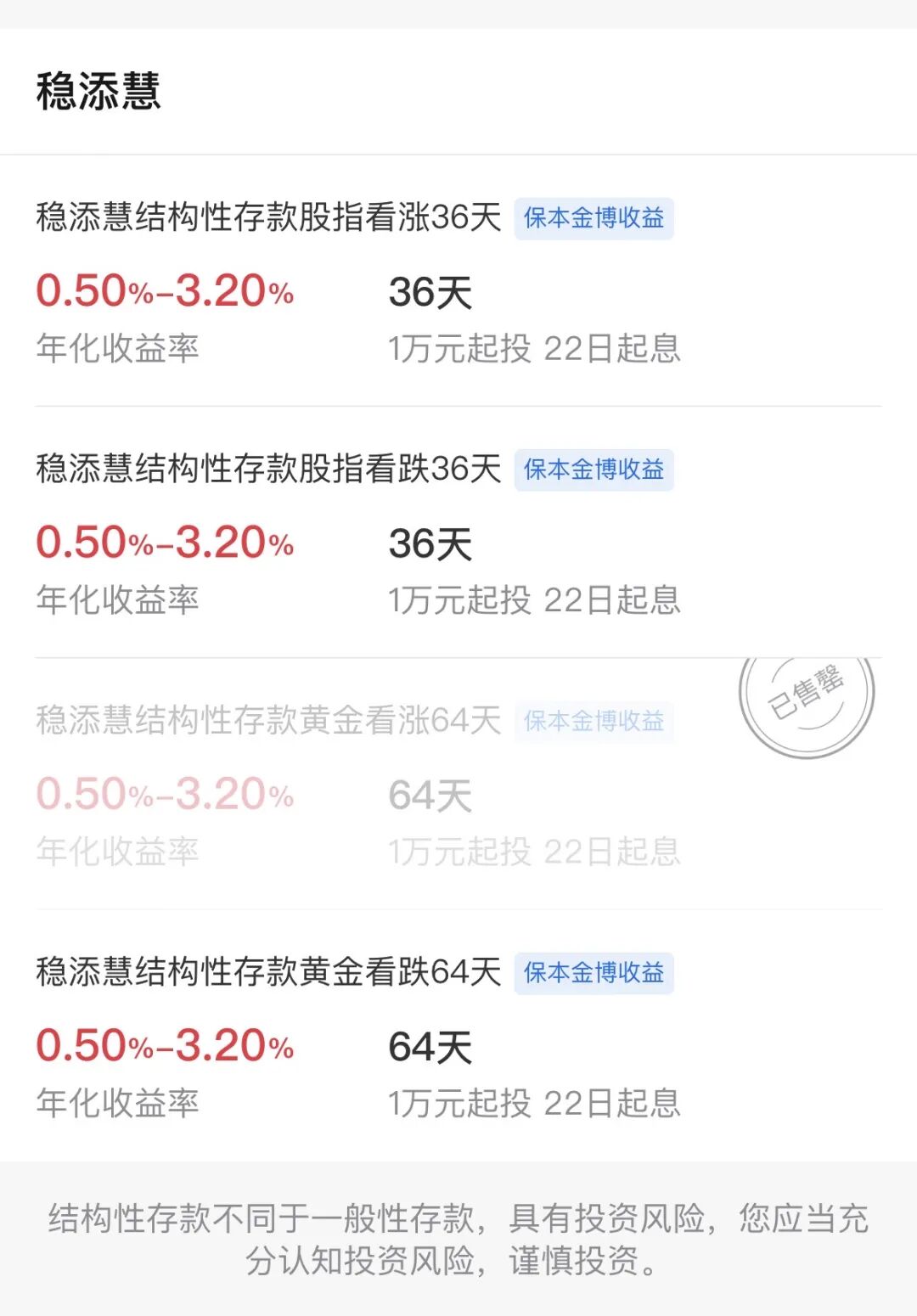
Core Viewpoint - The recent surge in gold prices has led to increased interest in structured deposits linked to gold, with some products offering annualized returns as high as 8% [1][9]. Group 1: Structured Deposit Products - Many banks are launching structured deposit products linked to gold, with varying annualized returns. For example, China Bank offers a product with a return range of 0.2% to 5.2% and a minimum investment of 10,000 yuan for a term of 87 days [1][4]. - The "Wenti Hui" structured deposit from the Bank of Communications includes four products with annualized returns between 0.5% and 3.20%, with a subscription period from January 14 to 20 [1][3]. - Minsheng Bank has introduced over ten gold-linked structured deposit products, with one example offering a return of 0.5% to 3.55% for a term of 97 days and a minimum investment of 5,000 yuan [6]. Group 2: Market Trends and Statistics - As of December 2025, the balance of structured deposits in Chinese banks reached 4.25 trillion yuan, a year-on-year increase of 6.01%. Unit structured deposits accounted for 69.49% of this total [8]. - A significant number of A-share listed companies have announced investments in structured deposits, with Sujiao Ke Group investing 90 million yuan in a product linked to gold prices [8][9]. - The popularity of gold-linked structured deposits is attributed to rising inflation and market volatility, prompting investors to seek alternatives to traditional savings products [9][10]. Group 3: Risk and Investment Considerations - Structured deposits are designed to provide higher returns than traditional savings while offering some level of principal protection. However, they carry investment risks due to their linkage to financial derivatives [10]. - Investors are advised to understand the terms of each product, as the level of principal protection can vary significantly [13].
国信证券王开:策略研究进入全球资产配置的新时代
点拾投资· 2026-01-20 11:01
Core Viewpoint - The year 2025 is seen as a pivotal moment for global asset allocation among Chinese households, with a significant increase in the scale of FOF products and growing interest in global assets like US stocks and gold [1]. Group 1: Changes in Asset Allocation Paradigms - Traditional stock-bond allocation frameworks are no longer sufficient to meet current financial needs, as stocks exhibit high volatility and low win rates, while bond yields are too low [3][4]. - From 2024, more FOF clients are seeking higher win-rate global asset allocation combinations, with a focus on assets like the Nasdaq and gold ETFs, which have historically shown higher success rates [3][4]. - Emerging markets such as India and Vietnam are being explored for their potential, as they replicate the urbanization and industrialization logic seen in China's past [3][4]. Group 2: Market Insights and Historical Context - The performance of "old blue-chip stocks" in China, which have seen stagnant profit growth but high dividend yields, mirrors the current growth stocks in emerging markets like India and Vietnam [4]. - Japan's experience during its low-interest era, where institutional investors significantly increased global asset allocations, serves as a reference point for current trends [15]. Group 3: Evolving Research and Strategy Frameworks - The shift from traditional top-down strategies to a more nuanced global asset allocation approach reflects the changing landscape of wealth management, with a focus on integrating various asset classes [9][11]. - The development of a comprehensive high-frequency data system and the need for more granular industry analysis highlight the evolution of investment strategies [11][12]. Group 4: Future Outlook on Key Assets - Gold is expected to gain importance as a safe-haven asset, especially in light of geopolitical tensions and the weakening of dollar credibility, with predictions of significant price increases [16]. - The long-term outlook for US stocks remains positive, driven by substantial capital expenditures in the tech sector, particularly in AI, which is anticipated to yield profitable returns [17][18]. Group 5: Role of AI in Investment Strategies - AI is transforming investment research by enhancing efficiency and allowing for more objective analysis, thus reducing emotional biases in decision-making [20]. - The integration of AI into investment frameworks is expected to streamline processes and improve the accuracy of asset allocation strategies [20]. Group 6: Organizational Changes and Research Integration - The restructuring of the research team under the leadership of a chief economist aims to enhance collaboration across various sectors, facilitating a more integrated approach to asset allocation [21].


A股两融余额结束10连增
Zheng Quan Shi Bao Wang· 2026-01-20 10:51
Core Viewpoint - The A-share market has experienced a cooling in margin trading, ending a streak of ten consecutive increases in margin balance as new regulations were implemented on January 19, 2026 [1][2]. Group 1: Margin Trading Regulations - On January 19, 2026, the minimum margin requirement for investors financing the purchase of securities was raised from 80% to 100% [3]. - This adjustment applies only to new financing contracts, while existing contracts will continue under the previous regulations [3]. Group 2: Market Data and Trends - As of January 19, 2026, the margin trading balance in the A-share market was approximately 27,232 billion yuan, a decrease of about 84 billion yuan from the previous trading day, marking the end of a ten-day growth streak [2]. - The financing balance on the same day was around 27,059 billion yuan, down by approximately 85 billion yuan, also ending a ten-day increase [2]. - The total margin trading volume on January 19 was about 2,684 billion yuan, the lowest daily figure since January 6, 2026, and the lowest for the year [2]. - The proportion of margin trading volume to total A-share trading volume fell to 9.82%, the first time it has been below 10% since December 16, 2025, compared to 11.01% on January 16, 2026 [2]. Group 3: High Margin Balances in Specific Stocks - Despite the overall decline in margin trading balance, many stocks still maintain high margin balances, with 17 stocks having balances exceeding 10 billion yuan as of January 19, 2026 [4]. - Notably, stocks such as China Ping An, Dongfang Wealth, and Ningde Times have margin balances exceeding 20 billion yuan [4].
消费贷贴息加码:增信用卡分期、城商行等机构
Xin Lang Cai Jing· 2026-01-20 10:41
Core Viewpoint - The Chinese government has extended the personal consumption loan interest subsidy policy until the end of 2026, including credit card installment payments in the subsidy scope, to stimulate domestic consumption and support economic growth [3][12][13]. Policy Extension and Scope Expansion - The personal consumption loan interest subsidy policy's deadline has been extended from August 31, 2026, to December 31, 2026 [4][14]. - Credit card installment payments are now included in the subsidy, with an annual interest subsidy rate of 1% [5][14]. - The policy aims to enhance consumer spending and support the healthy development of credit card businesses [5][14]. Increase in Eligible Institutions and Scenarios - The policy has expanded the range of eligible institutions to include city commercial banks rated 3A and above, rural cooperative financial institutions, foreign banks, consumer finance companies, and auto finance companies [6][16]. - The central and provincial finances will cover 90% and 10% of the subsidy funds, respectively, maintaining the previous funding ratio [6][16]. - The policy encourages innovation in consumer credit products and aims to create more financial support scenarios for consumption, enhancing the coverage and activity of service consumption [8][18]. Impact on Consumer Behavior and Market Dynamics - The subsidy policy is expected to significantly lower the actual costs for consumers, thereby boosting their willingness to spend [5][10]. - The policy's implementation has already led to a substantial increase in consumer loan applications and disbursements, indicating strong market demand [17]. - The removal of previous limits on subsidy amounts is anticipated to provide consumers with greater flexibility and choice, potentially leading to increased consumption [19][20]. Recommendations for Implementation - To optimize the implementation of the subsidy policy, it is suggested to enhance the precision of policy design, improve execution efficiency, and ensure better coordination among related policies [20]. - There is a call for dynamic adjustments to the supported industries and consumption areas based on local consumption trends and industrial planning [20].

招行信用卡迎新“掌门”:厉明东到任,老将刘加隆转任顾问、曾三度执掌卡中心
Xin Lang Cai Jing· 2026-01-20 10:37
Core Insights - The leadership of China Merchants Bank's Credit Card Center has changed, with Liu Jialong retiring and Li Mingdong set to take over pending regulatory approval [1][2] Group 1: Leadership Transition - Liu Jialong, a veteran with 30 years at China Merchants Bank, has served multiple terms as the head of the Credit Card Center and has been instrumental in the development of the bank's credit card business [1][4] - Li Mingdong, the incoming general manager, has extensive experience in retail finance and wealth management, having held various senior positions within the bank [1][5] Group 2: Credit Card Business Development - Under Liu Jialong's leadership, the bank's credit card business has been at the forefront of industry innovation, particularly in digital transformation, including the launch of the first mobile app in the industry and the introduction of smart customer service platforms [4] - The bank's credit card issuance has seen significant growth, with over 1 billion cards issued by the end of 2017, although the industry is now facing a decline, with the total number of credit cards in China dropping from 8.07 billion in September 2022 to 7.07 billion in September 2025 [5][6] Group 3: Industry Challenges - The credit card industry is undergoing a transformation from rapid growth to a focus on high-quality development, facing challenges such as risk management, declining consumer spending, and narrowing interest margins [6] - As of September 2025, the bank reported a credit card transaction volume of 20,209.60 billion yuan, a year-on-year decrease of 8.54%, and a decline in both interest and non-interest income [6] - The bank's non-performing loan ratio for credit cards was reported at 1.74% as of September last year, a slight decrease from 1.75% at the end of 2024 [7]
财政部连发多份重要文件,事关贷款贴息、民间投资贷款担保等 一揽子政策全文公布
Sou Hu Cai Jing· 2026-01-20 09:03
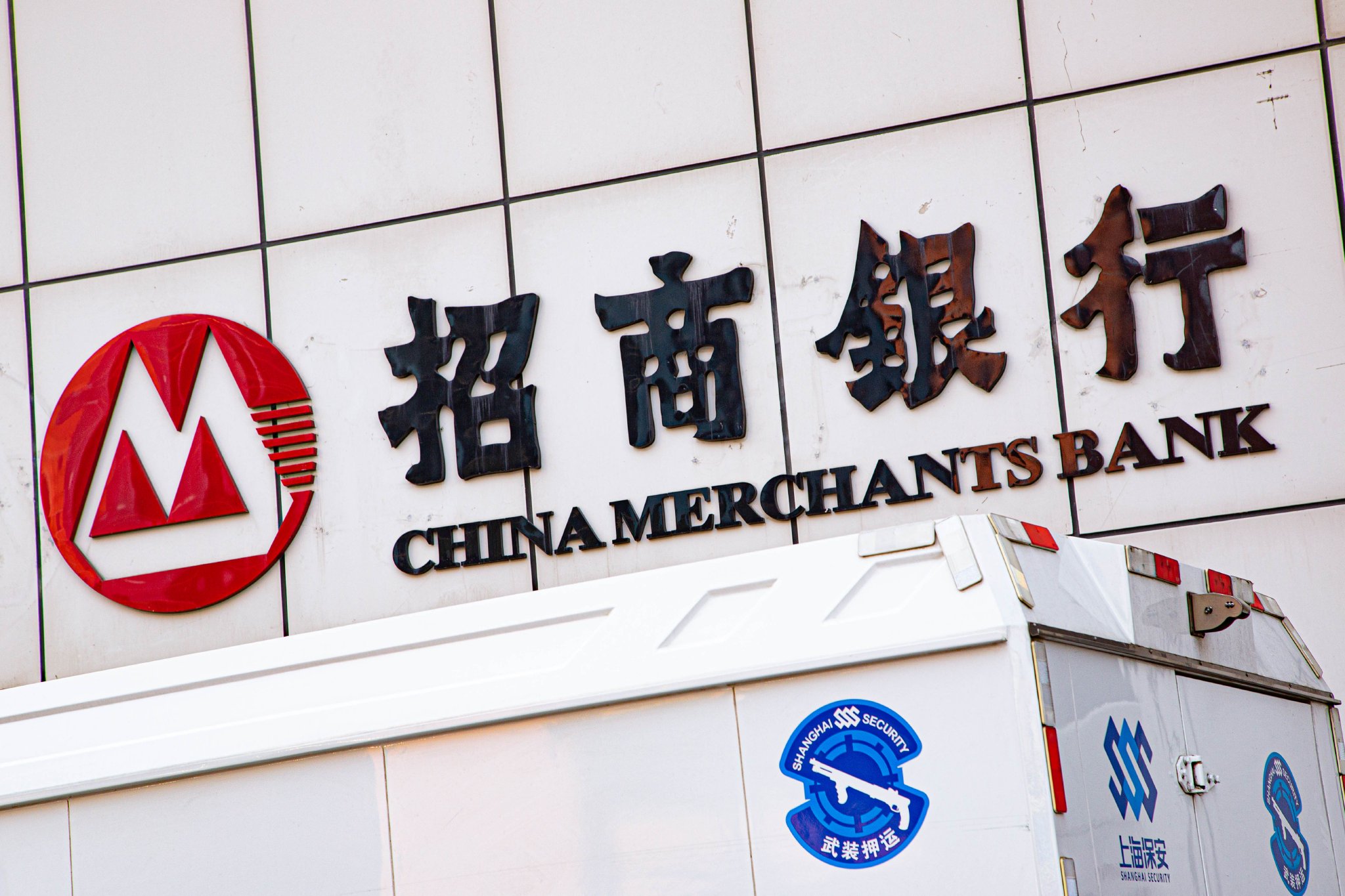
Group 1 - The core viewpoint of the news is the implementation of a financial subsidy policy for equipment renewal loans to support businesses in reducing financing costs and promoting effective investment [3][4][5] - The policy includes a 1.5% interest subsidy on fixed asset loans for equipment renewal projects, applicable for a maximum of two years, and is effective until December 31, 2026 [3][4] - The scope of support has been expanded to include various sectors such as construction, aviation, digital technology, and green energy, emphasizing high-end, intelligent, and digital equipment updates [4][6] Group 2 - A total of 26 banks are designated as eligible for processing the interest subsidy loans, including major national banks and several regional banks [4][5] - The subsidy process has been optimized to include a "pre-allocation + settlement" method, streamlining the application and approval process for banks and provincial financial departments [5][6] - The policy aims to enhance the experience of businesses by ensuring timely communication regarding subsidy payments through modern technology [6][7] Group 3 - The policy for small and micro enterprises includes a 1.5% interest subsidy on fixed asset loans, with a maximum loan amount of 50 million yuan, effective from January 1, 2026 [8][9] - The targeted sectors for this subsidy include new energy vehicles, medical equipment, and various service industries, aiming to stimulate investment and production [9][10] - The operational mechanism involves a "total-to-total" model for coordination between financial institutions and fiscal departments to ensure efficient processing of subsidy funds [11][12] Group 4 - The service industry loan subsidy policy has been extended until December 31, 2026, with an increased maximum loan amount of 10 million yuan and a 1% interest subsidy for one year [16][17] - New sectors such as digital, green, and retail have been added to the support scope, enhancing the policy's relevance to current economic trends [17][18] - The funding allocation process has been refined to improve efficiency and reduce redundancy in the approval process [18][19] Group 5 - A special guarantee plan for private investment has been introduced with a total quota of 500 billion yuan over two years, aimed at supporting small and micro enterprises [22][24] - The plan includes risk-sharing mechanisms where banks bear at least 20% of the loan risk, while the government guarantee fund covers up to 80% [24][25] - The initiative encourages innovative financing models and aims to enhance the capital strength of the government guarantee fund to support private investments effectively [26][27]




A股重磅!宽基ETF连续出现净赎回,有“巨无霸”份额回落至“924”行情之前,多只科创、创业板系ETF份额缩水,发生了啥?
Jin Rong Jie· 2026-01-20 08:57
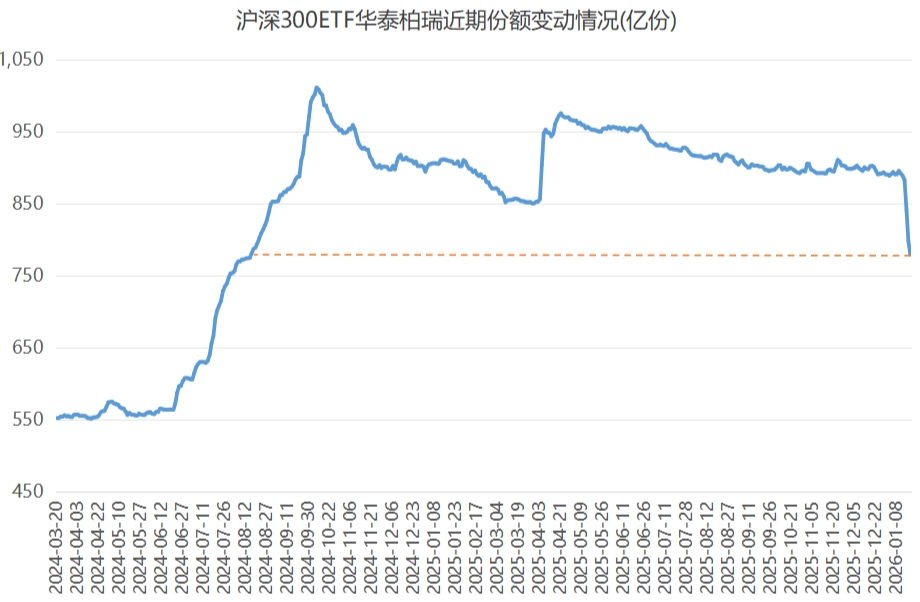
Group 1 - Recent net redemptions in A-share broad-based ETFs have drawn market attention, with significant outflows recorded on January 15 and 16, totaling 687 billion and 863 billion respectively, marking the highest single-day outflows in history [1] - As of January 19, four out of six major broad-based ETFs saw their shares decline by over 10% in the last three trading days, with the largest, Huatai-PB CSI 300 ETF, dropping to 778.63 billion shares, a scale of approximately 369.2 billion, the lowest since August 2024 [1] - The ChiNext and STAR Market ETFs also experienced significant declines, with the E Fund STAR 50 ETF and E Fund ChiNext ETF seeing share reductions of 34.55% and 20.22% respectively [3] Group 2 - In contrast to the outflows from broad-based ETFs, certain commodity, cross-border, and narrow-based ETFs attracted significant inflows, with the Southern Nonferrous ETF being the only product to receive over 10 billion in net inflows, totaling 100.87 billion, driven by rising base metal prices [3] - Other ETFs such as Yongying Satellite ETF, Harvest Software ETF, and GF Media ETF also received net inflows exceeding 6 billion [3] - According to CITIC Securities, the impact of ETF redemptions on individual stocks was significant, with main board, ChiNext, and STAR Market stocks experiencing sell-offs of 946 billion, 334 billion, and 265 billion respectively during the peak outflow days [3] Group 3 - Regulatory measures have been implemented to cool down the market following rapid price increases and overheated sentiment, including raising the minimum margin requirement for margin trading from 80% to 100% [5][6] - The China Securities Regulatory Commission emphasized the need for comprehensive market monitoring and timely counter-cyclical adjustments to maintain market stability and prevent excessive volatility [6] - There are differing views on the long-term outlook for A-shares, with some analysts suggesting the potential for a slow bull market due to reforms, while others remain skeptical about escaping historical volatility patterns [7]



股份制银行板块1月20日涨0.54%,中信银行领涨,主力资金净流入3.9亿元
Zheng Xing Xing Ye Ri Bao· 2026-01-20 08:56
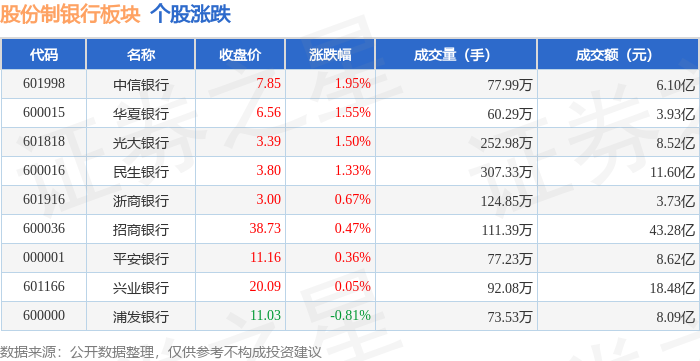
Core Viewpoint - The banking sector saw a slight increase of 0.54% on January 20, with CITIC Bank leading the gains, while the Shanghai Composite Index experienced a minor decline of 0.01% [1] Group 1: Stock Performance - CITIC Bank closed at 7.85, up by 1.95% with a trading volume of 779,900 shares and a transaction value of 610 million yuan [1] - Huaxia Bank closed at 6.56, up by 1.55% with a trading volume of 602,900 shares and a transaction value of 393 million yuan [1] - Everbright Bank closed at 3.39, up by 1.50% with a trading volume of 2,529,800 shares and a transaction value of 852 million yuan [1] - Minsheng Bank closed at 3.80, up by 1.33% with a trading volume of 3,073,300 shares and a transaction value of 1.16 billion yuan [1] - Zhejiang Commercial Bank closed at 3.00, up by 0.67% with a trading volume of 1,248,500 shares and a transaction value of 373 million yuan [1] - China Merchants Bank closed at 38.73, up by 0.47% with a trading volume of 1,113,900 shares and a transaction value of 4.33 billion yuan [1] - Ping An Bank closed at 11.16, up by 0.36% with a trading volume of 772,300 shares and a transaction value of 862 million yuan [1] - Industrial Bank closed at 20.09, up by 0.05% with a trading volume of 920,800 shares and a transaction value of 1.85 billion yuan [1] - Shanghai Pudong Development Bank closed at 11.03, down by 0.81% with a trading volume of 735,300 shares and a transaction value of 809 million yuan [1] Group 2: Capital Flow - The banking sector experienced a net inflow of 390 million yuan from institutional investors, while retail investors contributed a net inflow of 169 million yuan [1] - The sector saw a net outflow of 558 million yuan from speculative funds [1] - Specific capital flows for major banks include: - China Merchants Bank: 14.2 million yuan net inflow from institutional investors, 259 million yuan net inflow from retail investors [2] - Minsheng Bank: 11.2 million yuan net inflow from institutional investors, with net outflows from both speculative and retail investors [2] - Industrial Bank: 68.9 million yuan net inflow from institutional investors, with significant net outflows from speculative investors [2] - Everbright Bank: 38.9 million yuan net inflow from institutional investors, with net outflows from retail investors [2] - Huaxia Bank: 38.3 million yuan net inflow from institutional investors, with net outflows from retail investors [2] - Zhejiang Commercial Bank: 20.2 million yuan net inflow from institutional investors, with net outflows from retail investors [2] - CITIC Bank: 17.7 million yuan net inflow from institutional investors, with net outflows from both speculative and retail investors [2] - Ping An Bank: 4.9 million yuan net inflow from institutional investors, with net outflows from retail investors [2] - Shanghai Pudong Development Bank: 53.2 million yuan net outflow from institutional investors, with a net inflow from speculative investors [2]





14.72亿元主力资金今日抢筹银行板块
Zheng Quan Shi Bao Wang· 2026-01-20 08:49
沪指1月20日下跌0.01%,申万所属行业中,今日上涨的有20个,涨幅居前的行业为石油石化、建筑材 料,涨幅分别为1.74%、1.71%。银行行业今日上涨0.80%。跌幅居前的行业为通信、国防军工,跌幅分 别为3.23%、2.87%。 资金面上看,两市主力资金全天净流出957.23亿元,今日有11个行业主力资金净流入,银行行业主力资 金净流入规模居首,该行业今日上涨0.80%,全天净流入资金14.72亿元,其次是房地产行业,日涨幅为 1.55%,净流入资金为6.27亿元。 主力资金净流出的行业有20个,电力设备行业主力资金净流出规模居首,全天净流出资金190.54亿元, 其次是电子行业,净流出资金为183.94亿元,净流出资金较多的还有通信、国防军工、计算机等行业。 银行行业今日上涨0.80%,全天主力资金净流入14.72亿元,该行业所属的个股共42只,今日上涨的有41 只;下跌的有1只。以资金流向数据进行统计,该行业资金净流入的个股有31只,其中,净流入资金超 亿元的有7只,净流入资金居首的是招商银行,今日净流入资金2.25亿元,紧随其后的是农业银行、工 商银行,净流入资金分别为2.22亿元、2.08亿元。 ...